Subotica and Palić Lake
Reading time: 13 minutes
SUBOTICA AND PALIĆ LAKE, NORTH BAČKA DISTRICT, SERBIA
A Fairy-Tale Art Nouveau Town on the Hungarian Border
In the far north of Vojvodina, a few kilometres short of the Hungarian border, lies a city that looks unlike anywhere else in Serbia. Subotica’s centre is built almost entirely from the confident, ornamental architectural language of early twentieth-century Hungarian Art Nouveau, with curved facades, wrought iron, stained glass, and the unmistakable colourful Zsolnay ceramic tiles covering roofs and fountains across the old town. The city is genuinely multicultural, with Hungarians, Serbs, Croats, and Bunjevci all part of its population, a mix reflected in churches, street signs, and a long, easygoing pedestrian boulevard that locals simply call the Korzo.
A few kilometres away, Palić, a lakeside resort that first drew visitors to its mud baths in the 1880s, became Subotica’s elegant summer retreat during the same Art Nouveau golden age, and today the two destinations are best understood as a single excursion: city architecture in the morning, lakeside promenade in the afternoon.
For cyclists exploring the Danube along the EuroVelo 6, Subotica is reached by direct train from Belgrade, with a journey of around 80 minutes on Serbia’s newly modernised, 200 km/h-capable rail corridor, one of the fastest and most comfortable train rides anywhere in the country. Travellers can also join the same line at Petrovaradin, serving Novi Sad, for a shorter hop north. And for cyclists who enjoy a small geographic in-joke: Subotica also happens to sit directly on EuroVelo 13, the Iron Curtain Trail, which traces the old Cold War border all the way from the Barents Sea to the Black Sea. Two EuroVelo routes, a continent apart in spirit, quietly cross paths in the same small Vojvodina city.
Zsolnay Tiles, a Synagogue Like a Wedding Cake, and a Lake of Art Nouveau Villas
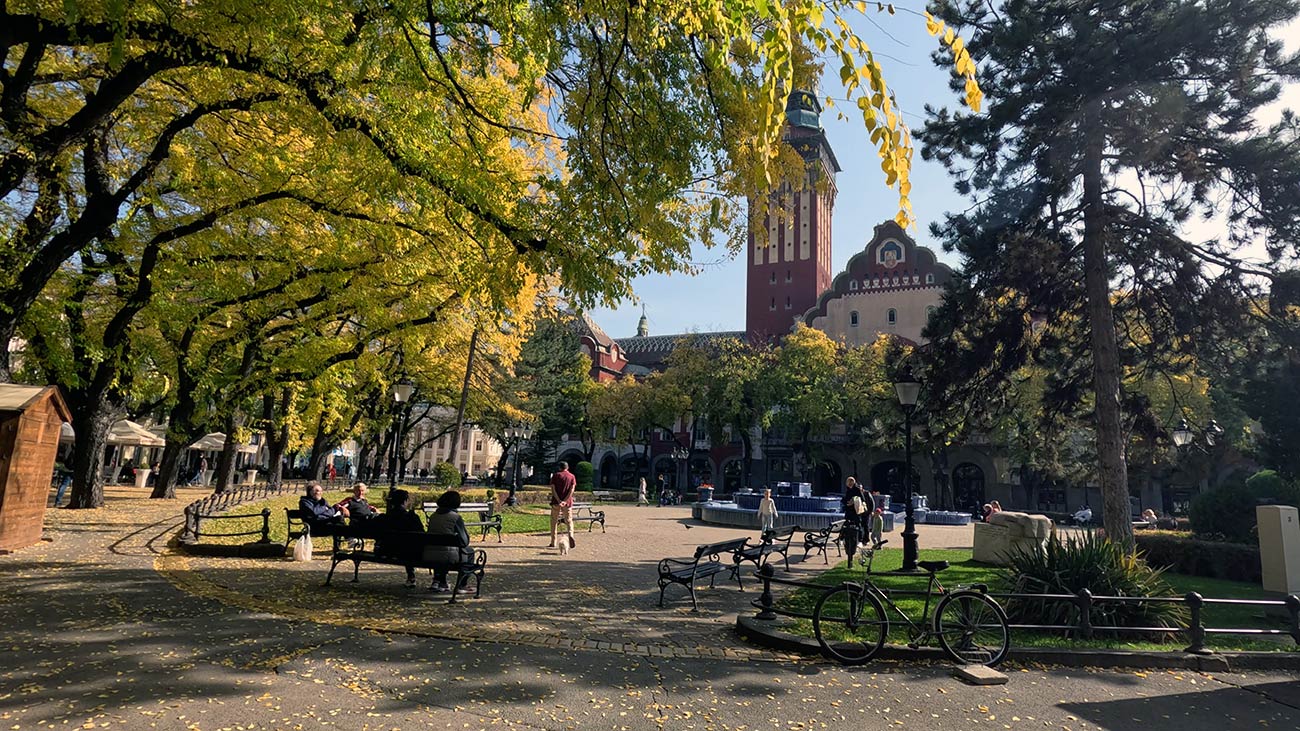
The natural centre of any visit is Freedom Square (Trg Slobode), the broad, tree-lined plaza dominated by Subotica’s City Hall, completed between 1908 and 1912 to a design by the Hungarian-Jewish architects Marcell Komor and Dezső Jakab, students of Ödön Lechner, sometimes nicknamed the “Hungarian Gaudí.” Built from carmine-red brick beneath copper domes, it is the largest building in Vojvodina, decorated inside with stained glass, painted arches, and ornamental motifs drawn from Hungarian folklore. A guided midday tour leads through the ornate council hall and up to an observation platform some 45 to 76 metres above the square, with sweeping views across the rooftops of the old town. Right in front of the building stands the Blue Fountain (Plava fontana), installed in 2001 from the same cobalt Zsolnay ceramic tiles that decorate so much of Subotica’s architecture, alongside an older Green Fountain from 1985 and a statue of Jovan Nenad, the short-lived self-proclaimed Serbian emperor who briefly made Subotica his capital in 1527 before being killed within the year.
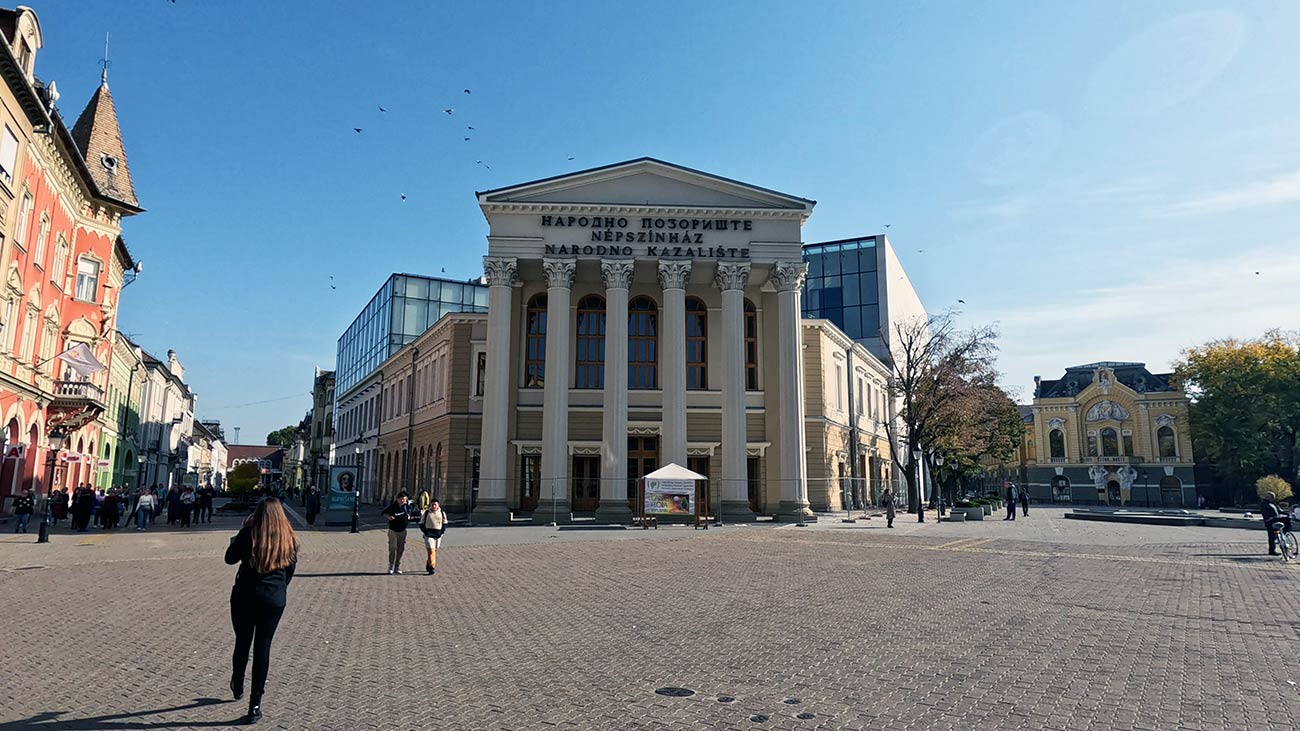
Directly opposite the City Hall stands the National Theatre, whose roots reach back to 1854, though its present form is the result of an extensive renovation completed between 2007 and 2022, blending a neoclassical facade with a contemporary glass-and-steel structure behind it. The theatre stages performances in Serbian, Hungarian, and Croatian, a fitting reflection of the city’s layered identity, and its presence beside the square completes one of the most photogenic civic ensembles anywhere in Serbia.
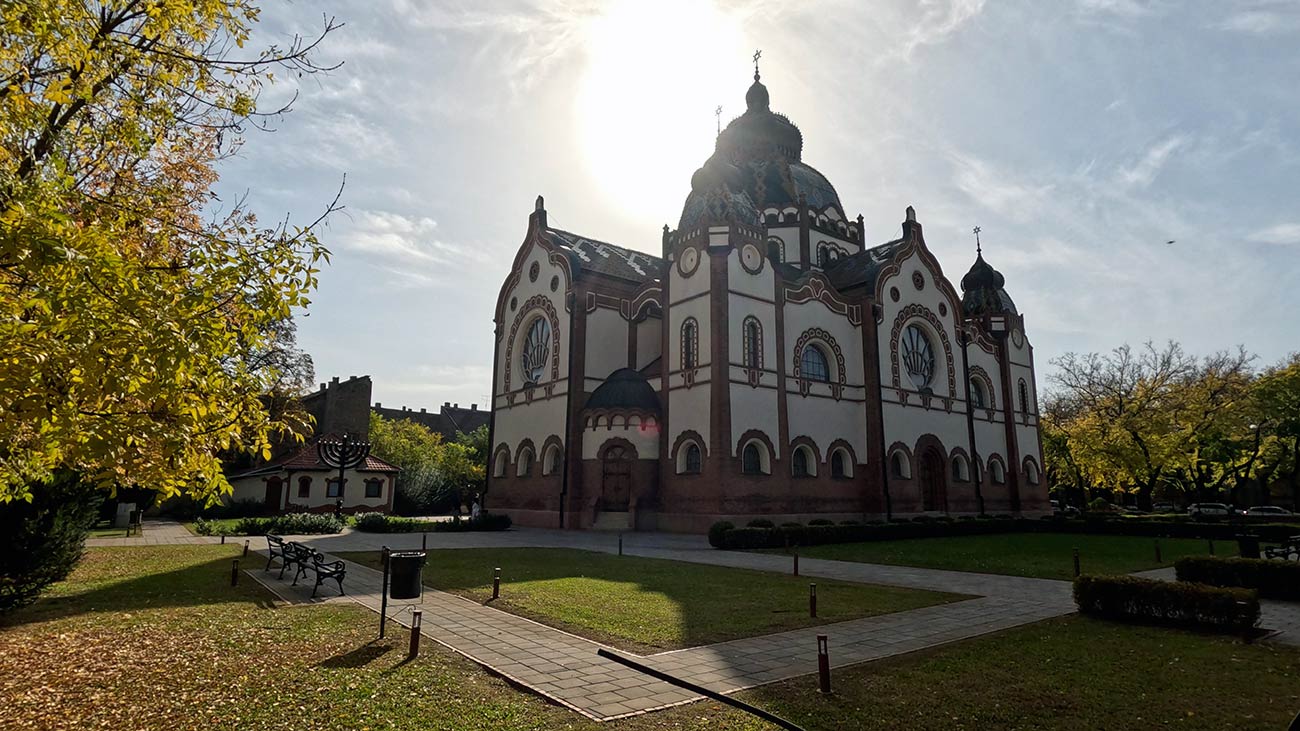
A short walk from the square, set within its own quiet garden, stands the Subotica Synagogue, completed in 1902 and frequently described as one of the most beautiful surviving examples of religious Art Nouveau architecture in Europe, alongside a comparable building in Bratislava. Designed by the same pair of architects responsible for the City Hall, the synagogue began life as a runner-up design from an 1899 competition in Szeged before Subotica’s Jewish community chose to build it here instead. Its light-filled interior combines painted arches, organic floral patterns, and exterior terracotta ornaments shaped like peacock feathers, roses, and lilies, manufactured at the same Zsolnay factory in Hungary whose tiles appear throughout the city. Visitors regularly rank it, alongside the City Hall, as one of the two unmissable sights in Subotica, with several describing the experience of stepping inside as something closer to walking onto an elaborately art-directed film set than visiting an ordinary house of worship.
The whole of the city centre, particularly along the pedestrianised Korzo, rewards slow, unhurried walking. Art Nouveau facades line both sides of the street, decorated with squirrels, human faces, floral motifs, and wave-like ornamental forms, with the privately built Raichle Palace, designed in 1904 by the architect Ferenc Raichle as his own residence and now home to a contemporary art gallery, standing out as one of the finest individual buildings in the entire city. The Cathedral of St. Theresa of Avila, dating from the 1770s and still bearing the Baroque character of Subotica’s earlier Habsburg-era architecture, adds a further, older layer to a city that otherwise wears its early twentieth-century identity so visibly.
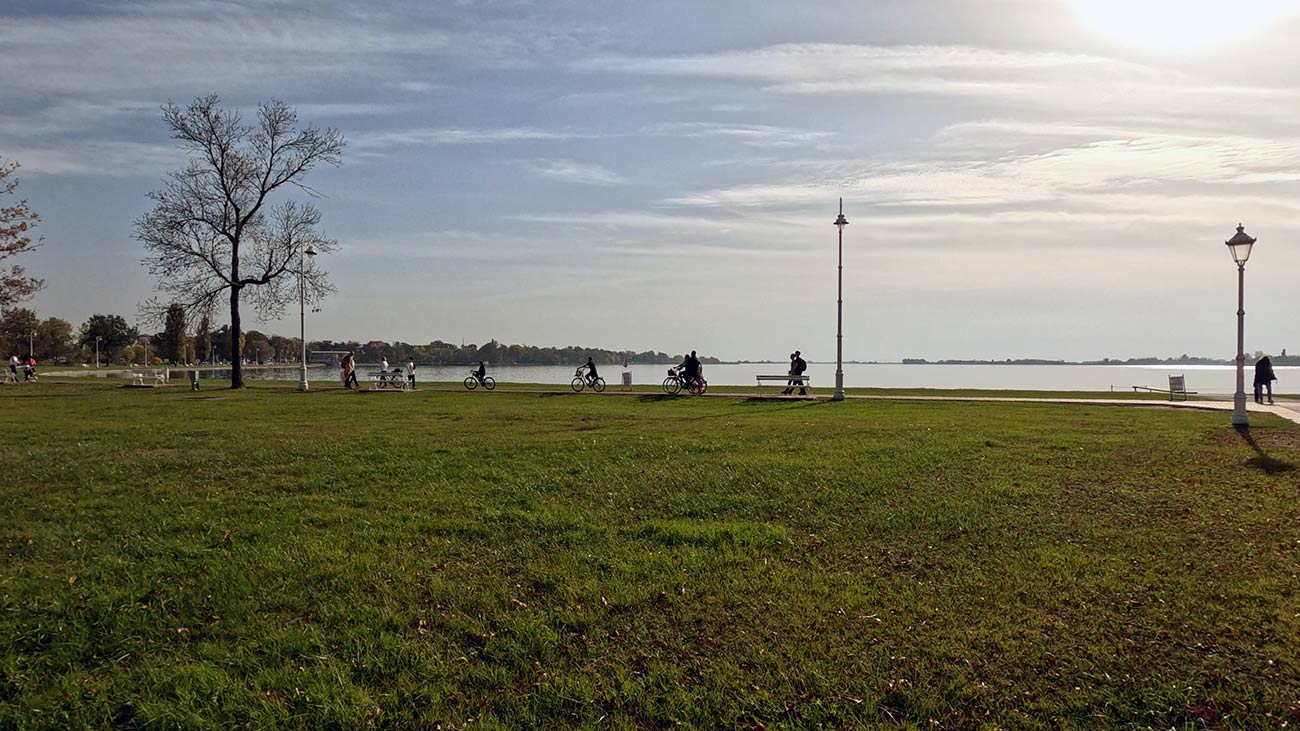
Eight kilometres from the city centre, Palić Lake offers a complete change of pace. The lake, around eight kilometres long and up to a kilometre wide, became fashionable from the 1880s onward as visitors flocked to its shores for mud baths believed to have healing properties, and the resort that grew up around it carries the same Art Nouveau spirit as Subotica itself, expressed here through the Grand Terrace, the elegant Water Tower, and the Women’s Lido, all designed in the Hungarian Secessionist style. A flat, well-shaded promenade circles much of the lake, ideal for an easy bike ride or a slow evening walk, while the water itself remains popular for paddle boating, sailing, canoeing, and fishing. Palić is also home to one of the most highly regarded zoos in Serbia, known for its spacious, naturalistic animal enclosures, and to a cluster of small wineries producing Riesling, Merlot, Chardonnay, and the traditional local varieties Kadarka and Kevedinka from vineyards that have flourished in the sandy soils around the lake for more than three centuries. Each summer, the lakeside also hosts the Palić Film Festival, drawing audiences and filmmakers from across the region to outdoor screenings beside the water.
 Useful Links
Mobility for Cyclists
The connection
The most practical connection from the EuroVelo 6 corridor is from Belgrade, where Srbija Voz runs frequent Soko high-speed trains, capable of speeds up to 200 km/h, directly to Subotica in around 80 minutes, on what is now one of the fastest and most comfortable rail journeys in the country. Cyclists riding the Serbian stretch of the EuroVelo 6 can also join the same line at Petrovaradin, serving Novi Sad, for a shorter onward hop north. The modern Soko trains offer dedicated bicycle storage space in every carriage, making this corridor one of the most reliable in Serbia for travellers carrying an assembled touring bike.
Serbian Trains
The rail network in Serbia is operated mainly by Srbija Voz, the national passenger rail operator, which runs both regional and InterCity services across the country. For much of the network, the system has historically been considerably less developed than rail networks in neighbouring central European countries, with ageing rolling stock, single-track lines, and journey times that often lag well behind road travel over the same distance. Against this backdrop, the modernised Belgrade-Novi Sad-Subotica corridor stands out as a genuine exception. Upgraded with new high-speed Soko electric trains and a parallel InterRegio service, this stretch has been transformed into one of the fastest and most reliable rail journeys anywhere in the region, with frequent departures running roughly every one-two hours throughout the day and journey times that now comfortably compete with, and often beat, the equivalent bus or car trip. Stops along this corridor include Novi Beograd, Petrovaradin (serving Novi Sad), Vrbas, Bačka Topola, and Subotica on the Soko line, with several additional stops served by the InterRegio service. Away from this modernised corridor, Serbian regional rail tends to be slower and less frequent, and for many shorter regional hops, buses remain the faster and more practical option. The Srbija Voz website and app are the main tools for checking timetables and buying tickets, and the app in particular is useful since not every station along the network, including some stops on the modernised corridor itself, has a staffed ticket counter. Tickets are normally purchased in advance through the website or app, but where no ticket counter is available at the departure station, tickets can simply be bought directly on board the train from the conductor, with no extra fee charged for doing so. This makes the system fairly forgiving for visitors unfamiliar with Serbian rail, since a missing ticket counter at a small rural station is not an obstacle to travel.
Taking your bike
Cycling support on Serbian trains follows clear rules set out by Srbija Voz, though capacity varies considerably by train type. On diesel-engine trains, bicycles are loaded through doors marked with a bicycle symbol and secured on built-in bike racks, of which there are only two per train set, located near the folding seats; bikes cannot be left in front of the wheelchair space or the toilets. On electric multiple-unit trains, bicycles are again loaded through marked doors and placed beside the folding seats near the entrance and toilets, though these carriages have no fixed racks, so the rider should stay close by to steady the bike; up to three bicycles can generally be carried if the multipurpose space is free, at the conductor’s discretion and depending on wheelchair users, prams, or large luggage already on board. The modern Soko electric trains on the upgraded Belgrade-Subotica corridor offer the most generous capacity, with dedicated bicycle space in every carriage near the luggage racks (the lower shelf folds down to free the space), allowing up to eight bicycles per train under normal conditions, again at the conductor’s discretion. On all train types, bicycles may be refused if the train is already at full capacity on a given stretch. On any other Serbian train not covered by these specific rules, and on all international services, a bicycle can still be carried as ordinary luggage if it is folded and packed so that it fits within the same compartment as its owner. Srbija Voz accepts no liability for damage or loss of bicycles carried on board. Given this patchwork of rules, the modernised Soko service remains the most reliable option for cyclists travelling with an assembled touring bike, while a folded or disassembled bike packed as luggage travels reliably on any service.
Bikes on Buses
Long-distance bus services in Serbia are extensive and, on most routes away from the main modernised rail corridor, faster and more frequent than the equivalent train journey. The network is operated by a large number of carriers, with Lasta among the largest national operators, alongside numerous regional companies such as Niš-Ekspres and Banat Trans, and the international operator FlixBus on selected routes. Bicycle transport on Serbian buses is not standardised across operators: bikes are typically carried in the luggage compartment beneath the bus when space allows, but capacity is not guaranteed, and advance reservation or direct confirmation with the specific operator is recommended, especially for an assembled touring bike. As a result, buses are best used by cyclists as a secondary, flexible option for repositioning between towns, particularly where rail connections are slow, infrequent, or simply don’t exist on a given route, while a packed or folded bike travels far more reliably as ordinary luggage than an assembled one.
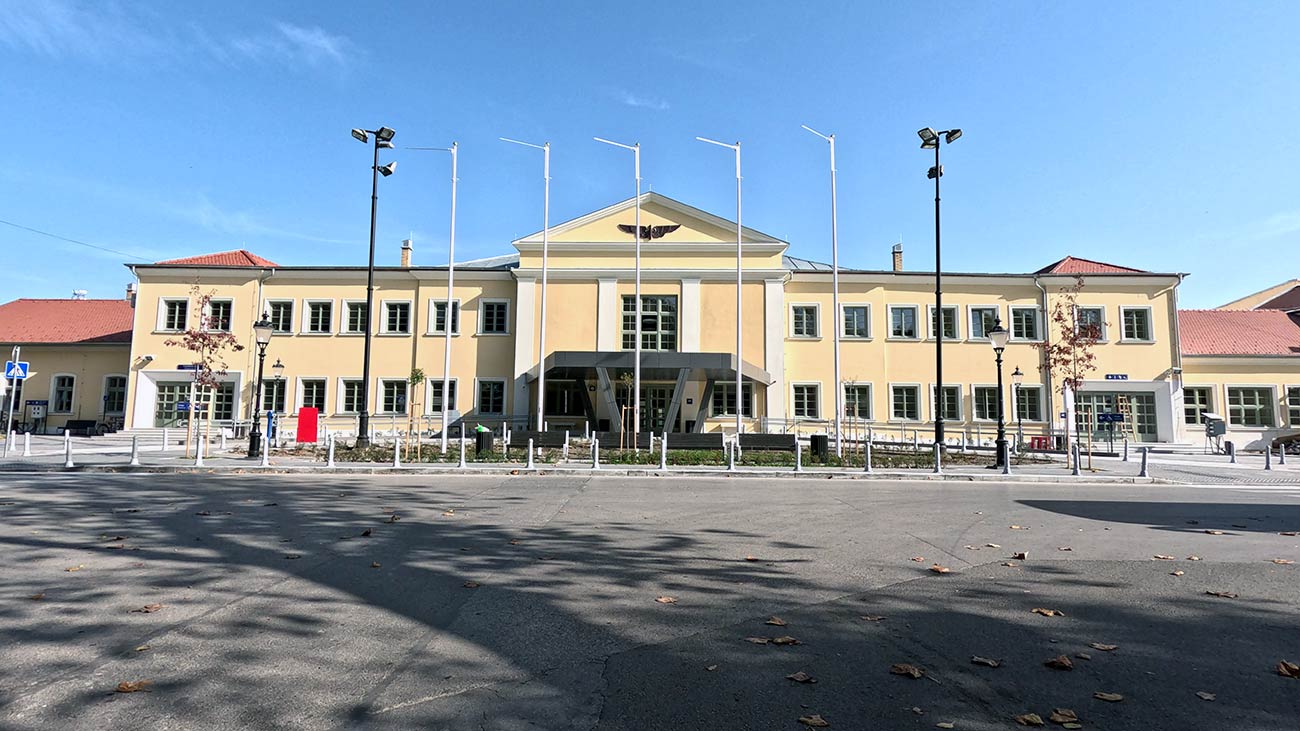
Arriving at Subotica Station and Continuing to Palić
Subotica’s railway station sits a short walk or ride from Freedom Square and the rest of the historic centre, with the City Hall, the Synagogue, and the Korzo all reachable on foot in around ten to fifteen minutes along flat, well-signposted streets. For the onward trip to Palić Lake, an easy flat ride of around 8 kilometres follows local roads or dedicated cycling routes out of the city, taking around 25 to 30 minutes by bike, with a local bus (line 6) also running the same route for travellers without a bicycle. Bike racks are available both at the railway station and around the lake promenade at Palić. For onward travel, the same high-speed line connects back toward Novi Sad and Belgrade and the wider Danube region, so a visit to Subotica and Palić works comfortably as a single full day, or as a more relaxed overnight stop combining the city’s Art Nouveau architecture with a slower afternoon by the lake.