Čachtice Castle
Reading time: 14 minutes
ČACHTICE CASTLE, TRENČÍN REGION, SLOVAKIA
A Hilltop Ruin and the Legend of the Blood Countess
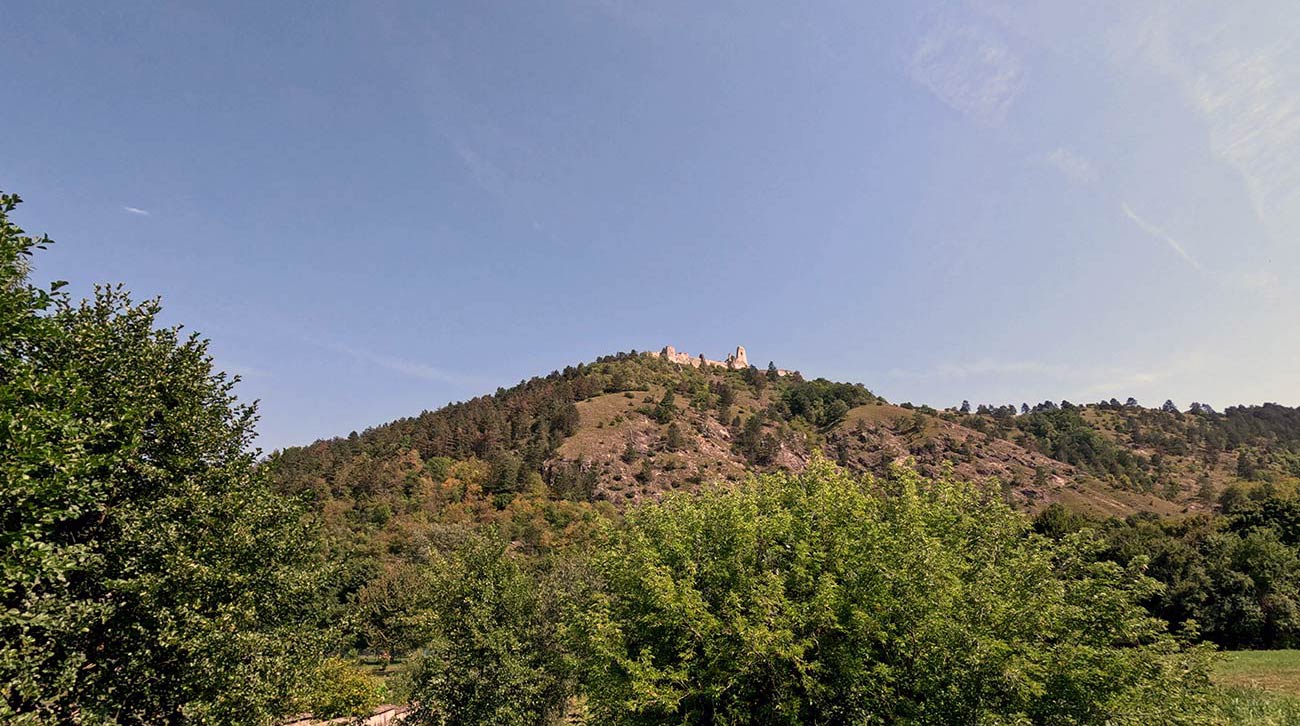
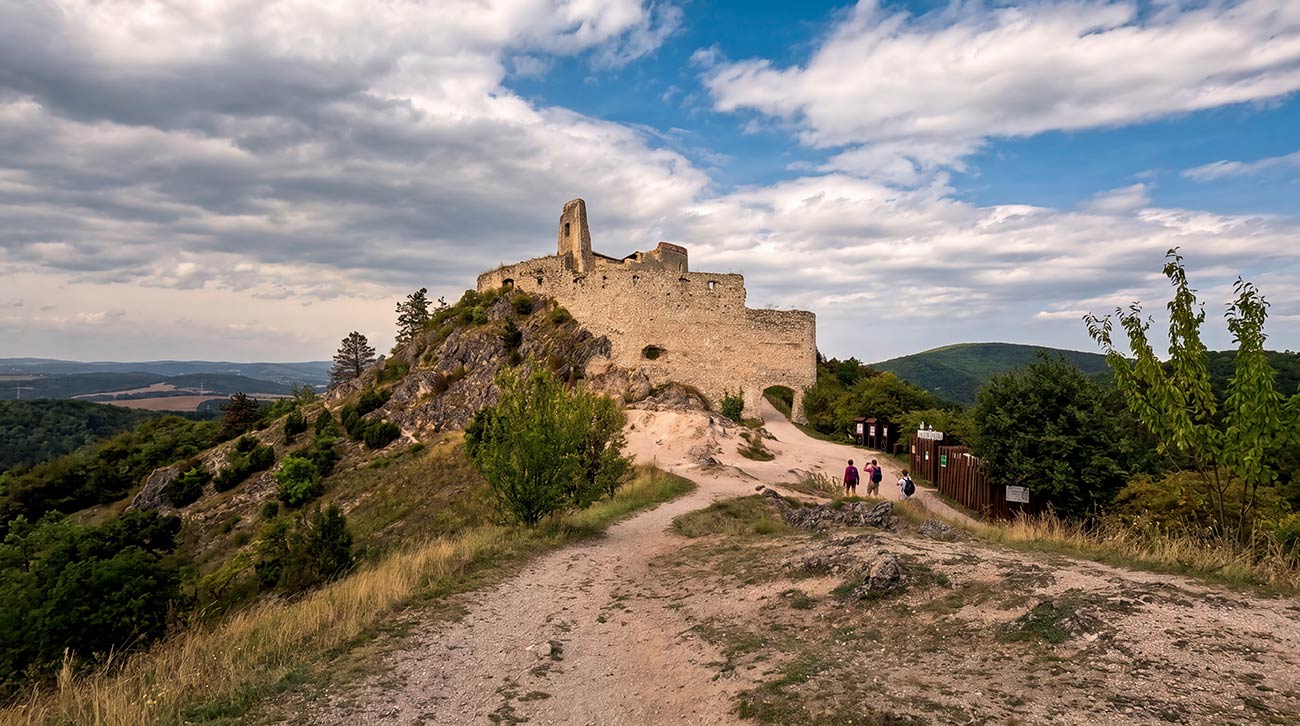
In the northern foothills of the Little Carpathians, where the limestone of the Čachtice Karst rises in a series of bare rocky ridges above the Váh valley, a fragmentary castle ruin stands 375 metres above the surrounding plain. The walls of Čachtice are broken now, the towers reduced to outlines, and the slopes around the hill have been declared a national nature reserve because of the rare plants that grow on the dry limestone soil. For most visitors, however, the appeal of the site is less the geology than the story attached to it. Čachtice Castle was for several decades the residence of one of the most notorious figures in European history, the Hungarian noblewoman Elizabeth Báthory, and the long shadow that her trial cast across the seventeenth century has clung to the ruined walls ever since.
The castle was built in the first half of the thirteenth century as one of the boundary royal fortresses defending the western frontier of the Kingdom of Hungary, and it was substantially extended in the fifteenth century. After passing into noble hands, it became the property of the Báthory family at the end of the sixteenth century through the marriage of Elizabeth to Count Ferenc Nádasdy. Following Nádasdy’s death in 1604, the widowed Elizabeth lived increasingly at Čachtice, and it was here that the accusations of cruelty and serial murder against her took shape. After a long investigation, the Hungarian Palatine György Thurzó ordered her arrest in 1610 and condemned her to lifelong imprisonment within the castle walls in 1611. She died at Čachtice in 1614. The castle itself was later burned during the Rákóczi rising at the start of the eighteenth century and never fully rebuilt.
For cyclists exploring the Danube along the EuroVelo 6, Čachtice is one of the more atmospheric and slightly demanding cultural detours from the Slovak stretch of the route. The castle lies around 100 kilometres north-east of Bratislava in the Trenčín Region, reached by a single train change at Nové Mesto nad Váhom and a short hike up the limestone hill from the small village of Višňové. The combination of a steep climb, a dramatic ruin, and a story that has filled libraries of folk legend and literature gives the place a distinct intensity that few hilltop castles in central Europe can match.
CastleRuinsHistoryHill
A Medieval Frontier Castle and the Story of Elizabeth Báthory
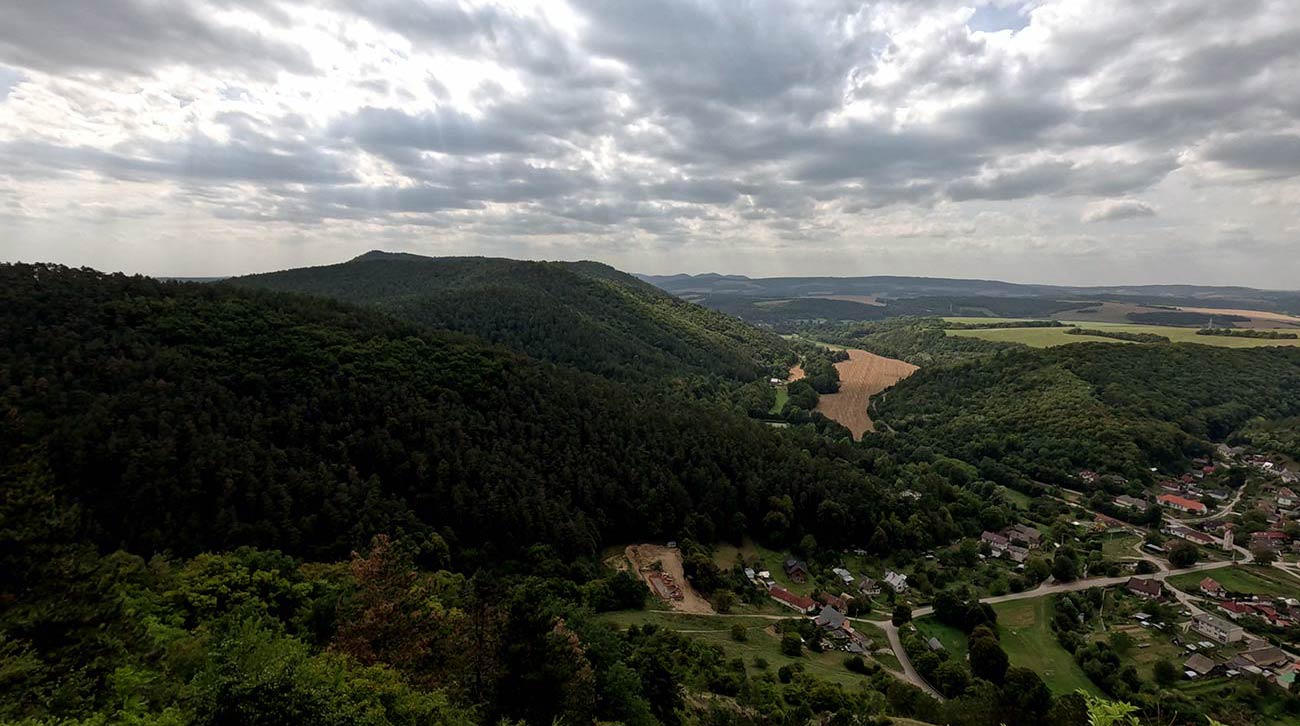
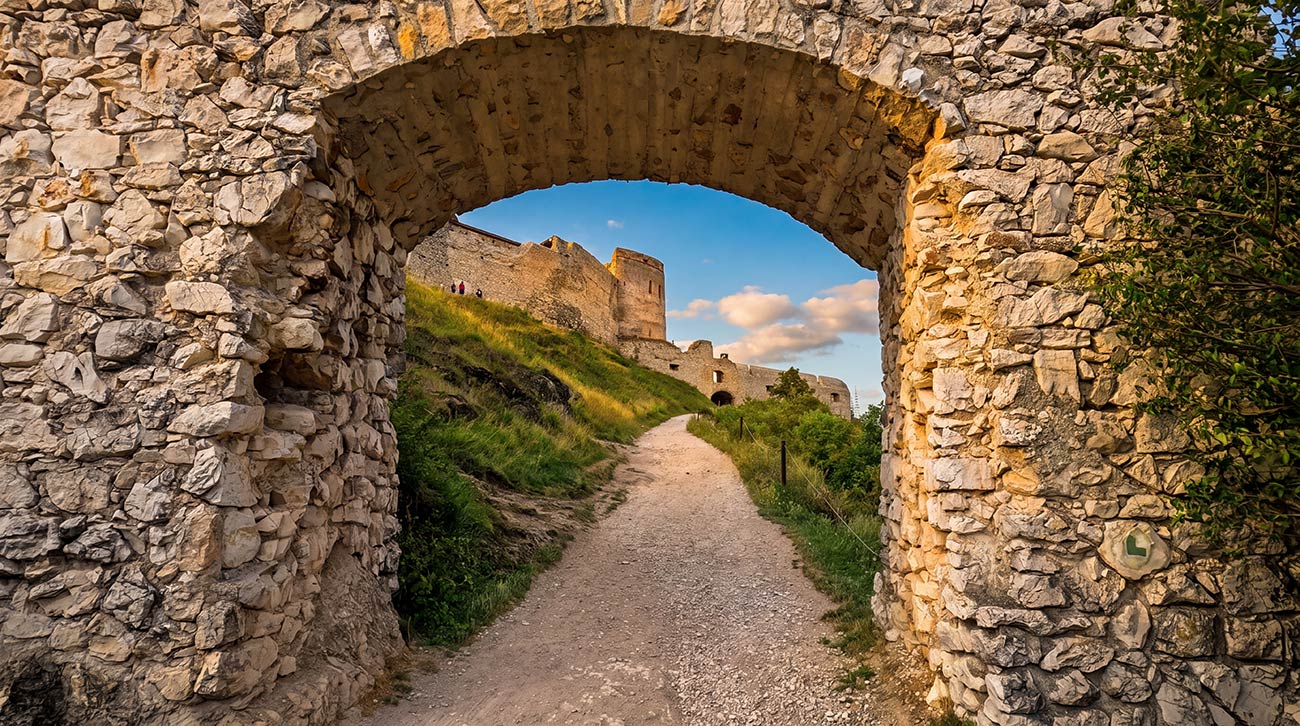
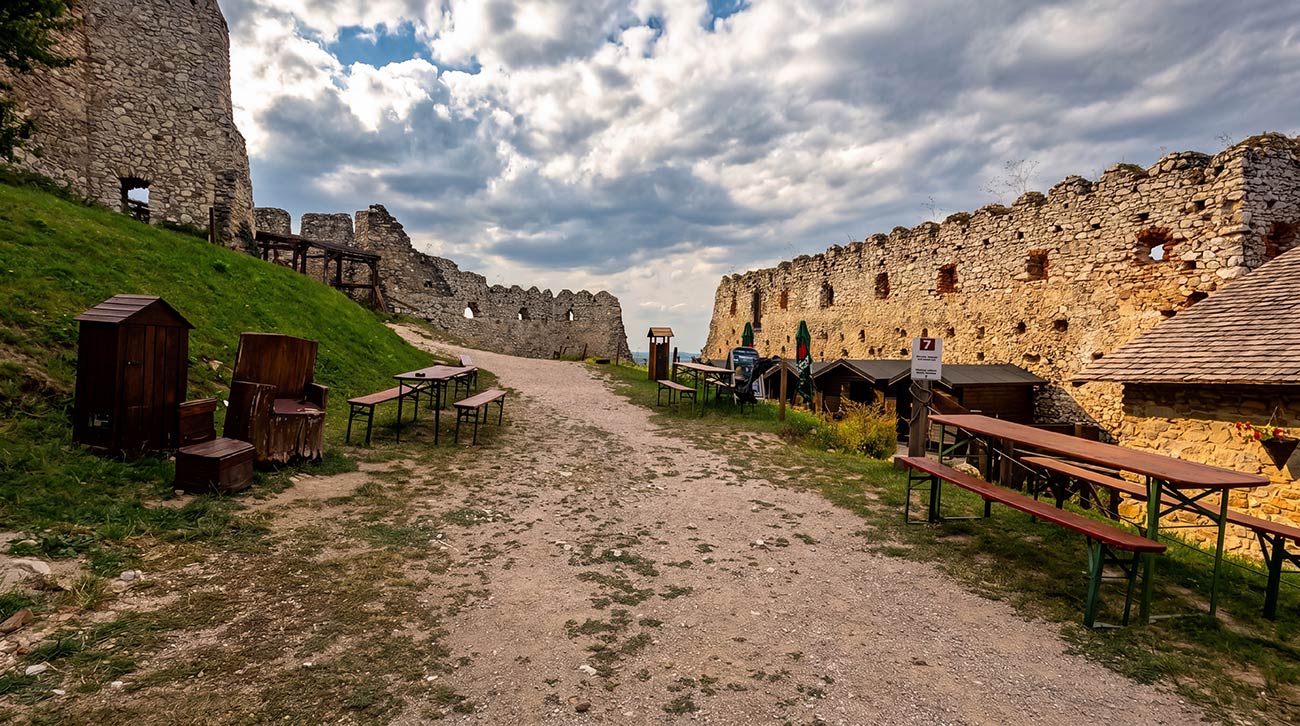
The castle stands on a high, exposed limestone ridge directly above the small village of Višňové, in a landscape of sparse scrub, dry meadows, and rocky outcrops typical of the Čachtice Karst. The slopes around the ruin are protected as a national nature reserve for the rare karst flora that grows on the thin soils, including unusual species adapted to the open limestone bedrock. The walk up to the castle from Višňové takes around 20 to 30 minutes on a marked yellow trail, climbing steadily through low forest and emerging onto open ground just below the western ramparts. The view from the upper bailey stretches across the Váh valley, the silhouette of Beckov Castle to the north, and the long ridge of the Little Carpathians running south toward Trnava. The ruin itself is open and largely free to wander, with the surviving walls of the upper castle, the inner courtyard, fragments of the residential palace, and a small interpretive exhibition tracing the architectural history of the site across eight centuries.
The medieval history of Čachtice is closely tied to its strategic location. The castle was built in the first half of the thirteenth century as one of the royal frontier fortresses of the Kingdom of Hungary, defending the western approaches against incursions from the north and west. In the fifteenth century, the original Gothic structure was substantially expanded, with new walls, towers, and residential apartments that gave the castle its present silhouette. The estate passed through several noble families before reaching the Báthory line at the end of the sixteenth century, when the young Elizabeth Báthory married Count Ferenc Nádasdy. By this point Čachtice was a comfortable Renaissance residence with a small adjoining manor village, and Nádasdy presented the castle to his wife as a wedding gift. After his death in 1604, Elizabeth Báthory spent increasing amounts of time at Čachtice, and her household became the focus of the rumours and accusations that would shape the rest of her life.
The story of Elizabeth Báthory (1560–1614), in Slovak Alžbeta Bátoriová, is one of the most contested in Hungarian history. According to the witnesses heard at her trial in 1611, Báthory was responsible for the torture and murder of a large number of young women, mostly servants and the daughters of minor nobility, over the course of more than a decade. The Hungarian Palatine György Thurzó led the investigation and, with the cooperation of the Habsburg court, ordered her arrest at the end of 1610. Four of her closest accomplices were tried and executed; Báthory herself, as a high-born noblewoman, was condemned to lifelong imprisonment in the castle, walled into a small set of rooms in the residential tower, where she died on 21 August 1614. The exact number of her victims has been disputed by historians for centuries: a contemporary register held around 80 names, while later popular tradition inflated the figure to as high as 650, and the famous story that she bathed in the blood of young girls to preserve her youth appears only in retellings from the nineteenth century, more than two hundred years after her death. Whatever the truth, Báthory has come to be remembered in folk tradition as the Blood Countess (Krvavá grófka), and her name has been attached to Čachtice ever since.
The castle itself outlived its most famous resident by less than a century. In 1708, during the Rákóczi Uprising against Habsburg rule, the soldiers of Prince Francis II Rákóczi set fire to Čachtice, and the ruined walls were never rebuilt. Some of the materials were carried down to the village over the following decades and reused in local buildings, but the upper castle was left to slowly decay into the dramatic outline that visitors see today. In the village of Čachtice itself, around four kilometres south of the ruin, a small Renaissance manor house built at the end of the seventeenth century houses an exhibition of the Trenčín Museum dedicated to the history and ethnography of the wider area, including the story of the Báthory family and contemporary materials connected to the trial. For travellers interested in piecing together the historical record behind the legend, the village museum is a useful counterpoint to the ruin on the hill.
 Useful Links
Mobility for Cyclists
Reaching the area by train with your bike
Čachtice Castle can be reached from the EuroVelo 6 by a rail journey from one of the main cities on the Danube cycle path, followed by a short local train and a hike up the hill. The castle lies in the Trenčín Region of western Slovakia, around 100 kilometres north-east of Bratislava, and the access is slightly more involved than for some of the other detours along the corridor.
The connection
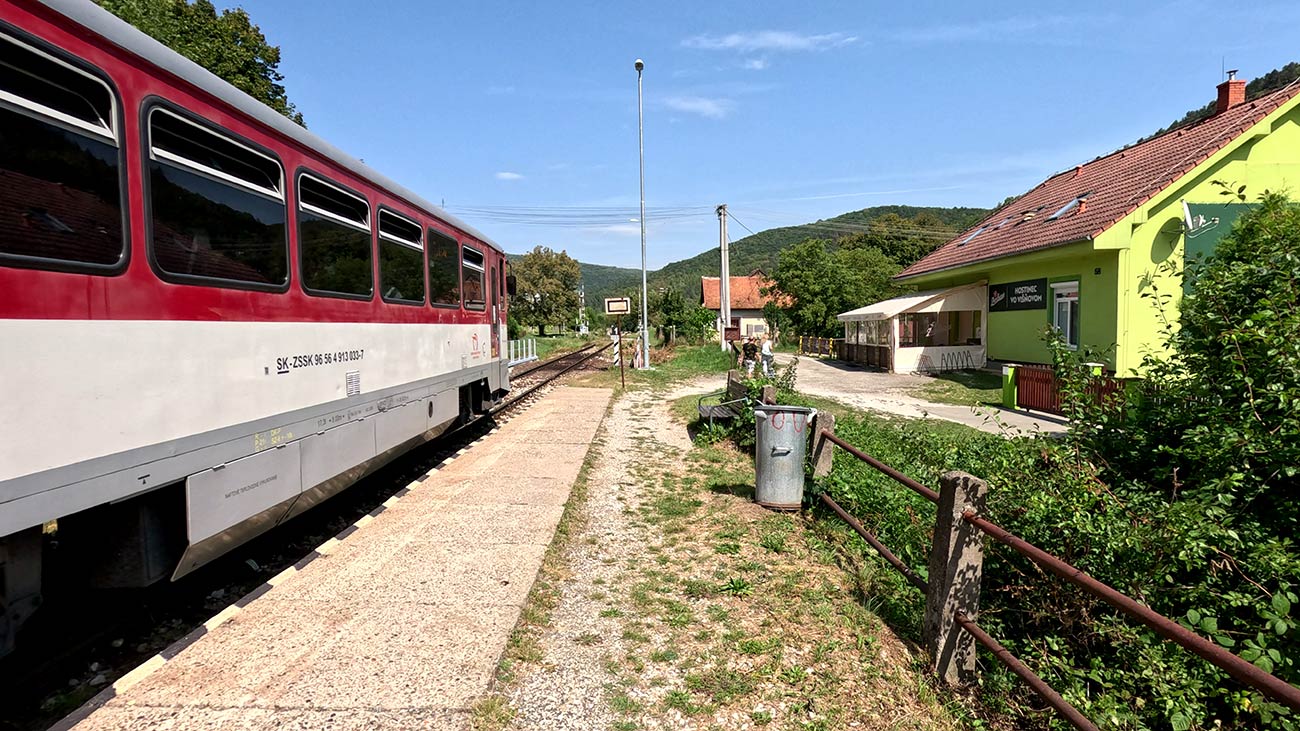
The most practical connection from the EuroVelo 6 corridor is from Bratislava, where ZSSK regional and InterCity trains run directly to Nové Mesto nad Váhom in around one hour to one hour and ten minutes, with hourly departures throughout the day. From Nové Mesto nad Váhom, a local regional train continues to the small village of Višňové, just below the castle hill, in around eleven minutes, with services running roughly every two hours. The two-leg journey takes around one and a half hours in total including the local change. Cyclists riding the Slovak stretch of the EuroVelo 6 will find Bratislava the natural transfer point. The visit also combines naturally with a stop at Beckov Castle further north on the same line, since both ruins lie within easy reach of Nové Mesto nad Váhom and tell parallel stories about the medieval frontier fortifications of the Váh valley.
Slovak Trains
The rail network in Slovakia is operated mainly by Železničná spoločnosť Slovensko (Slovak Railway Company, commonly known as ZSSK), the national passenger railway operator and by far the largest carrier in the country. ZSSK runs most long-distance services as well as a large share of regional connections, including the InterCity and EuroCity trains on the main east–west corridor and the dense network of regional and suburban Os and REX services that branch out into the Slovak countryside. Tickets, timetables, and bicycle reservations can be planned and booked through the ZSSK website and the IDS ZSSK app, which together serve as the central tools for travel across the system. Alongside ZSSK, the private operator RegioJet runs a smaller number of long-distance trains on selected routes, although its bicycle transport capacity is limited and depends on the specific train and route. A further private operator, Leo Express, does not serve the routes covered by this guide. For travellers leaving the EuroVelo 6 along the Slovak stretch of the Danube, the natural rail gateway is Bratislava, the country’s capital, where two regional railway branches run north into the surrounding region: one west and north toward Trenčín along the Váh valley, and one east toward Nitra. Both corridors are served by frequent ZSSK regional trains throughout the day, making short detours from the Danube cycle path quick and easy to organise.
Taking your bike
Slovakia is generally very bike-friendly when it comes to rail transport, especially on regional services operated by ZSSK, which form the core of mobility for cycle touring along the Danube and its connecting corridors. On regional and local trains (the Os and REX categories), bicycles can be taken on board for an additional fee, with no advance reservation possible and a first-come, first-served allocation of space. Bicycle tickets are sold as single trips or as affordable daily, weekly, or monthly passes, valid across the regional network. On long-distance services such as R (fast), Ex (express), EC, IC, and RJX trains, an advance reservation for the bicycle is mandatory, with the bike spaces located in dedicated zones in second-class carriages or in mobile luggage compartments. The private operator RegioJet runs a smaller number of long-distance trains on selected Slovak routes and also accepts bicycles on some of these, but the capacity is more limited than on ZSSK trains and an advance reservation is required. Leo Express, a further private operator, is fully bike-friendly on its train services and allows up to four bicycles per train with advance reservation, although its routes do not cover the detours in this guide and are mainly relevant for cyclists travelling between the Czech Republic and other parts of Slovakia. Folding bikes are carried free of charge as hand luggage on all three operators, provided they fit in the luggage racks. Overall, the Slovak rail system is well adapted to cycle tourism and offers a flexible combination of train and bike that makes it easy to leave the EuroVelo 6 route in either direction for short or extended detours.
Bikes on Buses
Long-distance bus services in Slovakia are primarily operated by FlixBus, complemented by RegioJet and Slovak Lines on selected routes, alongside a smaller number of regional and private coach operators. As in many central European countries, the long-distance bus market in Slovakia is less developed than the wider rail network, and many domestic connections that would otherwise be served by intercity coaches are instead handled by ZSSK trains. FlixBus is generally the most practical option for cyclists, with bicycle transport available on certain connections, either via external bike racks or in the luggage compartment, although it is not consistently guaranteed across the network and depends on the specific vehicle type and route configuration. Where available, bicycle transport must be reserved in advance and capacity is limited, making it less flexible compared to rail services. RegioJet also runs long-distance coaches alongside its trains, and Slovak Lines operates a network of domestic and international routes from Bratislava, but the bicycle-carrying options on both operators are limited and not guaranteed on the routes relevant to the detours in this guide. As a result, buses are generally used as a secondary option for cyclists, mainly for longer-distance repositioning between major cities rather than as a core part of cycling itineraries along the Danube region. While useful in specific cases where rail connections are less convenient, they are less predictable and less standardised for bicycle transport, so advance planning is essential.
Arriving at Višňové and Hiking to the Castle
From Višňové station, the path up to Čachtice Castle is reached by following the small road through the village and joining the marked yellow hiking trail that climbs steadily up the limestone ridge. The walk takes around 20 to 30 minutes one way at a steady pace, with the gradient noticeably steeper toward the top. The ruin itself is best explored on foot, and travellers should plan to leave any bicycles either at Nové Mesto nad Váhom station, where some bike parking is available, or at the small Višňové station. There are signposted cycle routes in the area, but the climb up to the castle is too steep and rough to ride comfortably on a touring bike. An alternative starting point is the larger village of Čachtice further south, with a longer hike of around two hours along marked yellow and green trails that follow the limestone ridge through the nature reserve. For onward travel, the same ZSSK line connects back toward Bratislava and the wider Danube region, as well as further north toward Trenčín, Žilina, and the Tatras, so Čachtice works well as a focused day excursion combined with a stop in Nové Mesto nad Váhom or as one element of a longer Slovak itinerary.