Cistercian Abbey of Zirc
Reading time: 13 minutes
ZIRC, VESZPRÉM COUNTY, HUNGARY
A Cistercian Abbey in the Bakony Hills
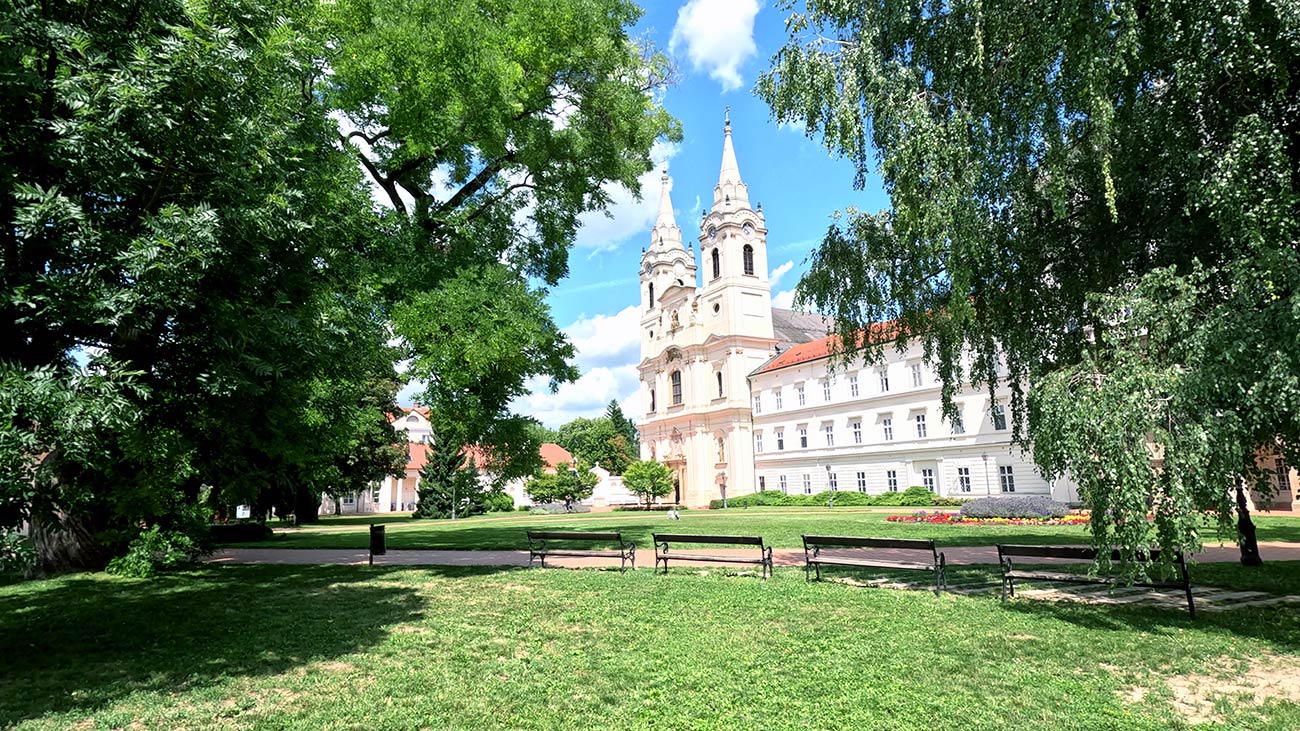
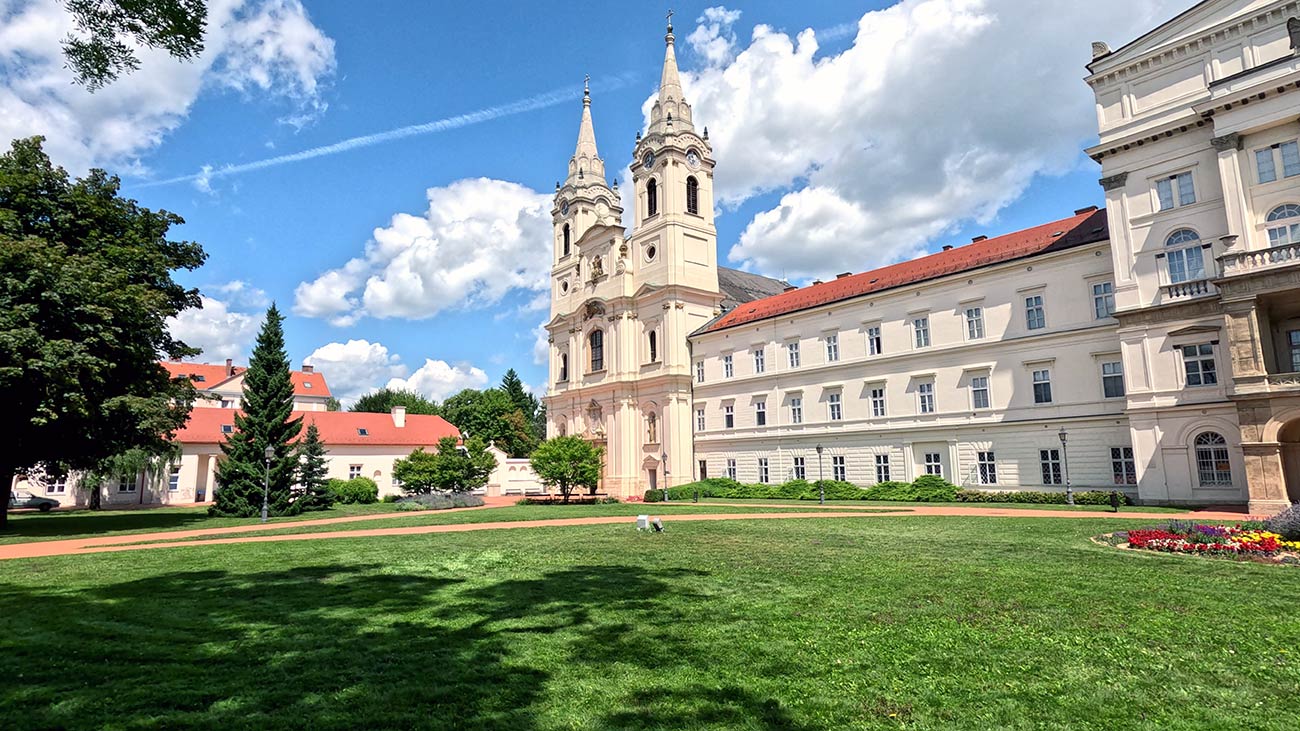
Set high in the wooded ridges of the Bakony Mountains, halfway between Veszprém and Győr in western Hungary, lies a quiet small town that has been a place of monastic life for more than eight centuries. The Cistercian Abbey of Zirc rises in the centre of its namesake town with the long pale facade of a Baroque monastery, the twin onion-shaped towers of an eighteenth-century basilica, and a sequence of gardens and outbuildings spreading out behind. At an altitude of around 400 metres above sea level, in air that locals like to point out is the freshest in the country, the abbey is the spiritual centre of the region that calls itself Bakony fővárosa, the Capital of the Bakony.
The story of the abbey reaches back to 1182, when King Béla III of Hungary invited monks from the great French Cistercian abbey of Clairvaux to settle on a wooded plateau in the heart of the country. They built a Romanesque church and monastery here, and for several centuries Zirc became one of the most important Cistercian houses in central Europe, famous for its scriptorium and its quiet religious life. The Ottoman conquest of the sixteenth century forced the monks to flee, and the medieval abbey fell into ruin. New life came only in the eighteenth century, when German Cistercians from the Silesian abbey of Heinrichau arrived to refound the community and built the present Baroque basilica and Classical monastery on the same sacred ground.
For cyclists exploring the Danube along the EuroVelo 6, Zirc is one of the more contemplative cultural detours from the Hungarian stretch of the route. The town lies around 50 kilometres south of the Danube at Győr, reached by a direct MÁV regional train on the historic Győr–Veszprém line. A day spent moving between the Baroque basilica, the foundations of the medieval church, and the oldest English landscape garden in the Bakony offers a complete change of pace from the river road, and a quiet introduction to a corner of Hungary that few international travellers know well.
AbbeyLibraryRuinsGardens
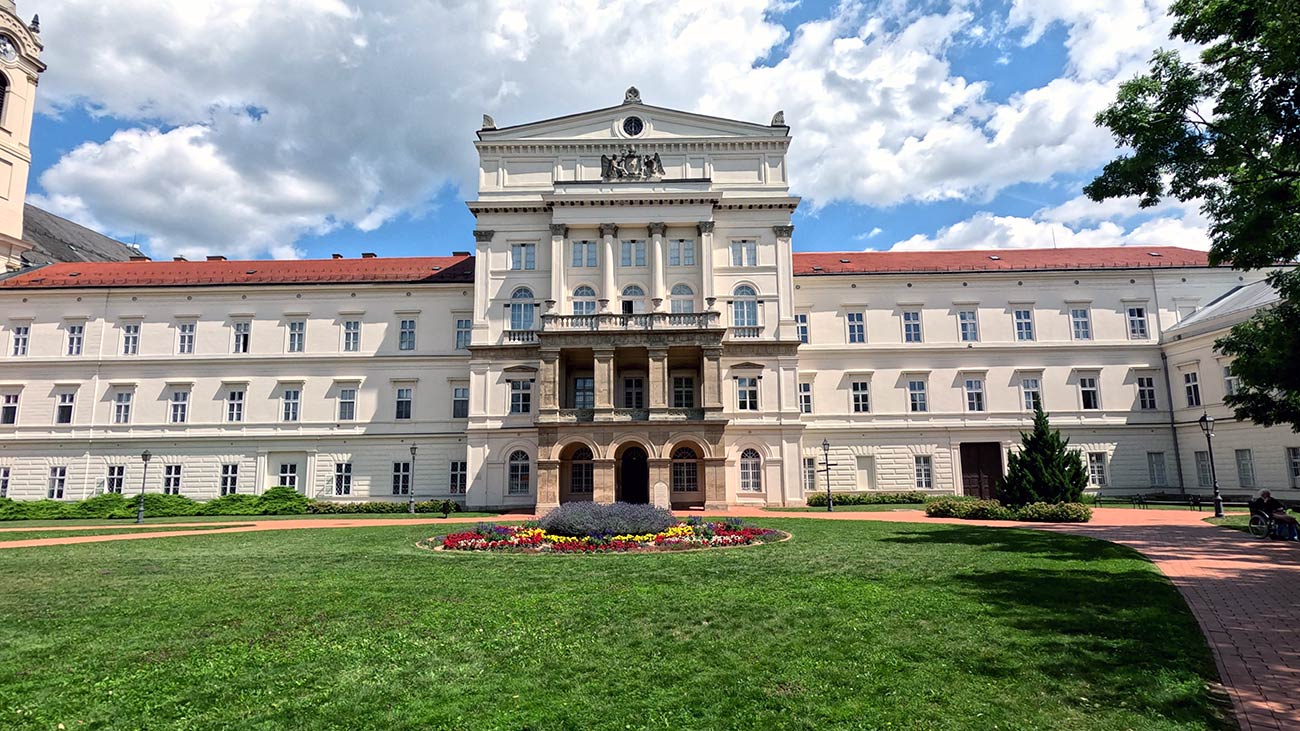
A Baroque Basilica, a Medieval Ruin Garden, and the Highest Arboretum in Hungary
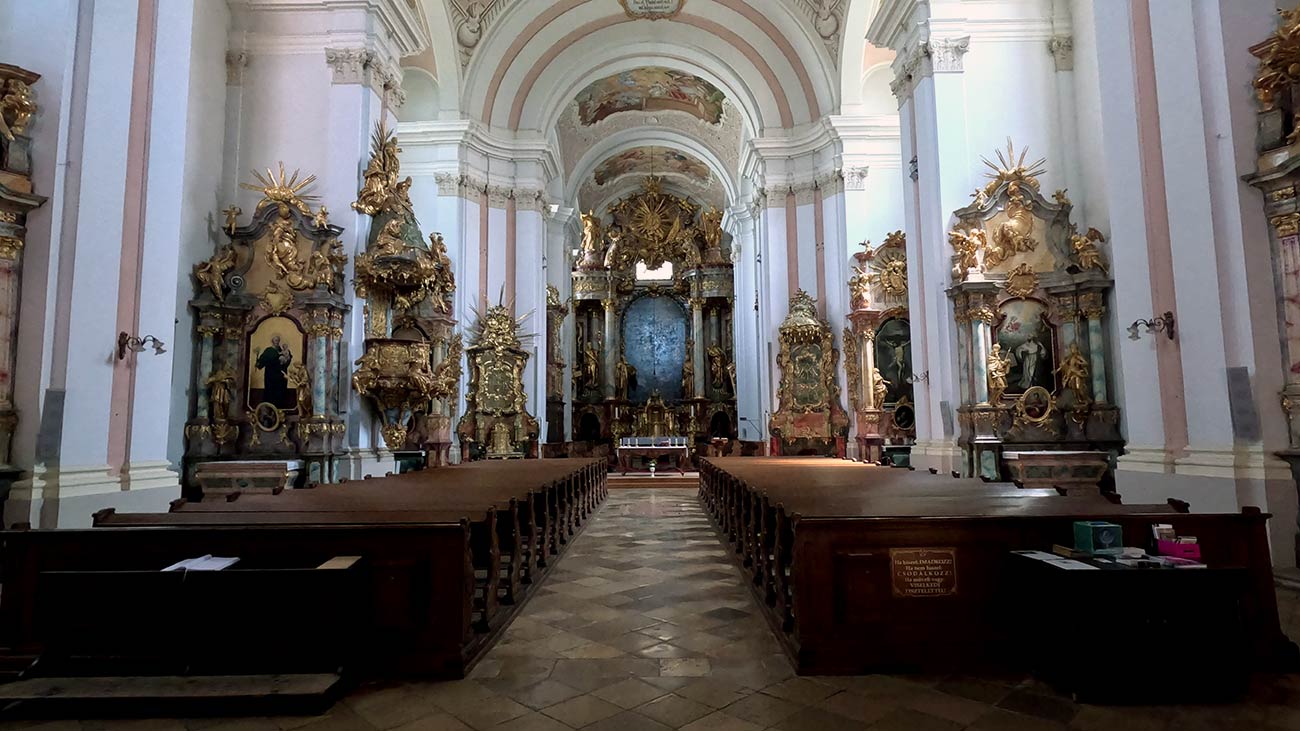
The natural centre of the visit is the Basilica of the Cistercian Abbey of Zirc (Zirci Bazilika), built by the German Cistercian monks of Heinrichau between 1732 and 1752 and incorporating stones recovered from the ruins of the medieval church on the same site. The interior reveals one of the great surprises of any visit to the Bakony. Behind a relatively restrained exterior with twin onion-domed towers stands the largest Baroque altar in Hungary, a soaring composition of gilded woodwork, carved figures, and dramatic vertical lines that rises through almost the full height of the nave. The walls hold two paintings by Franz Anton Maulbertsch, one of the leading Austrian Baroque painters of the eighteenth century, whose works decorated some of the most important churches across the Habsburg lands. The basilica also preserves two pipe organs that work together: a smaller shrine organ used by the monks for their daily prayers, and a larger German Romantic instrument in the gallery used for the parish liturgy. A thorough restoration completed in 2005 returned the interior to its original Baroque glow, and in 1982, on the 800th anniversary of the founding of the abbey, the church was raised to the dignity of a Basilica Minor by the Vatican. It remains today both an active monastic church for the resident Cistercian community and the parish church of Zirc.
A short walk from the basilica lies one of the more evocative archaeological sites in the Bakony. The Medieval Ruin Garden (Középkori Romkert) preserves what little remains of the original twelfth- and thirteenth-century Cistercian church and monastery that gave Zirc its first religious identity. When King Béla III of Hungary invited Cistercian monks from the French motherhouse of Clairvaux to settle in the Bakony in 1182, they built an early Gothic church without a tower and a working monastery that became famous across medieval Europe. The community survived the Tartar invasion of the thirteenth century, but was forced to flee during the Ottoman period, and the church and monastery were left abandoned for a century and a half. Although the building was still standing and could in principle have been restored, the German Cistercian monks who arrived from Heinrichau in the eighteenth century chose instead to demolish most of the medieval walls and build the present Baroque complex on the same ground. One surviving pillar of the medieval church can still be seen on Köztársaság Street, crowned by a 1749 statue of Saint Emeric surrounded by angels. The site was first excavated by the Cistercian monk Tibor Hümpfner in 1913, with insufficient funds to preserve the discoveries, and was excavated again and properly presented to visitors in 1958. The remaining foundations, displayed in the open garden behind the abbey, give a sense of the scale and beauty of the original Gothic abbey.
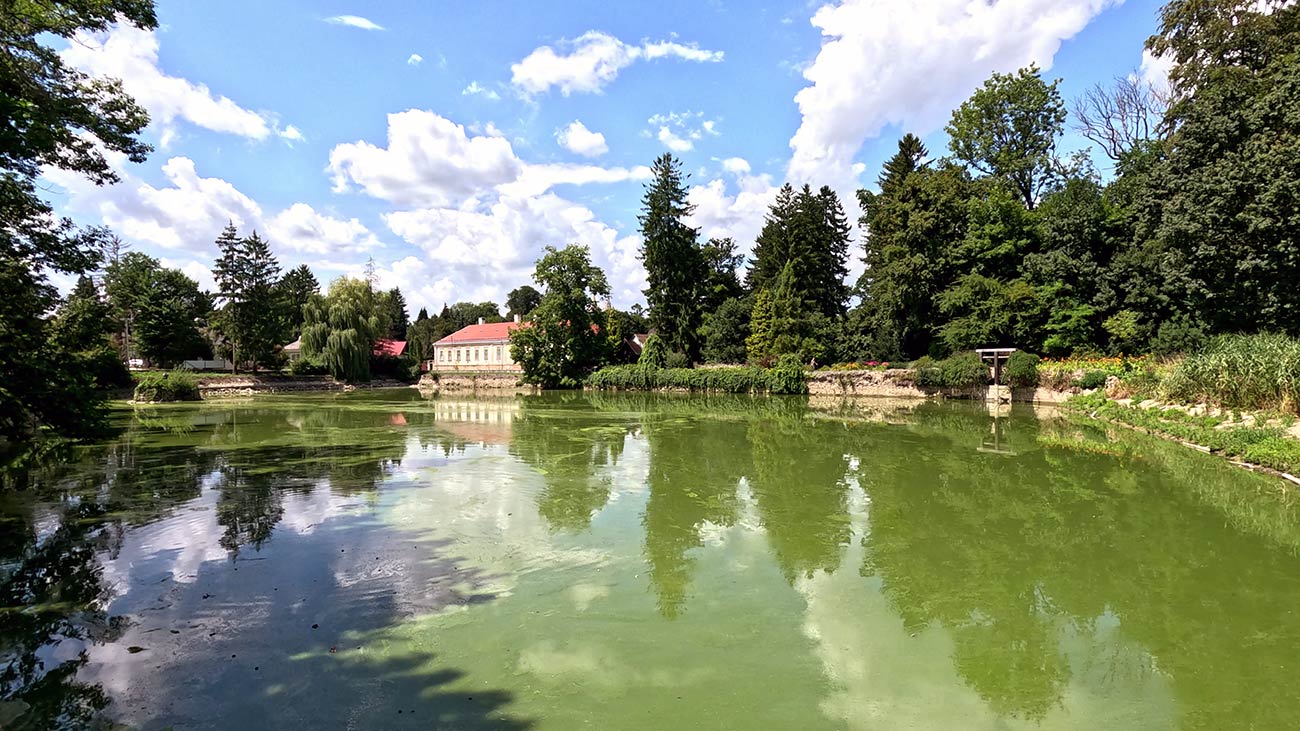
Behind the abbey, on the slope toward the surrounding hills, lies a quiet green world that visitors often discover with delight. The Zirc Arboretum (Zirci Arborétum) is the highest-altitude arboretum in Hungary, set on 18 hectares of land at around 400 metres above sea level and laid out in the English landscape garden style, probably in the second half of the eighteenth century. The arboretum opens out from the abbey courtyard into a series of long shaded paths that wind through tall linden trees, oaks, beeches, and a wide collection of native and exotic species, with a small fish pond and the murmur of the Cuha Brook giving the garden a quiet acoustic background. Each season has its own character: ornamental flowers and perennials around the pond in spring, a thousand shades of green and the rich scent of linden in summer, vivid yellows and browns in autumn, and quiet snow-covered branches in winter. The arboretum is also a small refuge for forest wildlife, with deer, squirrels, and insects characteristic of the wider Bakony habitats occasionally seen along the paths. The garden can be entered either from its main gate on Damjanich Street or directly through the abbey courtyard.
Beyond these three main highlights, the abbey complex includes several further attractions for travellers with more time. The OSZK Cistercian Memorial Library on the second floor of the monastery preserves around 65,000 historic volumes brought together since the eighteenth century, and a Church History and Order History Exhibition in the former orange house of the abbey traces the development of the Cistercian movement and the role of Zirc within it. The Zirc Abbey Manufactory continues a brewing tradition that the abbey itself dates back to 1735, while smaller displays and the monastery gift shop complete the visitor route. Year-round programmes of organ concerts, choral music, and seasonal events round out the cultural calendar.
 Useful Links
Mobility for Cyclists
Reaching the area by train with your bike
Zirc can be reached from the EuroVelo 6 by a single rail journey from one of the main cities on the Danube cycle path. The town lies around 50 kilometres south of the Danube in the Bakony Mountains of western Hungary, on the regional Győr–Veszprém railway line operated by MÁV-START.
The connection
The most practical connection from the EuroVelo 6 corridor is from Győr, the main Hungarian Danube city between Bratislava and Budapest, where regional trains run directly to Zirc in around one and a half hours, with several departures daily. The line climbs from the Danube plain up into the Bakony, passing through small forest villages and a number of railway tunnels along the way. Cyclists riding the Hungarian stretch of the EuroVelo 6 will find Győr the natural transfer point. The visit can also be combined with a stop in Veszprém, an important regional capital and 2023 European Capital of Culture, which lies further south on the same line and is reachable from Zirc in around an hour.
Hungarian Trains
The rail network in Hungary is operated mainly by MÁV-START, the passenger arm of the Hungarian State Railways (Magyar Államvasutak), which runs most long-distance services and a large share of regional connections across the country. Alongside MÁV-START, the private operator GySEV / Raaberbahn (Győr-Sopron-Ebenfurti Vasút) runs cross-border lines in the western part of the country toward Austria, while a smaller number of regional operators run local and feeder lines on selected routes. All operators are fully integrated into the national rail system, so transfers between them are straightforward. The Hungarian rail network is organised around Budapest, with high-frequency InterCity and EuroCity services radiating out from the capital toward Lake Balaton, the Croatian border, the Carpathian foothills, and the eastern plains, alongside a dense network of regional and local services. The Danube region in Hungary is particularly well served by rail, with the main north-south corridor running close to the river from the Slovak border through Budapest and onward toward Mohács, and several east-west lines branching out to inland destinations. The MÁV app is the central tool for planning journeys, checking timetables, and purchasing tickets across all services, including both regional and long-distance trains.
Taking your bike
Hungary is generally very bike-friendly when it comes to rail transport, especially on regional services operated by MÁV-START, which form the core of mobility for cycle touring along the Danube and its connecting corridors. On regional and local trains, bicycles can be taken on board for an additional fee, with no advance reservation possible and a first-come, first-served allocation of space. Bicycle tickets are sold as single trips or as affordable daily or weekly passes, valid across the regional network. On long-distance services such as InterCity and EuroCity trains, an advance reservation for the bicycle is mandatory, with the bike spaces located in dedicated zones in second-class carriages. The private operator GySEV / Raaberbahn, which runs cross-border services in the western part of the country, also accepts bicycles on board with broadly similar rules. Folding bikes are carried free of charge as hand luggage on all operators, provided they fit in the luggage racks. Overall, the Hungarian rail system is well adapted to cycle tourism and offers a flexible combination of train and bike that makes it easy to leave the EuroVelo 6 route in either direction for short or extended detours.
Bikes on Buses
Long-distance bus services in Hungary are primarily operated by Volánbusz, the national coach operator now consolidated under the MÁV group, alongside FlixBus and a smaller number of regional and private operators on selected international and domestic routes. The long-distance bus network is unusually well developed by central European standards, with frequent connections from Budapest to all the major regional centres and a dense web of services across the countryside that complement and sometimes overlap with the rail network. Bicycle transport is available on certain FlixBus connections, either via external bike racks or in the luggage compartment, but it is not consistently guaranteed across the network and depends on the specific vehicle type and route configuration. Where available, bicycle transport must be reserved in advance and capacity is limited, making it less flexible compared to rail services. Volánbusz coaches generally do not carry assembled bicycles, although folded or packed bikes may be accepted as luggage on a case-by-case basis. As a result, buses are generally used as a secondary option for cyclists, mainly for longer-distance repositioning between major cities rather than as a core part of cycling itineraries along the Danube region. While useful in specific cases where rail connections are less convenient, they are less predictable and less standardised for bicycle transport, so advance planning is essential.
Arriving at Zirc Station
Zirc railway station sits on the southern edge of the town, around fifteen minutes on foot or under ten minutes by bike from the abbey and Rákóczi Square. The walk into the centre is mostly flat and leads through quiet residential streets, with the twin towers of the basilica visible from a long way off. The entire abbey complex, including the basilica, the medieval ruin garden, the arboretum, the library, and the manufactory, can be explored on foot once you arrive. Bike racks are available at the station and at the abbey for shorter stops. The surrounding Bakony Mountains are well known for their network of marked cycle and hiking trails, with longer routes leading from Zirc into the forested high plateau and toward the smaller surrounding villages. For onward travel, the same line connects back toward Győr and the wider Danube region, as well as south toward Veszprém, so Zirc works equally well as a half-day excursion, a full-day visit, or a quiet overnight stop in the heart of the Bakony.