Sopron
Reading time: 13 minutes
SOPRON, GYŐR-MOSON-SOPRON COUNTY, HUNGARY
The City of Loyalty on the Austrian Border
In the far north-western corner of Hungary, where the country narrows to a finger of land between Austria and the Slovak frontier, lies one of the most quietly distinguished towns in central Europe. Sopron, known in German as Ödenburg, sits at the foot of the wooded Lővér Hills, only 60 kilometres south of Vienna and a short distance from the Austrian Lake Neusiedl. The setting has shaped its identity for two millennia: Roman Scarbantia stood on this site in the first century, the medieval town walls reused Roman foundations, and the historic streets of the old centre still trace the lines of the original Roman forum and the gates that controlled the Amber Road between the Baltic and the Adriatic.
Sopron is the second-richest town in Hungary by number of protected monuments, behind only Budapest, with around 240 listed buildings packed into a compact and almost entirely walkable old core. Roman foundations, Gothic interiors, Renaissance balconies, and Baroque facades stand side by side along streets that feel more central European than Hungarian, an architectural language shaped by the long German-speaking community that gave the town much of its prosperity. The wine region surrounding Sopron is famous for its Kékfrankos (Blaufränkisch in German), a robust red grape variety grown on the southern slopes of the hills, and the town’s cultural calendar still revolves around the rhythms of the surrounding vineyards.
For cyclists exploring the Danube along the EuroVelo 6, Sopron is one of the more rewarding cultural detours from the Hungarian stretch of the route. The town is reached by a single regional train from Győr in around one hour and a quarter, on the historic Győr-Sopron line operated by the private cross-border company GySEV/Raaberbahn, with hourly services throughout the day. The visit can also be combined with a longer Austrian-Hungarian loop, since the same rail company runs frequent direct trains between Sopron, Wiener Neustadt, and Vienna, opening up the rare possibility of crossing between two EuroVelo countries within a single afternoon.
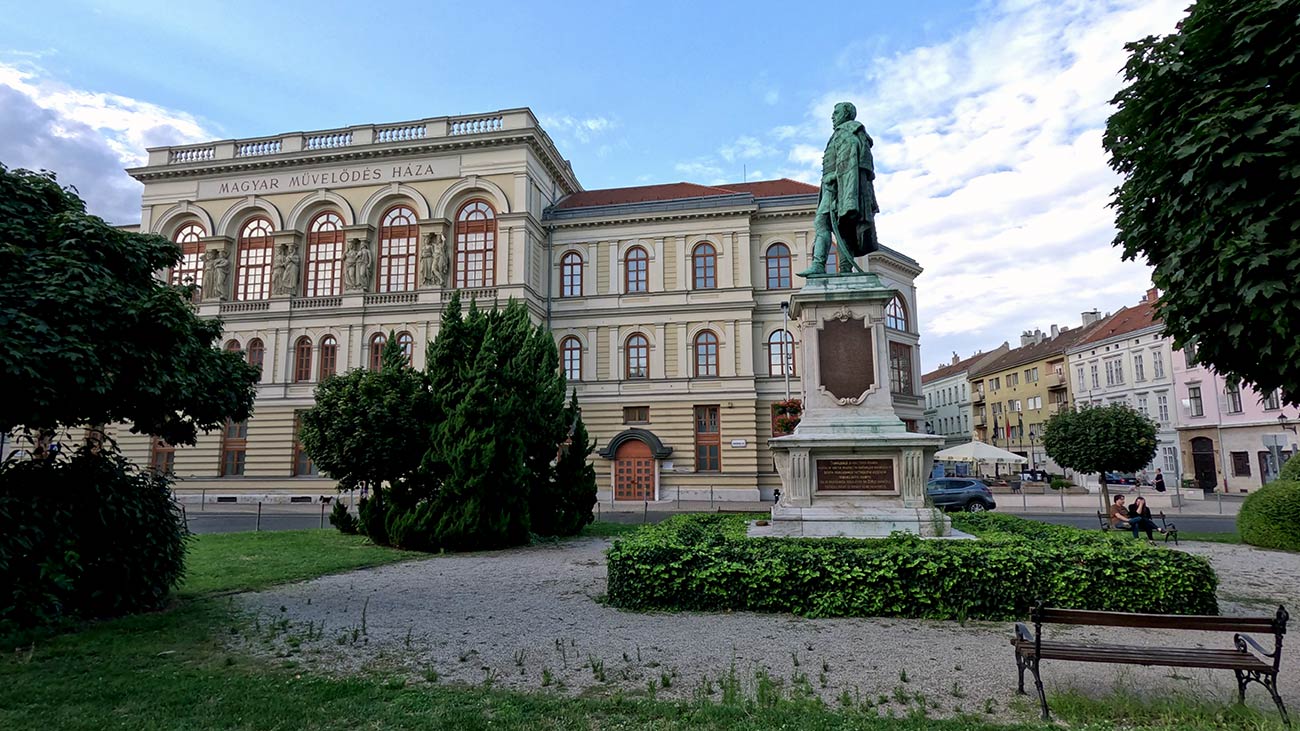
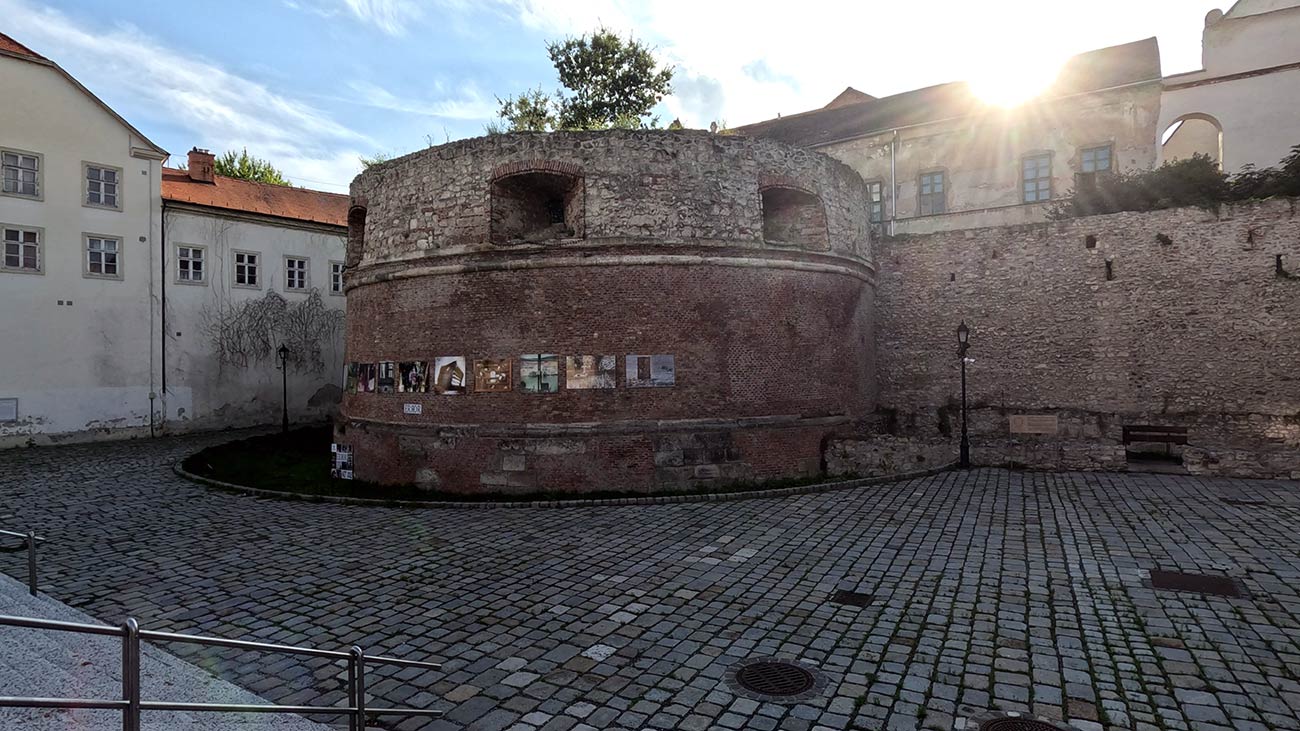
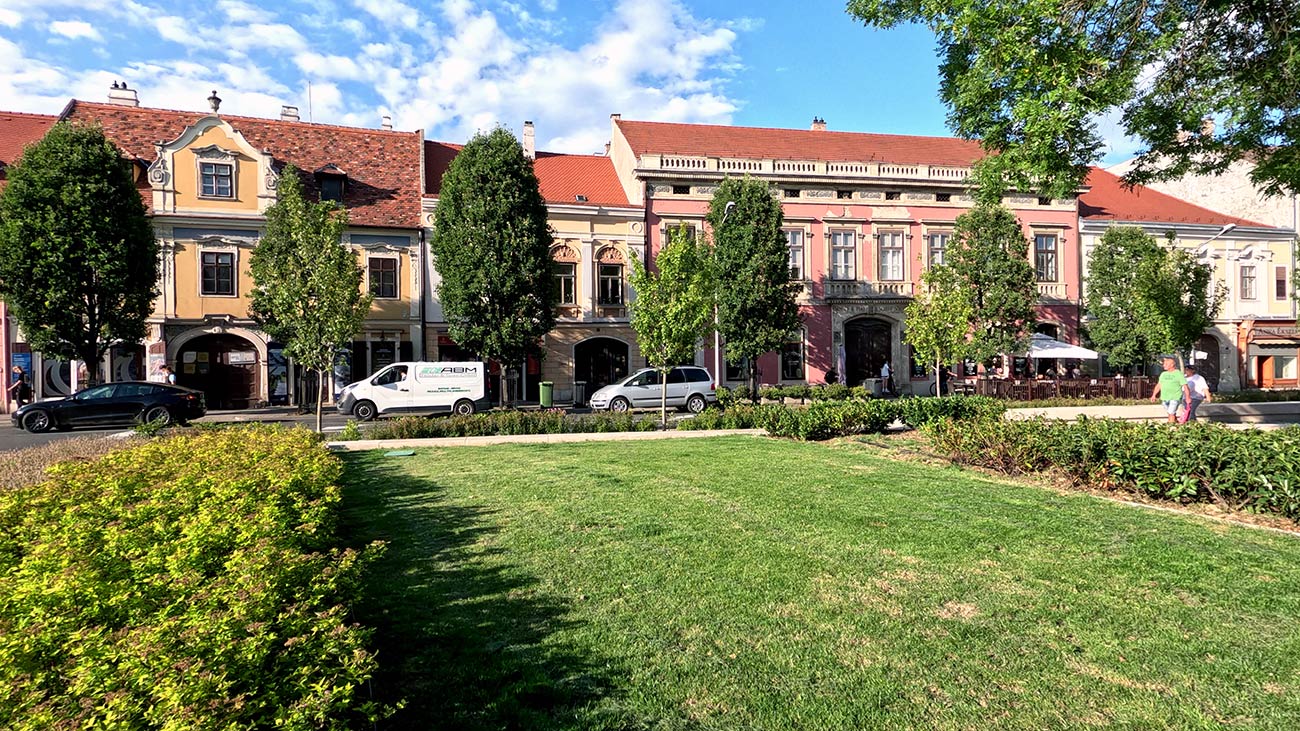
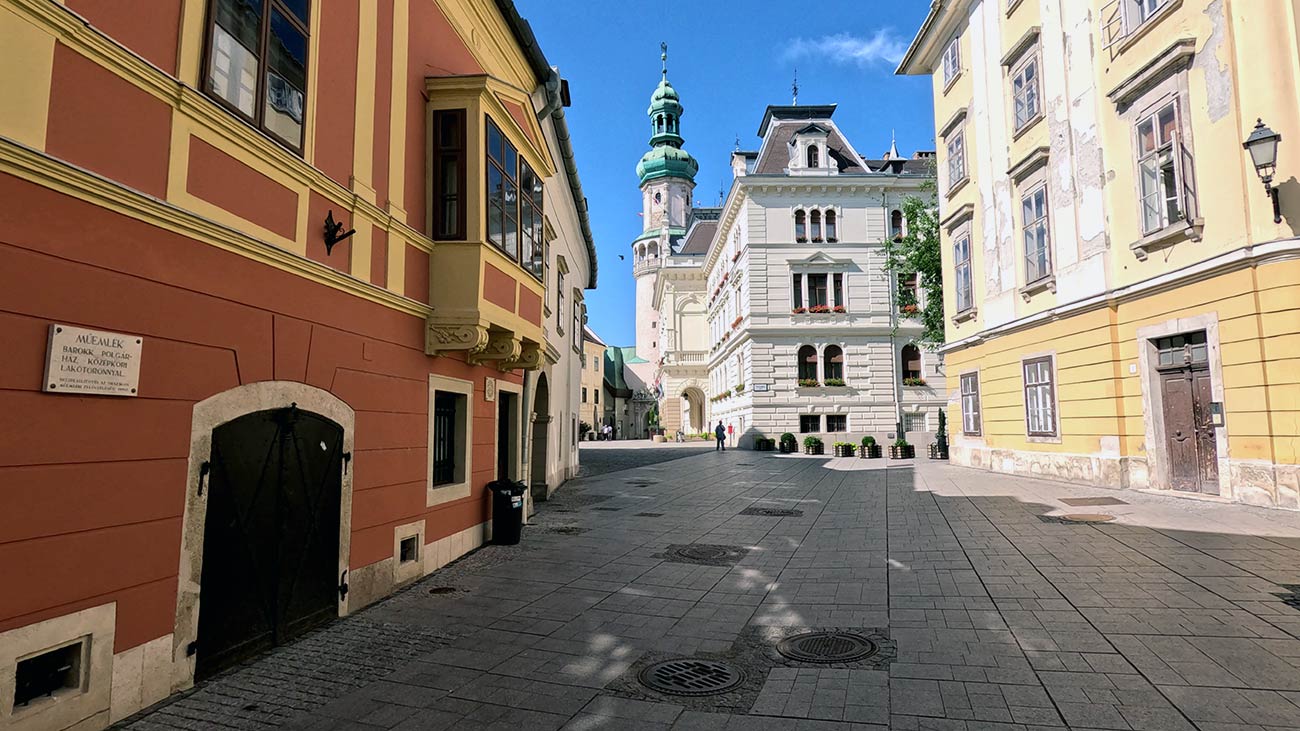
A Roman Forum, a Gothic Church, and the Most Loyal Town in Hungary
The undisputed symbol of Sopron is the Fire Tower (Tűztorony), the 60-metre tower that rises above the northern edge of the old town and serves as the natural starting point for any visit. The tower is itself a small geological cross-section of the city’s history: its base preserves the original Roman foundations of the ancient gate of Scarbantia, the cylindrical middle section is medieval, the balcony and clock tower were added in the Renaissance, and the elegant copper dome is Baroque. A narrow spiral staircase of 116 steps leads to the upper balcony, from which trumpeters once watched for fires, marked the hours of the day, and signalled the approach of enemies. The view from the top stretches across the old town, the surrounding vineyards, and on clear days across the border to the Alpine foothills of Austria. At the foot of the tower stands the Loyalty Gate (Hűségkapu), an early twentieth-century arch that depicts the figure of Hungaria receiving the kneeling town of Sopron and bears the Latin inscription civitas fidelissima, the title that gives the town its identity.
The tower opens directly onto the Main Square (Fő tér), an irregularly shaped Baroque space that sits, almost literally, on top of history. The square is built over the former Roman forum of Scarbantia, the ceremonial heart of the ancient settlement, and excavations beneath several of the buildings have revealed Roman baths, sarcophagi, and a remarkably complete street grid. The buildings around the square have not changed in plan since the thirteenth century, and every one is listed as a national monument. At the centre stands the Holy Trinity Column (Szentháromság-szobor), erected in 1701 by the noblewoman Éva Katalin Késmárki Thököly and her husband Jakab Löwenburg as thanksgiving for surviving the plague of 1695–1701. It is widely regarded as the finest plague pillar in Hungary, and it shares the square with two of the great Baroque mansions of the town: Storno House (Storno-ház), an elegant palatial residence preserved with its original interiors, and Fabricius House (Fabricius-ház), which holds the city’s archaeological collection of Celtic, Roman, and medieval finds, including the 1,200-year-old Cunpald Goblet, one of the oldest pieces of Christian goldwork in the Carpathian basin.
Facing the square stands the Church of the Assumption (Nagyboldogasszony-templom), known throughout the region by its affectionate nickname, the Goat Church (Kecske-templom). The church was founded by Franciscan monks in the thirteenth century and is one of the most significant Hungarian Gothic buildings, with a single soaring tower, a richly carved interior, and one of the finest red marble pulpits in the country. Its name comes from a small stone goat carved into the church facade, the heraldic device of the Geissel family, whose German surname means goat and who funded the fourteenth-century tower as penance, according to local tradition, for a crime committed by one of their members. The church has hosted five sessions of the Hungarian parliament and the coronations of two Hungarian queens, including Eleonora of Gonzaga, the wife of Ferdinand III, in 1622. The adjoining Chapter Hall (Káptalanterem) preserves an exceptional cycle of Gothic stone carvings depicting allegorical figures of the seven deadly sins.
A short walk from the main square, the Old Synagogue (Ó-zsinagóga) on Új utca tells a quieter and harder story. Built in the early fourteenth century, it is one of the oldest synagogues in central Europe and a rare survivor of medieval Jewish religious architecture in the wider region. The building preserves two distinct prayer rooms, one for men and a smaller one for women on the west side with its own narrow windows, along with a medieval holy of holies recess for the Torah scrolls. Sopron’s Jewish community was expelled in 1526 and never returned in the same numbers, which paradoxically preserved the original medieval interior largely unaltered. The street itself, originally known as Zsidó utca (Jewish Street), runs through the heart of the old town and is among the most atmospheric in Sopron. A second medieval synagogue stands further along the same street and is open seasonally as a museum.
Beyond the old town, the rolling Lővér Hills (Lővérek) rise immediately to the south, with marked walking and cycling trails through oak and chestnut forest and the small Károly Lookout Tower offering panoramic views back across Sopron, the surrounding wine slopes, and Lake Fertő on the horizon. The wine region itself, one of the oldest in Hungary, can be explored through tastings at small family cellars in the surrounding villages, with Kékfrankos (Blaufränkisch) as the signature red. The town also continues a long musical tradition through the annual Sopron Festive Weeks in summer and a long-running concert season focused on chamber music, fitting for a place that was the favourite Hungarian residence of generations of Habsburg-era musicians.
 Useful Links
Mobility for Cyclists
The connection
The most practical connection from the EuroVelo 6 corridor is from Győr, where GySEV regional and InterCity trains run directly to Sopron in around one hour and 15 minutes, with hourly departures and around 16 trains per day. Cyclists riding the Hungarian stretch of the EuroVelo 6 will find Győr the natural transfer point, and the journey fits comfortably into a single travel day. Sopron also lies on the Vienna–Sopron and Wiener Neustadt–Sopron corridors, with frequent GySEV cross-border trains making it an unusually accessible destination for travellers coming from the Austrian Danube section of the EuroVelo 6 as well. For travellers in Hungary, the town can also be combined with a stop at Pannonhalma, Győr, or Lake Fertő on a longer itinerary in the north-western corner of the country.
Hungarian Trains
The rail network in Hungary is operated mainly by MÁV-START, the passenger arm of the Hungarian State Railways (Magyar Államvasutak), which runs most long-distance services and a large share of regional connections across the country. Alongside MÁV-START, the private operator GySEV / Raaberbahn (Győr-Sopron-Ebenfurti Vasút) runs cross-border lines in the western part of the country toward Austria, while a smaller number of regional operators run local and feeder lines on selected routes. All operators are fully integrated into the national rail system, so transfers between them are straightforward. The Hungarian rail network is organised around Budapest, with high-frequency InterCity and EuroCity services radiating out from the capital toward Lake Balaton, the Croatian border, the Carpathian foothills, and the eastern plains, alongside a dense network of regional and local services. The Danube region in Hungary is particularly well served by rail, with the main north-south corridor running close to the river from the Slovak border through Budapest and onward toward Mohács, and several east-west lines branching out to inland destinations. The MÁV app is the central tool for planning journeys, checking timetables, and purchasing tickets across all services, including both regional and long-distance trains.
Taking your bike
Hungary is generally very bike-friendly when it comes to rail transport, especially on regional services operated by MÁV-START, which form the core of mobility for cycle touring along the Danube and its connecting corridors. On regional and local trains, bicycles can be taken on board for an additional fee, with no advance reservation possible and a first-come, first-served allocation of space. Bicycle tickets are sold as single trips or as affordable daily or weekly passes, valid across the regional network. On long-distance services such as InterCity and EuroCity trains, an advance reservation for the bicycle is mandatory, with the bike spaces located in dedicated zones in second-class carriages. The private operator GySEV / Raaberbahn, which runs cross-border services in the western part of the country, also accepts bicycles on board with broadly similar rules. Folding bikes are carried free of charge as hand luggage on all operators, provided they fit in the luggage racks. Overall, the Hungarian rail system is well adapted to cycle tourism and offers a flexible combination of train and bike that makes it easy to leave the EuroVelo 6 route in either direction for short or extended detours.
Bikes on Buses
Long-distance bus services in Hungary are primarily operated by Volánbusz, the national coach operator now consolidated under the MÁV group, alongside FlixBus and a smaller number of regional and private operators on selected international and domestic routes. The long-distance bus network is unusually well developed by central European standards, with frequent connections from Budapest to all the major regional centres and a dense web of services across the countryside that complement and sometimes overlap with the rail network. Bicycle transport is available on certain FlixBus connections, either via external bike racks or in the luggage compartment, but it is not consistently guaranteed across the network and depends on the specific vehicle type and route configuration. Where available, bicycle transport must be reserved in advance and capacity is limited, making it less flexible compared to rail services. Volánbusz coaches generally do not carry assembled bicycles, although folded or packed bikes may be accepted as luggage on a case-by-case basis. As a result, buses are generally used as a secondary option for cyclists, mainly for longer-distance repositioning between major cities rather than as a core part of cycling itineraries along the Danube region. While useful in specific cases where rail connections are less convenient, they are less predictable and less standardised for bicycle transport, so advance planning is essential.
Arriving at Sopron Station
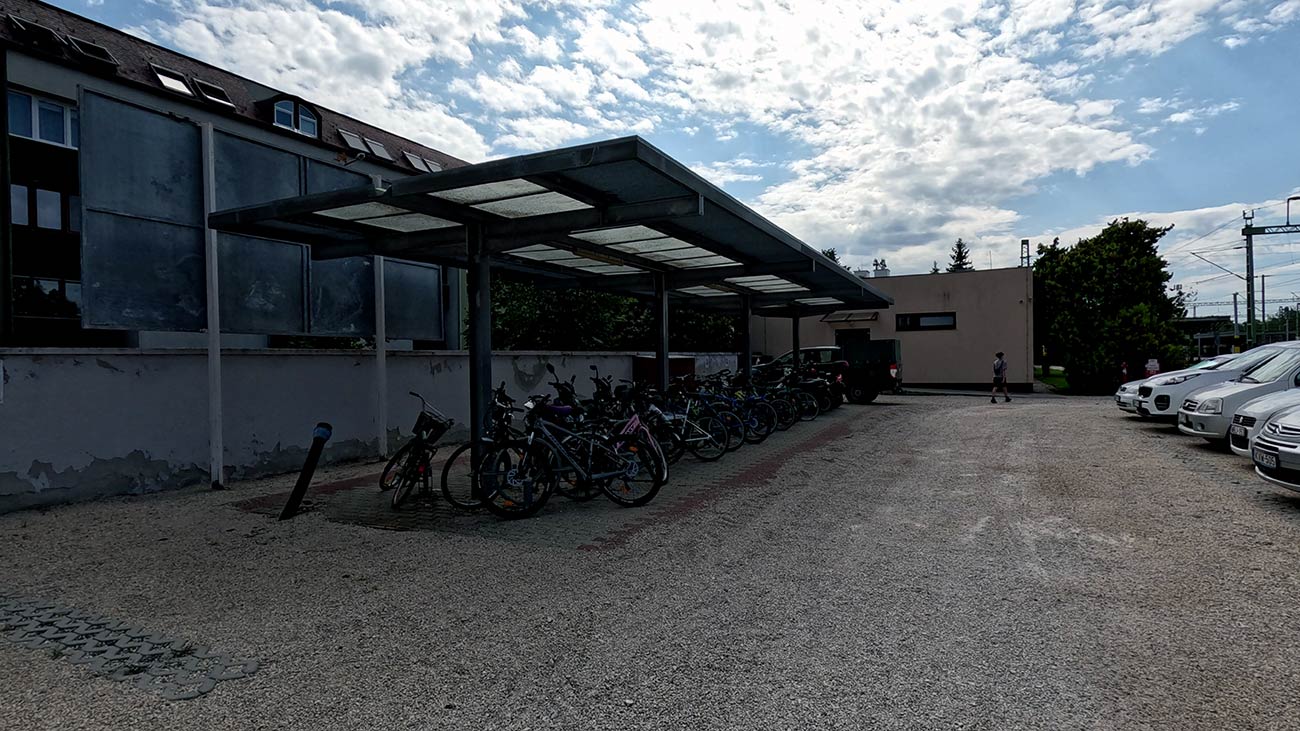
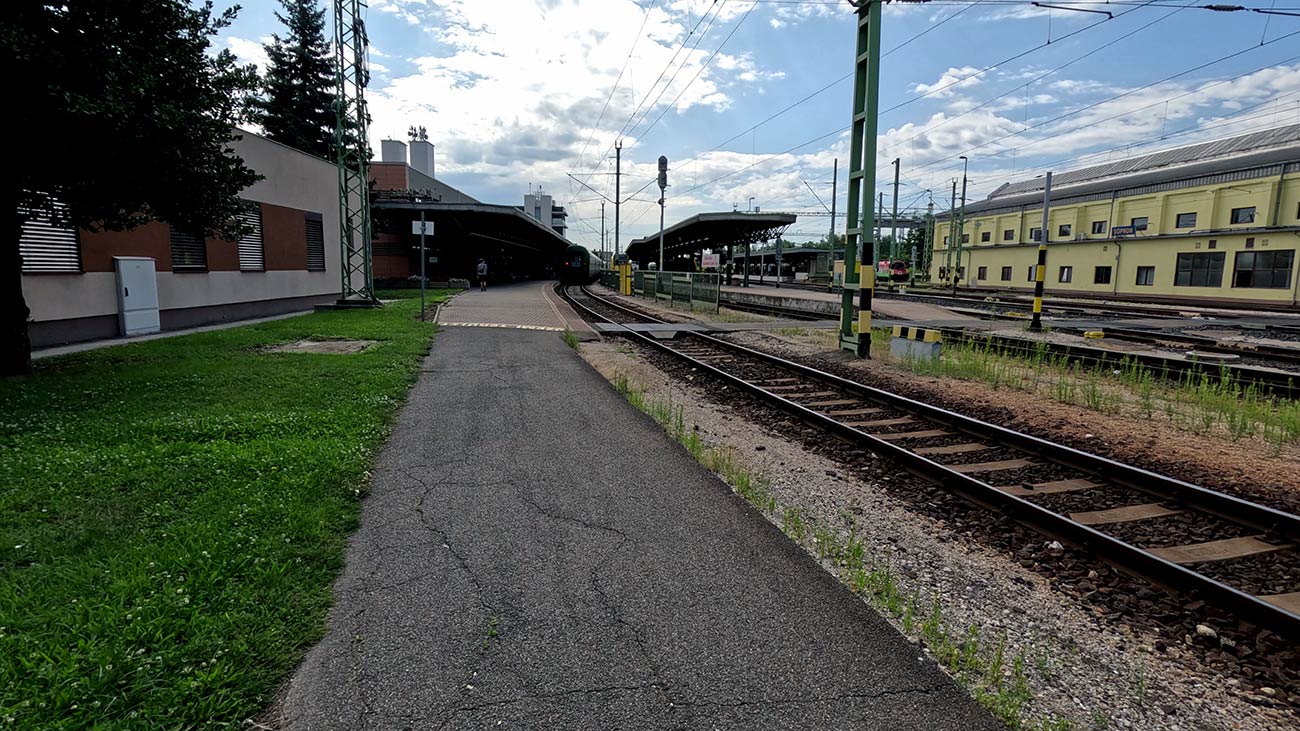
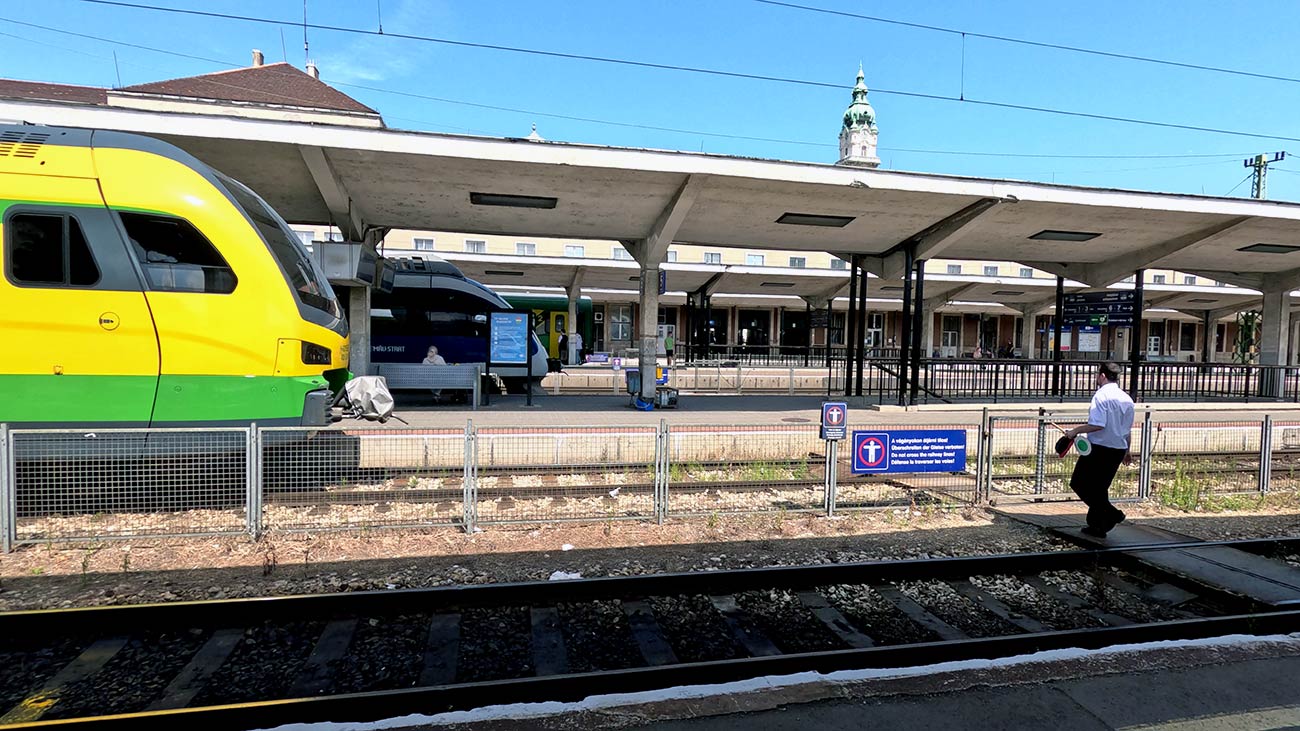
Sopron’s railway station sits a few hundred metres south of the old town walls, with the Goat Church, the Fire Tower, and the Main Square all reachable on foot in under ten minutes along flat, well-signposted streets. The historic core is small, mostly pedestrianised, and very easy to navigate, with every major monument within a five-minute walk of the Main Square. The Lővér Hills rise immediately south of the town and are easily reached on foot or by bike from the centre, with marked trails into the forest beginning at the edge of the residential districts. Bike racks are available at the station and at several points around the old town. For onward travel, the same line connects back toward Győr and the wider Danube region in the east, and to Wiener Neustadt and Vienna across the Austrian border in the west, so Sopron works equally well as a one-day excursion, an overnight detour, or a cross-border gateway between the Hungarian and Austrian sections of the EuroVelo 6.