Szekszárd
Reading time: 14 minutes
SZEKSZÁRD, TOLNA COUNTY, HUNGARY
A Baroque Wine Town in Tolna County
In the gentle, vineyard-covered hills of southern Hungary, where the Danube turns south through the wide plain of Tolna and the surrounding ridges fold up into seven small wooded peaks, lies one of the most distinctive small wine capitals in the country. Szekszárd has been growing red wine on these slopes since Roman times, when the area belonged to the province of Pannonia, and the modern town spreads across the hilltops and side valleys in a quietly elegant arrangement of Baroque facades, classicist mansions, leafy squares, and the occasional traditional wine cellar (borospince) cut directly into the loess soil at the foot of a garden wall. The Hungarian poet János Garay, who was born here in 1812, set the tone for what travellers still come for: a refined provincial culture, a strong local literary identity, and an unbroken wine tradition that locals describe as inseparable from the town's soul.
The Roman wine tradition was renewed in the Middle Ages, when King Béla I of Hungary founded a Benedictine abbey here in 1061, the ruins of which still survive in the courtyard of the old county hall. Szekszárd received its formal civic privileges in the seventeenth century, was thoroughly rebuilt in Late Baroque style after the end of the Ottoman occupation, and became the seat of Tolna County under the Habsburgs. The most distinctive feature of the wider wine region is the local cultivation of Kadarka and Kékfrankos, two robust red grape varieties that have shaped Szekszárd reds for more than two centuries. Today the town hosts the annual Szekszárd Harvest Days (Szekszárdi Szüreti Napok) every September, alongside a regular calendar of wine tastings, festivals, and small concerts.
For cyclists exploring the Danube along the EuroVelo 6, Szekszárd offers a rewarding cultural and culinary detour from Hungary’s main river route. The town is easily reached from Baja, one of the key stops on the EuroVelo 6, with regular train connections taking around 40 minutes. Spending a day or two among the wine cellars, elegant squares of the historic centre, the County Museum, and the surrounding vineyards provides a relaxed introduction to one of Hungary’s lesser-known regions, far from the usual tourist trail.
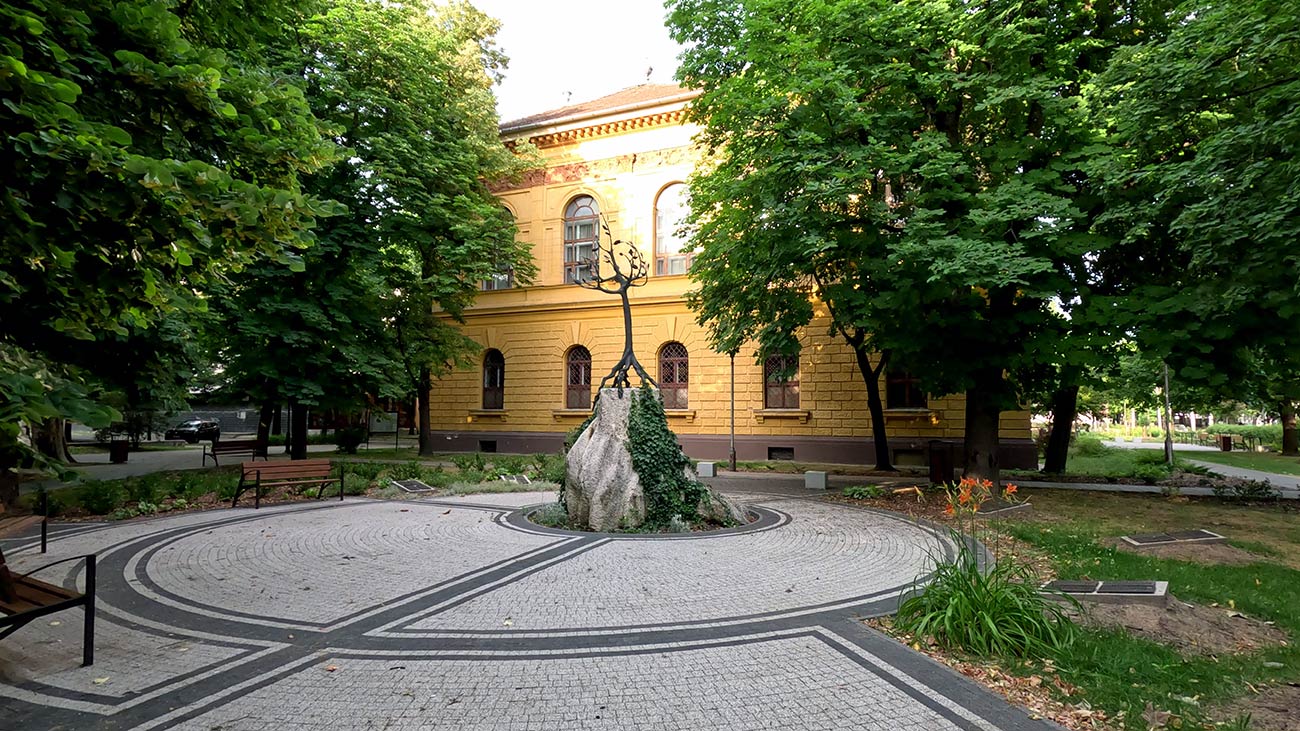
A Town of Two Squares, a Late-Baroque Church, and a County Museum
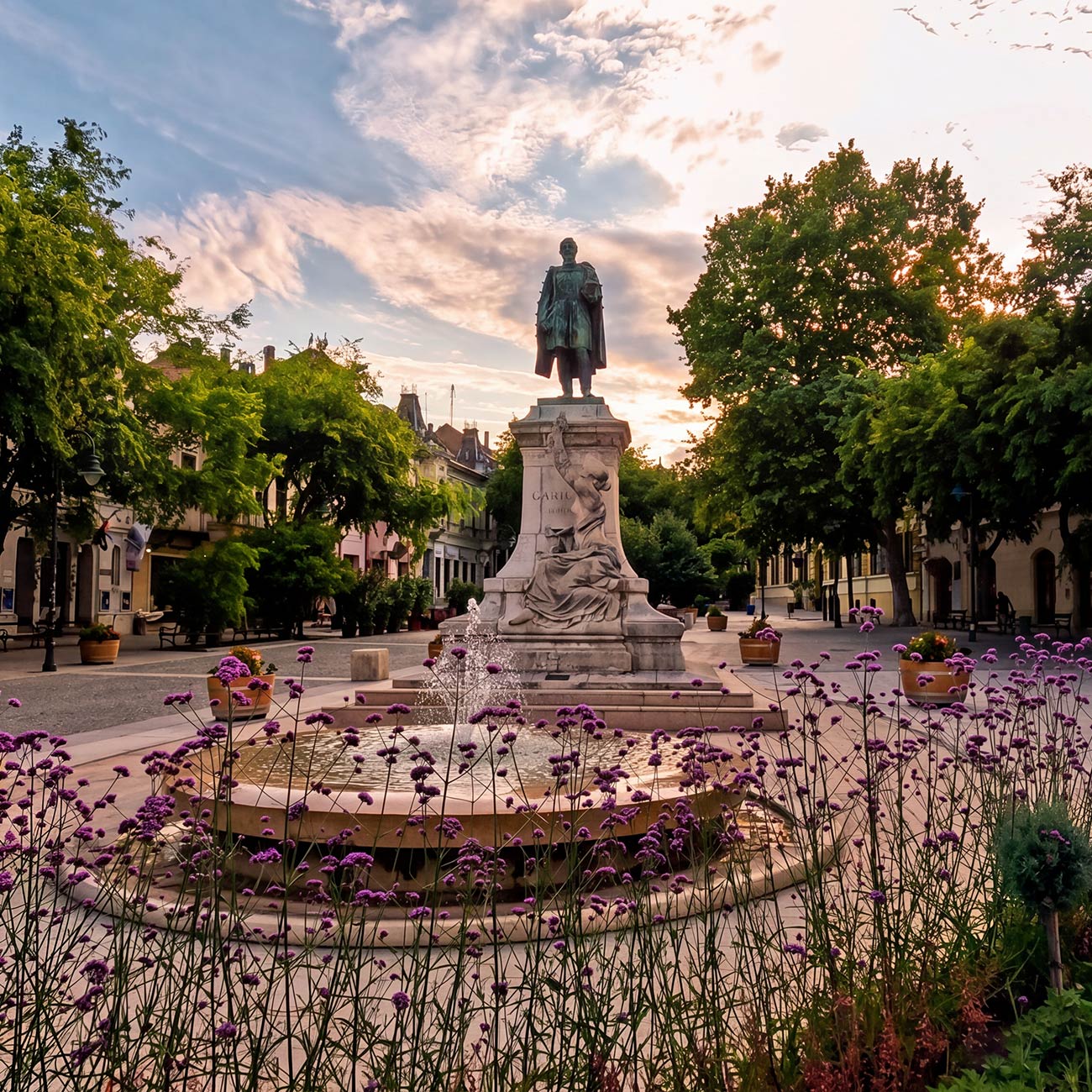
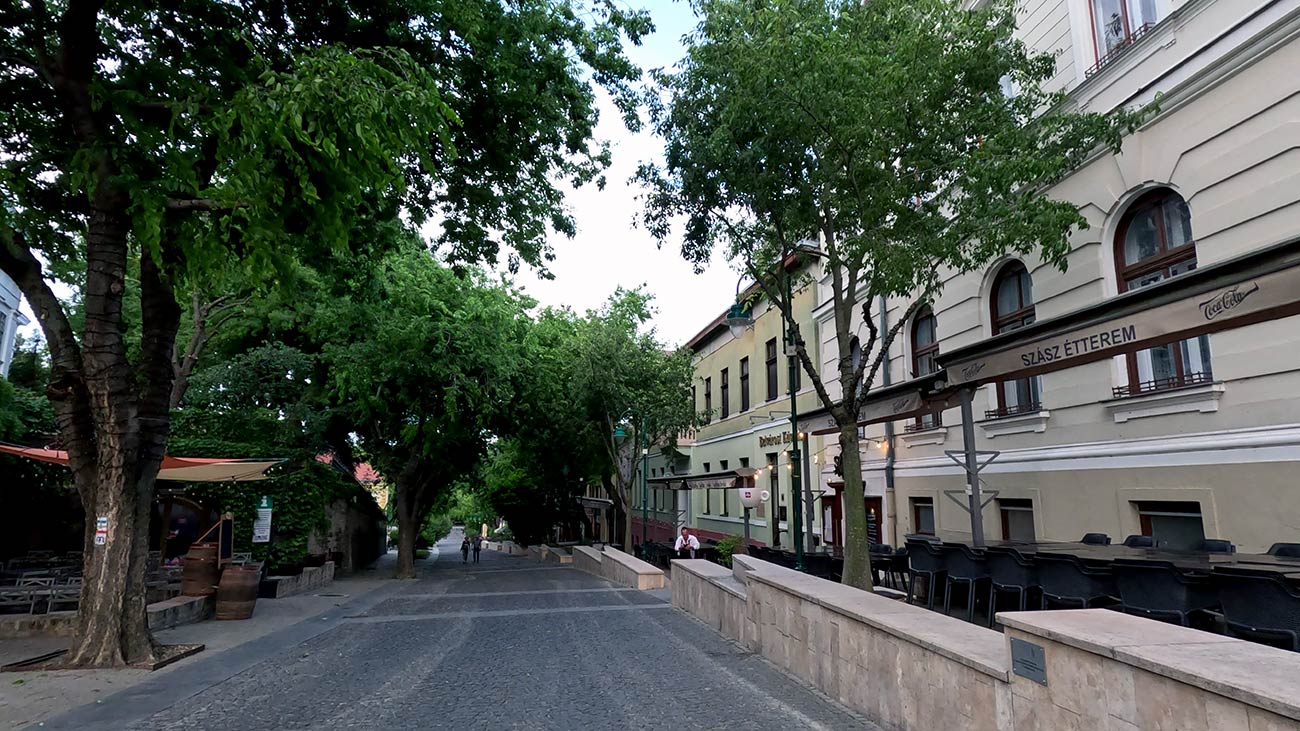
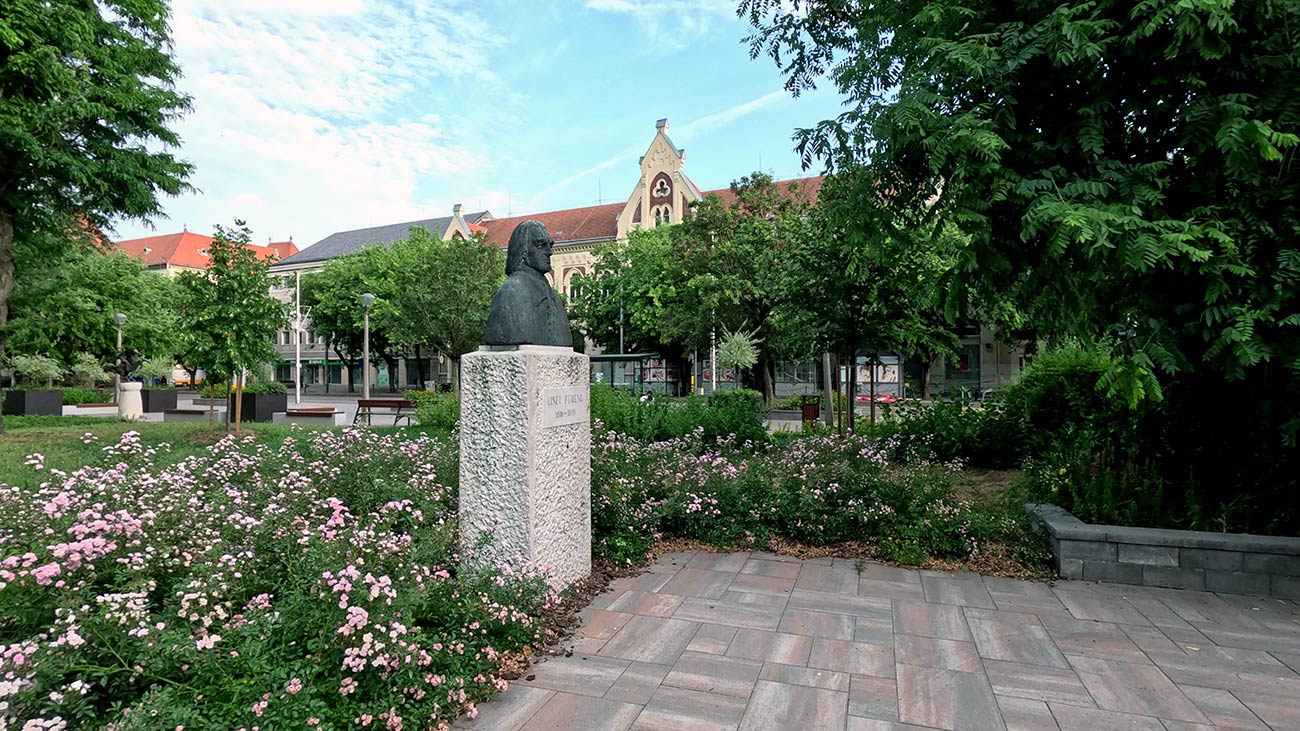
The natural starting point for any visit is Garay Square (Garay tér), the long pedestrianised civic square named after the locally born Hungarian poet János Garay (1812–1853). The bronze statue of Garay at its centre, the work of the sculptor Ferenc Szárnovszky and unveiled in 1898, was cast in Paris and stands on a tall pedestal flanked by a female allegorical figure that was considered daring at the time. Around its base, low reliefs based on the drawings of Mihály Zichy depict scenes from Garay's most famous epic poem The Discharged Soldier (Az obsitos), whose hero Háry János has become one of the most beloved figures in Hungarian literature. Four notable buildings frame the corners of the square. The Szekszárd Hotel (Szekszárd Szálló) carries the legacy of an early-nineteenth-century inn that local tradition credits as the site of the first public demonstration of the telephone on the European continent in 1877. The Augusz House (Augusz-ház) at nearby Széchenyi Street 36–40 hosted the composer Franz Liszt on four separate visits, and a small commemorative plaque records his stays. The Diczenty House (Diczenty-ház, the former Finance Palace) was built on the site where the poet Garay was born, with a memorial plaque from 1905 still set into the façade. The fourth corner is occupied by the old Pirnitzer Merchant House, the oldest surviving commercial house in Szekszárd. The square also holds the elegant Art Nouveau facade of the Deutsche Bühne at number 4, the only German-language theatre in Hungary.
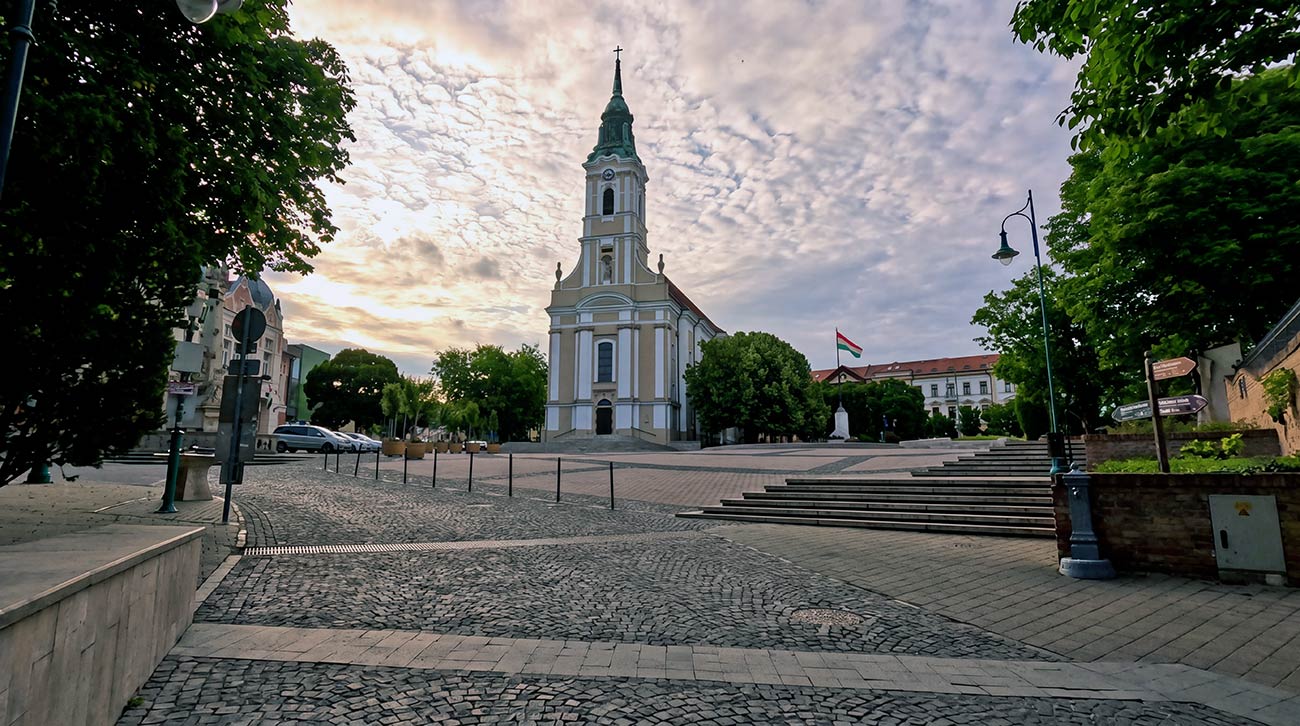
A short walk from Garay tér leads to King Béla Square (Béla király tér), the older ceremonial heart of the town, where Szekszárd's most distinguished building rises in calm Late Baroque proportions. The Inner City Catholic Church (Belvárosi katolikus templom), formally dedicated to the Ascension of Our Lord (Urunk Mennybemenetele templom), is widely cited as the largest single-nave Catholic church in central Europe. It was designed by the court architect József Thallher in a Late Baroque and copf style and built between 1802 and 1806 by the local master builder Schmidt Vencel. The interior is unusually rich for a town of this size: the high altar is finely worked in mosaic-inlaid Carrara marble, with the Ascension of Christ altarpiece painted by the Vienna academician Joseph Schmidt, and the pulpit was carved by József Buck of Pécs. The decorative furnishings around 1800 follow the elegant lines of the copf style that bridges late Baroque and early Classicism. The church was consecrated on 23 November 1806, and on the very same day it hosted its first wedding: the marriage of János Garay senior and Zsuzsanna Walter, the parents of the poet whose statue stands a few minutes' walk away. A bell carillon now plays three times daily from the tower, which was rebuilt in 1926 by Diczenty László after fire damage in 1925. In front of the church stands Szekszárd's oldest statue, the Baroque Holy Trinity Column from 1753, raised in memory of a plague epidemic. The same square also holds the Old County Hall (Régi Vármegyeháza), a Classicist building designed by Mihály Pollack between 1828 and 1833, in whose inner courtyard the excavated ruins of the Benedictine Abbey founded in 1061 by King Béla I can still be seen, alongside a Liszt Ferenc memorial exhibition and the works of the painter Mattioni Eszter.
The third of Szekszárd's essential stops, a short walk east of Béla tér on Saint Stephen Square (Szent István tér 26), is the Wosinsky Mór County Museum (Wosinsky Mór Megyei Múzeum), the cultural and historical anchor of the town. The museum holds the most important archaeological collection of the wider Tolna County, with finds reaching from Stone Age and Bronze Age settlements through the Celtic and Roman occupation of Alisca (the Roman predecessor of Szekszárd) to medieval and early modern objects, including a remarkable late-Roman sarcophagus discovered in the town itself. A second permanent collection is devoted to the ethnography of the surrounding region, with traditional costume, folk furniture, ceramics, and craft objects collected from the Hungarian, German (Swabian), and South Slavic villages of Tolna County. Temporary exhibitions on local history, fine art, and contemporary archaeology rotate through the year. The museum is named after the man who effectively created its founding collection, the priest and archaeologist Wosinsky Mór, whose long association with the town is one of the more unusual stories in Hungarian cultural history.
Beyond these three central attractions, Szekszárd preserves several quieter sites that reward a longer walk. The Babits Mihály Memorial House (Babits Mihály Emlékház) at Babits Mihály utca 13 is the birthplace of the great twentieth-century Hungarian poet, set in a modest braid-style (fonott) building from around 1780, with a small museum and a bronze statue of the poet in the courtyard. The Calvary Hill (Kálvária) lookout above the town offers panoramic views over the seven hills, the vineyards, and the Sárköz lowlands toward the Danube. The traditional Bartina wine cellar row on the slopes east of the centre opens out into a long sequence of small family wine cellars carved into the loess soil, many of which welcome visitors for tastings of the local Kadarka, Kékfrankos, and the regional speciality known as Szekszárdi Bikavér (Bull's Blood of Szekszárd). The Garay Élménypince, an interactive wine cellar back in the centre of town, offers a more curated tasting experience for travellers with less time.
 Useful Links
Mobility for Cyclists
The connection
The most practical connection from the EuroVelo 6 corridor is from Baja, where MÁV-START regional trains run directly to Szekszárd in around 40 minutes, with regular departures throughout the day. The line follows the gentle rolling country between the Danube and the Szekszárd hills, with views of vineyards and wine villages along the way. Cyclists riding the Hungarian stretch of the EuroVelo 6 will find Baja the natural transfer point, since the town sits directly on the river and on the cycle corridor. The visit can also be combined naturally with Pécs further south on a longer Hungarian itinerary, since both towns are linked by regular rail connections.
Hungarian Trains
The rail network in Hungary is operated mainly by MÁV-START, the passenger arm of the Hungarian State Railways (Magyar Államvasutak), which runs most long-distance services and a large share of regional connections across the country. Alongside MÁV-START, the private operator GySEV / Raaberbahn (Győr-Sopron-Ebenfurti Vasút) runs cross-border lines in the western part of the country toward Austria, while a smaller number of regional operators run local and feeder lines on selected routes. All operators are fully integrated into the national rail system, so transfers between them are straightforward. The Hungarian rail network is organised around Budapest, with high-frequency InterCity and EuroCity services radiating out from the capital toward Lake Balaton, the Croatian border, the Carpathian foothills, and the eastern plains, alongside a dense network of regional and local services. The Danube region in Hungary is particularly well served by rail, with the main north-south corridor running close to the river from the Slovak border through Budapest and onward toward Mohács, and several east-west lines branching out to inland destinations. The MÁV app is the central tool for planning journeys, checking timetables, and purchasing tickets across all services, including both regional and long-distance trains.
Taking your bike
Hungary is generally very bike-friendly when it comes to rail transport, especially on regional services operated by MÁV-START, which form the core of mobility for cycle touring along the Danube and its connecting corridors. On regional and local trains, bicycles can be taken on board for an additional fee, with no advance reservation possible and a first-come, first-served allocation of space. Bicycle tickets are sold as single trips or as affordable daily or weekly passes, valid across the regional network. On long-distance services such as InterCity and EuroCity trains, an advance reservation for the bicycle is mandatory, with the bike spaces located in dedicated zones in second-class carriages. The private operator GySEV / Raaberbahn, which runs cross-border services in the western part of the country, also accepts bicycles on board with broadly similar rules. Folding bikes are carried free of charge as hand luggage on all operators, provided they fit in the luggage racks. Overall, the Hungarian rail system is well adapted to cycle tourism and offers a flexible combination of train and bike that makes it easy to leave the EuroVelo 6 route in either direction for short or extended detours.
Bikes on Buses
Long-distance bus services in Hungary are primarily operated by Volánbusz, the national coach operator now consolidated under the MÁV group, alongside FlixBus and a smaller number of regional and private operators on selected international and domestic routes. The long-distance bus network is unusually well developed by central European standards, with frequent connections from Budapest to all the major regional centres and a dense web of services across the countryside that complement and sometimes overlap with the rail network. Bicycle transport is available on certain FlixBus connections, either via external bike racks or in the luggage compartment, but it is not consistently guaranteed across the network and depends on the specific vehicle type and route configuration. Where available, bicycle transport must be reserved in advance and capacity is limited, making it less flexible compared to rail services. Volánbusz coaches generally do not carry assembled bicycles, although folded or packed bikes may be accepted as luggage on a case-by-case basis. As a result, buses are generally used as a secondary option for cyclists, mainly for longer-distance repositioning between major cities rather than as a core part of cycling itineraries along the Danube region. While useful in specific cases where rail connections are less convenient, they are less predictable and less standardised for bicycle transport, so advance planning is essential.
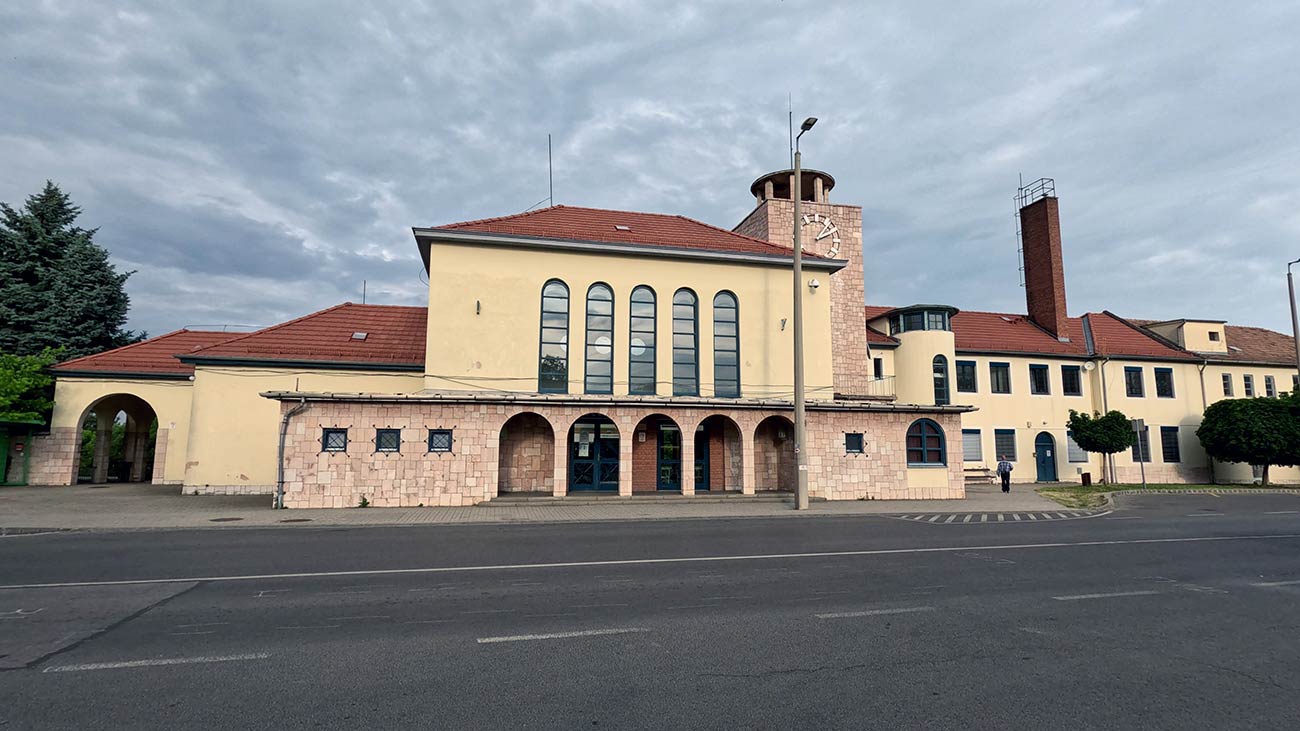
Arriving at Szekszárd Station
Szekszárd's railway station sits a short walk east of the historic centre, with Garay tér, Béla király tér, and the Wosinsky Mór County Museum all reachable on foot or by bike in around fifteen minutes along largely flat, well-signposted streets. The historic core is compact, mostly pedestrianised, and very easy to navigate on foot, with all the major attractions within a five- to ten-minute walk of each other once you arrive. The surrounding hills are crossed by signposted cycling routes for travellers wanting to extend the visit into the wine villages of the region. Bike racks are available at the station and at several points around the centre. For onward travel, the same line connects back toward Baja and the wider Danube region, as well as south toward Pécs, so Szekszárd works equally well as a half-day excursion, an overnight detour, or a longer base for exploring southern Tolna and the surrounding wine country.