Felix Romuliana
Reading time: 13 minutes
FELIX ROMULIANA, ZAJEČAR DISTRICT, SERBIA
An Emperor’s Palace Named for His Mother
In the rolling hill country of eastern Serbia, not far from the Bulgarian border, lie the excavated foundations of one of the most important late Roman palaces ever discovered. Felix Romuliana, near the village of Gamzigrad, eleven kilometres north-west of Zaječar, is the legacy of the Roman emperor Gaius Galerius Valerius Maximianus, who ruled the eastern half of the empire from 293 to 311 AD. Within a double ring of fortified walls, archaeologists have uncovered the remains of an imperial residence so richly decorated with mosaics, frescoes, and sculpture that, in scale and preservation, it has been judged to surpass comparable late Roman palaces in Trier, Milan, Thessaloniki, Istanbul, and Nicomedia.
Galerius was born around 260 AD in a settlement on this exact spot, in what was then the Roman province of Dacia Ripensis. As a boy he tended cattle, a humble origin his political rivals never let him forget, before rising through the army to become one of the four rulers of Diocletian’s tetrarchy. Once in power, he built a fortified palace at his birthplace and named it Romuliana, after his mother Romula, a refugee from Dacia whose own name he intended to honour alongside his own. An inscription found on site in 1984 reading FELIX ROMULIANA gave the place its full name, commemorating what Galerius regarded as the divine favour shared by mother and son alike. In 2007, the site was inscribed on the UNESCO World Heritage List, recognised for the unusual way its architecture fuses Roman palace design with a deliberate sacred and memorial programme.
For cyclists exploring the Danube along the EuroVelo 6, Felix Romuliana is a more demanding but genuinely rewarding inland detour from the Serbian stretch of the route. The site lies well south of the river, reached by a direct Srbija Voz train from Negotin, the natural EuroVelo 6 gateway in this part of eastern Serbia, to Zaječar in around 1 hour 45 minutes, followed by a final stretch by bike or local connection to Gamzigrad itself. A full day spent among the palace walls, its mosaics, and the sacred hilltop site nearby offers one of the more substantial archaeological experiences anywhere along the Serbian Danube corridor.
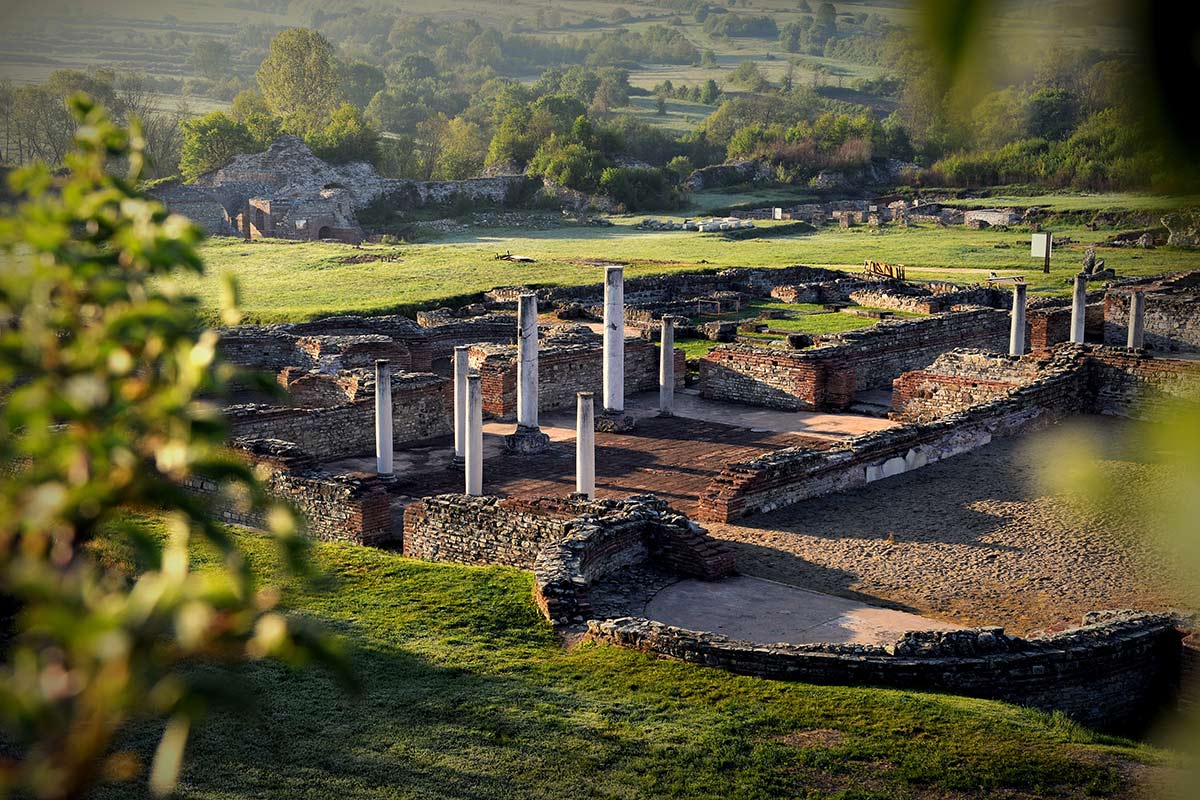
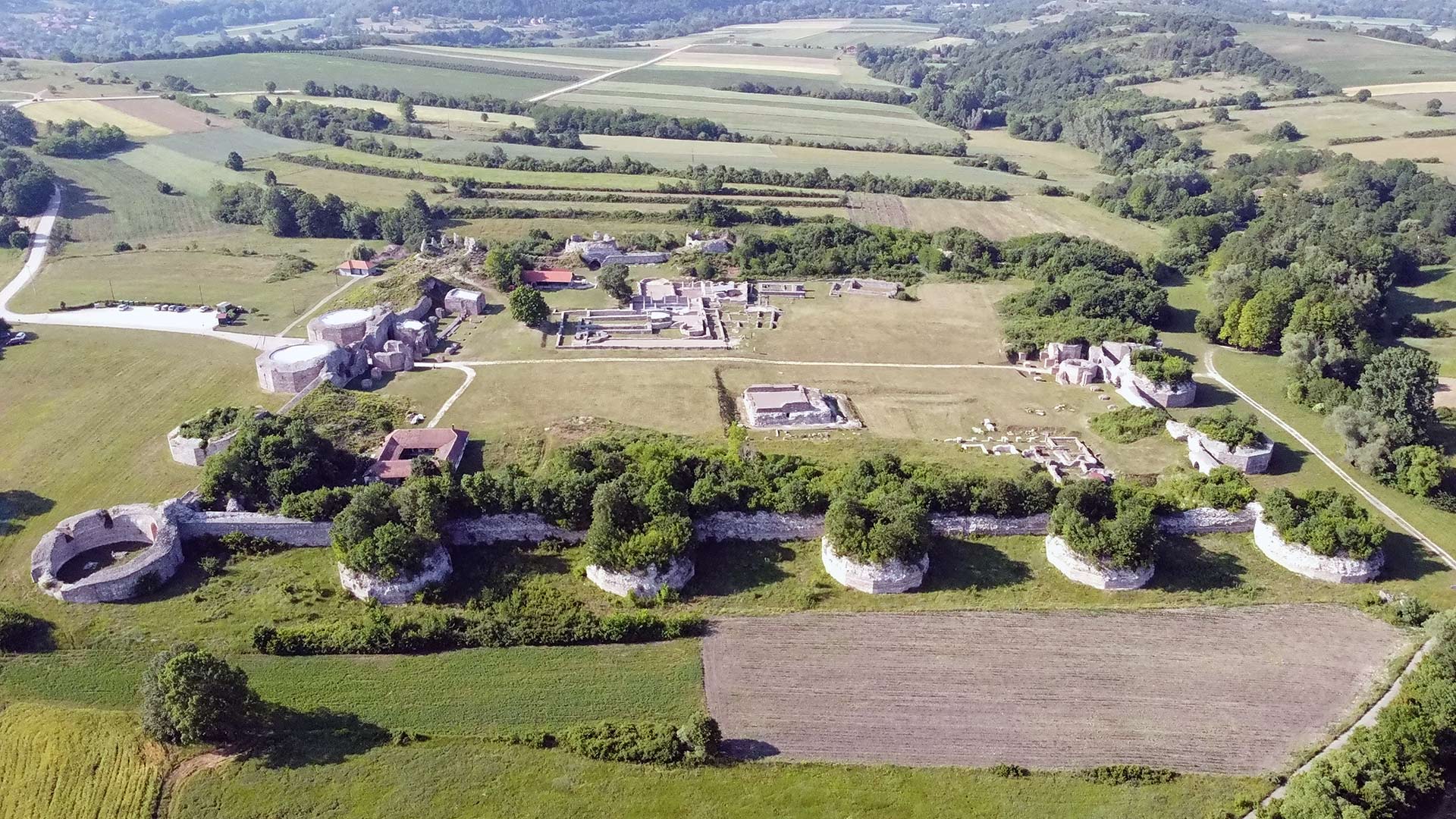
Inside the Walls of an Emperor’s Last Great Building Project
The palace at Felix Romuliana is enclosed by two concentric fortified walls, a clear record of its construction in two distinct phases. The older wall, dating from the late third century, was reinforced with sixteen towers, while a much more imposing fortification added in the early fourth century surrounds it with twenty massive polygonal towers, giving the whole complex an unmistakably defensive, almost theatrical grandeur. The original main entrance to the palace stood on its eastern side, though visitors today enter through the western gate. Within the walls, archaeologists have identified two broad zones: the southern half holds the remains of a large temple complex with two crypts and an old Roman bath, while the northern half preserves a well-preserved sequence of imperial residential buildings, a smaller temple, and an altar where pagan rituals were once performed.
What set Romuliana apart from other Roman provincial residences, and what continues to impress visitors and archaeologists alike, is the sheer quality of its surviving decoration. The palace floors were once covered in fine mosaics, its walls finished with lavish frescoes and panels of precious imported stone, and its niches filled with sculpture carved from rare and difficult-to-work materials. Three of the most significant mosaics recovered from the site, Dionysus at the Feast, a Labyrinth, and Venatori (depicting the imperial hunters of wild beasts), are now preserved at the National Museum in Zaječar, alongside the most important sculptural finds: the archivolt bearing the inscription FELIX ROMULIANA, discovered in 1984 and the key to identifying the site; a pilaster depicting the four tetrarchs in medallions; the porphyry head of Emperor Galerius himself; a colossal head of Jupiter; and a head of Hercules. Anyone planning a full day at the site should consider combining the open-air ruins at Gamzigrad with a visit to the National Museum, where the finest portable finds are properly displayed and explained.
Galerius intended Romuliana as a place to retire and reside in dignity as senior Augustus, and after his death, to be worshipped as a god. About one kilometre from the palace’s main gate, on the slopes of Mount Magura, lies a remarkable sacred complex built for exactly this purpose: two mausoleums, one for Galerius and one for his mother Romula, alongside two consecrated monuments built as giant tumuli with stone foundations. This hilltop site marks, as far as historians can tell, the last recorded occasion in the Roman world on which a formal apotheosis ceremony took place, elevating an emperor and his mother into the ranks of the gods after their deaths. Visiting the Magura tumuli after the main palace complex completes the story of Romuliana in the way its builder intended: a residence for life, and a stage for divinity in death.
History remembers Galerius chiefly as one of the most determined persecutors of Christians during the last great wave of Roman religious violence, yet his final acts complicate that reputation. Just two years before Emperor Constantine’s celebrated Edict of Milan of 313, which formally established religious tolerance across the empire, the dying Galerius issued his own edict of tolerance from his sickbed, becoming, briefly and unexpectedly, an unlikely forerunner to the very policy his successor would make famous. For a five-year stretch between 306 and 311, Galerius and Constantine, lifelong political rivals, even ruled the empire simultaneously as co-emperors, a reminder that the tetrarchic system Galerius helped build was as much about uneasy compromise as it was about absolute power. After his death, Romuliana did not fall silent: the unused palace became a lively centre of late antique craft and trade, particularly iron metallurgy, and by the sixth century, under Emperor Justinian I, it may have served as the seat of a Christian church community. Life continued within its formidable walls until the middle of the eleventh century, nearly eight hundred years after Galerius first built them.
 Useful Links
Mobility for Cyclists
The connection
The most practical connection from the EuroVelo 6 corridor is from Negotin, where Srbija Voz runs a direct regional train to Zaječar twice daily, with a journey time of around 1 hour 45 minutes. Cyclists riding the Serbian stretch of the EuroVelo 6 will find Negotin the natural transfer point, though the relatively limited frequency of this regional service means the day’s itinerary should be planned carefully around the available departures. Given the overall travel time involved, this detour is best treated as a full-day excursion or an overnight stop rather than a quick half-day visit.
Serbian Trains
The rail network in Serbia is operated mainly by Srbija Voz, the national passenger rail operator, which runs both regional and InterCity services across the country. For much of the network, the system has historically been considerably less developed than rail networks in neighbouring central European countries, with ageing rolling stock, single-track lines, and journey times that often lag well behind road travel over the same distance. Against this backdrop, the modernised Belgrade-Novi Sad-Subotica corridor stands out as a genuine exception. Upgraded with new high-speed Soko electric trains and a parallel InterRegio service, this stretch has been transformed into one of the fastest and most reliable rail journeys anywhere in the region, with frequent departures running roughly every one-two hours throughout the day and journey times that now comfortably compete with, and often beat, the equivalent bus or car trip. Stops along this corridor include Novi Beograd, Petrovaradin (serving Novi Sad), Vrbas, Bačka Topola, and Subotica on the Soko line, with several additional stops served by the InterRegio service. Away from this modernised corridor, Serbian regional rail tends to be slower and less frequent, and for many shorter regional hops, buses remain the faster and more practical option. The Srbija Voz website and app are the main tools for checking timetables and buying tickets, and the app in particular is useful since not every station along the network, including some stops on the modernised corridor itself, has a staffed ticket counter. Tickets are normally purchased in advance through the website or app, but where no ticket counter is available at the departure station, tickets can simply be bought directly on board the train from the conductor, with no extra fee charged for doing so. This makes the system fairly forgiving for visitors unfamiliar with Serbian rail, since a missing ticket counter at a small rural station is not an obstacle to travel.
Taking your bike
Cycling support on Serbian trains follows clear rules set out by Srbija Voz, though capacity varies considerably by train type. On diesel-engine trains, bicycles are loaded through doors marked with a bicycle symbol and secured on built-in bike racks, of which there are only two per train set, located near the folding seats; bikes cannot be left in front of the wheelchair space or the toilets. On electric multiple-unit trains, bicycles are again loaded through marked doors and placed beside the folding seats near the entrance and toilets, though these carriages have no fixed racks, so the rider should stay close by to steady the bike; up to three bicycles can generally be carried if the multipurpose space is free, at the conductor’s discretion and depending on wheelchair users, prams, or large luggage already on board. The modern Soko electric trains on the upgraded Belgrade-Subotica corridor offer the most generous capacity, with dedicated bicycle space in every carriage near the luggage racks (the lower shelf folds down to free the space), allowing up to eight bicycles per train under normal conditions, again at the conductor’s discretion. On all train types, bicycles may be refused if the train is already at full capacity on a given stretch. On any other Serbian train not covered by these specific rules, and on all international services, a bicycle can still be carried as ordinary luggage if it is folded and packed so that it fits within the same compartment as its owner. Srbija Voz accepts no liability for damage or loss of bicycles carried on board. Given this patchwork of rules, the modernised Soko service remains the most reliable option for cyclists travelling with an assembled touring bike, while a folded or disassembled bike packed as luggage travels reliably on any service.
Bikes on Buses
Long-distance bus services in Serbia are extensive and, on most routes away from the main modernised rail corridor, faster and more frequent than the equivalent train journey. The network is operated by a large number of carriers, with Lasta among the largest national operators, alongside numerous regional companies such as Niš-Ekspres and Banat Trans, and the international operator FlixBus on selected routes. Bicycle transport on Serbian buses is not standardised across operators: bikes are typically carried in the luggage compartment beneath the bus when space allows, but capacity is not guaranteed, and advance reservation or direct confirmation with the specific operator is recommended, especially for an assembled touring bike. As a result, buses are best used by cyclists as a secondary, flexible option for repositioning between towns, particularly where rail connections are slow, infrequent, or simply don’t exist on a given route, while a packed or folded bike travels far more reliably as ordinary luggage than an assembled one.
Arriving in Zaječar and Continuing to Gamzigrad
From Zaječar, the archaeological site at Gamzigrad lies around 11 kilometres to the north-west, a stretch most easily covered by bike along local roads, or by taxi or local transport for travellers who prefer not to cycle the final leg. Once at the site, the National Museum in Zaječar holding the finest portable finds from the palace is worth visiting either before or after the ruins themselves, ideally as part of the same day. The archaeological park itself, the sacred complex on Mount Magura, and the surrounding rural landscape are best explored slowly and on foot. Bike racks are available near the site’s visitor facilities. For onward travel, the same regional rail line connects back toward Negotin and the wider Danube region, so a visit to Felix Romuliana works best as a considered full-day or overnight detour rather than a brief stop along the route.