Valjevo
Reading time: 13 minutes
VALJEVO, KOLUBARA DISTRICT, SERBIA
Where Two Rivers and Two Centuries Meet
In the wooded hills of western Serbia, where the Gradac and Kolubara rivers meet at the foot of green slopes, lies a town first mentioned in Dubrovnik trading records as early as 1393. For centuries Valjevo sat at a genuine crossroads between East and West, a position that left it with not one but two distinct historic centres facing each other across the same river: an Ottoman-era trading quarter on one bank, and a nineteenth-century European-style street laid out by order of Prince Miloš Obrenović on the other. The town’s setting is part of its character too, with no fewer than five waterways threading through the wooded hills around it, keeping the air fresh and the surroundings green in every direction.
Valjevo’s history carries real weight beyond its picturesque streets. It was here that some of the opening events of the Serbian uprisings against Ottoman rule unfolded in the early nineteenth century, and more than a century later the town again became a centre of resistance during the Second World War, a chapter commemorated by one of the largest sculptural monuments in the country, rising above the rooftops on the hill of Vidrak. Valjevo is also a town of poetry and quiet reflection: it is the hometown of Desanka Maksimović, one of Serbia’s most beloved poets, whose memory is honoured both here and in the nearby village of Brankovina where she was born.
For cyclists exploring the Danube along the EuroVelo 6, Valjevo is a worthwhile inland detour from the Serbian stretch of the route. The town lies a direct train ride from Belgrade, the country’s capital and the natural EuroVelo 6 gateway, with a journey of around 1 hour 15 minutes through the green hill country of western Serbia. A half day or full day spent moving between the old Tešnjar quarter, the viewpoints of Vidrak, and the National Museum offers a genuinely different texture from the flat river towns further east, with hills, rivers, and a slower, more reflective rhythm of its own.
A Town of Two Centres, a Hilltop Monument, and a Riverbank Bazaar
The oldest and most evocative part of Valjevo lies on the right bank of the Kolubara, beneath the wooded slope of Vidrak hill. This is Tešnjar, the old trading quarter, one of the most picturesque and best-preserved Ottoman-style bazaars anywhere in Serbia. Its name is thought to come from the Serbian word for narrow or squeezed, an apt description for a single street pressed tightly between the river on one side and the steep hillside on the other. Through the nineteenth century and into the first half of the twentieth, Tešnjar was packed with small craft workshops, where artisans sold their wares from early morning before the street transformed each evening into a promenade for the whole town. Cobblestone lanes, low traditional houses, and a handful of surviving workshops still give the quarter the feel of a place caught gently out of time, protected today as an immovable cultural monument of the city. Every August, the Tešnjar Nights festival, with its strong theatre and film programme, brings the old quarter back to life with crowds, performances, and the kind of cultural energy that once filled its workshops by day.
Directly across the river, on the left bank, runs the street that Prince Miloš Obrenović ordered built in a deliberately European style during the nineteenth century, today the lively core of Valjevo’s modern town centre, anchored by the main shopping street, Knez Miloševa, and a series of open squares used for festivals and everyday city life alike. The contrast between the two banks, Ottoman-era Tešnjar on one side and Obrenović’s European quarter on the other, is precisely what locals mean when they describe Valjevo as a town with two historical centres rather than one, each shaped by a different empire’s idea of what a town should look like.
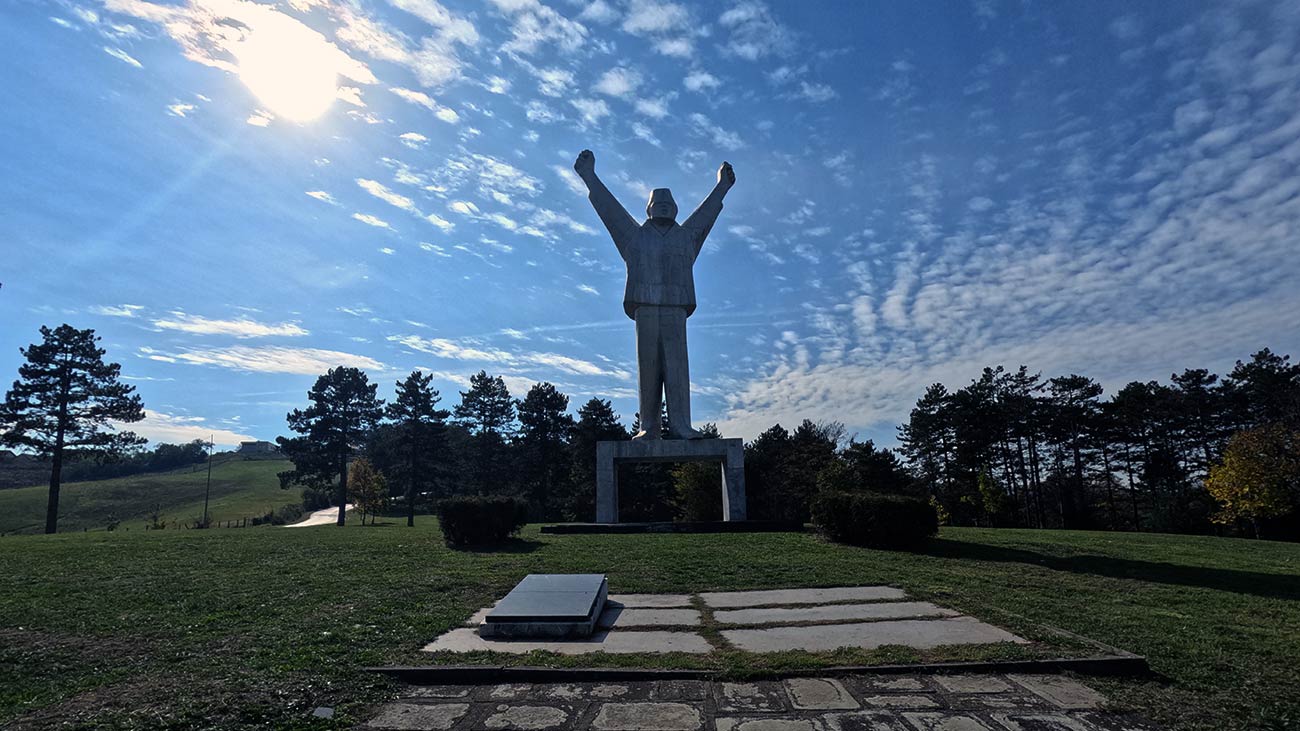
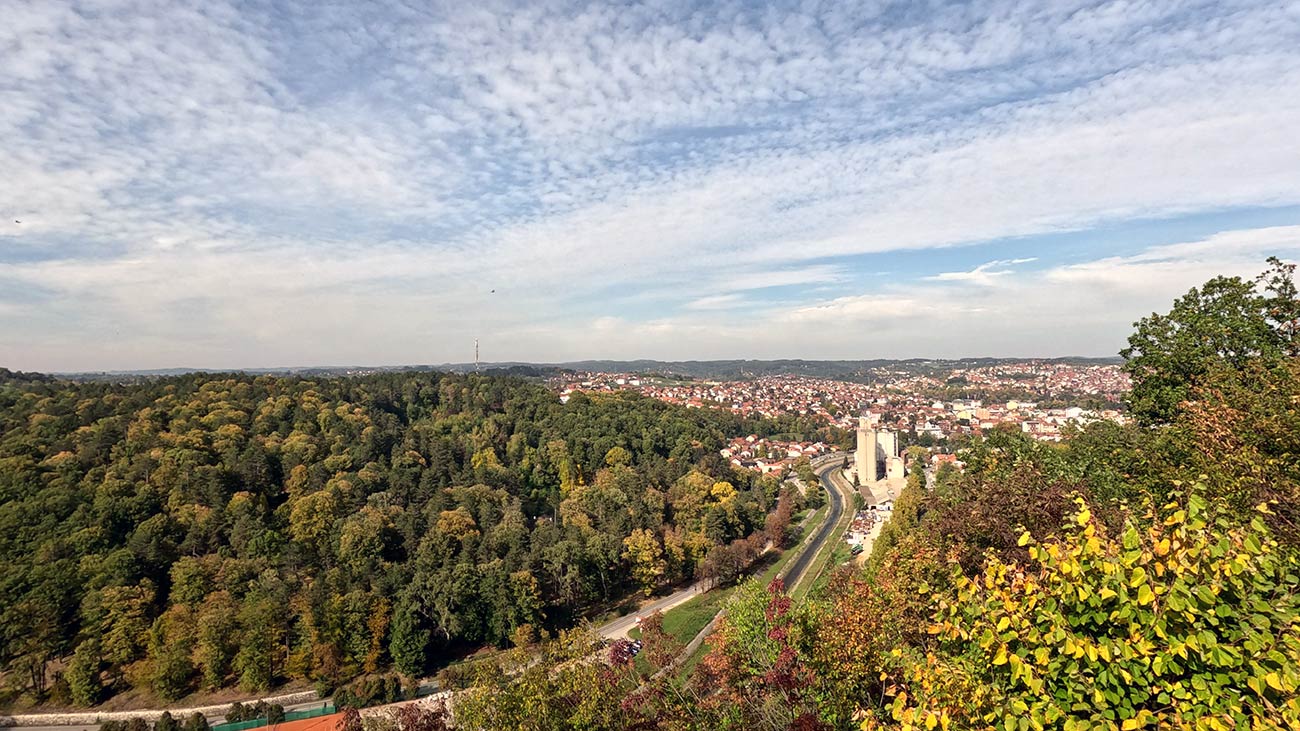
Rising above both of them is Vidrak, the forested hill that has become Valjevo’s natural balcony over itself. A network of shaded paths climbs through deciduous and coniferous woodland to several viewpoints, the most celebrated being the Pavilion lookout on the plateau known as Markova Stolica, Marko’s Chair, named for a folk legend in which the medieval hero Marko Kraljević is said to have rested here, dangling his feet in the Kolubara below as he took in the same view that visitors enjoy today. From the Pavilion, the whole of Valjevo spreads out beneath the hill, rivers, rooftops, and the green slopes beyond knitted together in a single panorama. The same hill carries a far heavier monument: a colossal sculpture by Vojin Bakić dedicated to the fighters of the Second World War resistance, modelled on the figure of Stjepan Filipović, executed by occupying forces in Valjevo in 1942 in one of the most widely reproduced acts of defiance from that conflict. Standing among the trees, the monument is one of the largest full-body figurative sculptures anywhere in the world, a quietly overwhelming presence above an otherwise gentle, wooded park.
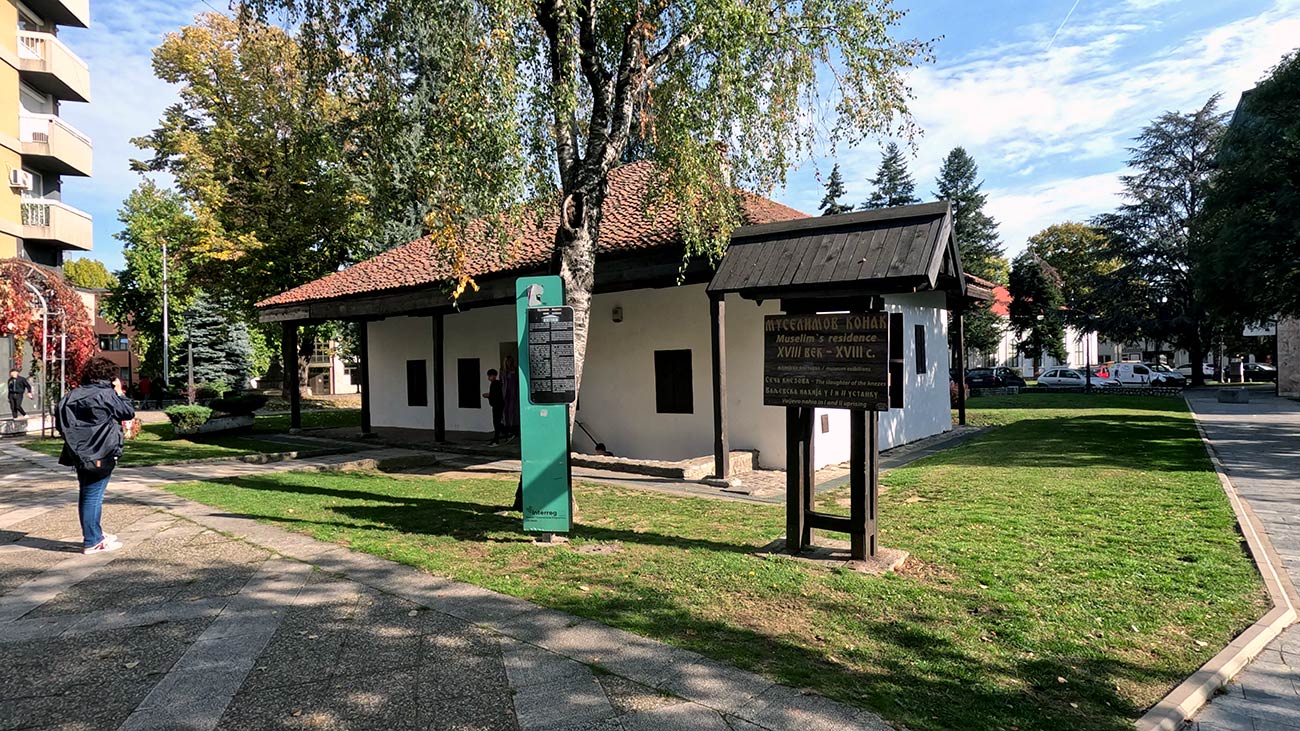
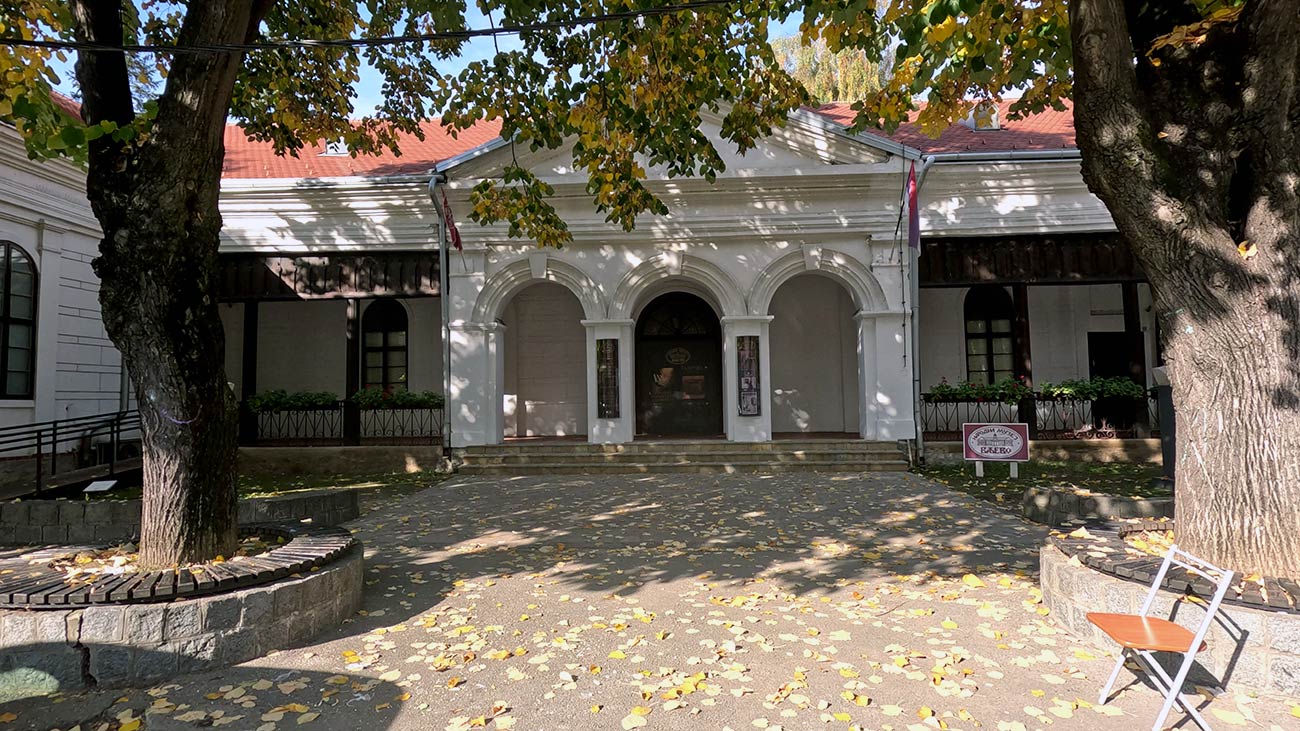
The town’s deeper layers of history are gathered in the National Museum of Valjevo (Narodni muzej Valjevo), founded in 1951 and now home to around 24,500 items spanning archaeology, ethnology, history, art, and numismatics from the wider Kolubara region. Its centrepiece permanent exhibition, The Third Dimension of the Past, a View from the Future, opened in 2007 and traces the development of Valjevo from prehistoric times through to the end of the Second World War across ten exhibition halls. The museum also maintains a sequence of historic sites around town: the Muselim’s House (Muselimov konak), the oldest surviving building in Valjevo and the site of the very first museum display here, holds in its basement the memory of the imprisoned Serbian dukes Aleksa Nenadović and Ilija Birčanin, held here before their execution on the bank of the Kolubara during the turbulent years before the First Serbian Uprising. The Nenadović Tower (Kula Nenadovića), built in 1813, has become one of the enduring symbols of the town, and together with the Muselim’s House and the central museum building, it forms a small but historically dense circuit through the town’s Ottoman and early national period.
 Useful Links
Mobility for Cyclists
The connection
The most practical connection from the EuroVelo 6 corridor is from Belgrade, where Srbija Voz runs direct regional trains to Valjevo every one to three hours throughout the day, with a journey time of around 1 hour 12 to 15 minutes. The line forms part of the longer Belgrade-Valjevo-Užice route that continues toward Montenegro, and the stretch into Valjevo itself crosses the green hill country of western Serbia. Cyclists riding the Serbian stretch of the EuroVelo 6 will find Belgrade the natural transfer point, with a comfortable frequency of departures that makes Valjevo one of the more flexible inland detours on this part of the network.
Serbian Trains
The rail network in Serbia is operated mainly by Srbija Voz, the national passenger rail operator, which runs both regional and InterCity services across the country. For much of the network, the system has historically been considerably less developed than rail networks in neighbouring central European countries, with ageing rolling stock, single-track lines, and journey times that often lag well behind road travel over the same distance. Against this backdrop, the modernised Belgrade-Novi Sad-Subotica corridor stands out as a genuine exception. Upgraded with new high-speed Soko electric trains and a parallel InterRegio service, this stretch has been transformed into one of the fastest and most reliable rail journeys anywhere in the region, with frequent departures running roughly every one-two hours throughout the day and journey times that now comfortably compete with, and often beat, the equivalent bus or car trip. Stops along this corridor include Novi Beograd, Petrovaradin (serving Novi Sad), Vrbas, Bačka Topola, and Subotica on the Soko line, with several additional stops served by the InterRegio service. Away from this modernised corridor, Serbian regional rail tends to be slower and less frequent, and for many shorter regional hops, buses remain the faster and more practical option. The Srbija Voz website and app are the main tools for checking timetables and buying tickets, and the app in particular is useful since not every station along the network, including some stops on the modernised corridor itself, has a staffed ticket counter. Tickets are normally purchased in advance through the website or app, but where no ticket counter is available at the departure station, tickets can simply be bought directly on board the train from the conductor, with no extra fee charged for doing so. This makes the system fairly forgiving for visitors unfamiliar with Serbian rail, since a missing ticket counter at a small rural station is not an obstacle to travel.
Taking your bike
Cycling support on Serbian trains follows clear rules set out by Srbija Voz, though capacity varies considerably by train type. On diesel-engine trains, bicycles are loaded through doors marked with a bicycle symbol and secured on built-in bike racks, of which there are only two per train set, located near the folding seats; bikes cannot be left in front of the wheelchair space or the toilets. On electric multiple-unit trains, bicycles are again loaded through marked doors and placed beside the folding seats near the entrance and toilets, though these carriages have no fixed racks, so the rider should stay close by to steady the bike; up to three bicycles can generally be carried if the multipurpose space is free, at the conductor’s discretion and depending on wheelchair users, prams, or large luggage already on board. The modern Soko electric trains on the upgraded Belgrade-Subotica corridor offer the most generous capacity, with dedicated bicycle space in every carriage near the luggage racks (the lower shelf folds down to free the space), allowing up to eight bicycles per train under normal conditions, again at the conductor’s discretion. On all train types, bicycles may be refused if the train is already at full capacity on a given stretch. On any other Serbian train not covered by these specific rules, and on all international services, a bicycle can still be carried as ordinary luggage if it is folded and packed so that it fits within the same compartment as its owner. Srbija Voz accepts no liability for damage or loss of bicycles carried on board. Given this patchwork of rules, the modernised Soko service remains the most reliable option for cyclists travelling with an assembled touring bike, while a folded or disassembled bike packed as luggage travels reliably on any service.
Bikes on Buses
Long-distance bus services in Serbia are extensive and, on most routes away from the main modernised rail corridor, faster and more frequent than the equivalent train journey. The network is operated by a large number of carriers, with Lasta among the largest national operators, alongside numerous regional companies such as Niš-Ekspres and Banat Trans, and the international operator FlixBus on selected routes. Bicycle transport on Serbian buses is not standardised across operators: bikes are typically carried in the luggage compartment beneath the bus when space allows, but capacity is not guaranteed, and advance reservation or direct confirmation with the specific operator is recommended, especially for an assembled touring bike. As a result, buses are best used by cyclists as a secondary, flexible option for repositioning between towns, particularly where rail connections are slow, infrequent, or simply don’t exist on a given route, while a packed or folded bike travels far more reliably as ordinary luggage than an assembled one.
Arriving at Valjevo Station
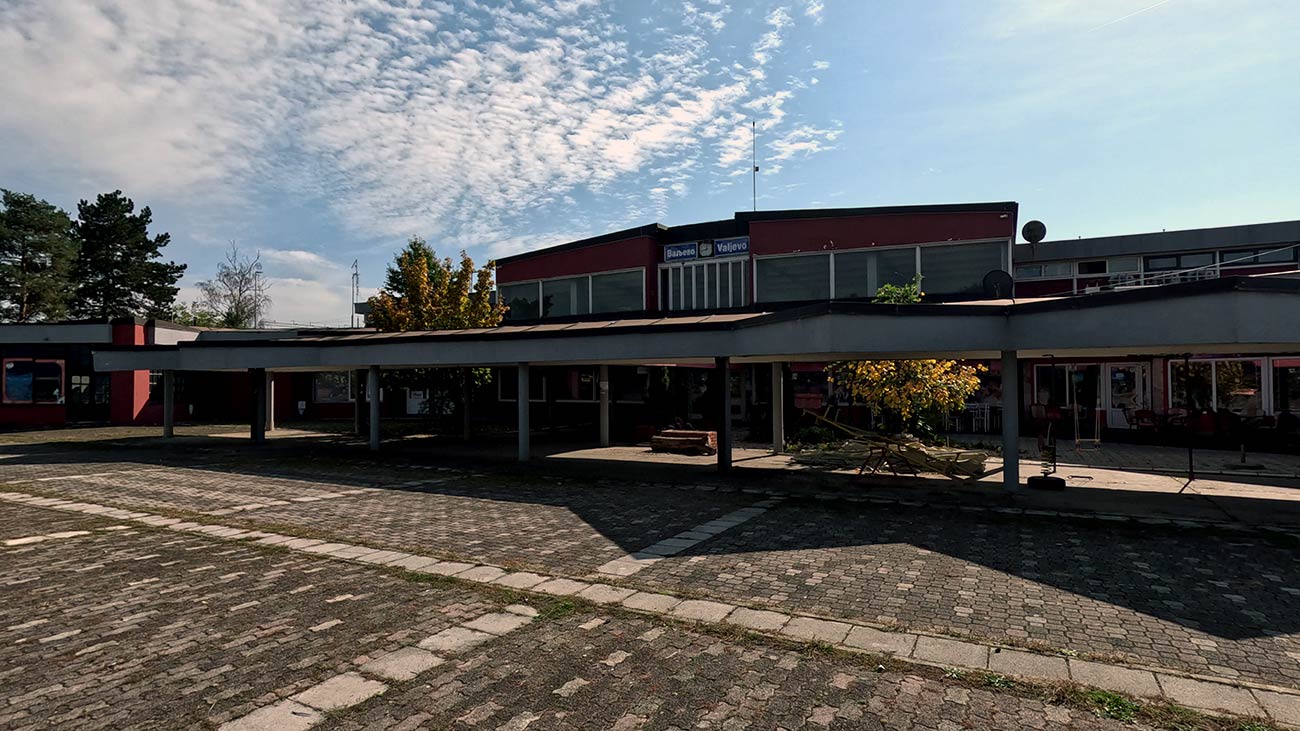
Valjevo’s railway station sits within easy reach of the town centre, with Tešnjar, the Knez Miloševa shopping street, and the National Museum all reachable on foot in around fifteen minutes along flat, well-signposted streets, or considerably faster by bike. The climb up Vidrak hill to the Pavilion and the Markova Stolica viewpoint is the one genuinely uphill stretch of the visit, manageable on foot or by bike along the marked park paths. The town centre itself, split across the two riverbanks, is compact and easy to navigate, with the old quarter and the museum sites clustered close together. Bike racks are available near the central squares and around Tešnjar. For onward travel, the same line connects back toward Belgrade and the wider Danube region, so Valjevo works equally well as a half-day excursion or as a longer overnight stop in the hills of western Serbia.