Freistadt
Reading time: 13 minutes
FREISTADT, UPPER AUSTRIA, AUSTRIA
A Walled Brewing Town on the Bohemian Border
In the hilly country of the Mühlviertel, around forty kilometres north-east of Linz and just seventeen kilometres from the Czech border, lies one of the most thoroughly preserved medieval towns in Austria. Freistadt grew up in the thirteenth century as a fortified settlement on the salt route that connected the Salzkammergut with Bohemia, and the wealth that trade brought is still visible today in its almost fully intact ring of walls, gates, towers, and moats. With around 8,000 inhabitants and a long rectangular main square at the heart of its old town, the city has kept much of the layout and rhythm of a late medieval European trading town.
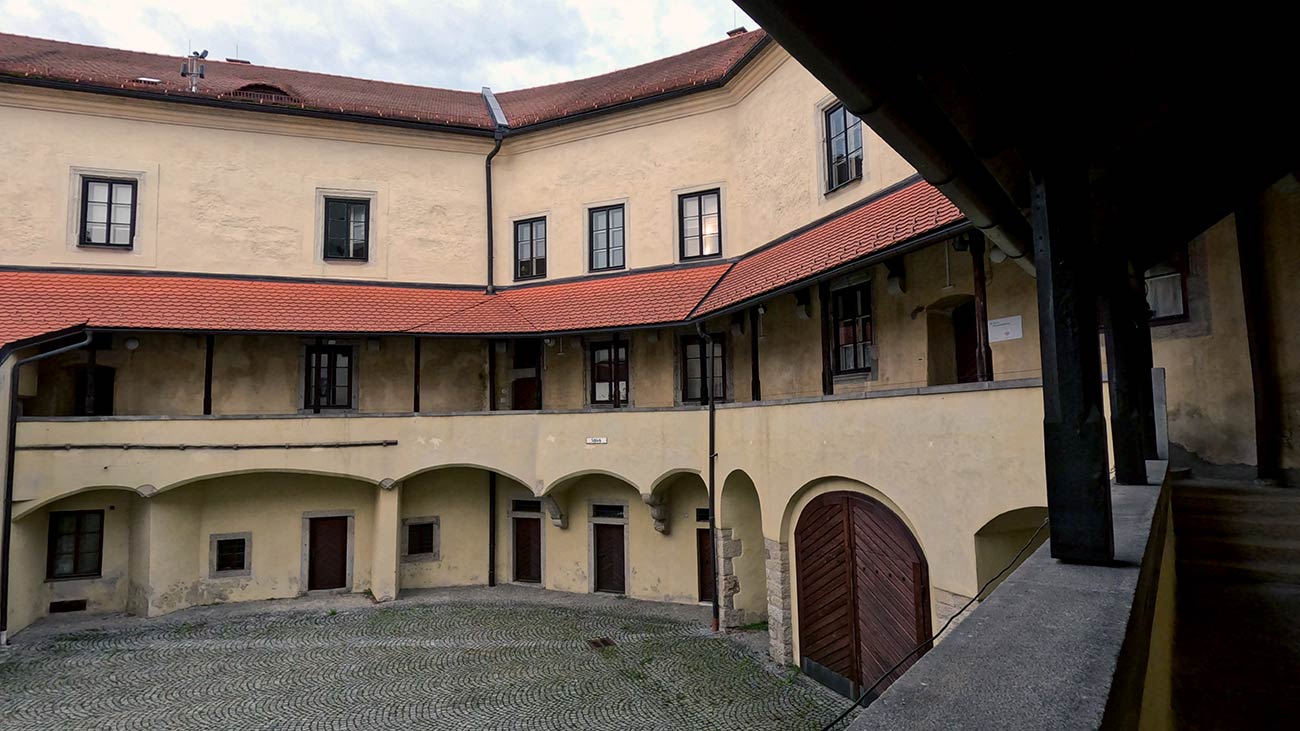
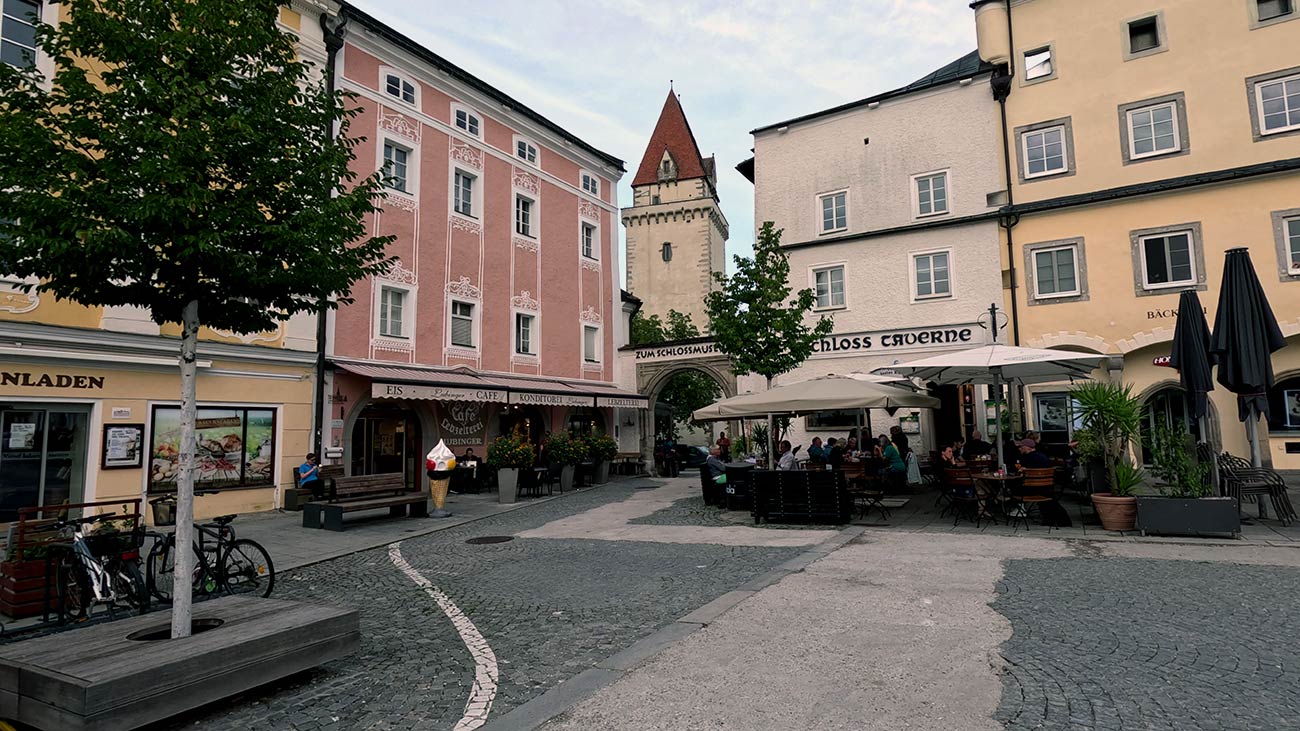
The architectural ensemble is unusually complete. Two great gate towers, the Linz Gate at the southern entrance and the Bohemian Gate at the northern one, still guard the only carriage entrances to the old centre, and the network of inner and outer walls, with their towers, embrasures, and dry moats, can be walked almost without interruption. Inside the walls, around one hundred and fifty Gothic, Renaissance, and Baroque burgher houses line the streets that radiate from the main square, the whole forming one of the most concentrated medieval urban environments in this corner of Europe. To this day, the town wears the title of Austria’s medieval brewing town, a nod to the locally beloved Freistädter beer, brewed by what is widely regarded as the world’s only fully community-owned brewery.
For cyclists exploring the Danube along the EuroVelo 6, Freistadt is a straightforward cultural detour from the Austrian stretch of the route. The town is reached by a direct ÖBB regional train from Linz on the historic Summerauer Bahn line, which runs north toward the Czech border. A day spent moving between the gate towers, the broad rectangular main square, the surviving city walls, and a quiet evening with a glass of the local beer offers a complete change of pace from the river, and a real taste of medieval Upper Austria.
Old TownBeerCastle
A Walled Old Town of Gates, Fountains, and a Quiet Church Beyond the Walls
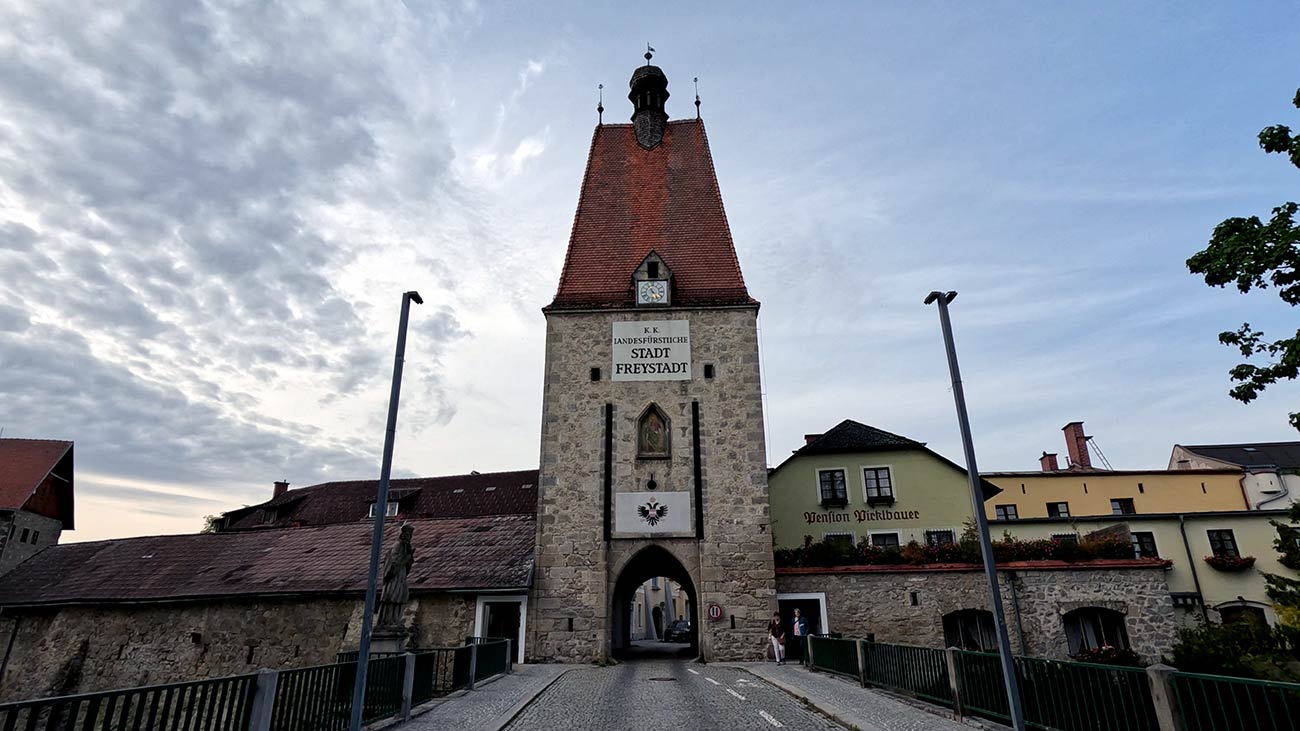
The southern entrance to the old town has been controlled for over seven hundred years by the Linz Gate (Linzertor), a 28-metre tower built in the thirteenth century and rebuilt around 1485 in late-Gothic style by the local master builder Mathes Klayndl. It is one of the largest medieval gate towers anywhere in central Europe and remains the symbol of Freistadt. The traces of the original drawbridge supports can still be seen above the carriage entrance, and the outer face carries a painted royal double eagle, a single loophole, and an image of Saint Catherine of Alexandria, the patron saint of the city, along with the older spelling of the town’s name, Freystadt. A short walk to the west, the smaller semicircular Bürgerkorps Tower (Bürgerkorpsturm, also known as Schmidingerturm) rises from the surviving line of the outer wall. Built around 1777 as part of the late phase of the fortifications, it stands roughly 13.5 metres high, with firing slits aimed across the dry moat. Since 1967 the tower has housed the Bürgerkorps, an old citizens’ defence association that gave the tower its present name, and the upper room functions today as a small art gallery, with the surrounding Zwinger, the space between the inner and outer walls, displaying parts of the city’s original hand-bored wooden water pipes recovered from the medieval moat.
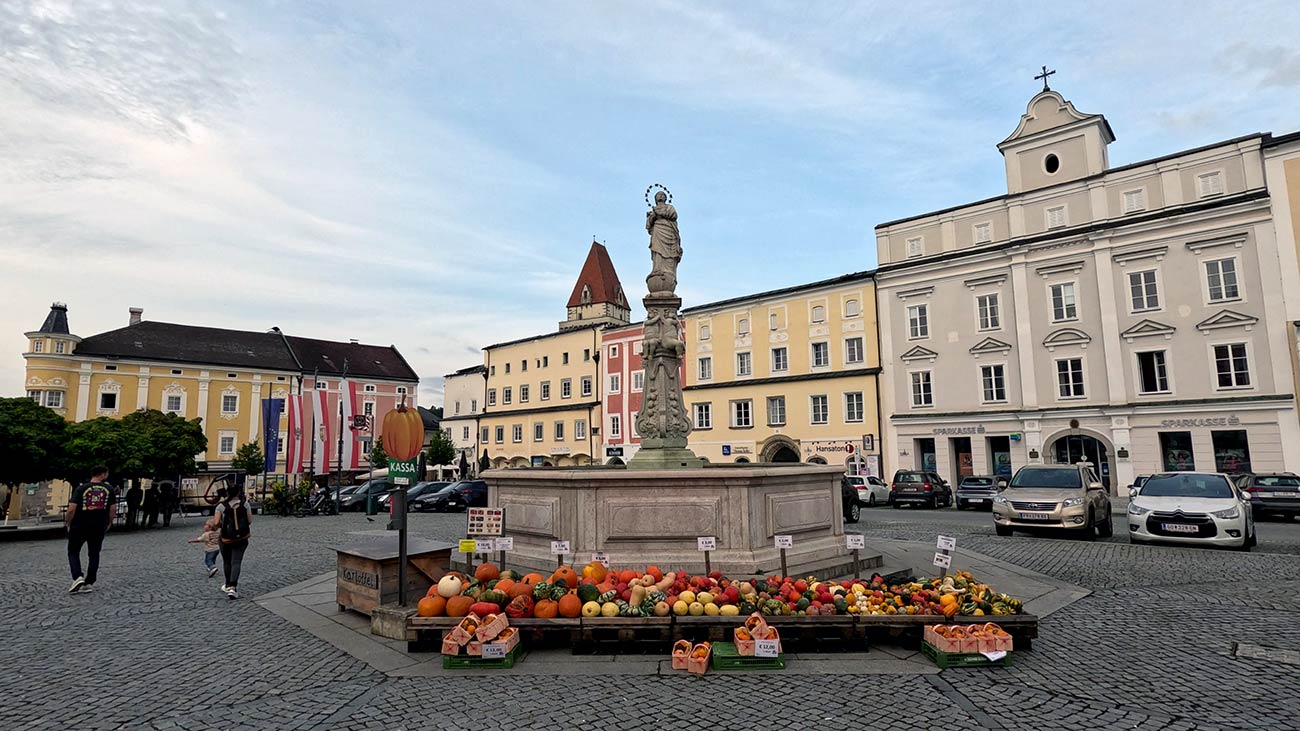
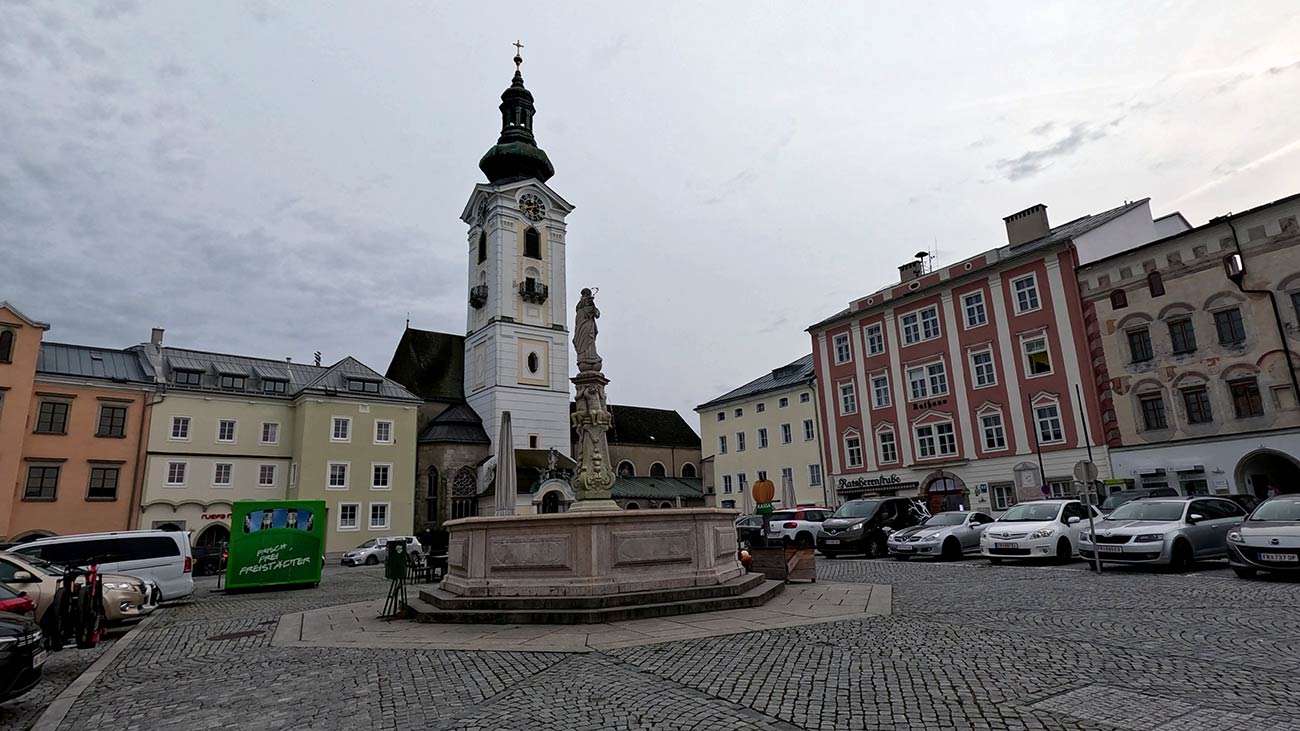
At the heart of the old town stretches the Main Square (Hauptplatz), a long rectangular space covering some 6,500 square metres and one of the largest Baroque town squares in Upper Austria. The shape and proportions go back to the original thirteenth-century layout of the town as a planned settlement, with the square placed at the intersection of the two main axes and the church set on the highest point of the urban grid. At its centre stands the Marian Fountain (Marienbrunnen), erected in 1704 as a work of the Salzburg sculptor Johann Baptist Spaz the Younger during the great Baroque transformation of the city. The fountain is a fine example of the smaller-scale provincial Baroque that flourished in this part of Austria in the early eighteenth century, with the Virgin Mary standing on a stone column above a basin that once served as one of the five public water points of the medieval town. Around the square, painted burgher houses, the former Piarist order school (now the Sparkasse building), and the exposed wall paintings of an unusually well-preserved rich merchant’s house all give the impression of a place that has been carefully tended across many centuries.
Set on the eastern side of the Main Square, the Town Hall (Rathaus) is a late-medieval and Renaissance building that was raised an extra storey in later centuries to give the structure its present proportions. It stands directly next to the rich merchant’s house with the exposed wall paintings and looks across the open square toward the Marian Fountain. The historic council chamber and other ceremonial rooms inside are still in use today as the working seat of the city administration. The original medieval town hall stood at the southern edge of the city, where the Old Town Hall Tower (Alter Rathausturm) is still part of the city wall, a robust Renaissance structure designed to defend the city as well as to govern it. That building today houses the district court, while the civic life of Freistadt has long since shifted into the lighter, taller Rathaus on the Main Square.
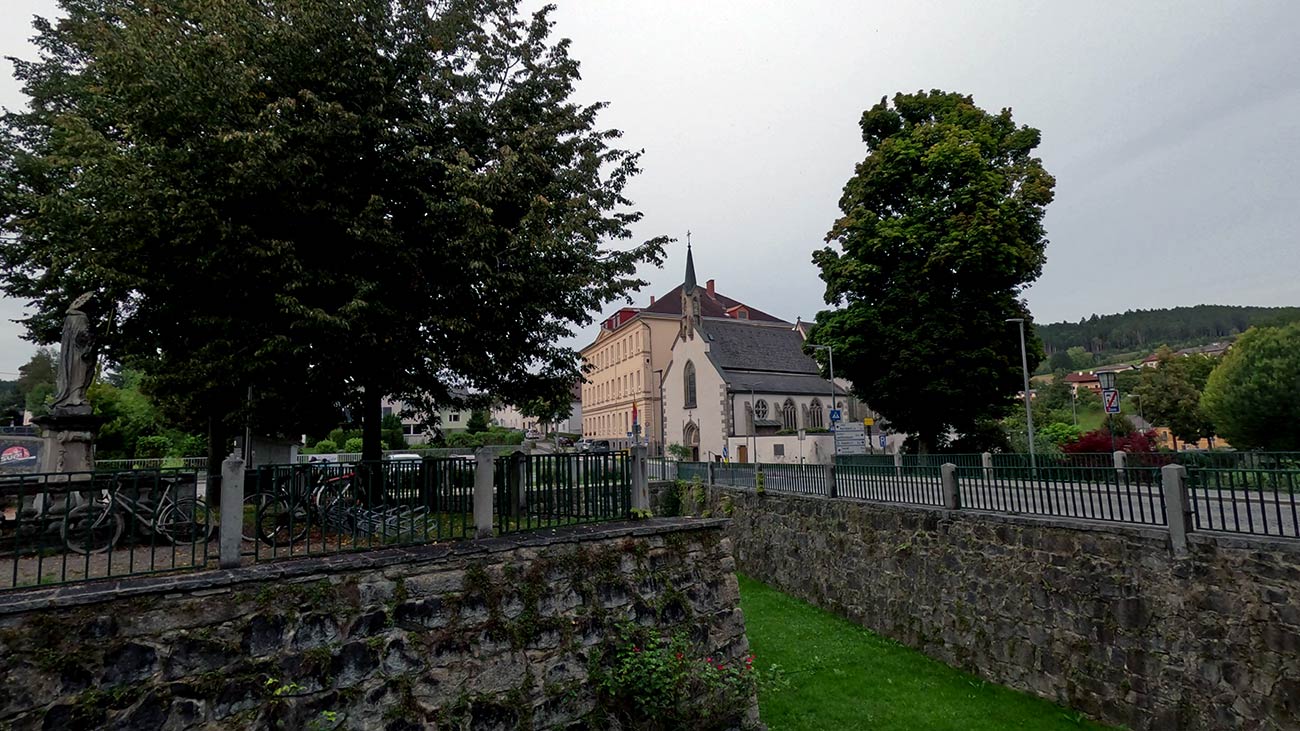
A short walk beyond the northern edge of the old town, just outside the Bohemian Gate, stands the Church of Our Lady, Maria Hilf (Liebfrauenkirche Maria Hilf), a quiet late-Gothic church with one of the longest histories in Freistadt. First mentioned in 1345 as a hospital and pilgrimage church dedicated to the Virgin Mary, the building was twice destroyed: once by fire in 1361, and again around 1422 during the Hussite Wars. The current building dates from the rebuilding that followed, with the choir completed around 1447 (a date still visible carved on one of the outer buttresses) and the nave added shortly afterwards. The church served the surrounding cemetery for centuries, until the burial ground was closed in 1855, and it is now a filial church of the main Freistadt parish. The neighbouring building, connected to the church through the sacristy, houses the School Sisters of Our Lady (Schulschwestern Unserer Lieben Frau), who continue to care for the church and run an adjoining secondary school. The setting, just outside the old walls and surrounded by the former cemetery garden, is one of the quietest and most atmospheric corners of the city.
 Useful Links
Mobility for Cyclists
Reaching the area by train with your bike
Freistadt can be reached from the EuroVelo 6 by a single direct rail journey from one of the main cities on the Danube cycle path. The town lies around 38 kilometres north of the Danube in the Mühlviertel hills, on the historic Summerauer Bahn line operated by ÖBB, the Austrian Federal Railways, which connects Linz with the Czech border at Summerau.
The connection
The most practical connection from the EuroVelo 6 corridor is from Linz, where ÖBB regional trains run directly to Freistadt Bahnhof in around one hour, with hourly departures throughout the day. The line crosses the green Mühlviertel hills toward the Czech border and is the same route that continues on to České Budějovice, making Freistadt a natural stop for travellers planning to extend their journey north into Bohemia. Cyclists riding the Danube stretch of the route will find Linz the natural transfer point, and the journey fits comfortably into a single travel day.
Austrian trains
The rail network in Austria is operated mainly by ÖBB (Österreichische Bundesbahnen), the Austrian Federal Railways, which runs most long-distance services and a large share of regional connections across the country. Alongside ÖBB, the private operator Westbahn provides competing long-distance services on the main east-west corridor between Vienna, Salzburg, and onward to Munich. Several smaller regional operators run local and feeder lines on secondary routes, but they are fully integrated into the national rail system, so transfers between operators are straightforward. The Danube region in Austria is particularly well served by rail: the main east-west line links Vienna with Krems, Linz, Wels, Salzburg, and the German border at Passau, closely paralleling the river for much of its length and forming one of the busiest and most reliable rail axes in central Europe. From the main cities along this corridor, dense networks of regional and S-Bahn lines branch out both north and south of the Danube, with frequent departures throughout the day that make inland detours easy to organise without long waiting times or complicated changes. The ÖBB app is the central tool for planning journeys, checking timetables, and purchasing tickets across all services, including both regional and long-distance trains.
Taking your bike
Austria is generally very bike-friendly when it comes to rail transport, especially on regional services operated by ÖBB, which form the core of mobility for cycle touring along the Danube and its connecting corridors. On regional and S-Bahn trains, bicycles can be taken on board for an additional fee, with no advance reservation possible and a first-come, first-served allocation of space. Bicycle tickets are sold as single trips or as affordable daily, weekly, or monthly passes, and the Klimaticket Austria annual pass includes free bicycle transport on regional trains in several federal states. On long-distance services such as Railjet, Intercity, Eurocity, and Nightjet trains, an advance reservation for the bicycle is mandatory, with the bike zones located in second-class carriages. The private operator Westbahn, which runs frequent services along the main east-west corridor between Vienna, Linz, and Salzburg, also accepts bicycles, but only with an advance reservation. Folding bikes are carried free of charge as hand luggage on both ÖBB and Westbahn trains. Overall, the Austrian system is well adapted to cycle tourism and offers a flexible combination of train and bike that makes it easy to leave the EuroVelo 6 route in either direction for short or extended detours.
Bikes on Buses
Long-distance bus services in Austria are primarily operated by FlixBus and by ÖBB-Postbus, the long-distance coach arm of the Austrian Federal Railways, complemented by a smaller number of regional and private coach operators on selected routes. The long-distance bus market in Austria is less developed than in neighbouring countries, as the wider rail network covers most of the country efficiently and many connections that would otherwise be served by intercity coaches are instead handled by train. Bicycle transport is available on certain FlixBus connections, either via external bike racks or in the luggage compartment, but it is not consistently guaranteed across the network and depends on the specific vehicle type and route configuration. Where available, bicycle transport must be reserved in advance and capacity is limited, making it less flexible compared to rail services. ÖBB-Postbus also operates seasonal bicycle and hiking buses in cooperation with regional tourism boards, designed specifically to bring cyclists and hikers to popular starting points along trails and bike paths, although these services run on selected routes only and outside the main long-distance network. As a result, buses are generally used as a secondary option for cyclists, mainly for longer-distance repositioning between major cities rather than as a core part of cycling itineraries along the Danube region. While useful in specific cases where rail connections are less convenient, they are less predictable and less standardised for bicycle transport, so advance planning is essential.
Arriving at Freistadt Bahnhof
Freistadt’s railway station is located around four kilometres south of the medieval old town, well outside the historic walls. The route into the centre is mostly flat and well signposted, taking around fifteen minutes by bike or roughly forty minutes on foot. A local city bus also runs between the station and the centre of the old town, providing a useful alternative for travellers without a bicycle. The old town itself is compact and entirely walkable, with the Linz Gate, the Main Square, the Marian Fountain, the Town Hall, and the Bürgerkorps Tower all within a five-minute walk of each other once you arrive. Bike racks are available at the station for shorter stops. For onward travel, the same line connects back toward Linz and the wider Danube region, as well as north into the Czech Republic, so Freistadt works equally well as a half-day excursion, an overnight detour, or a stepping stone for travellers continuing their journey toward Bohemia.