Neusiedl am See
Reading time: 13 minutes
NEUSIEDL AM SEE, BURGENLAND, AUSTRIA
Where the Sun Sets Over a Sea of Reeds
At the northern end of Austria's largest lake, where wide reed belts meet the open sky and the landscape stretches flat toward the Hungarian border, sits a small Burgenland town that has been welcoming bathers, sailors, and Sunday day-trippers from Vienna for nearly a hundred years. Neusiedl am See is the gateway to Lake Neusiedl (Neusiedler See), a vast, shallow steppe lake unlike anything else in central Europe. It belongs less to the cool alpine tradition that defines most Austrian lakes and more to the warm Pannonian world that begins here and rolls eastward into the great plains beyond.
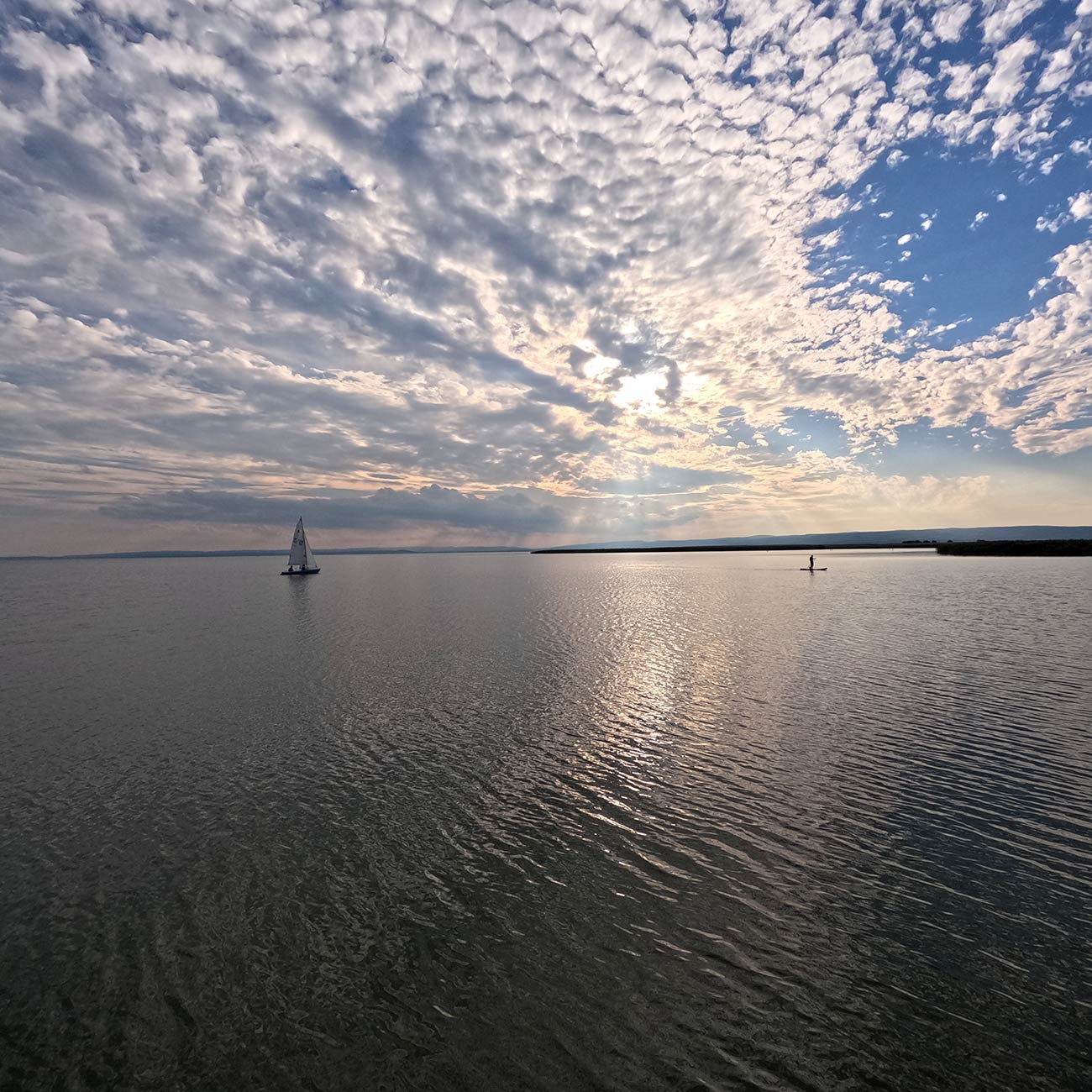
Lake Neusiedl is in many ways a place that hides its scale until you arrive. From the lakeshore promenade in Neusiedl am See, the open water stretches to a horizon that on most days fades into reeds and sky, with the southern Hungarian shore too distant to make out. Wide skies, soft breezes, and a particular evening light have shaped the town's slow rhythm for generations. The lake is also one of the warmest in Austria, with surface temperatures that allow comfortable swimming from late spring well into autumn, and a steady wind on the eastern shore that has made the region a favourite of windsurfers, kitesurfers, and sailors.
For cyclists exploring the Danube along the EuroVelo 6, the lake is a straightforward and rewarding detour from Vienna. A direct regional train brings you in around 50 minutes from Vienna Hauptbahnhof to Neusiedl am See Bad station, the small halt set close to the lake itself. From there a short ride of just a few minutes by bike along a flat, signposted path brings you to the lakeshore, the bathing beach, and the open horizon that defines the place. Few destinations on the wider EuroVelo 6 corridor offer such an immediate change of register: from the dense banks of the Danube to a warm, slow lake that feels almost like the edge of a different climate.
BeachWindLakeSunset
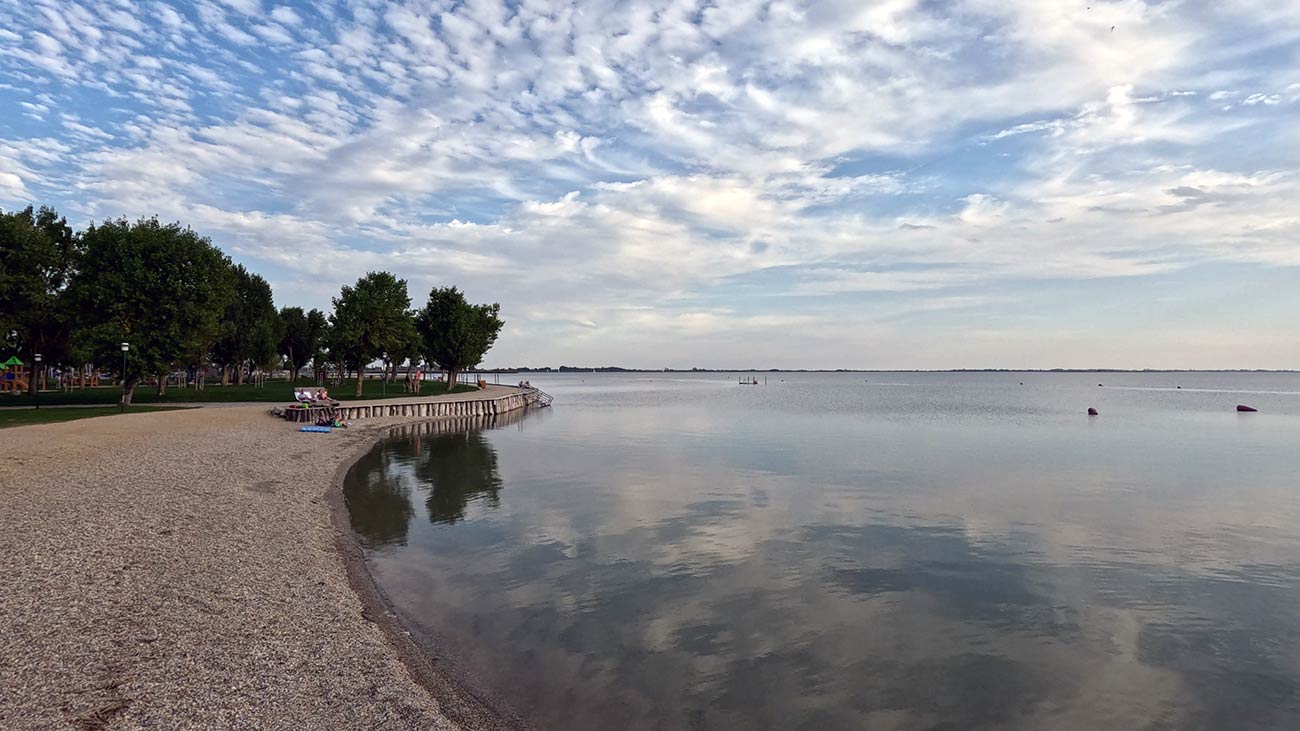
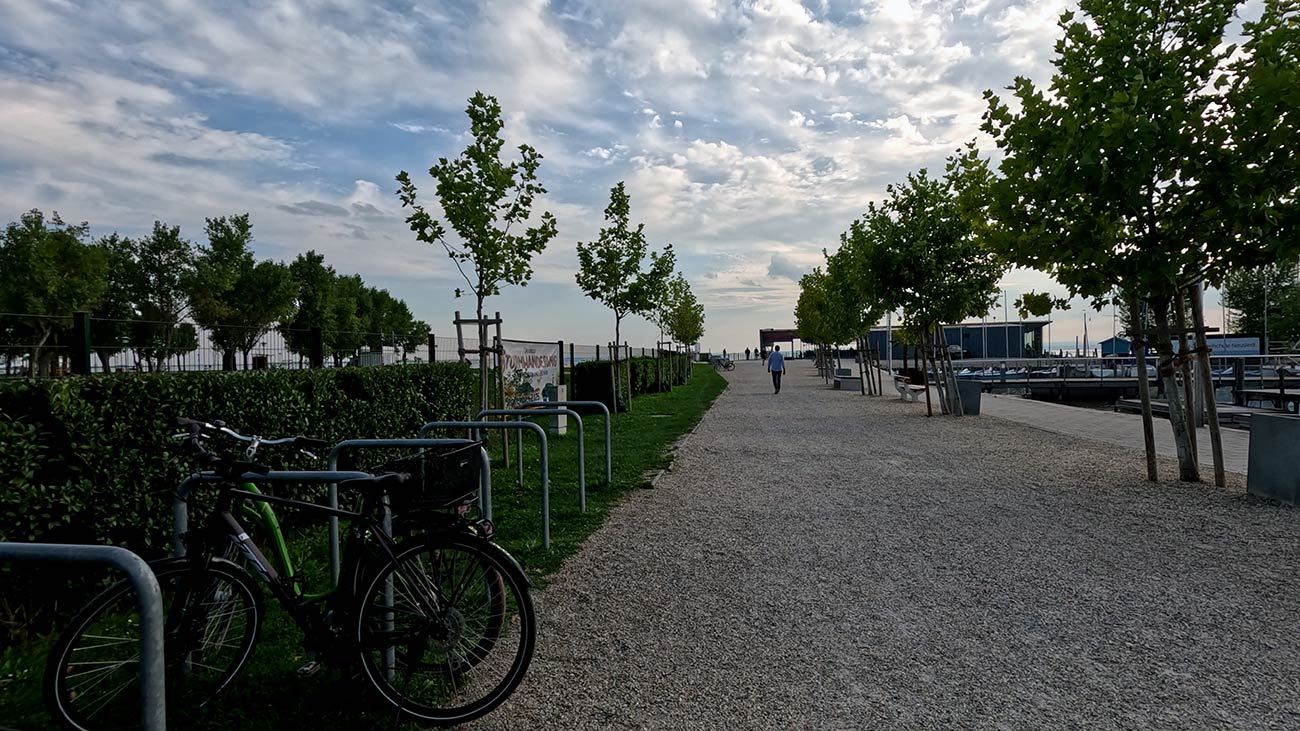
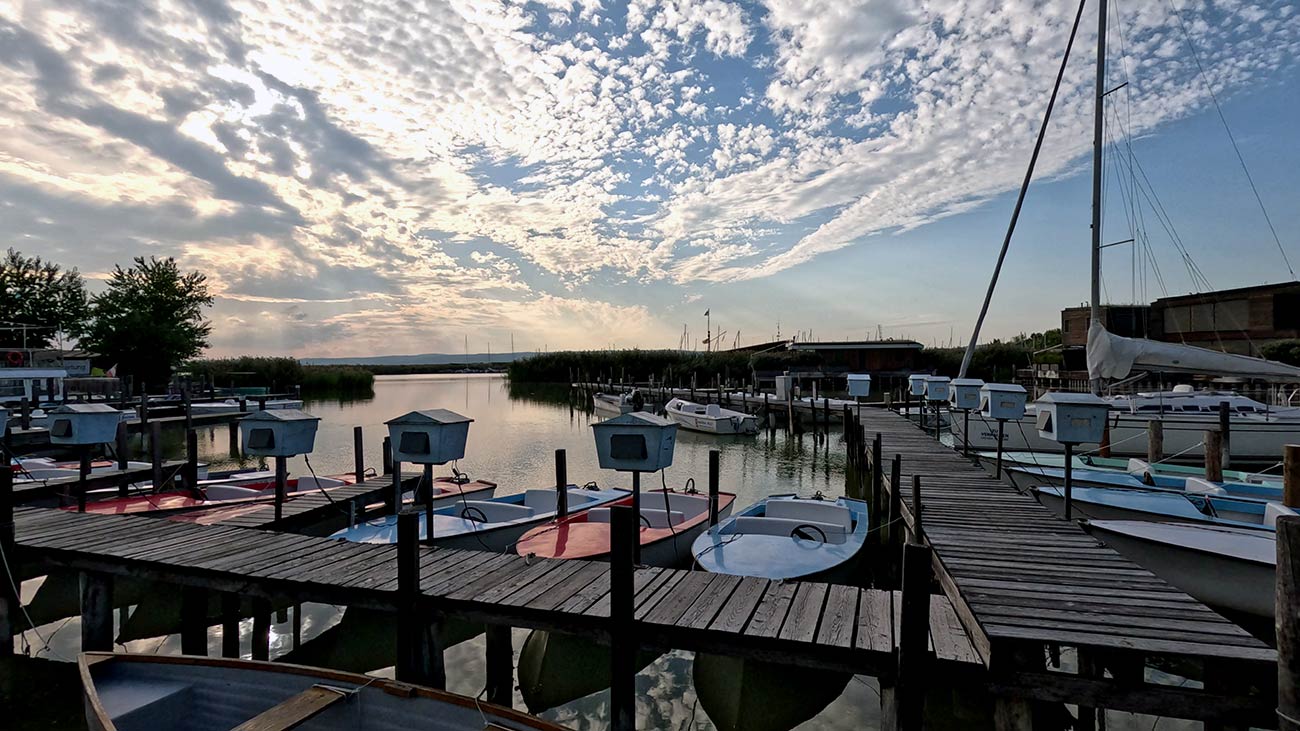
A Steppe Lake, a Bathing Beach, and the Slow Drama of Evening Light
Lake Neusiedl is one of the most unusual lakes in Europe. It is the westernmost steppe lake on the continent, a wide, exceptionally shallow body of water with an average depth of just one metre and a maximum depth of around two metres anywhere in the basin. The lake covers around 320 square kilometres, of which roughly 180 square kilometres are reed belt, the second-largest continuous reed area in Europe after the Danube Delta. The shores are home to more than 340 bird species, and the surrounding salt pans, meadows, and seasonal wetlands form part of the Neusiedler See–Seewinkel National Park, recognised together with the Hungarian Fertő by UNESCO as a World Heritage cultural landscape. Locals affectionately call the water the Cappuccino Lake (Cappuccino-See), since the constant churning of waves over the muddy lakebed gives it a milky, light-brown colour that has nothing to do with pollution and everything to do with the geology of the basin.
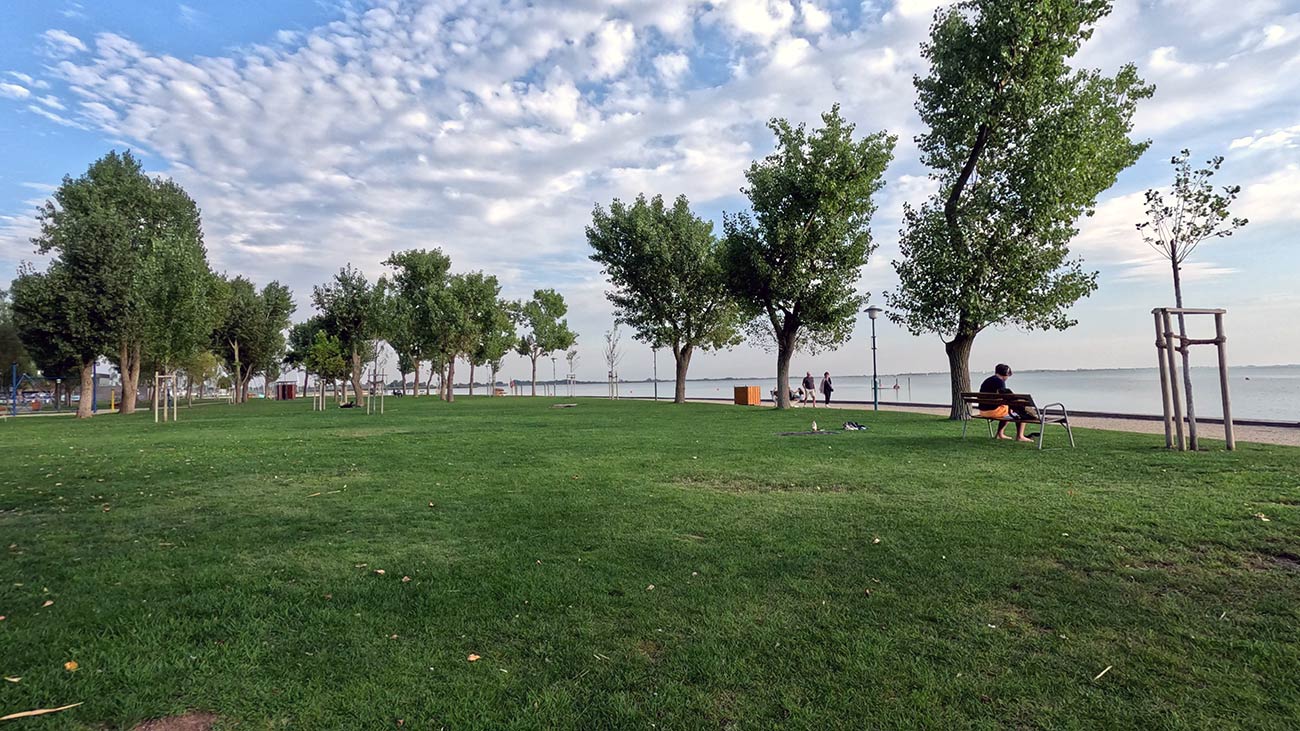
The natural anchor of any visit to the northern shore is the Bathing Beach of Neusiedl am See (Strandbad Neusiedl am See), the town's open-air bathing complex that opened all the way back in 1927 and was the very first bathing beach to be built on the lake. The site has been kept up and modernised many times since, and today it combines a long sandy and grass-covered shoreline with a generous set of family-friendly amenities. A shallow children's pool with a small water slide, large lawns for sunbathing, several beach volleyball and basketball courts, table tennis tables, and shaded areas under tall trees together make the Strandbad one of the most popular summer destinations within easy reach of Vienna. The water entry is famously gentle, the surface temperature stays warm well into early autumn, and the entire complex is run with the relaxed informality of a lakeside summer town.
The Strandbad is also the main hub of water-sports activity on the lake. A boat rental on site offers pedalos, electric boats, and stand-up paddleboards, while the small excursion boat Neptun runs short cruises across the open water. Surfers, kitesurfers, and sailors are well looked after, with a dedicated sailing school in Neusiedl am See offering courses for beginners and advanced sailors of all ages, surf storage boxes available to rent for the season, and a yacht harbour adjoining the beach with both seasonal and guest berths. For travellers who would prefer to stay dry, a long lakeside promenade and a network of flat cycle paths run in both directions from the Strandbad, connecting Neusiedl am See with the smaller villages on the lake's eastern and western shores.
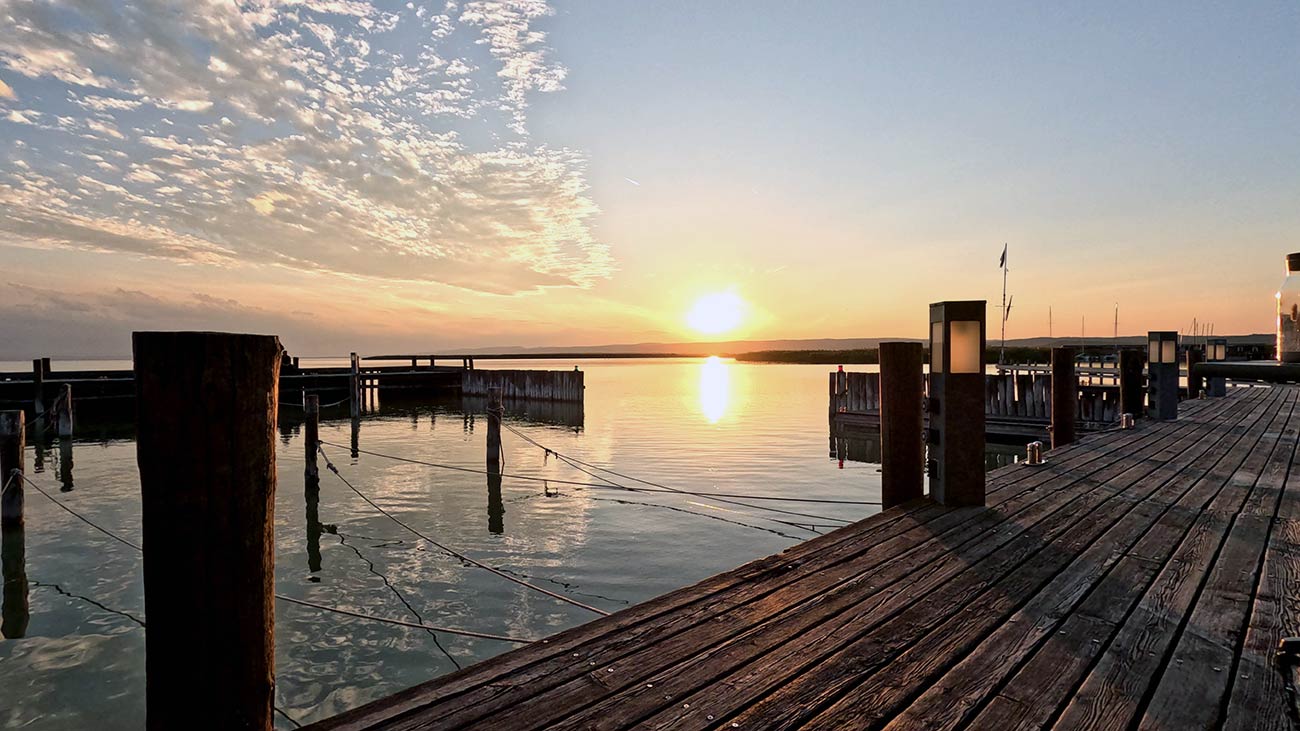
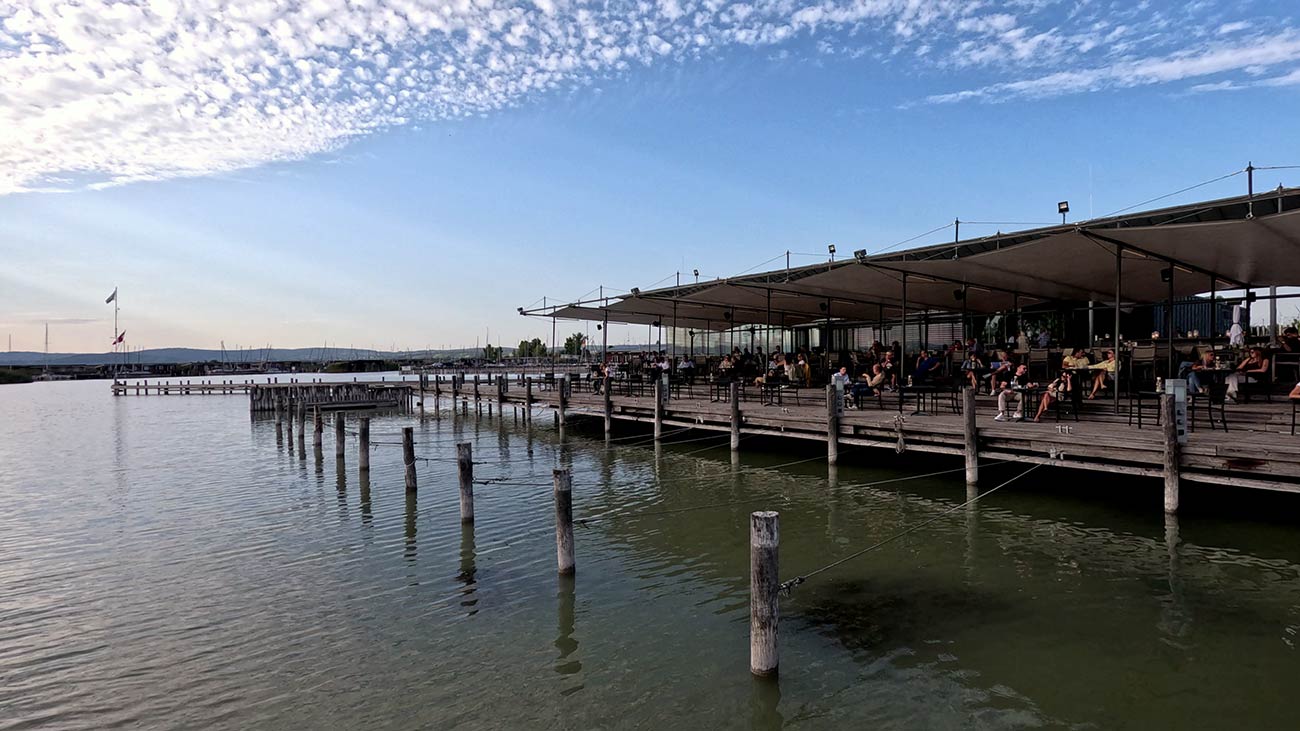
What lingers longest, however, is the light. The flatness of the surrounding landscape, the wide reed belt, and the broad open sky combine to give Lake Neusiedl a long, deliberate evening light that is unlike anything else on the EuroVelo 6 corridor. Sunset over the lake has become one of the defining experiences of the region, with the sky turning slowly through pinks, oranges, and reds, the reeds dark against the water, and the small jetties and harbour piers becoming natural viewing platforms. The lakeside restaurants around the Strandbad, including the well-known Mole West on its long timber pier, are designed almost entirely around this evening hour. After a day spent moving between the water, the sailing schools, and the cycle paths, a slow drink as the sun sets over a sea of reeds is the small ritual that most travellers remember long after the journey itself.
For travellers with extra time, the lakeshore opens out into a wider landscape worth exploring. The Neusiedler See–Seewinkel National Park, with its visitor centre in the village of Illmitz on the eastern shore, offers ranger-led birdwatching tours through salt pans and grasslands grazed by Hungarian grey cattle, Przewalski's horses, and the rare local white donkeys. The wine villages and Heuriger taverns of the surrounding Lake Neusiedl wine region lie within easy cycling distance, with the warm Pannonian climate producing distinctive whites and reds across some 14,000 hectares of vineyards. From Neusiedl am See itself, the surrounding bike paths form part of the famous Lake Neusiedl Cycle Path (Neusiedler See-Radweg), a flat 125-kilometre loop around the entire lake that crosses briefly into Hungary on its eastern stretch.
 Useful Links
Mobility for Cyclists
Reaching the area by train with your bike
Neusiedl am See can be reached from the EuroVelo 6 by a single direct rail journey from one of the main cities on the Danube cycle path. The town lies around 50 kilometres south-east of Vienna in the gentle landscape of Burgenland, on a frequent regional line operated by ÖBB, the Austrian Federal Railways, which makes the connection both quick and well served throughout the day.
The connection
The most practical connection from the EuroVelo 6 corridor is from Vienna, where ÖBB Regional Express (REX) trains run directly from Vienna Hauptbahnhof to Neusiedl am See in around 50 minutes, with hourly departures throughout the day. Cyclists riding the Danube stretch of the route will find Vienna the natural transfer point, and the journey fits comfortably into a single travel day. The trip can also be combined naturally with a stop at Esterházy Palace in Eisenstadt on a longer Burgenland itinerary, which lies on a parallel branch of the same regional network and offers a complete cultural contrast to the lakeshore.
Austrian trains
The rail network in Austria is operated mainly by ÖBB (Österreichische Bundesbahnen), the Austrian Federal Railways, which runs most long-distance services and a large share of regional connections across the country. Alongside ÖBB, the private operator Westbahn provides competing long-distance services on the main east-west corridor between Vienna, Salzburg, and onward to Munich. Several smaller regional operators run local and feeder lines on secondary routes, but they are fully integrated into the national rail system, so transfers between operators are straightforward. The Danube region in Austria is particularly well served by rail: the main east-west line links Vienna with Krems, Linz, Wels, Salzburg, and the German border at Passau, closely paralleling the river for much of its length and forming one of the busiest and most reliable rail axes in central Europe. From the main cities along this corridor, dense networks of regional and S-Bahn lines branch out both north and south of the Danube, with frequent departures throughout the day that make inland detours easy to organise without long waiting times or complicated changes. The ÖBB app is the central tool for planning journeys, checking timetables, and purchasing tickets across all services, including both regional and long-distance trains.
Taking your bike
Austria is generally very bike-friendly when it comes to rail transport, especially on regional services operated by ÖBB, which form the core of mobility for cycle touring along the Danube and its connecting corridors. On regional and S-Bahn trains, bicycles can be taken on board for an additional fee, with no advance reservation possible and a first-come, first-served allocation of space. Bicycle tickets are sold as single trips or as affordable daily, weekly, or monthly passes, and the Klimaticket Austria annual pass includes free bicycle transport on regional trains in several federal states. On long-distance services such as Railjet, Intercity, Eurocity, and Nightjet trains, an advance reservation for the bicycle is mandatory, with the bike zones located in second-class carriages. The private operator Westbahn, which runs frequent services along the main east-west corridor between Vienna, Linz, and Salzburg, also accepts bicycles, but only with an advance reservation. Folding bikes are carried free of charge as hand luggage on both ÖBB and Westbahn trains. Overall, the Austrian system is well adapted to cycle tourism and offers a flexible combination of train and bike that makes it easy to leave the EuroVelo 6 route in either direction for short or extended detours.
Bikes on Buses
Long-distance bus services in Austria are primarily operated by FlixBus and by ÖBB-Postbus, the long-distance coach arm of the Austrian Federal Railways, complemented by a smaller number of regional and private coach operators on selected routes. The long-distance bus market in Austria is less developed than in neighbouring countries, as the wider rail network covers most of the country efficiently and many connections that would otherwise be served by intercity coaches are instead handled by train. Bicycle transport is available on certain FlixBus connections, either via external bike racks or in the luggage compartment, but it is not consistently guaranteed across the network and depends on the specific vehicle type and route configuration. Where available, bicycle transport must be reserved in advance and capacity is limited, making it less flexible compared to rail services. ÖBB-Postbus also operates seasonal bicycle and hiking buses in cooperation with regional tourism boards, designed specifically to bring cyclists and hikers to popular starting points along trails and bike paths, although these services run on selected routes only and outside the main long-distance network. As a result, buses are generally used as a secondary option for cyclists, mainly for longer-distance repositioning between major cities rather than as a core part of cycling itineraries along the Danube region. While useful in specific cases where rail connections are less convenient, they are less predictable and less standardised for bicycle transport, so advance planning is essential.
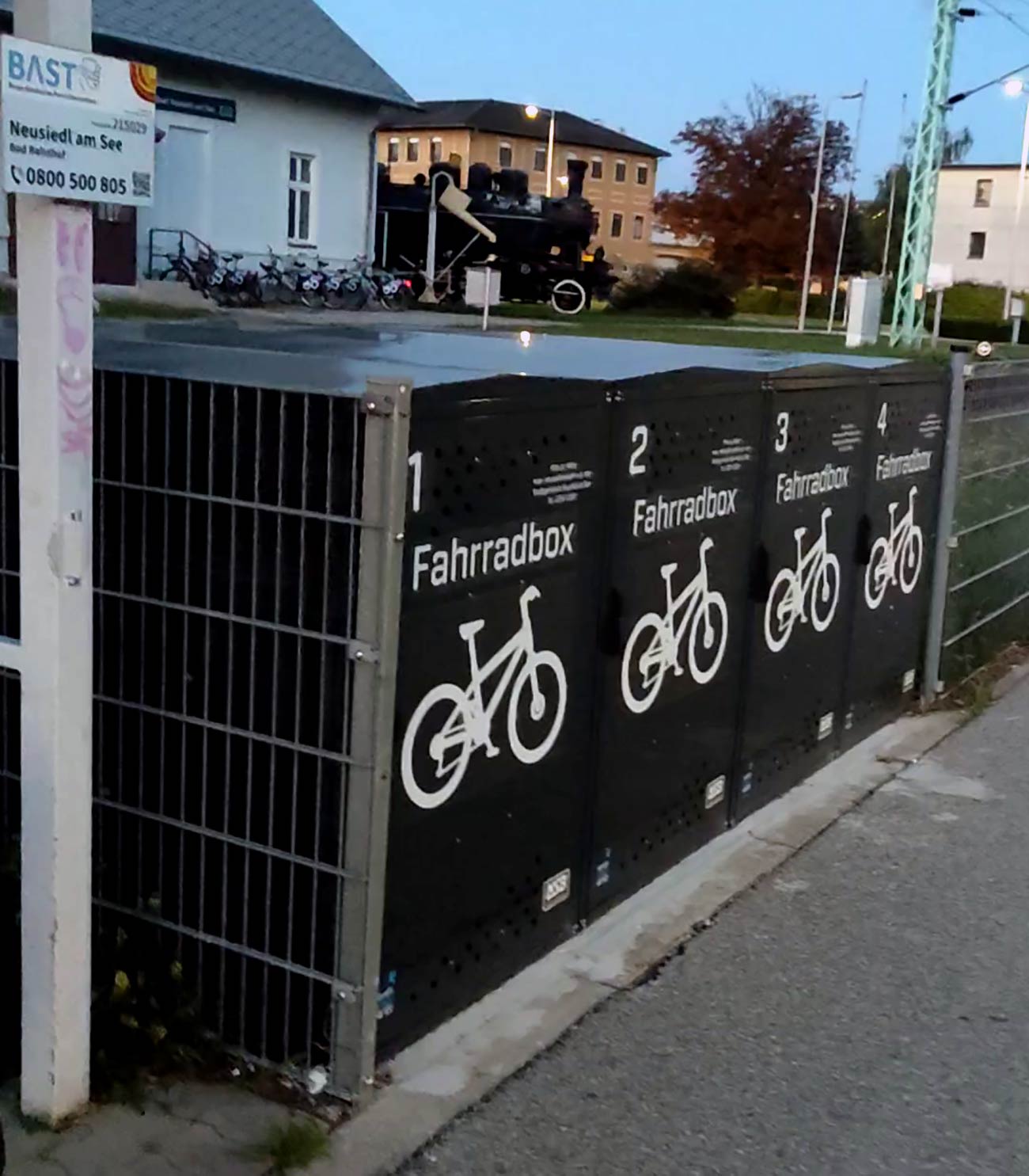
Arriving at Neusiedl am See Bad Station
The most useful arrival point for travellers heading to the lake is the small halt of Neusiedl am See Bad (Bahnhaltestelle Neusiedl am See Bad), one stop after the main town station on the short branch line that runs down to the shore. The halt sits just a few minutes by bike from the bathing beach, the lakeside promenade, and the Mole West restaurant, along flat, signposted paths through the small lakeside neighbourhoods. The terrain in and around Neusiedl am See is gentle and easy, and the wider Lake Neusiedl Cycle Path passes directly through the area, making longer rides easy to extend in either direction. Bike racks are available at both Neusiedl am See Bad and the main station for shorter stops, and a small seasonal shuttle bus runs in July and August on weekends between the main railway station, the town square, and the Strandbad for travellers without a bike. For onward travel, the same line connects back toward Vienna and the wider Danube region, so Neusiedl am See works equally well as a one-day excursion or as an overnight detour from the EuroVelo 6.