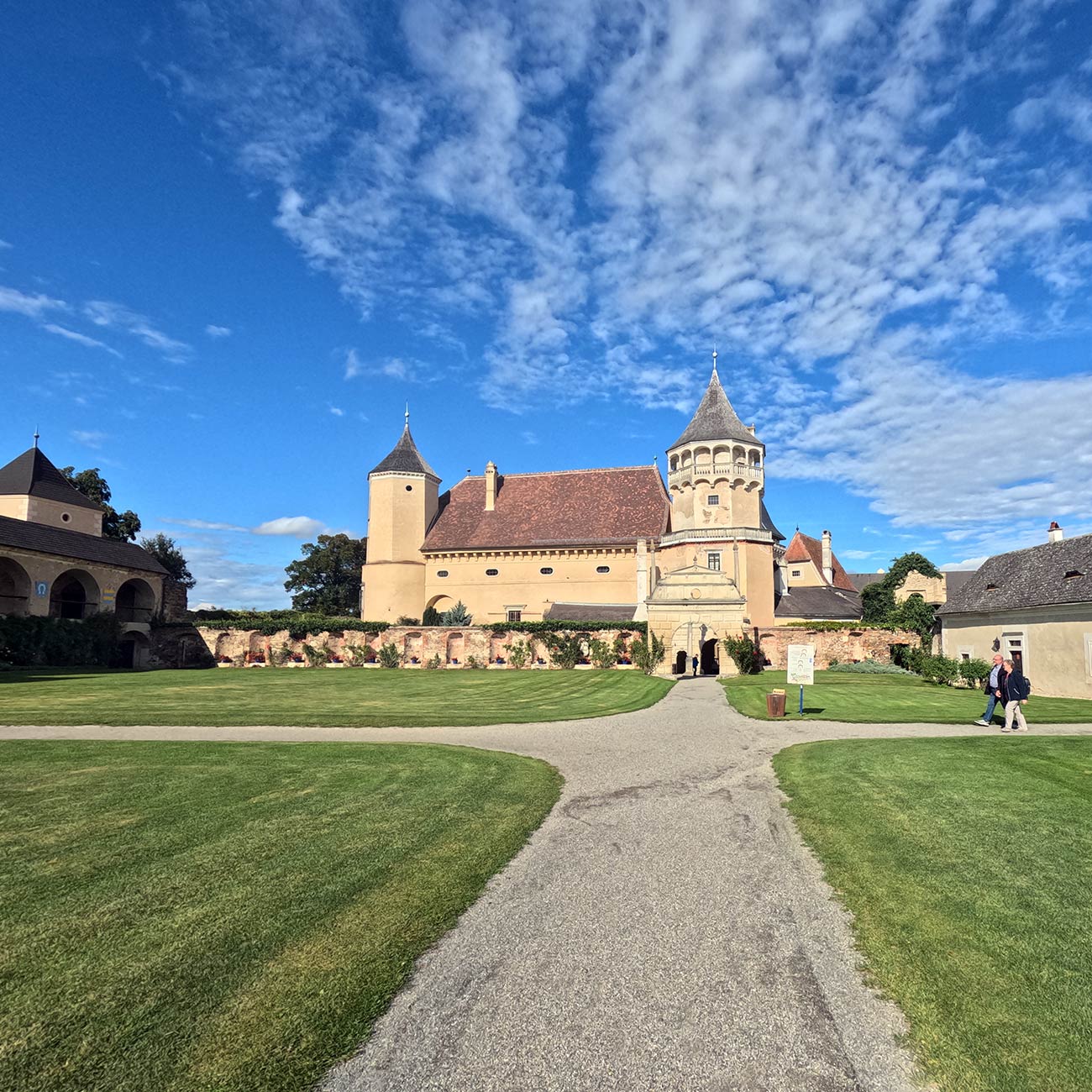
Rosenburg Castle
Reading time: 14 minutes
ROSENBURG, LOWER AUSTRIA, AUSTRIA
A Renaissance Castle Above the Wild Kamptal
In the rolling, lightly forested country of the Waldviertel, where small rivers cut quiet valleys through the granite plateau north of the Danube, lies one of the most beautifully preserved Renaissance castles in Austria. Rosenburg stands enthroned on a rock 345 metres above the Kamp Valley, its pale walls, gabled roofs, and 13 small towers rising directly out of the cliff in the middle of the Kamptal Nature Park. Seen from the cycle path along the river, the castle appears almost unannounced behind a turn in the valley, the kind of silhouette that explains immediately why it has been featured on Austrian postage stamps, banknotes, and a commemorative silver coin issued in 1999.
The story of the castle stretches back more than 800 years to a first written mention in 1175, when a knight called Gozwin de Rosenberg was recorded as the lord of the rock. The Gothic chapel and keep of his fortress still survive in the foundations of the present building, but the structure that visitors see today was largely shaped during the late fifteenth and seventeenth centuries, when successive owners transformed the medieval castle into one of the finest Renaissance complexes in central Europe. The pentagonal inner courtyard, the giant jousting yard, the ornamental gardens, and the state rooms all date from this period. The Hoyos-Sprinzenstein family has owned and cared for the castle since the seventeenth century, and 100% of the entrance fees today still go toward its preservation.
For cyclists exploring the Danube along the EuroVelo 6, Rosenburg is one of the most rewarding cultural detours from the Wachau and Krems stretch of the route. The castle lies around 50 kilometres north of Krems, on the Kamp Valley regional rail line, and is reached by a single change at Hadersdorf am Kamp. The final approach from the local railway station is a 3-kilometre climb up the road through the woods to the castle gates, where bike racks are available directly in front of the entrance for visitors arriving on two wheels.
CastleHillViewsFalconry
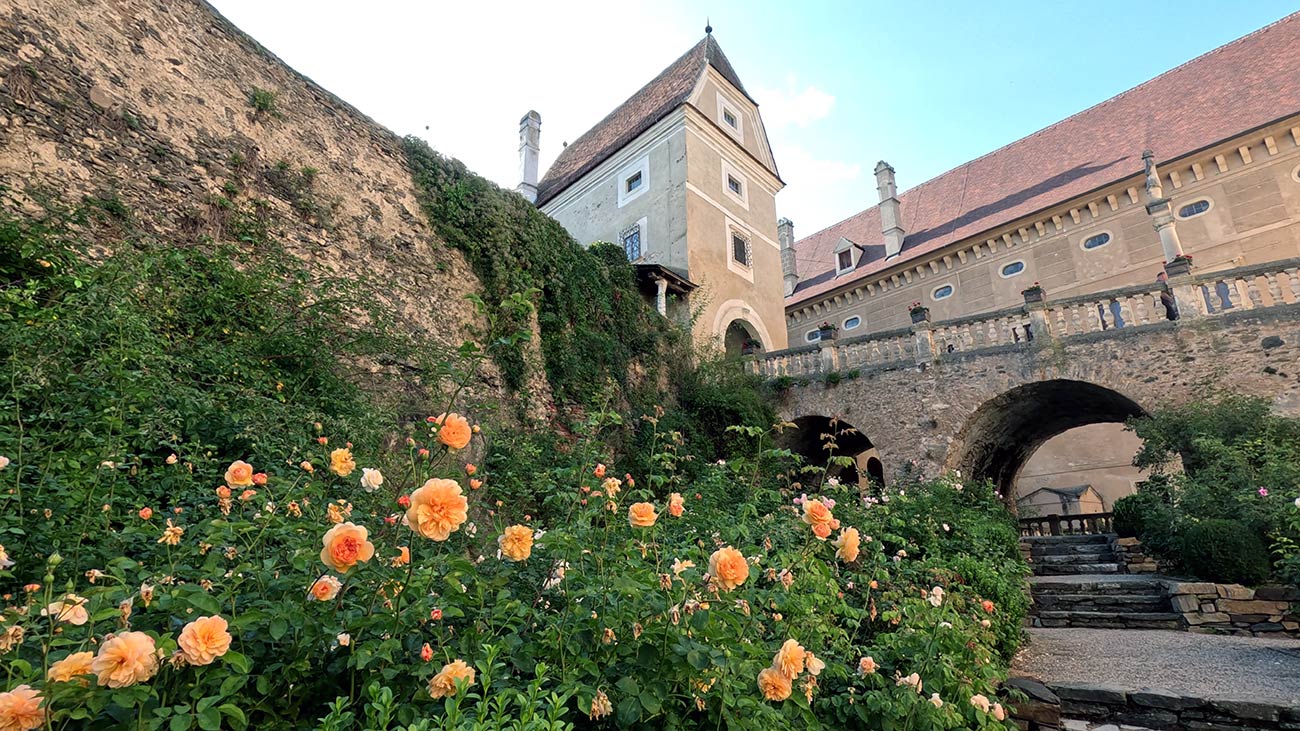
A Renaissance Castle, a Jousting Yard, and the Art of Falconry
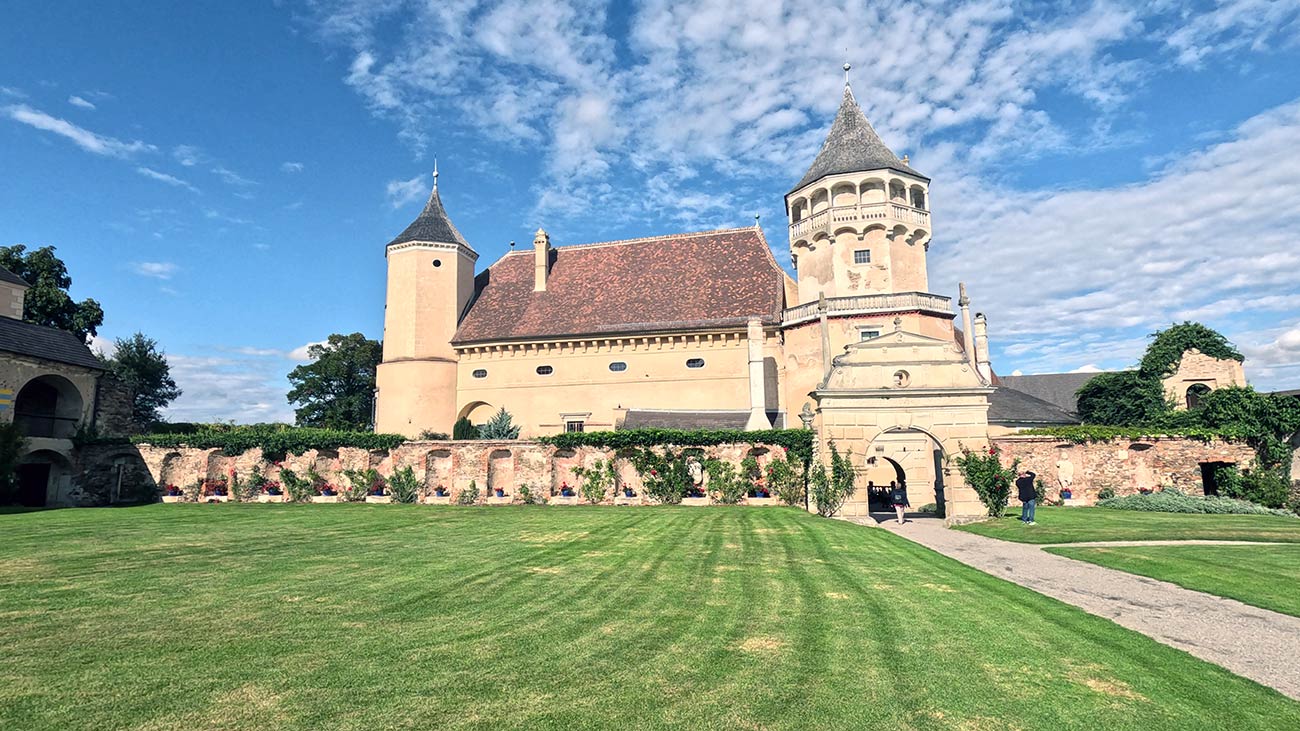
At the heart of the visit lies the Renaissance Castle Rosenburg (Renaissanceschloss Rosenburg) itself, one of the best-preserved architectural monuments of its kind in Austria. The medieval fortress on this rock was acquired in 1487 by the Grabner brothers and transformed into a Renaissance complex, and successive seventeenth-century owners, particularly Vinzenz Muschinger and Count Windhag, gave the building its present shape. The result is a pentagonal inner courtyard surrounded by 13 small towers, ornamented oriels, balconies, and a sequence of stately living quarters that can be visited as part of a guided tour. Inside, the state rooms preserve their historic furnishings, family portraits, and a library, while a separate armoury holds weapons and equipment from the fifteenth to the eighteenth centuries. After heavy damage during the 1620 siege, the castle was restored by the Hoyos-Sprinzenstein family between 1859 and 1875 using a 1673 depiction as a reference, which makes it one of the first castles in Austria to have been opened to the public.
The single most distinctive architectural feature of Rosenburg is the immense Tournament Courtyard (Turnierhof), built in the early seventeenth century under Vinzenz Muschinger as a setting for knightly jousts and ceremonial events. It is the largest surviving jousting yard anywhere in Europe, an open rectangular space bounded by arcaded loggias and viewing balconies from which the castle's noble residents and their guests once watched the tournaments below. The yard is still used today for atmospheric staged knights' tournaments and themed events through the summer season, including the spectacular Rosenburg Knight's Banquet held in midsummer. Walking the long arcades of the courtyard gives an unusually direct sense of how the castle worked as a stage for Renaissance court life, beyond its function as a residence and fortress.
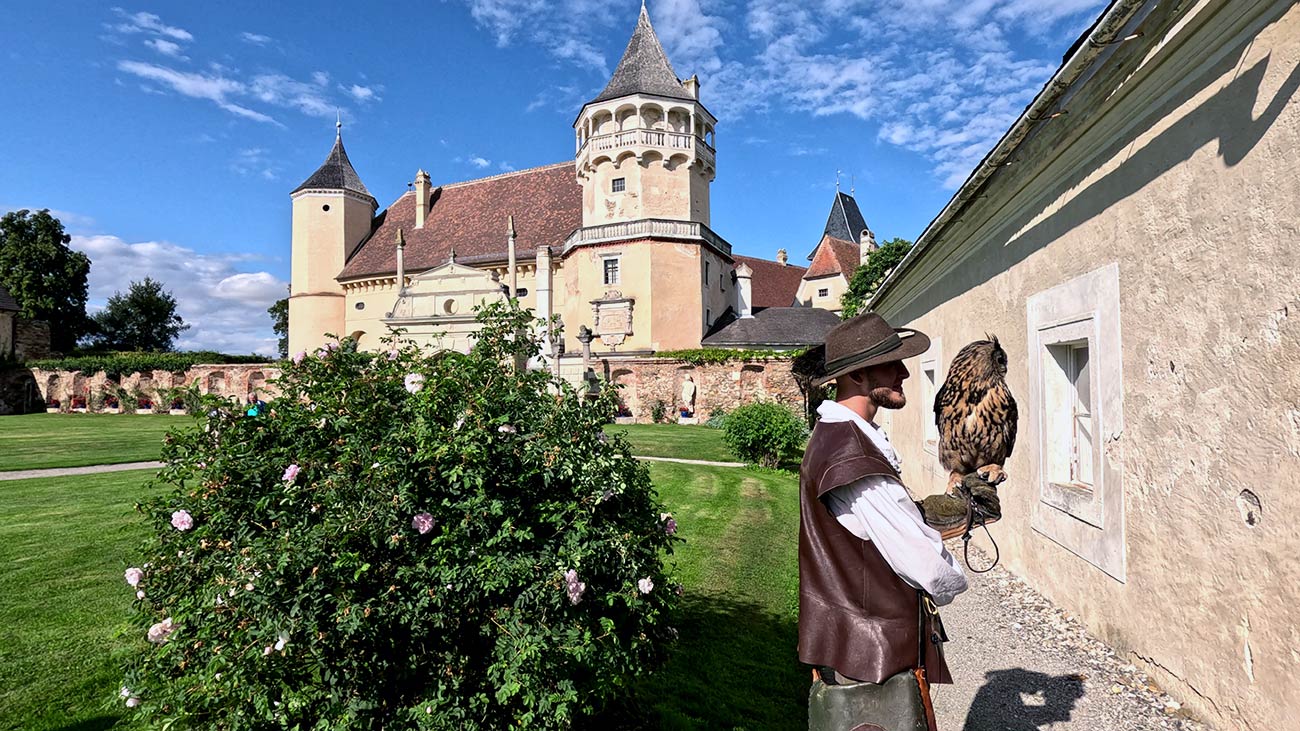
Rosenburg is one of the very few Renaissance castles in Europe that still operates a fully working Renaissance Falconry (Renaissance-Falknerei) on its original site, with daily demonstrations on a viewing terrace high above the Kamp valley. Eagles, hawks, falcons, owls, kites, and vultures take to the air from the falconer's hand and circle directly over the heads of the spectators, with informed commentary on the history of falconry, the natural behaviour of each species, and the European-wide breeding programmes that have helped preserve them. Falconry has been a UNESCO Intangible Cultural Heritage since 2012, and Rosenburg is one of the most important historic sites associated with the tradition. Demonstrations take place daily at 11 am and 3 pm during the season, with a separate dedicated Falconry Museum on the upper floor of the castle telling the broader history of falconry in Austria through stuffed birds, historical garments, photographs, and small bird-mounted videos that offer a literal bird's-eye view of the surrounding landscape.
Wrapped around the castle on its rocky outcrop lies one of the most photographed Renaissance garden compositions in Austria. The Castle Gardens include flowering terraces, herb beds, and small ornamental parterres laid out according to Renaissance ideals of symmetry and seasonal colour. The most distinctive feature is the 120-metre-long Rose Wall that runs along the upper edge of the Tournament Courtyard, which becomes the floral centrepiece of the entire complex when the climbing roses are in full bloom between late May and early July. Annual Garden Days and Rose Days during this period draw visitors from across Lower Austria, with regional artisans, traditional craft demonstrations, and culinary stalls set up among the flowerbeds. A small memorial column in the castle garden honours those who died during the 1620 siege of the castle.
Beyond the castle walls, the rocky outcrop of Rosenburg sits in the middle of the Kamptal Nature Park (Naturpark Kamptal), one of the most picturesque small-river landscapes in northern Austria. The Kamp itself winds quietly through the valley below the castle, flanked by wooded slopes, vineyards, and small medieval villages. A short walk from the castle gates lies the Rosenburg Adventure Park (Erlebnispark Rosenburg), with climbing trails and archery courses for families, while a regular programme of seasonal events at the castle includes the long-running Summer Night Comedy Festival, the medieval-themed Knights' Tournament, and a popular Christmas Market in December. The castle's own Schlossgasthof and Taverne Rosenburg offer regional cuisine made with Waldviertel ingredients, and quiet overnight accommodation is available at the Schlosshotel Rosenburg just below the castle for travellers wanting to extend the visit.
 Useful Links
Mobility for Cyclists
Reaching the area by train with your bike
Rosenburg Castle can be reached from the EuroVelo 6 by a single rail journey from one of the main cities on the Danube cycle path, followed by a short uphill ride from the local railway station. The castle lies around 50 kilometres north of the Danube in the Kamp valley of the Waldviertel, on the scenic regional Kamptalbahn railway line operated by ÖBB, the Austrian Federal Railways.
The connection
The most practical connection from the EuroVelo 6 corridor is from Krems an der Donau, where ÖBB regional trains run north into the Kamp valley with a single change at Hadersdorf am Kamp, reaching Rosenburg/Kamp Bahnhof in around one hour in total. Trains run roughly hourly throughout the day, and the journey itself is part of the experience, with the single-track Kamptalbahn following the river closely through a string of small wine villages and crossing the Kamp on several historic stone and steel-truss bridges along the way. Cyclists riding the Danube stretch of the route will find Krems the natural transfer point. For travellers who prefer to ride rather than take the train all the way, the Kamp Cycle Path (Kamp-Thaya-March-Radroute) follows the same valley and offers an alternative way to reach the castle directly from Krems by bike.
Austrian trains
The rail network in Austria is operated mainly by ÖBB (Österreichische Bundesbahnen), the Austrian Federal Railways, which runs most long-distance services and a large share of regional connections across the country. Alongside ÖBB, the private operator Westbahn provides competing long-distance services on the main east-west corridor between Vienna, Salzburg, and onward to Munich. Several smaller regional operators run local and feeder lines on secondary routes, but they are fully integrated into the national rail system, so transfers between operators are straightforward. The Danube region in Austria is particularly well served by rail: the main east-west line links Vienna with Krems, Linz, Wels, Salzburg, and the German border at Passau, closely paralleling the river for much of its length and forming one of the busiest and most reliable rail axes in central Europe. From the main cities along this corridor, dense networks of regional and S-Bahn lines branch out both north and south of the Danube, with frequent departures throughout the day that make inland detours easy to organise without long waiting times or complicated changes. The ÖBB app is the central tool for planning journeys, checking timetables, and purchasing tickets across all services, including both regional and long-distance trains.
Taking your bike
Austria is generally very bike-friendly when it comes to rail transport, especially on regional services operated by ÖBB, which form the core of mobility for cycle touring along the Danube and its connecting corridors. On regional and S-Bahn trains, bicycles can be taken on board for an additional fee, with no advance reservation possible and a first-come, first-served allocation of space. Bicycle tickets are sold as single trips or as affordable daily, weekly, or monthly passes, and the Klimaticket Austria annual pass includes free bicycle transport on regional trains in several federal states. On long-distance services such as Railjet, Intercity, Eurocity, and Nightjet trains, an advance reservation for the bicycle is mandatory, with the bike zones located in second-class carriages. The private operator Westbahn, which runs frequent services along the main east-west corridor between Vienna, Linz, and Salzburg, also accepts bicycles, but only with an advance reservation. Folding bikes are carried free of charge as hand luggage on both ÖBB and Westbahn trains. Overall, the Austrian system is well adapted to cycle tourism and offers a flexible combination of train and bike that makes it easy to leave the EuroVelo 6 route in either direction for short or extended detours.
Bikes on Buses
Long-distance bus services in Austria are primarily operated by FlixBus and by ÖBB-Postbus, the long-distance coach arm of the Austrian Federal Railways, complemented by a smaller number of regional and private coach operators on selected routes. The long-distance bus market in Austria is less developed than in neighbouring countries, as the wider rail network covers most of the country efficiently and many connections that would otherwise be served by intercity coaches are instead handled by train. Bicycle transport is available on certain FlixBus connections, either via external bike racks or in the luggage compartment, but it is not consistently guaranteed across the network and depends on the specific vehicle type and route configuration. Where available, bicycle transport must be reserved in advance and capacity is limited, making it less flexible compared to rail services. ÖBB-Postbus also operates seasonal bicycle and hiking buses in cooperation with regional tourism boards, designed specifically to bring cyclists and hikers to popular starting points along trails and bike paths, although these services run on selected routes only and outside the main long-distance network. As a result, buses are generally used as a secondary option for cyclists, mainly for longer-distance repositioning between major cities rather than as a core part of cycling itineraries along the Danube region. While useful in specific cases where rail connections are less convenient, they are less predictable and less standardised for bicycle transport, so advance planning is essential.
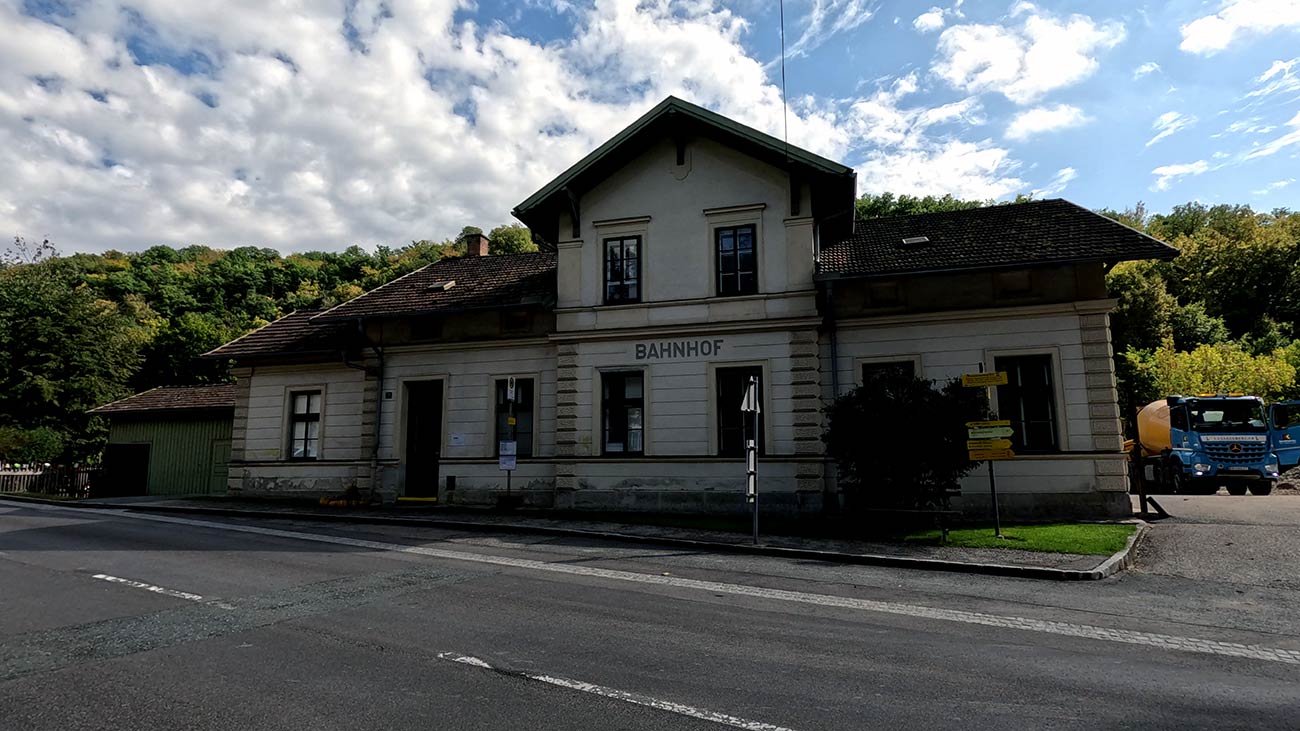
Arriving at Rosenburg/Kamp Bahnhof
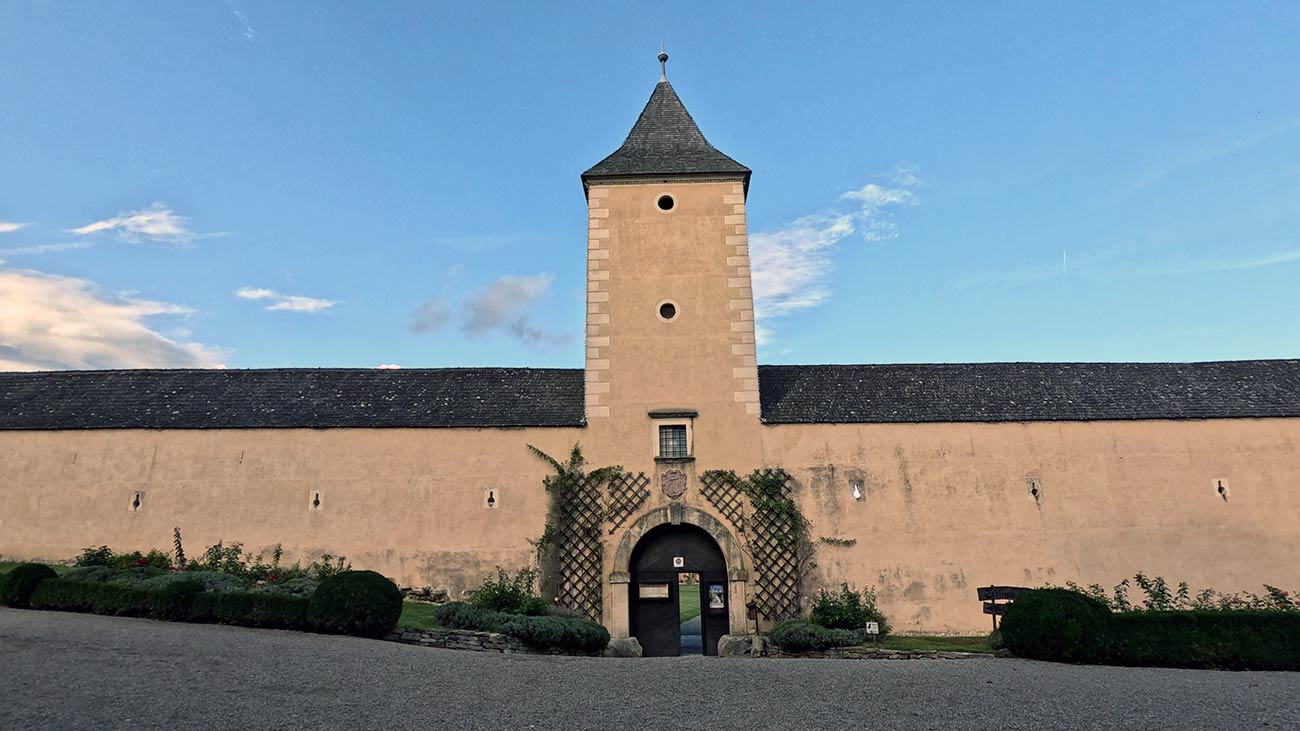
Rosenburg's small railway station sits in the valley below the castle, around three kilometres from the castle gates. The road up to the castle climbs steadily through the forest and is best ridden by sporty cyclists on lighter bikes, since the gradient becomes noticeable on the final section. Travellers with a loaded touring bike may prefer to walk the last stretch or to leave the bike at the small station for the day, although secure parking facilities at the station itself are limited. At the castle gates, bike racks are available directly in front of the entrance, where bikes can be parked safely for the duration of the visit. Once inside the castle complex, the entire site is explored on foot, and travellers can spend a full day moving between the castle museum, the falconry, the gardens, the tournament courtyard, and the Schlossgasthof restaurant before continuing back down to the station in the evening. For onward travel, the same Kamptalbahn line connects back toward Krems and the wider Danube corridor, so Rosenburg works equally well as a one-day excursion or as part of a longer overnight stay in the Waldviertel.