Schärding
Reading time: 15 minutes
SCHÄRDING, UPPER AUSTRIA, AUSTRIA
A Baroque Pearl on the River Inn
Just across the border from Bavaria, where the broad current of the River Inn forms the line between two countries, lies one of the most carefully preserved Baroque small towns in Austria. Schärding sits on the right bank of the river in the Innviertel, the upper-western corner of Upper Austria that belonged to the Electorate of Bavaria until 1779, when the Peace of Teschen transferred the whole region to the Habsburg crown. The Bavarian inheritance is still visible in almost every façade, in the gabled merchant houses and bell-shaped pediments of the Inn-Salzach building style, and in the warm pastel colours that give the town its instantly recognisable character.
The story of Schärding has been bound up with the river since the Middle Ages. Salt from the mines of Hallein and Bad Reichenhall was once shipped here on flat-bottomed Inn boats, unloaded at the quay, and brought through the water gate into the town for onward trade across central Europe. Grain, wine, and textiles followed the same route, and the wealth from this long-distance commerce shaped a town that today still feels remarkably composed for its small size, with around 5,300 inhabitants spread across a tight oval old town surrounded by surviving medieval walls and gates. Schärding celebrated its 700th anniversary recently, and the festivities only confirmed what many travellers had quietly suspected for some time: that for a town of its scale, it has one of the most photogenic old centres in Austria.
For cyclists exploring the Danube along the EuroVelo 6, Schärding is one of the most natural detours from the German stretch of the route. The town lies just 12 kilometres from Passau, and a direct regional train covers the distance in around 10 to 15 minutes. The journey is short enough to do as a half-day excursion, and the old town is small enough to be walked end to end in an hour at an unhurried pace. Three different cycle paths — the Danube Cycle Path, the Inn Cycle Path, and the historic Roman Cycle Path — also meet in the town, so the visit can easily be extended by riding back to Passau along the Inn rather than returning by train.
Silver LineOld TownInnCastle
Pastel Façades, Old Gates, and a Long River Story
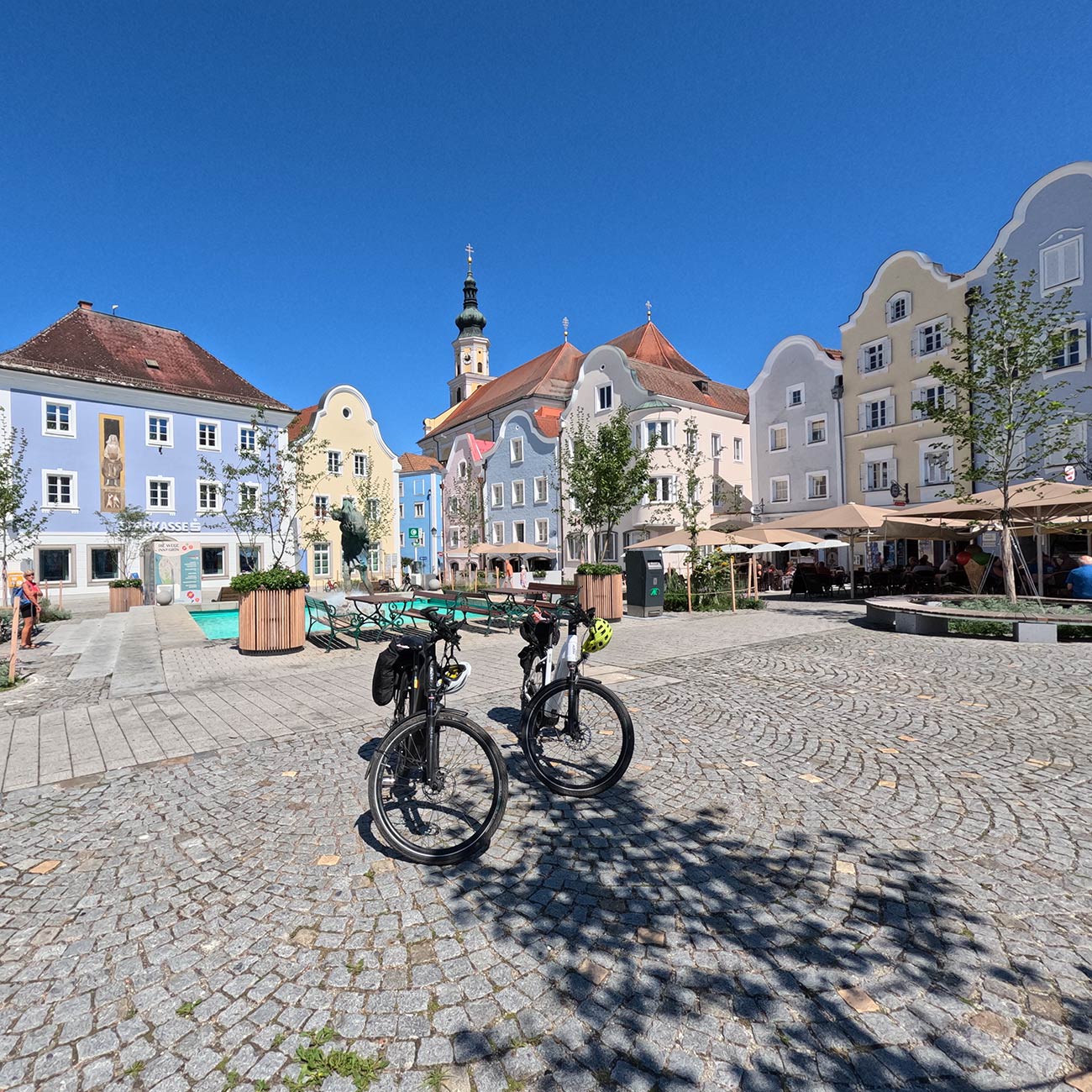
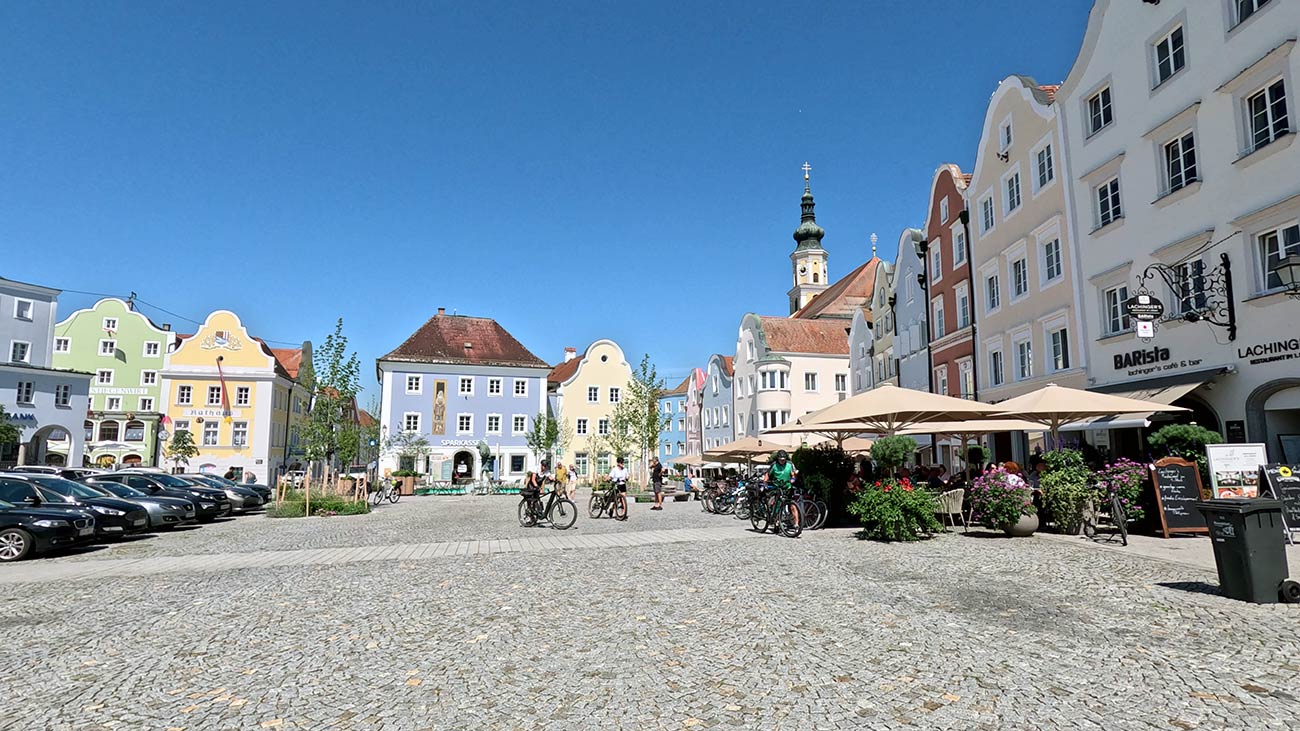
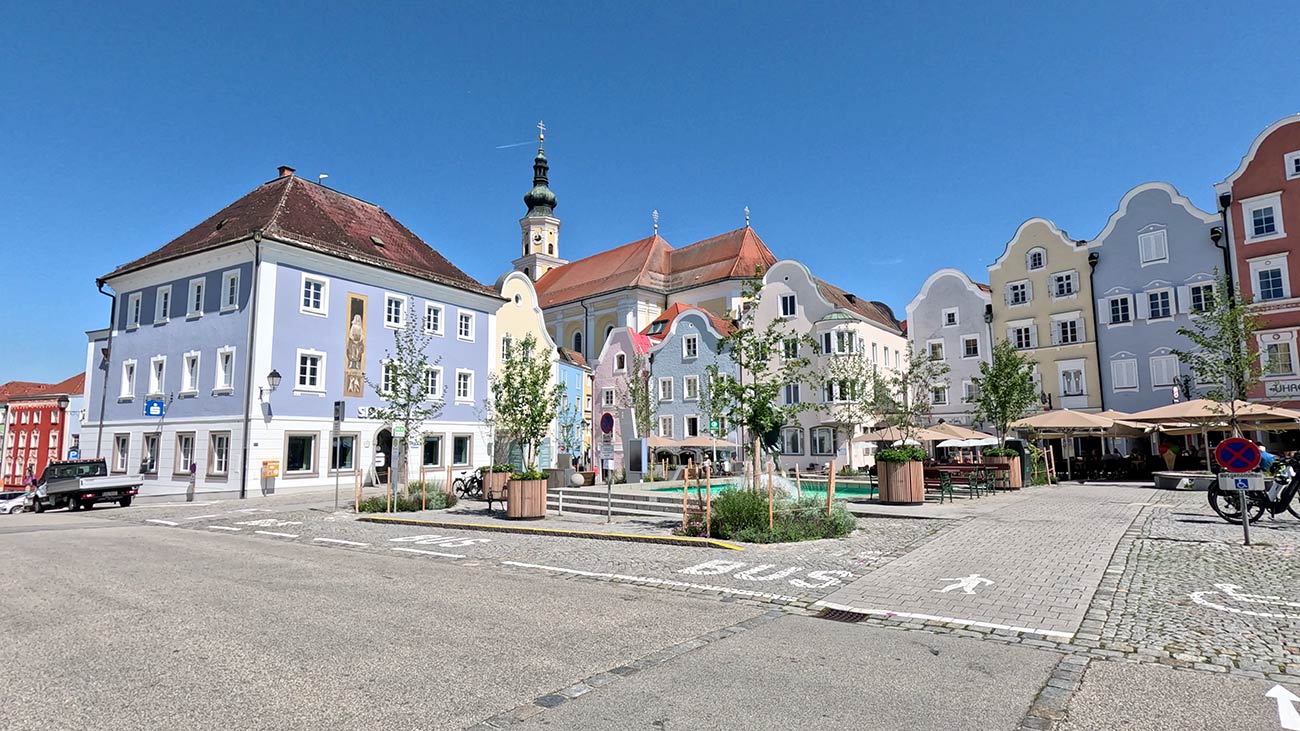
The natural starting point for any visit is the long Main Square (Stadtplatz), divided into an upper and a lower half by the central axis of the historic town. At its centre stands the Christopher Fountain (Christophorusbrunnen), a 1963 work by the sculptor Hans Wimmer, whose large basin was conceived as a symbol of the river wealth that shaped Schärding: the trade on the Inn, the energy of the Inn hydroelectric plants, and the warm and cold-water cures that became part of the town's later identity as a spa destination. The square is lined with pavement cafés, ice-cream stalls, antiques shops, and shaded benches, and serves throughout the year as the town's social and architectural centrepiece. From here, almost all of Schärding's other landmarks are within a few minutes' walk in any direction.
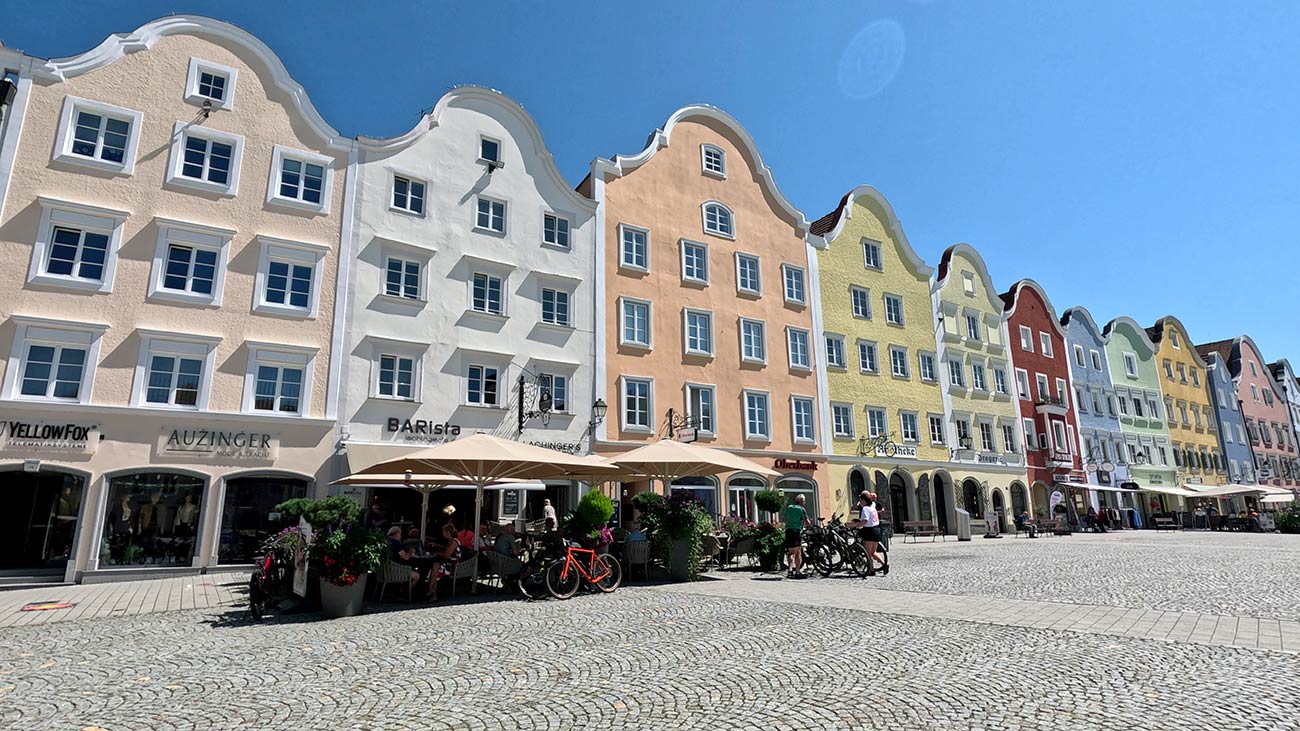
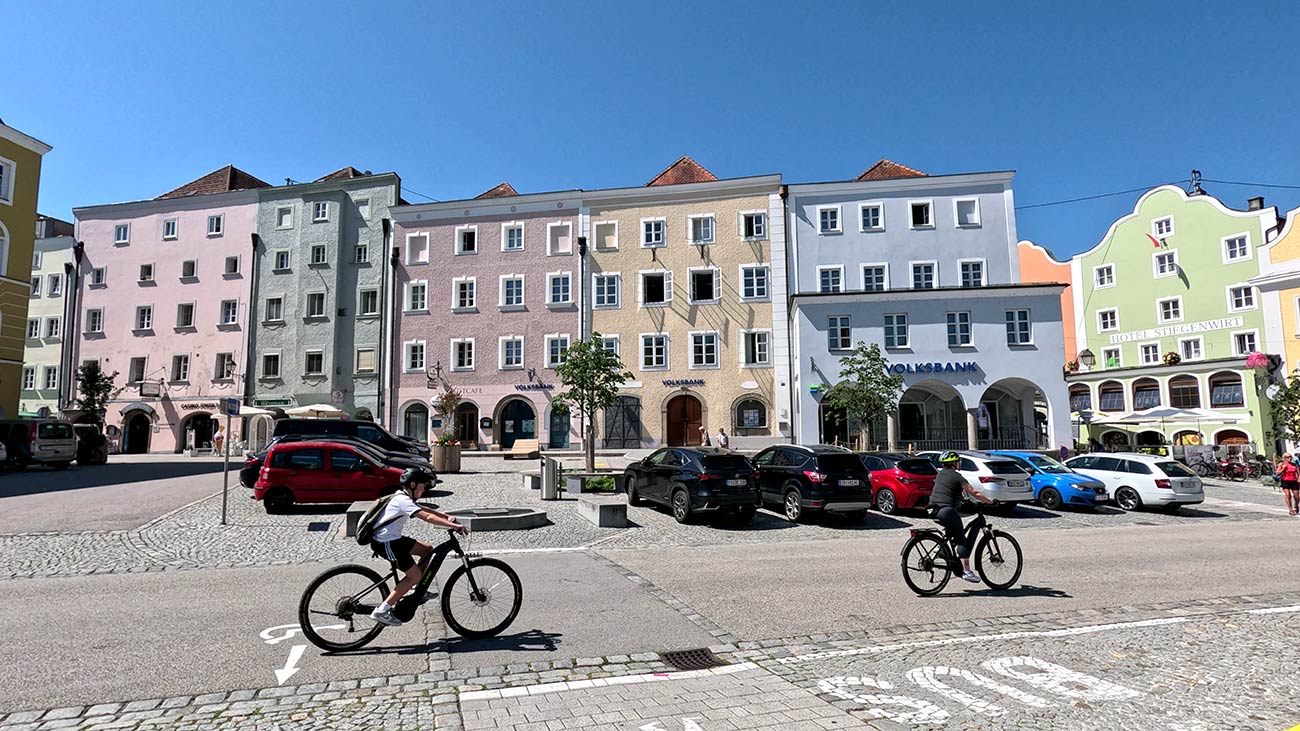
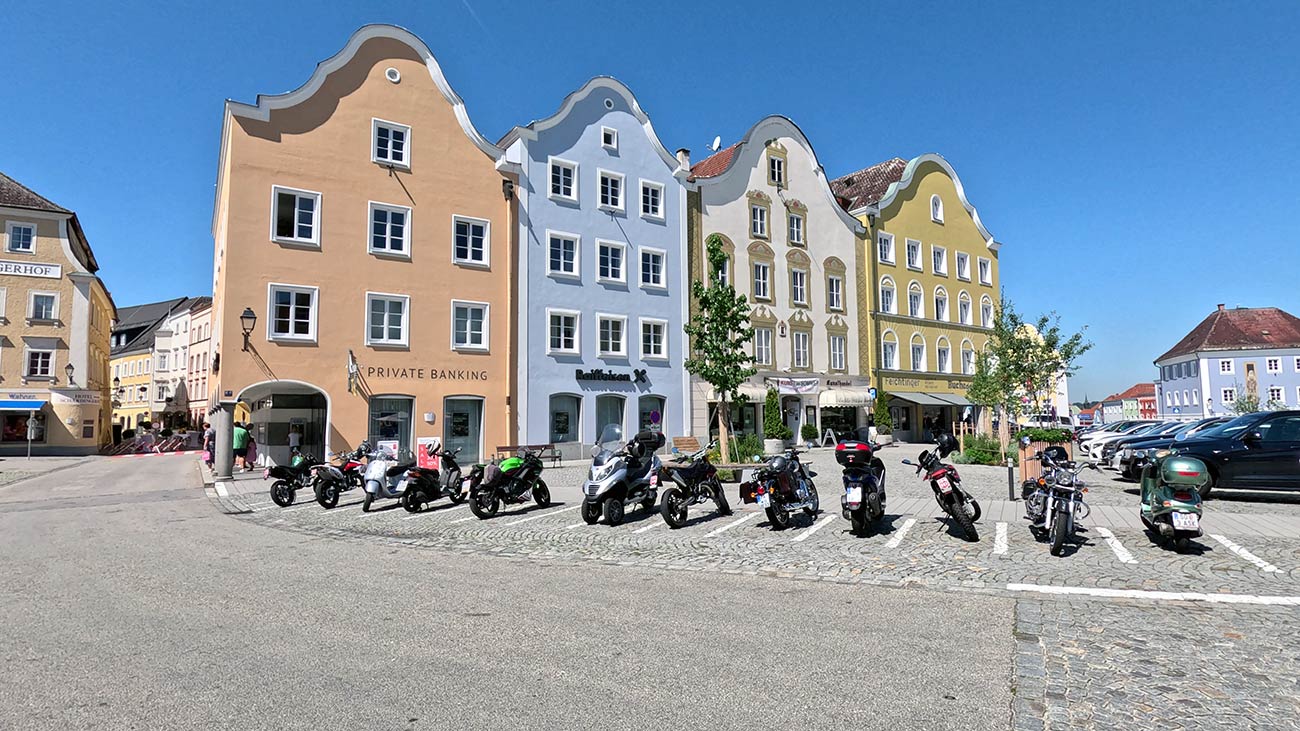
The most photographed face of the town stretches along the north-eastern side of the Upper Stadtplatz and bears its own name: the Silver Row (Silberzeile), a continuous row of 17 late-Baroque gabled houses painted in some of the most distinctive guild colours of medieval central Europe. The blue of the bakers, the red of the butchers, and the yellow and green of the innkeepers run side by side along the bell-shaped pediments, with the Schönbrunnergelb (Schönbrunn yellow) of churches and aristocratic houses adding further variations along the line. The name Silver Row comes from the silver coins that filled the pockets of the merchants who built the houses, when the Inn was still one of the most important trade routes between Bavaria and Austria. Together with the surviving city walls and several medieval city gates, the Silver Row makes Schärding one of the finest examples of the Inn-Salzach Baroque style anywhere in the region.
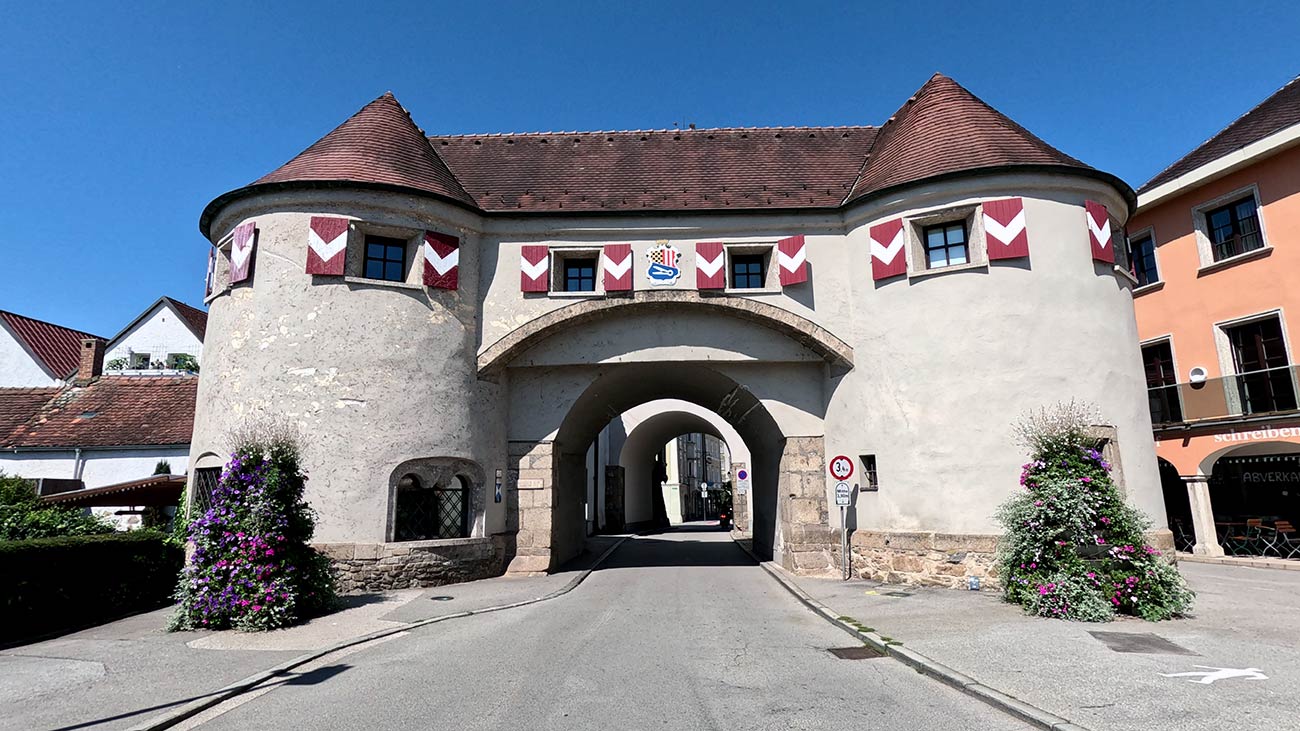
The eastern entrance into the old town is guarded by the Linz Gate (Linzer Tor), the former upper town tower at the head of the road to Linz. Its distinctive double portals stretch across the street, with a covered guard's walkway above them, and a small chamber that once housed the town warder who controlled access to the square beyond. The pastel-painted façade and the elegant onion turret give the gate its characteristic silhouette, and its central archway frames one of the most photographed views in Schärding, looking straight into the Silver Row from outside the walls. Together with the Passau Gate (Passauer Tor) on the opposite side of the old town, the Linz Gate marks the historic axis along which travellers and goods once moved between the river and the inland trading routes.
A short walk downhill from the Stadtplatz, the western edge of the old town reaches the river itself through the Water Gate (Wassertor), a narrow tunnel that runs beneath one of the riverfront houses and opens directly onto the quay along the Inn. The gate was formerly known as the Inn Gate or the Customs Tower (Zollturm), because every load of salt, grain, and merchandise arriving by boat on the river had to be brought through this passage and assessed for customs before being allowed into the town. The exterior carries a Baroque fresco that depicts the cannonade of Schärding in 1703 during the War of the Spanish Succession, when the town was heavily bombarded by Bavarian troops, and the inner walls are marked with the levels of past floods along the Inn, some of which reach more than two metres above the cobbles. The neighbouring Granite Museum (Granitmuseum), open from spring to autumn with free admission, displays sculptures and historical objects relating to the local Schärdinger granite, including a detailed reconstruction model of the medieval Schärding castle.
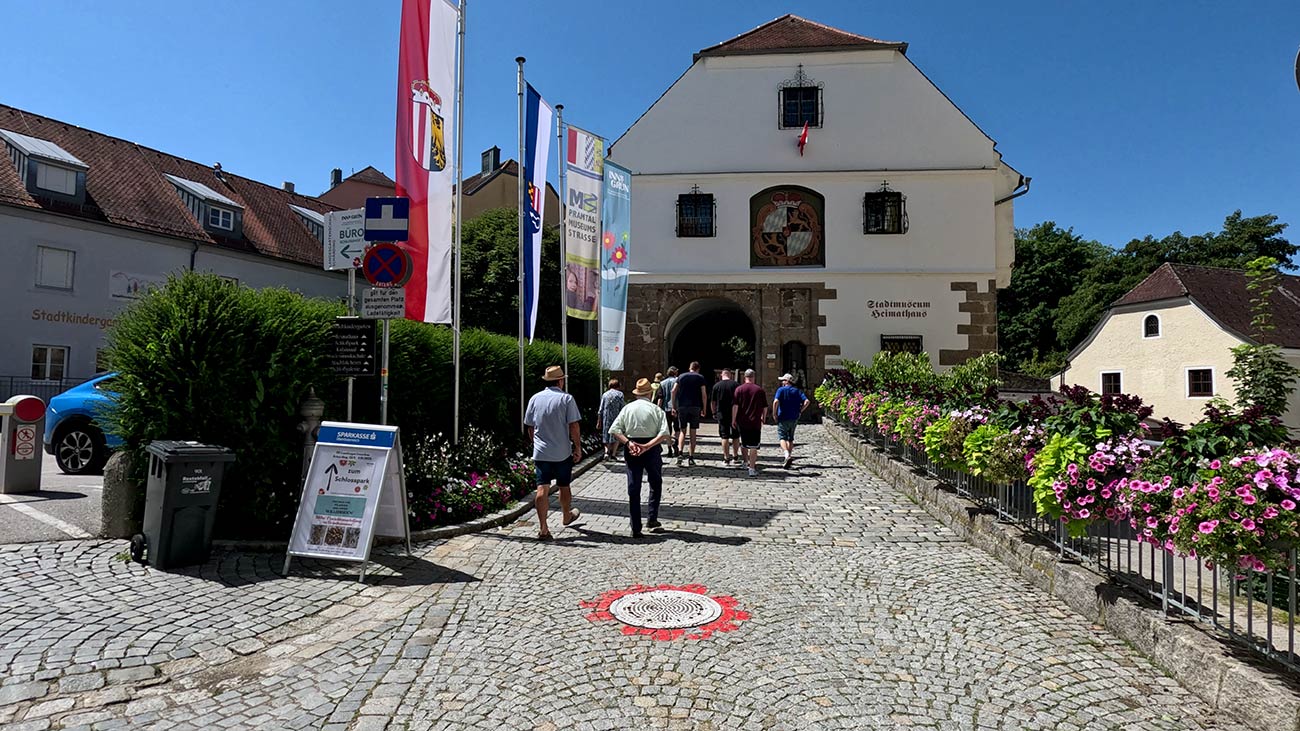
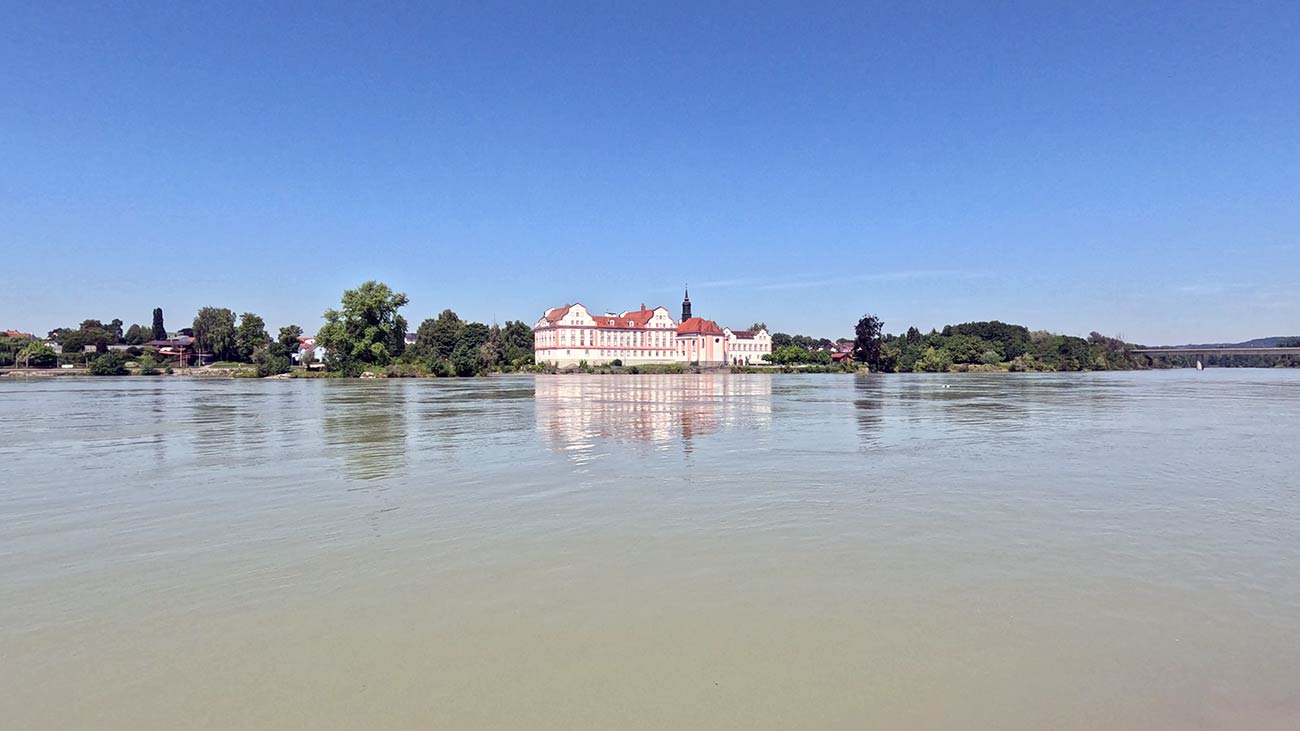
Above the old town, on the high ground overlooking the river, lies the small but evocative Castle Park (Schlosspark) on the site of the former ducal castle. Of the Gothic fortress that once stood here, almost nothing remains beyond the semicircular ring wall and a reconstructed fountain house from 2003, but the open lawn has been laid out as a public park with shaded benches and viewing points along the riverside. From the wall edge the view stretches across the Inn to the village of Neuhaus am Inn on the Bavarian side, with its small castle rising on the opposite bank. The adjoining Castle Gate (Schlosstor), once the residence of the ducal castle warden, today houses the Town Museum (Stadtmuseum), which traces the development of Schärding from its medieval salt-trading origins through the wars of the eighteenth century to its modern role as a Baroque resort town.
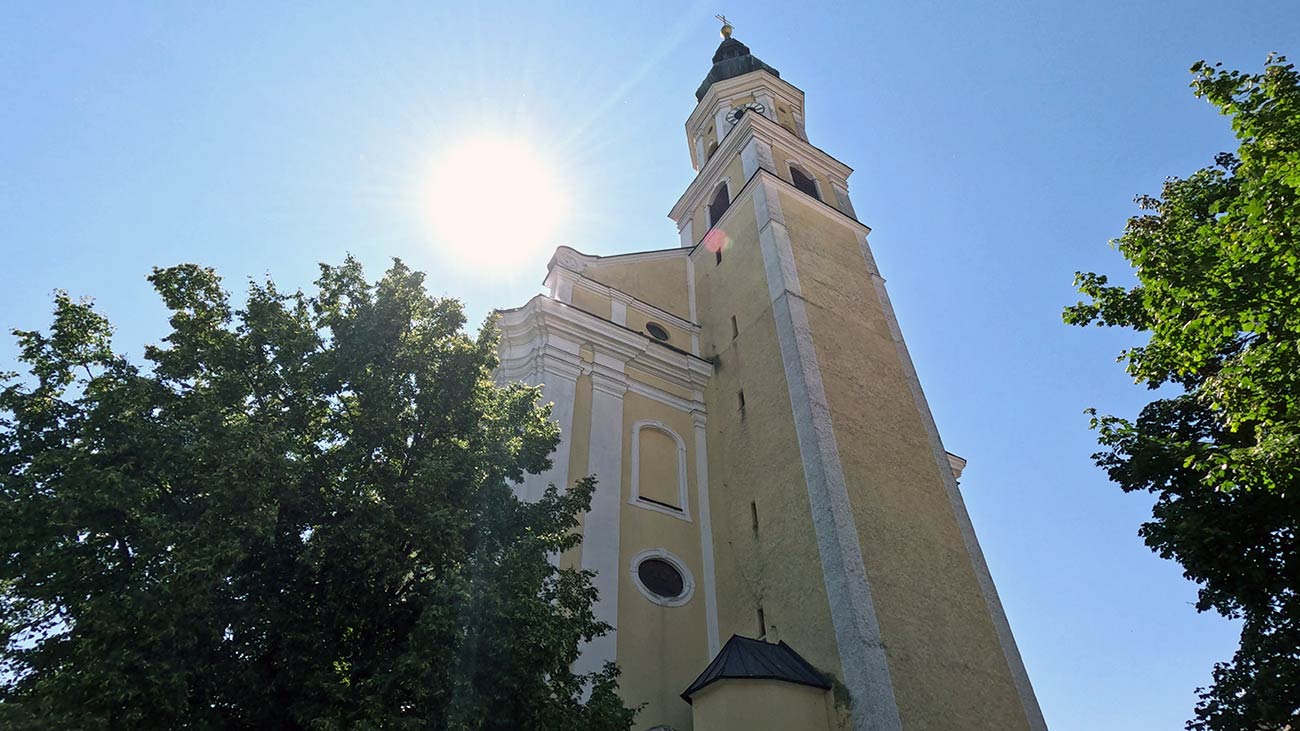
Tucked into a quiet corner just off the main square stands the Parish Church of St George (Stadtpfarrkirche St. Georg), the spiritual centre of the town. The earliest parts of the church, including the gate hall accessed through the tower portal, date back to 1307. After heavy damage during the war of 1703, the church was rebuilt in Baroque style between 1720 and 1726 by the Passau cathedral architect Jakob Pawagner, with the project later completed by the celebrated Munich master Johann Michael Fischer, one of the leading Baroque architects of southern Germany. The French bombardment of 1809 caused further damage and a major fire inside the church, after which it was restored in 1814. A comprehensive renovation since 1975 has returned the interior to much of its eighteenth-century glow, with finely worked Baroque altars, stucco work, and a calm white-and-gold atmosphere that contrasts with the colourful animation of the square outside.
 Useful Links
Mobility for Cyclists
Reaching the area by train with your bike
Schärding can be reached from the EuroVelo 6 by a single short rail journey from one of the main cities on the Danube cycle path. The town lies just upstream of the Inn's confluence with the Danube at Passau, on a frequent regional line operated jointly by ÖBB, the Austrian Federal Railways, and Deutsche Bahn, the German national rail operator, which makes the connection both quick and very well served throughout the day.
The connection
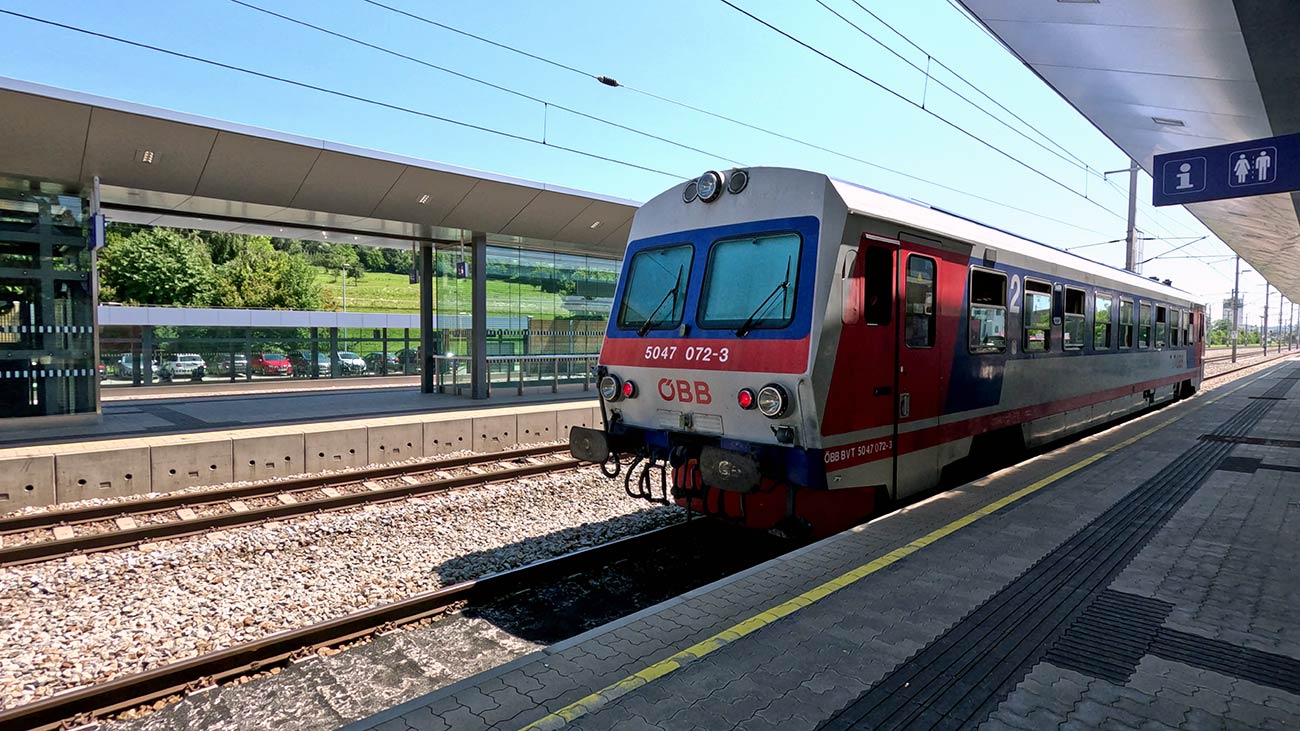
The most practical connection from the EuroVelo 6 corridor is from Passau, where direct regional and intercity trains run to Schärding Bahnhof in around 10 to 15 minutes, with departures roughly every 30 minutes and more than 30 trains per day. The line crosses the German-Austrian border just before reaching the town and is operated by both ÖBB and Deutsche Bahn services, including some ICE long-distance trains that also call at Schärding. Cyclists riding the German Danube stretch of the EuroVelo 6 will find Passau the natural transfer point, and the journey fits comfortably into a half-day excursion. The visit can also be combined naturally with a return ride along the Inn Cycle Path (Innradweg), which follows the river all the way back to Passau and the EuroVelo 6 corridor in around three hours of easy cycling.
Austrian trains
The rail network in Austria is operated mainly by ÖBB (Österreichische Bundesbahnen), the Austrian Federal Railways, which runs most long-distance services and a large share of regional connections across the country. Alongside ÖBB, the private operator Westbahn provides competing long-distance services on the main east-west corridor between Vienna, Salzburg, and onward to Munich. Several smaller regional operators run local and feeder lines on secondary routes, but they are fully integrated into the national rail system, so transfers between operators are straightforward. The Danube region in Austria is particularly well served by rail: the main east-west line links Vienna with Krems, Linz, Wels, Salzburg, and the German border at Passau, closely paralleling the river for much of its length and forming one of the busiest and most reliable rail axes in central Europe. From the main cities along this corridor, dense networks of regional and S-Bahn lines branch out both north and south of the Danube, with frequent departures throughout the day that make inland detours easy to organise without long waiting times or complicated changes. The ÖBB app is the central tool for planning journeys, checking timetables, and purchasing tickets across all services, including both regional and long-distance trains.
Taking your bike
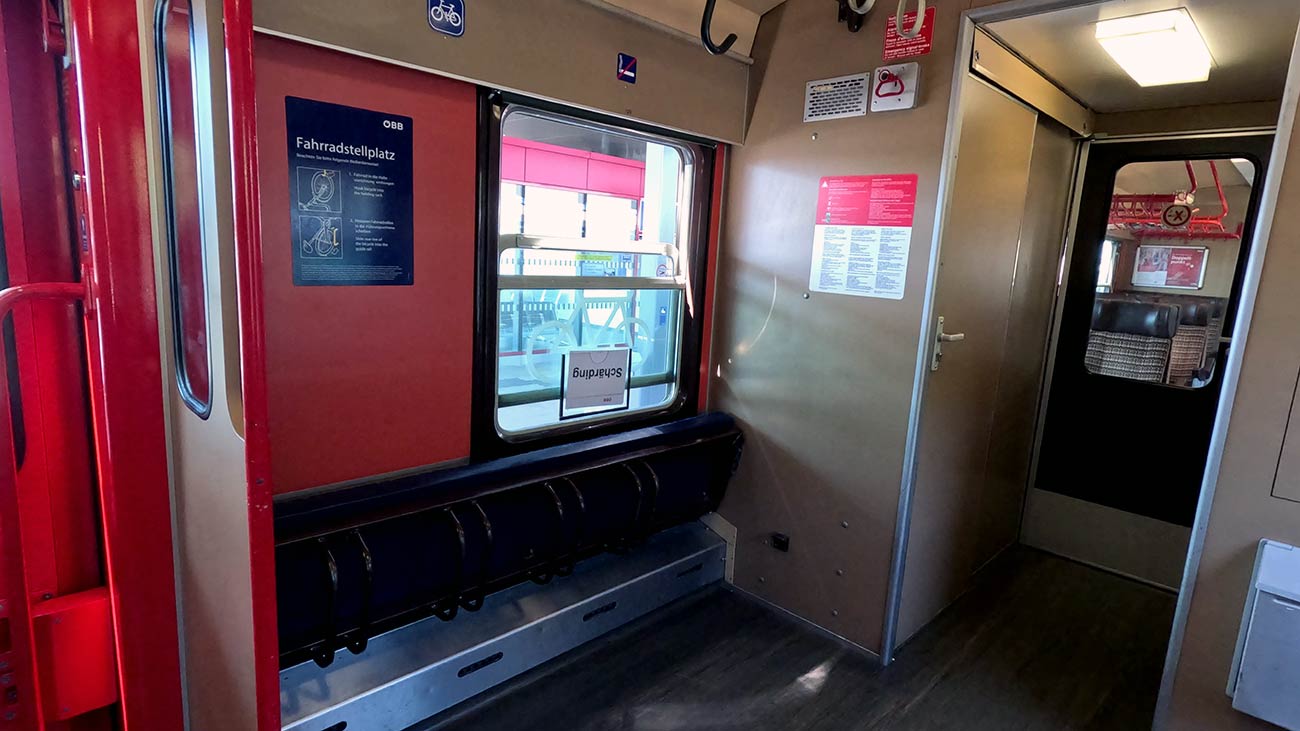
Austria is generally very bike-friendly when it comes to rail transport, especially on regional services operated by ÖBB, which form the core of mobility for cycle touring along the Danube and its connecting corridors. On regional and S-Bahn trains, bicycles can be taken on board for an additional fee, with no advance reservation possible and a first-come, first-served allocation of space. Bicycle tickets are sold as single trips or as affordable daily, weekly, or monthly passes, and the Klimaticket Austria annual pass includes free bicycle transport on regional trains in several federal states. On long-distance services such as Railjet, Intercity, Eurocity, and Nightjet trains, an advance reservation for the bicycle is mandatory, with the bike zones located in second-class carriages. The private operator Westbahn, which runs frequent services along the main east-west corridor between Vienna, Linz, and Salzburg, also accepts bicycles, but only with an advance reservation. Folding bikes are carried free of charge as hand luggage on both ÖBB and Westbahn trains. Overall, the Austrian system is well adapted to cycle tourism and offers a flexible combination of train and bike that makes it easy to leave the EuroVelo 6 route in either direction for short or extended detours.
Bikes on Buses
Long-distance bus services in Austria are primarily operated by FlixBus and by ÖBB-Postbus, the long-distance coach arm of the Austrian Federal Railways, complemented by a smaller number of regional and private coach operators on selected routes. The long-distance bus market in Austria is less developed than in neighbouring countries, as the wider rail network covers most of the country efficiently and many connections that would otherwise be served by intercity coaches are instead handled by train. Bicycle transport is available on certain FlixBus connections, either via external bike racks or in the luggage compartment, but it is not consistently guaranteed across the network and depends on the specific vehicle type and route configuration. Where available, bicycle transport must be reserved in advance and capacity is limited, making it less flexible compared to rail services. ÖBB-Postbus also operates seasonal bicycle and hiking buses in cooperation with regional tourism boards, designed specifically to bring cyclists and hikers to popular starting points along trails and bike paths, although these services run on selected routes only and outside the main long-distance network. As a result, buses are generally used as a secondary option for cyclists, mainly for longer-distance repositioning between major cities rather than as a core part of cycling itineraries along the Danube region. While useful in specific cases where rail connections are less convenient, they are less predictable and less standardised for bicycle transport, so advance planning is essential.
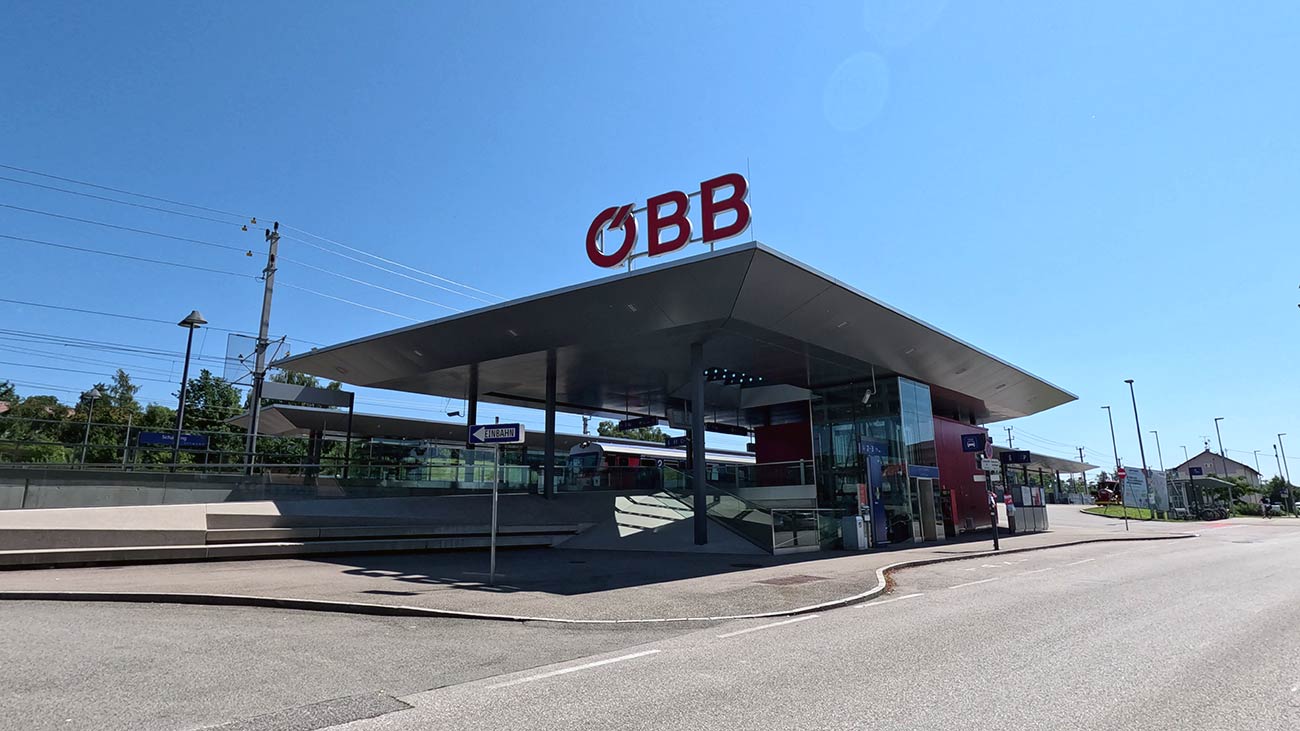
Arriving at Schärding Bahnhof
Schärding's railway station sits at the southern edge of the town, about ten minutes on foot or under five minutes by bike from the Stadtplatz and the Silver Row. The walk into the old town is gentle, well signposted, and passes through quiet residential streets before opening out into the main square. The historic core itself is compact, mostly pedestrianised, and entirely walkable, with the Linz Gate, the Silver Row, the Water Gate, the parish church, and the Castle Park all within a five- to ten-minute walk of each other once you arrive. Bike racks are available at the station for shorter stops. For onward travel, the same line connects back toward Passau and Germany on one side, and east toward Wels and Linz on the other, so Schärding works equally well as a half-day excursion, an overnight stop, or a quick stepping stone between the German and Austrian stretches of the EuroVelo 6..