Esslingen
Reading time: 11 minutes
ESSLINGEN AM NECKAR, BADEN-WÜRTTEMBERG, GERMANY
A Medieval Town the Centuries Forgot to Change
Just upstream from Stuttgart, where the Neckar winds between steep terraced vineyards, lies one of the most completely preserved medieval towns in southern Germany. Esslingen am Neckar escaped the destruction that reshaped so many German cities, and the result is a centre that has changed remarkably little in five or six hundred years. More than eight hundred listed buildings crowd its old town, including what is widely considered the oldest surviving row of half-timbered houses in the country, and the whole ensemble is watched over by a hillside castle and a skyline of Gothic towers.
To walk into Esslingen from the station is to cross a threshold in time. Within a few minutes you pass through a medieval gate tower, cross a canal of the Neckar, and emerge onto a market square framed by leaning timber facades and the ornate Renaissance gable of the old town hall. Narrow cobbled lanes branch off in every direction, water channels run between the houses, and steep stairways climb through vineyards toward the fortifications above. It is a town built at a human scale, where almost everything worth seeing lies within a compact and walkable old centre.
For cyclists exploring the Danube along the EuroVelo 6, Esslingen is one of the most rewarding medieval detours within easy reach of the route. A single direct train from Ulm brings you into the Neckar valley in under an hour, and the town can be explored comfortably in a single day. The contrast with the river road could hardly be greater: from the open horizontal of the Danube to a dense, vertical world of towers, gables, stairways, and vineyard slopes.
TowersCanalsCastleSparkling Wine
For the best viewing experience and full understanding of the story, please turn on Closed Captions (CC)
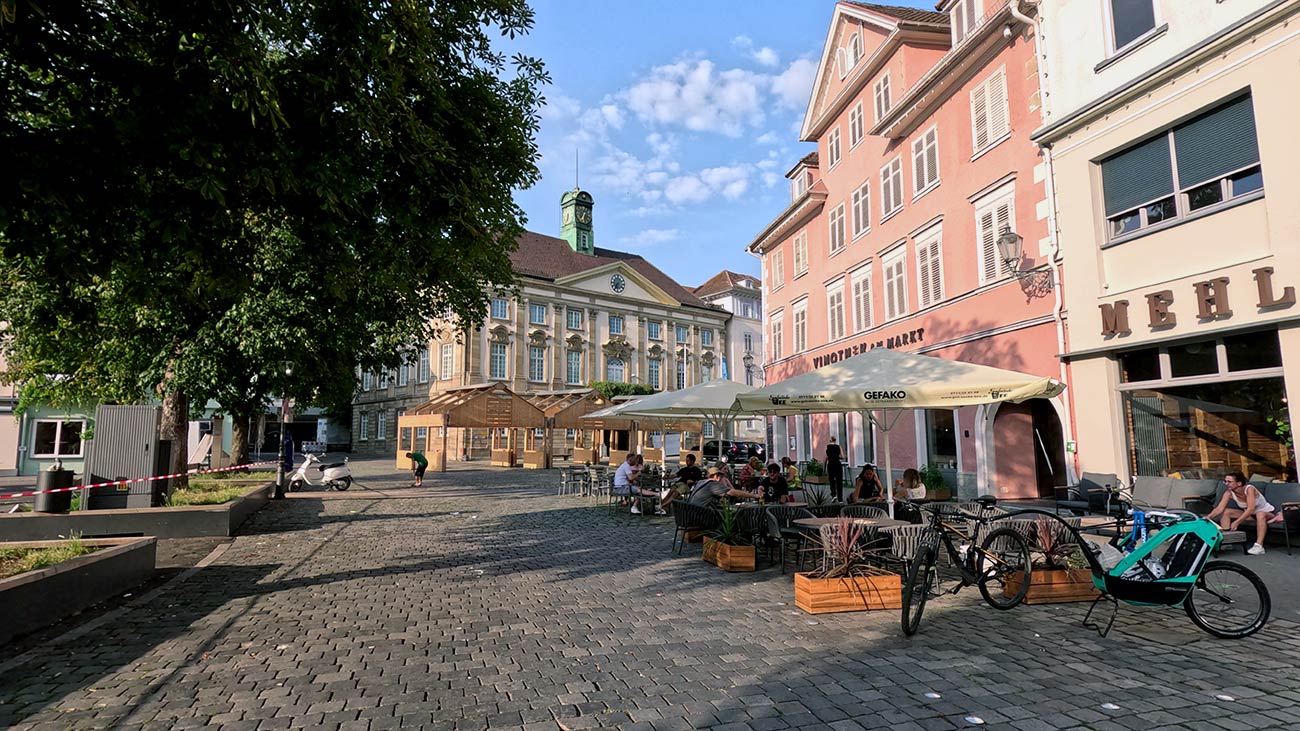
A Medieval Old Town Beneath a Vineyard Castle
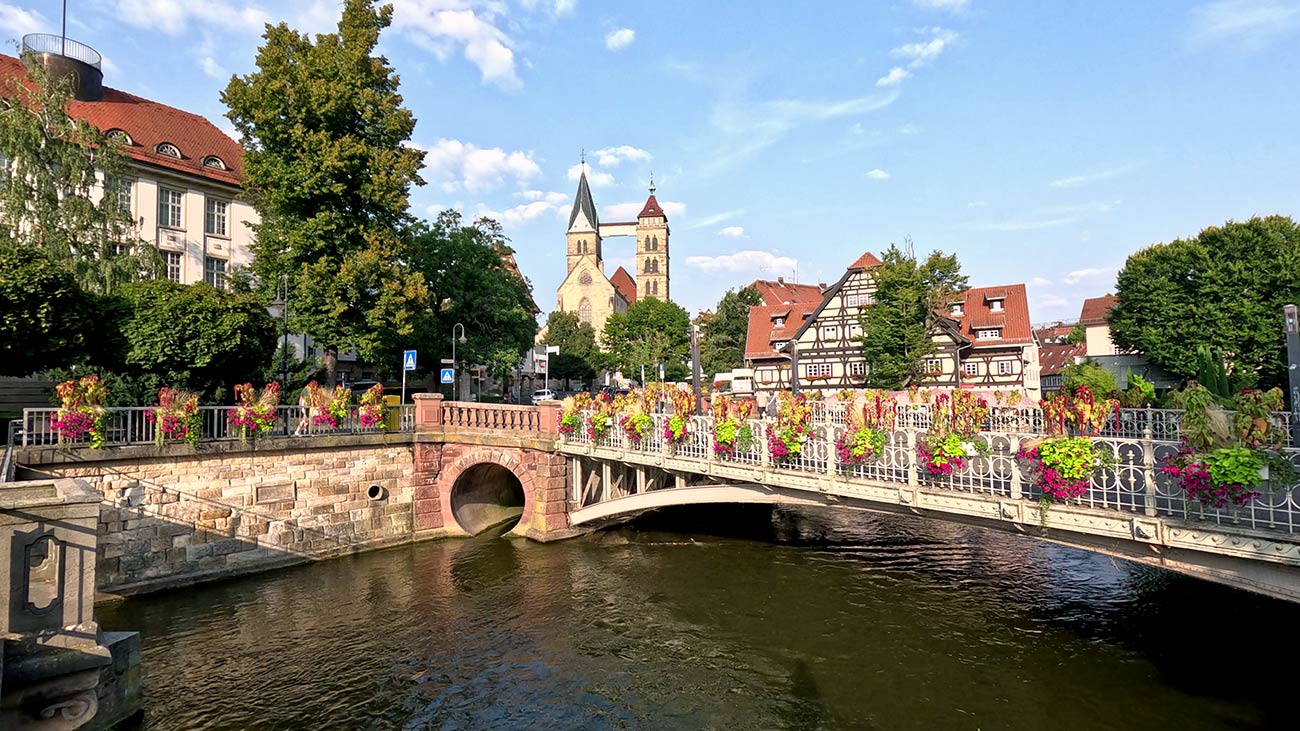
The spiritual heart of Esslingen is the Church of St Dionysius (Stadtkirche St. Dionys), a Gothic church standing on foundations that reach back to the eighth century. Its most distinctive feature is a pair of towers linked near their tops by a covered bridge, an unusual architectural arrangement rarely seen elsewhere in Germany. Inside, the church preserves some of the most important medieval stained-glass windows in the region, along with an ornately carved rood screen and a stone baptismal font, the whole interior reflecting the long centuries during which Esslingen was a wealthy and self-governing free imperial city. Archaeological excavations beneath the church have uncovered the remains of even earlier buildings, making St Dionys not just a place of worship but a record of more than a thousand years of continuous settlement on the same spot.
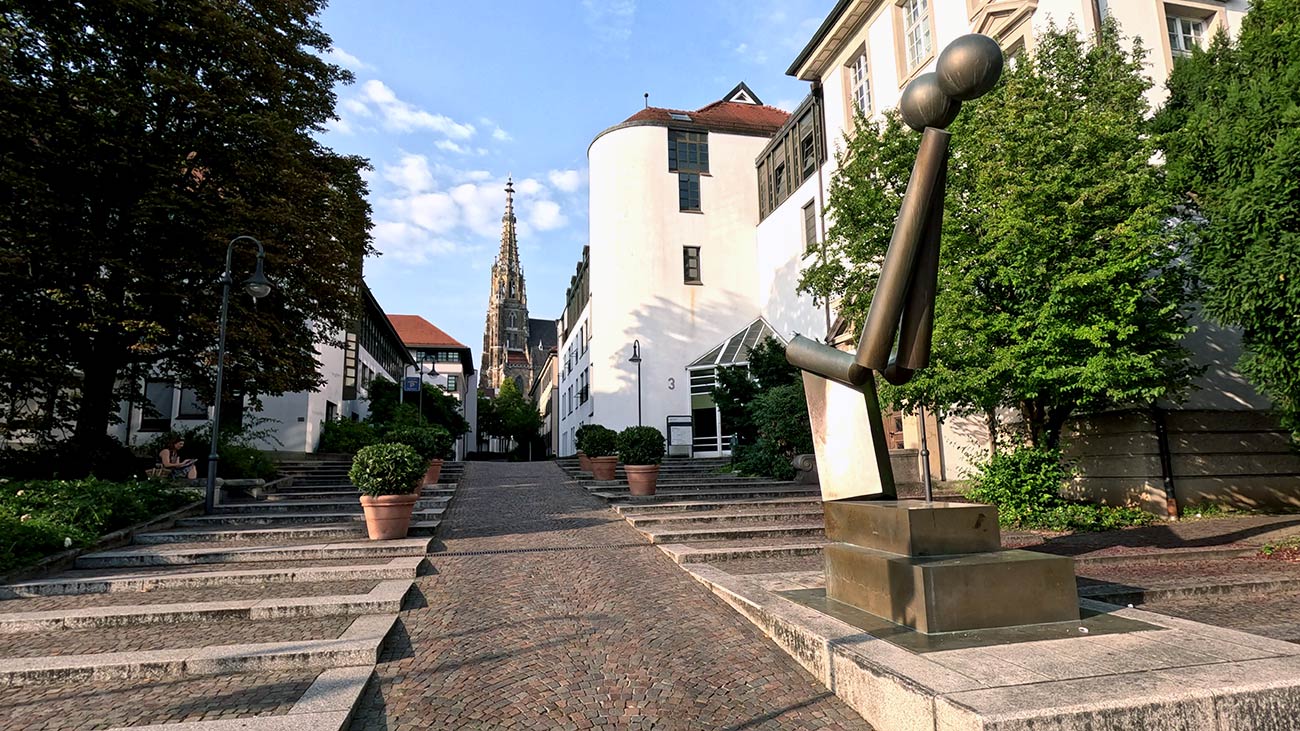
A short walk away rises the Frauenkirche, the Church of Our Lady, one of the finest examples of late-Gothic architecture in the region. Built over roughly a century and a half from the fourteenth century onwards, it is crowned by a delicate openwork spire that reaches more than seventy metres into the sky, a masterpiece of medieval stonework whose lacy stone tracery seems almost too fine to be load-bearing. The interior is tall, narrow, and luminous, with a vaulted nave, two side aisles, and a celebrated cycle of medieval stained-glass windows. Standing on a slight rise above the surrounding streets, the Frauenkirche is one of the defining silhouettes of the Esslingen skyline and a quiet, contemplative counterpoint to the busier squares below.
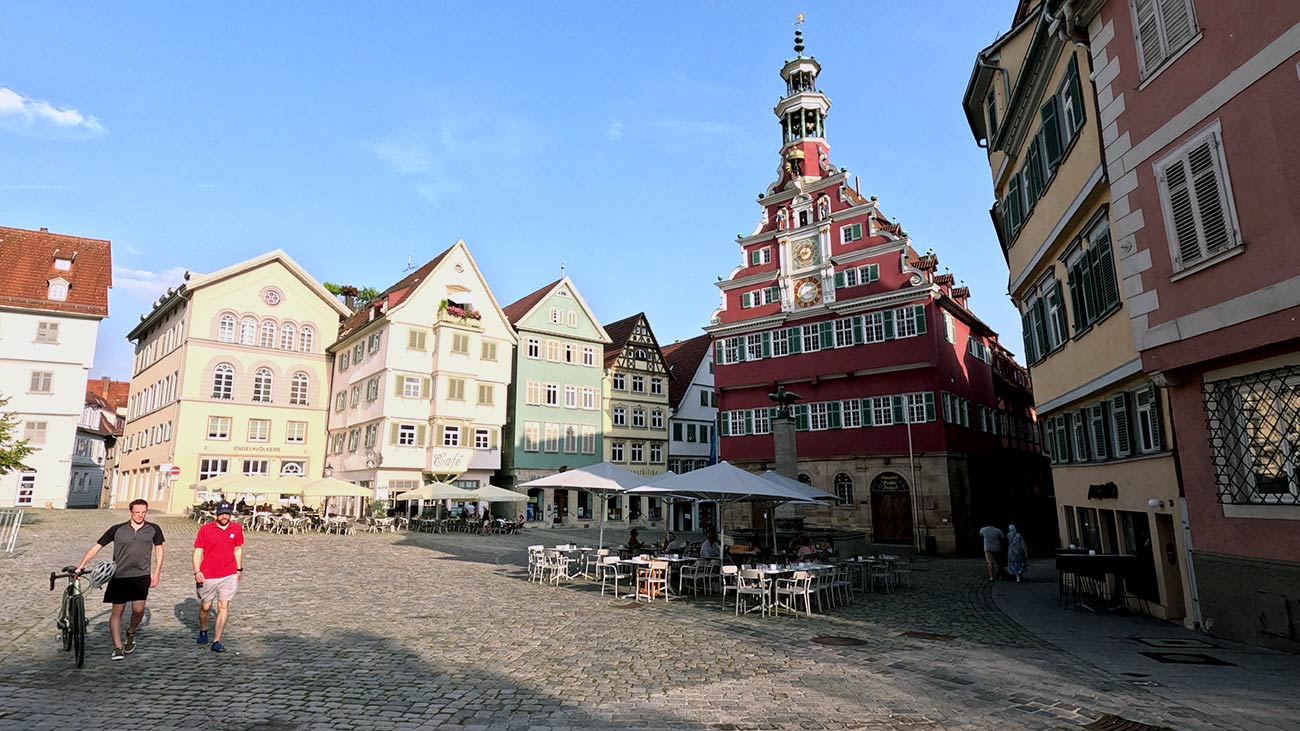
The civic heart of the town is the Old Town Hall (Altes Rathaus), first built in the fifteenth century as a market and customs hall and later given a magnificent Renaissance facade. That facade, remodelled by the architect Heinrich Schickhardt at the end of the sixteenth century, carries an elaborate astronomical clock and a carillon, and looks out over the cobbled market square that has been the focus of town life for centuries. The square and the surrounding lanes contain a remarkable concentration of half-timbered architecture, including a row of houses dating from the early fourteenth century that is widely regarded as the oldest surviving timber-framed terrace in Germany. With more than eight hundred protected monuments in total, the old town is less a collection of individual sights than a single, continuous historic environment.
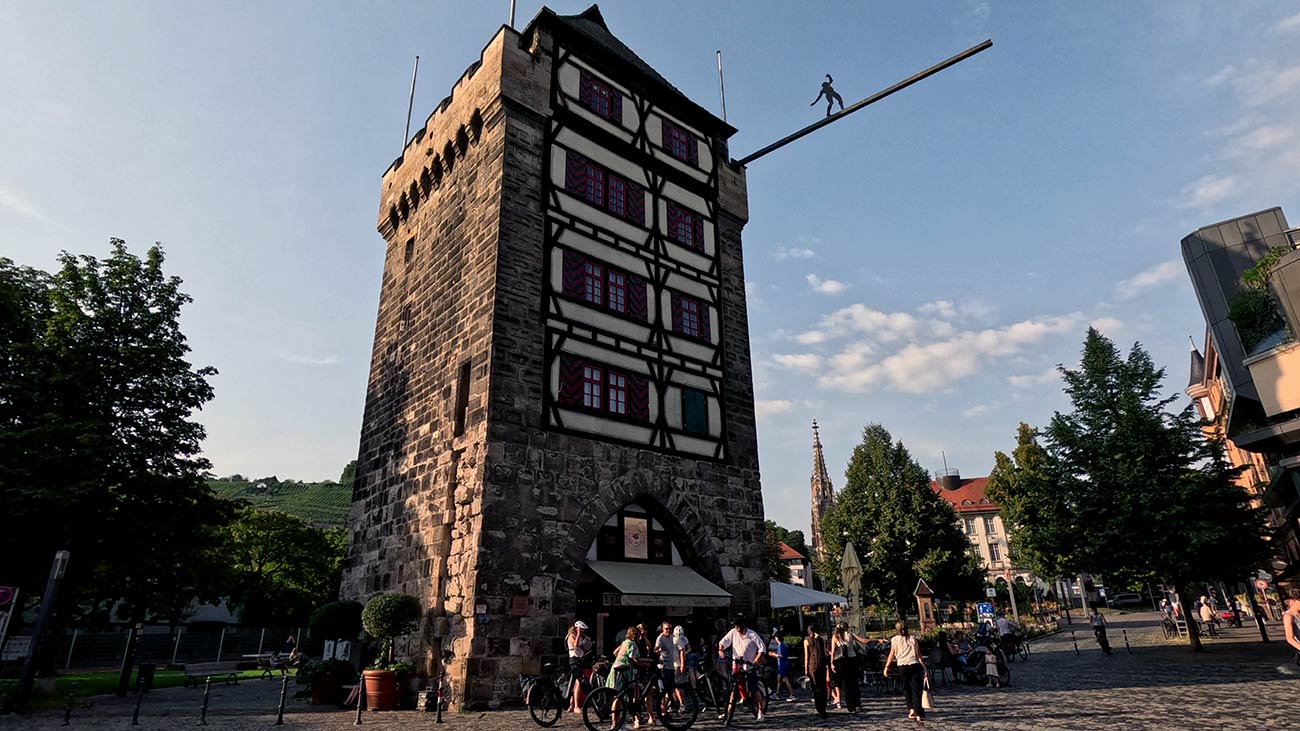
Guarding the northern edge of the old town stands the Schelztor Tower (Schelztorturm), one of three surviving gate towers from the town’s medieval fortifications, dating to the thirteenth century. Square, tall, and crowned with a steep roof, it once controlled one of the main entrances through the city wall and today marks the start of many visitors’ walk into the centre from the railway station. Together with the other surviving towers and stretches of wall, it gives a clear sense of the scale of Esslingen’s medieval defences, which once ringed the entire town and climbed the hillside to connect with the fortress above.
That fortress, Esslingen Castle (Esslinger Burg), crowns the vineyard slope directly above the old town and offers the finest views in the city. Despite its name, it was never a residence for nobility but rather the upper part of the town’s own fortifications, built from the thirteenth century onwards to protect the citizens of the free imperial city. Its most striking elements are the tall High Watch Tower, the long covered stairway known as the Ropers’ Walk that climbs steeply up from the old town, and the massive Big Tower (Dicker Turm). Visitors can climb the more than two hundred steps of the covered stairway or wind up through the vineyards to reach the castle gardens, where restaurants and terraces look out across the rooftops of the old town and the Neckar valley beyond, ideally with a glass of the local wine in hand.
Threaded through the lower part of the old town is the network of water channels that has earned Esslingen its affectionate nickname of Little Venice (Klein Venedig). These canals, fed by the Neckar, once powered mills and workshops and served the tanners, dyers, and craftsmen who made the medieval town prosperous. Today they run quietly between half-timbered houses, crossed by small bridges and lined with flowers, forming one of the most photographed corners of the town. A short walk away, the historic Kessler Sekt cellars, Germany’s oldest sparkling-wine producer in operation since 1826, offer tours and tastings beneath atmospheric vaulted ceilings, a fitting reminder that Esslingen’s vineyards have shaped the town’s character for as long as its towers and churches.
ℹ️ Useful Links
Mobility for Cyclists
Reaching the town by train with your bike
Esslingen can be reached from the EuroVelo 6 by a single direct rail journey from one of the main cities on the Danube cycle path. The town lies northwest of the Danube in the Neckar valley, just upstream from Stuttgart, and the line connecting it to the river corridor is fast, frequent, and direct.
The connection
The most practical connection from the EuroVelo 6 corridor is from Ulm, where regional trains run directly to Esslingen (Neckar) in around 55 minutes, with departures roughly every half hour throughout the day. The line follows the historic route between Ulm and Stuttgart, crossing the Swabian Alb before descending into the Neckar valley, and requires no change on the direct services. Cyclists riding the Danube stretch of the route will find Ulm the natural transfer point, and the journey fits comfortably into a single travel day with ample time to explore the old town on arrival.
German trains
The rail network in this part of Germany is operated mainly by Deutsche Bahn (DB), which runs most long-distance services and a large share of regional connections across the area. Alongside DB, several regional operators run local and feeder lines, particularly on secondary routes through the Swabian Alb and the Neckar valley, but they are fully integrated into the national rail system. This creates a highly coordinated transport network where transfers between different operators are seamless and require no separate tickets. The DB Navigator app is the central tool for planning journeys, checking timetables, and purchasing tickets across all services, including both regional and long-distance trains. During the main holiday season, special bike-friendly trains with expanded capacity for bicycles also run on selected regional routes, making travel with a bike across the region noticeably easier.
Taking your bike
This part of Germany is generally very bike-friendly when it comes to rail transport, especially on regional trains, which form the core of mobility for cycle touring along the Danube and Neckar corridors. Most regional services allow bicycle transport without mandatory reservation, although space is limited and operates on a first-come, first-served basis. A separate bicycle ticket is typically required during weekday morning peak hours, or it can be purchased as an affordable regional day pass, while outside peak periods and on weekends bicycle transport is often free across large parts of Baden-Württemberg. Long-distance trains such as IC and ICE require advance bicycle reservations and have limited capacity, so early planning is important for intercity travel. Overall, the system is well adapted to cycle tourism, offering strong flexibility and occasional dedicated bicycle-friendly or seasonal train services that further improve connectivity for travellers leaving the EuroVelo 6 route.
Bikes on Buses
Long-distance bus services in southern Germany are primarily operated by FlixBus, complemented by a smaller number of regional and private coach operators on selected routes. Bicycle transport is available on certain intercity connections, either via external bike racks or in the luggage compartment, but it is not consistently guaranteed across the network and depends on the specific vehicle type and route configuration. Where available, bicycle transport must be reserved in advance and capacity is limited, making it less flexible compared to rail services. As a result, buses are generally used as a secondary option for cyclists, mainly for longer-distance repositioning between major cities rather than as a core part of cycling itineraries along the Danube region. While useful in specific cases where rail connections are less convenient, they are less predictable and less standardized for bicycle transport, so advance planning is essential.
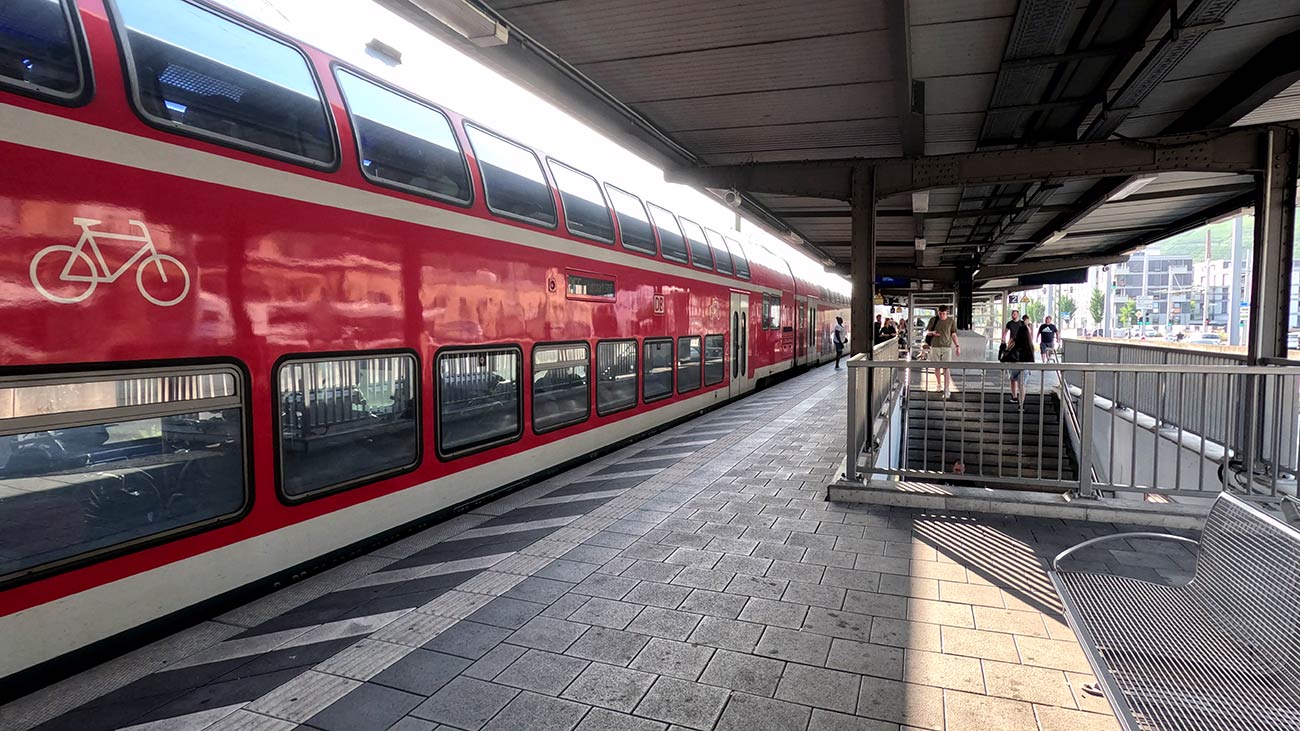
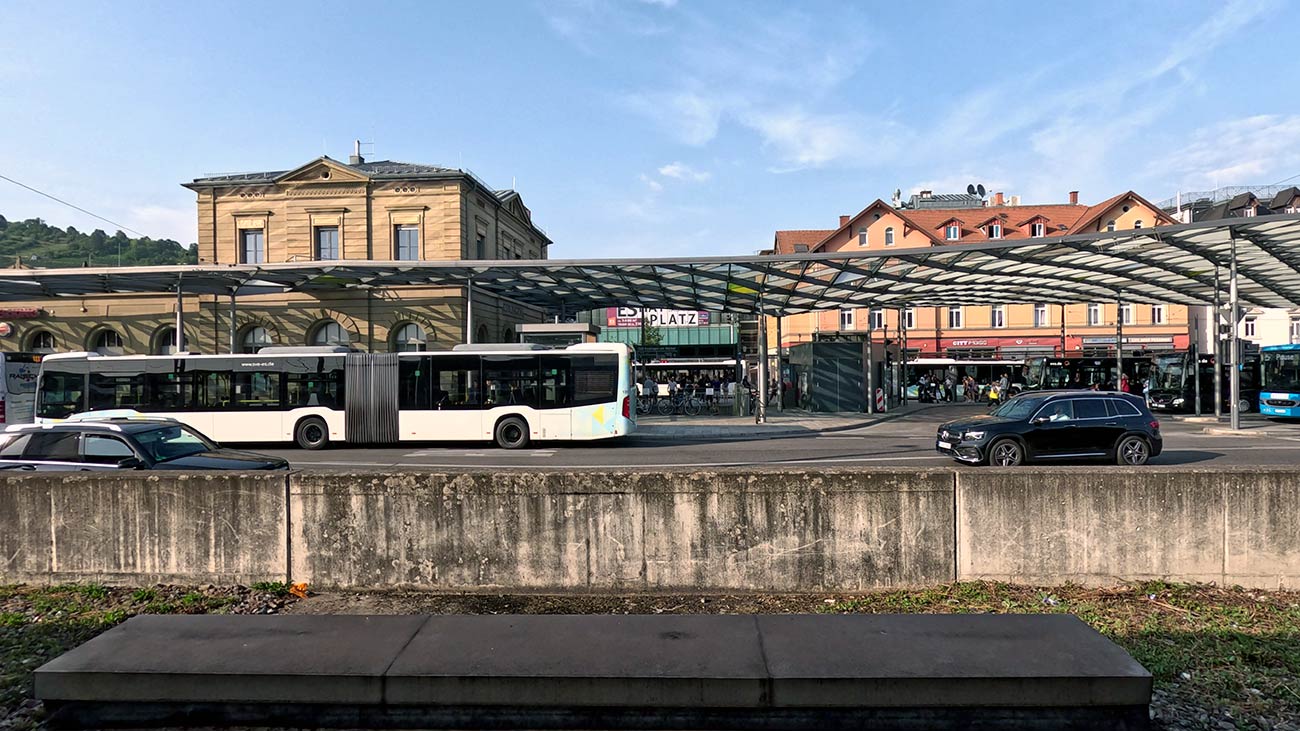
Arriving at Esslingen Station
Esslingen’s railway station sits just south of the old town, only a few minutes’ walk or ride from the medieval centre across one of the Neckar canals. The Schelztor Tower, the market square, the churches, and the foot of the castle stairway are all easily reachable on foot, and the compact scale of the old town means most travellers leave their bicycles at their accommodation or at the station and explore on foot. The climb up to Esslingen Castle is best done on foot, either up the covered stairway or through the vineyards, as the old town’s cobbled lanes and steps are not well suited to cycling. Bike racks are available at the station for shorter stops. For onward travel, the same line connects back toward Ulm and the wider Danube region, as well as onward to Stuttgart, so Esslingen works equally well as a day excursion or as part of a longer loop through the Neckar valley.