Friedrichshafen
Reading time: 13 minutes
FRIEDRICHSHAFEN, BADEN-WÜRTTEMBERG, GERMANY
Where Airships and the Alps Meet on the Lake
On the northern shore of Lake Constance, where wide open water meets the foothills of the Alps, lies a city with one of the most unusual reputations in southern Germany. Friedrichshafen has spent more than a century associated with two of the most famous names in the history of flight: the Zeppelin airships and the Dornier aircraft. Long before either of them, however, it was a comfortable lakeside town of monastic origins, chosen by the kings of Württemberg in the early nineteenth century as their summer residence on the lake. The result is a city where Baroque church towers, royal palace gardens, and a long lakeside promenade share the shoreline with a Bauhaus harbour station turned museum and a hangar-shaped exhibition hall full of aviation history.
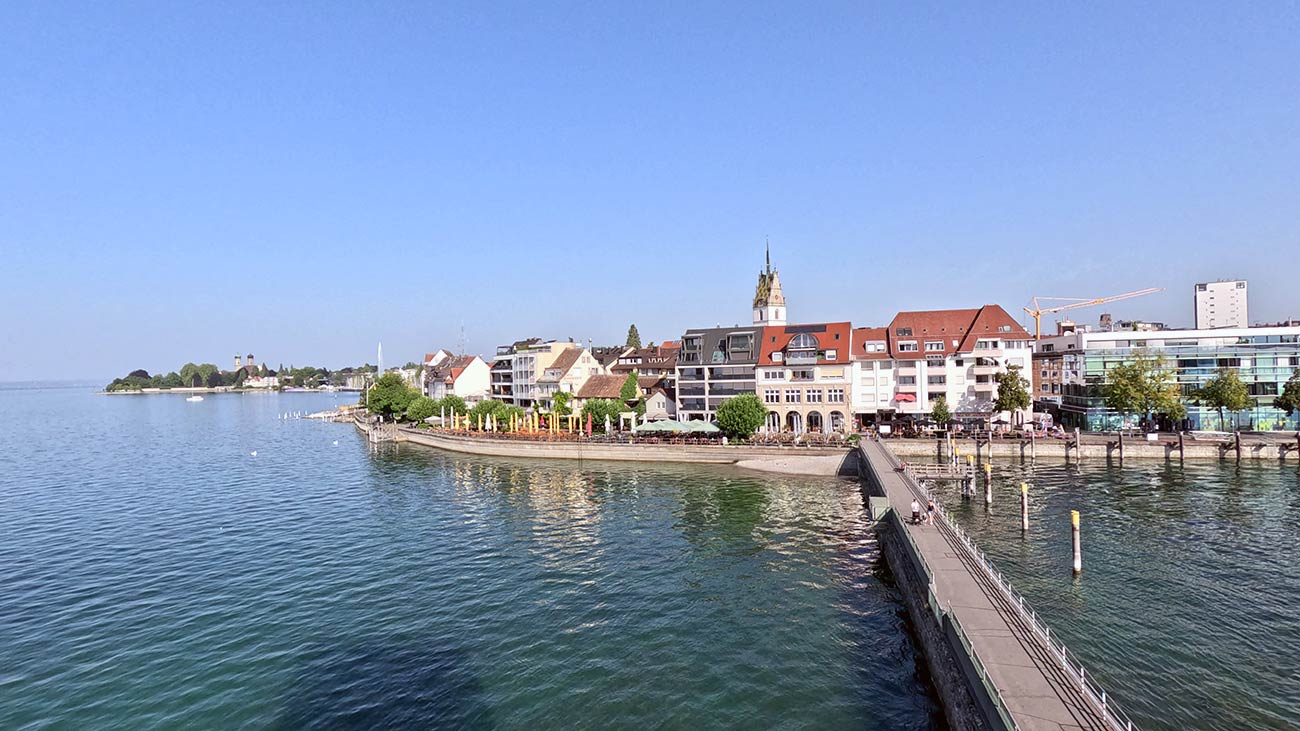
The lake itself is the main protagonist of any visit. From the long promenade you look across the open water toward the silhouette of the Swiss Alps, which rise on the southern horizon and seem to float above the lake on clear days. White passenger ships and the bright orange catamaran from Constance arrive and depart from the harbour every hour, and small sailing boats drift in and out of the bay throughout the day. Friedrichshafen is, in the most literal sense, a city that lives by its water, and the contrast between that lakeside calm and the high-technology aviation past gives the place its particular character.
For cyclists exploring the Danube along the EuroVelo 6, Friedrichshafen is one of the most rewarding lakeside detours within easy reach of the route. The town is reached by a direct train from Ulm in around an hour and twenty minutes, or by an even shorter train ride from neighbouring Ravensburg. Once here, it also functions as a natural junction on the wider lake itinerary, with boat connections that carry bicycles across the water to Constance, Mainau, Überlingen, and Lindau, opening up the possibility of combining several lakeside detours into a single longer loop.
ViewpointLakeMuseumsAlps
A Lakeside City Shaped by Flight
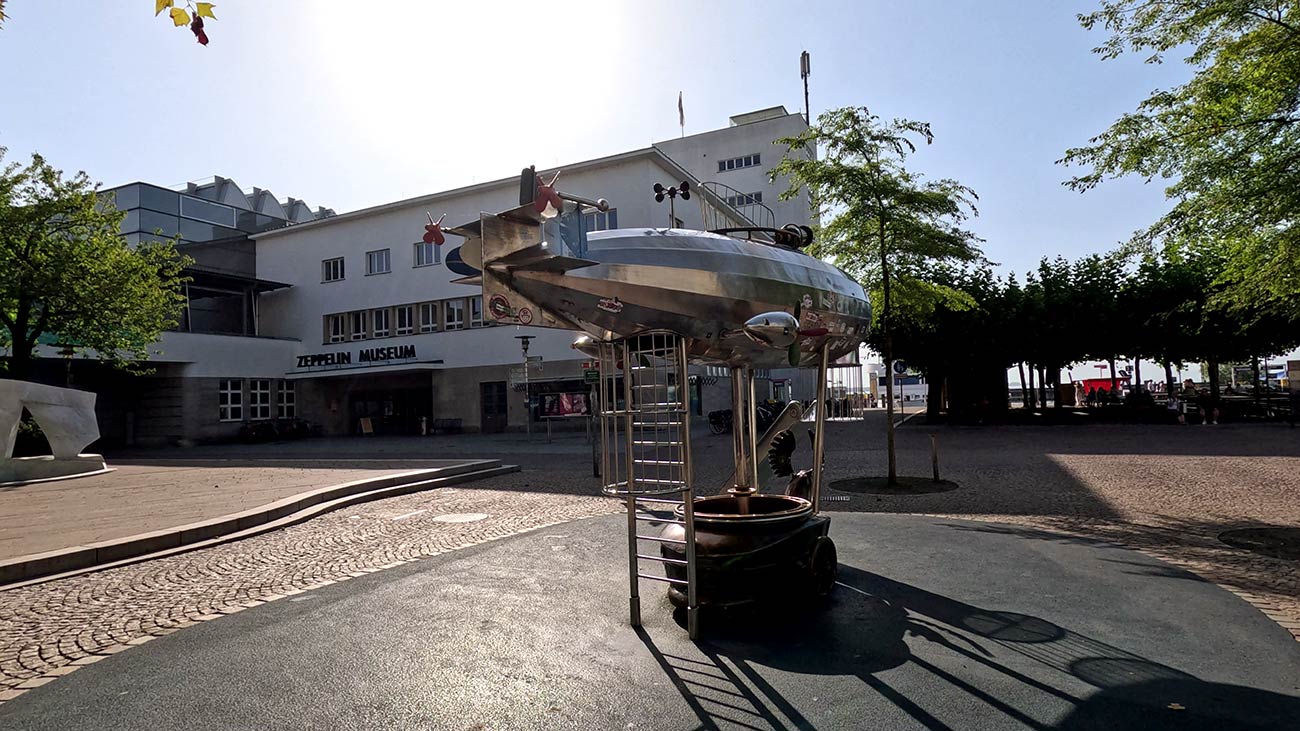
The natural starting point for most visitors is the Zeppelin Museum (Zeppelin Museum Friedrichshafen), housed in the elegant former harbour railway station of 1932, a fine example of Bauhaus-era architecture directly on the lake at the eastern edge of the promenade. The collection is the world’s largest dedicated to airship travel, with more than 1,500 original exhibits spread across roughly 4,000 square metres of exhibition space, brought to life through multimedia installations, historical film and audio recordings, and a series of lighter than air experimentation stations that let visitors feel the principles of buoyancy and flight for themselves. The centrepiece is a partial reconstruction of the LZ 129 Hindenburg, the largest airship ever built, whose recreated passenger areas can be entered along a 33-metre walk-through section. A separate art collection occupies the upper floors of the former harbour station, with works ranging from medieval to modern southern German painting and a notable focus on twentieth-century artists who took refuge around the lake during the Nazi years, including Otto Dix, Max Ackermann, and Willi Baumeister.
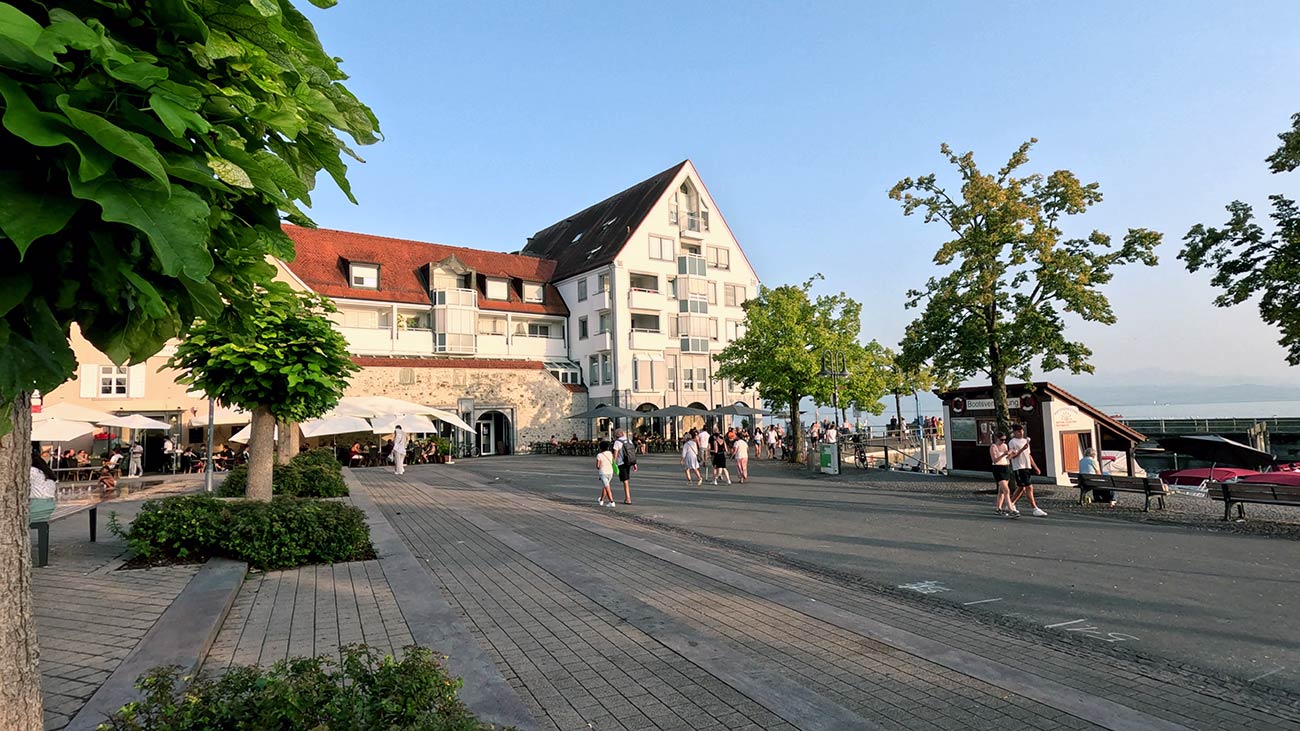
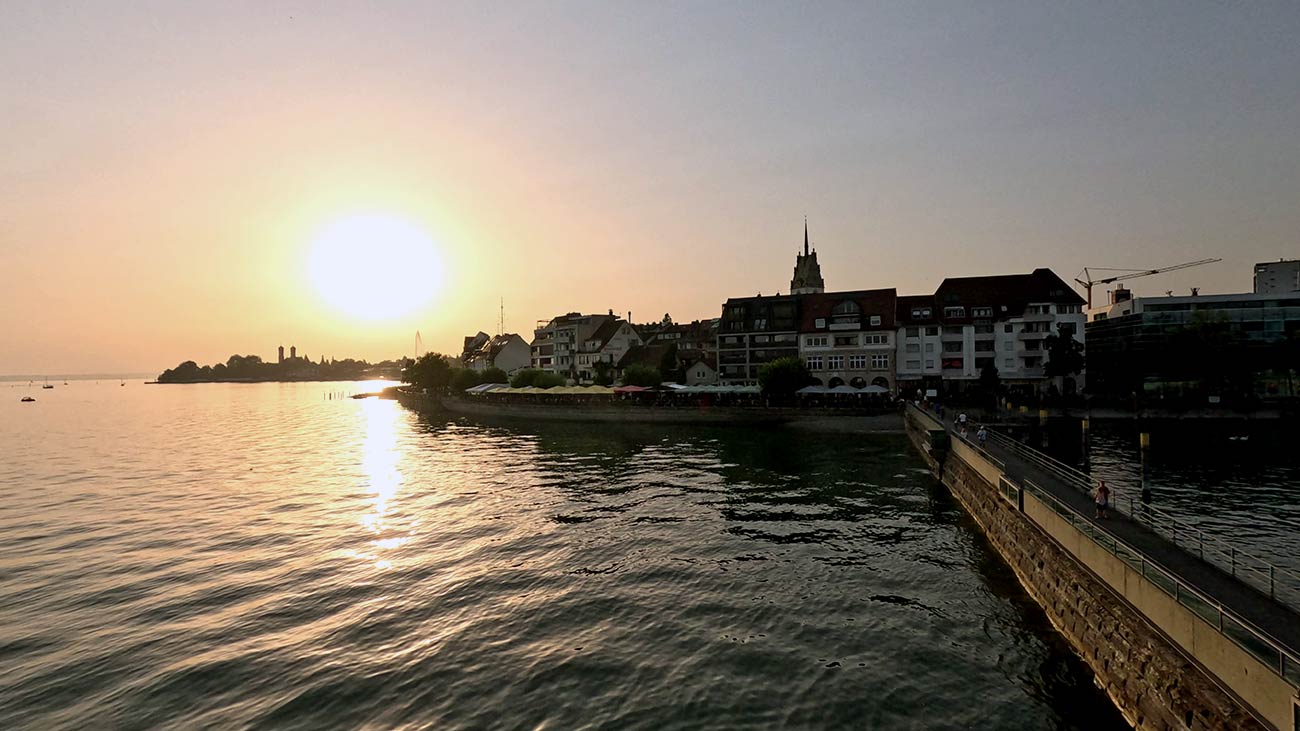
Just outside the museum begins the Lakeside Promenade (Uferpromenade), which stretches for around a kilometre west along the shore and is the heart of life in Friedrichshafen. Lined with cafés, restaurants, lakeside benches, the green of the city park, and small piers for ferries and pleasure boats, it is the kind of place where an afternoon turns naturally into a slow walk, a coffee with a view, and an early evening sunset over the water. On clear days the long line of the Swiss Alps rises above the southern shore, sometimes capped with snow well into the spring, and the promenade is one of the best places anywhere on the German side of the lake to take in the full sweep of the Alpine horizon. Small boats and pedalos can be hired by the hour, and the harbour offers regular ferry departures across the lake to other lakeside towns on the German, Swiss, and Austrian shores.
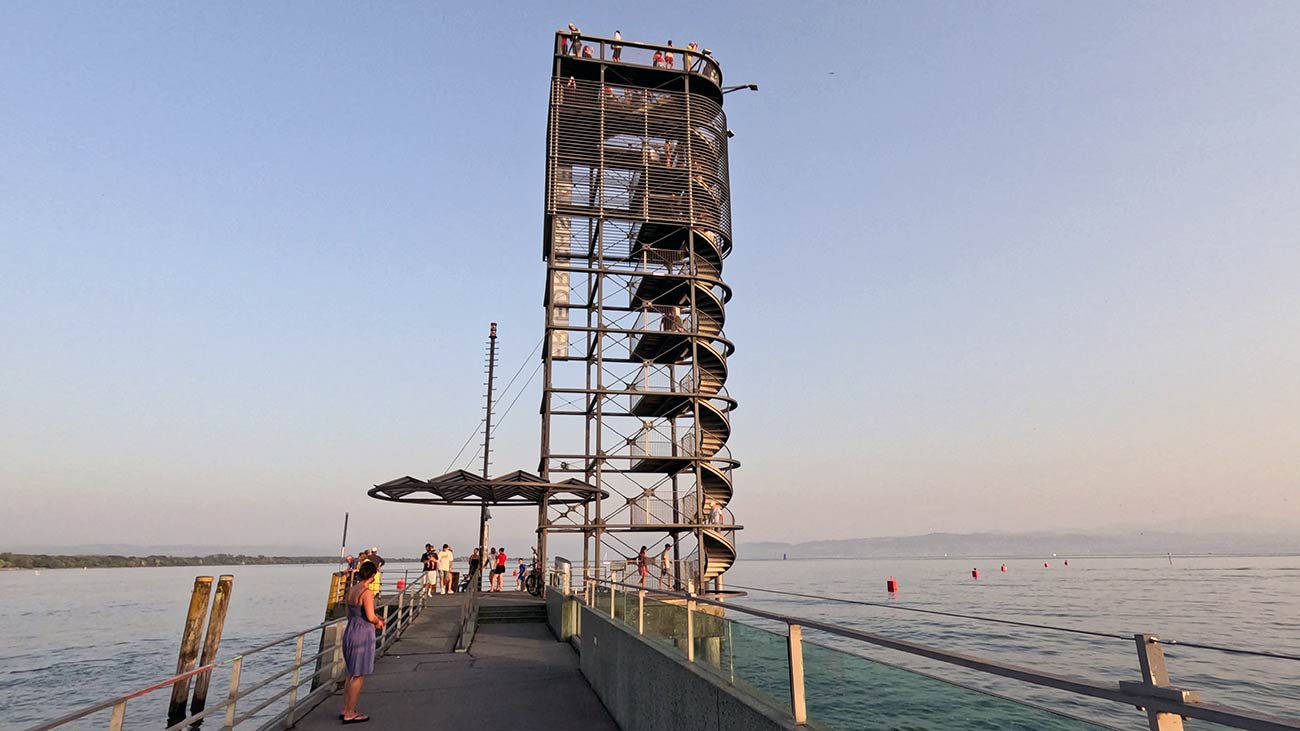
A short walk along the harbour leads to the Mole Tower (Moleturm), a slender steel viewing tower that rises at the end of the mole at the entrance to the harbour. Its platform looks out across the entire bay of Friedrichshafen, the wide expanse of Lake Constance, the Swiss shore opposite, and the line of the Alps in the distance. The climb up the open spiral staircase is short, the platform unenclosed and breezy, and the view at sunset is one of the most photographed in the city. Together with the harbour basin and the nearby sound ship, an unusual public sound sculpture in the shape of a small vessel, the Mole Tower gives the lakefront its distinctive contemporary skyline.
At the western end of the promenade, a pair of pale Baroque towers rises above the rooftops in one of the most recognisable silhouettes in the city. The Castle Church (Schlosskirche) is the only publicly accessible part of the former Hofen Monastery, founded as a religious community in the eleventh century and rebuilt in its present early-eighteenth-century Baroque form. The interior is unusually bright, with a brilliant white ceiling, fine stucco work, and a calm, restrained atmosphere that suits its garden setting. After the dissolution of the monastery in 1802, the surrounding buildings were converted into the summer residence of the kings of Württemberg, the event that gave Friedrichshafen its name and its later status as a royal resort town. The palace itself remains in private hands, still owned by the descendants of the royal family, but the surrounding park and the church can be freely visited and offer one of the most peaceful corners of the lakefront.
A short journey on the outskirts of the city, next to the airport, the story of Friedrichshafen’s other great aviation tradition is told in full. The Dornier Museum (Dornier Museum Friedrichshafen), opened in 2009, is set in a striking hangar-shaped building and traces a century of aviation and aerospace history through the work of the pioneer Claude Dornier and the company he founded here on the lake. Its key message, Everyone can be a pioneer, runs through almost 400 exhibits arranged across 6,000 square metres of exhibition space, including 12 original aircraft, seven full-scale aerospace exhibits, and two life-size replicas of the Dornier Merkur and the legendary Dornier Wal flying boat. Surrounding displays place the aircraft in the broader political, economic, and social context of each era, charting world records, patents, and technological breakthroughs that shaped the company’s history. The museum’s modern interior, hands-on exhibits, and the experience of walking among real aircraft make it one of the most rewarding stops for anyone interested in the technical side of flight, and a natural companion to the Zeppelin Museum at the opposite end of the city. A short ride on a local bus or a longer ride along signposted cycle paths links the two museums, allowing a full day of aviation history with the lake never far away.
ℹ️ Useful Links
Mobility for Cyclists
Reaching the town by train with your bike
Friedrichshafen sits at an unusual crossroads of the EuroVelo 6 network. It lies directly on the lakeside variant of the route that runs around Lake Constance, while at the same time being easily reachable by train from the Danube stretch further north. The result is that the city can be approached either by bike along the shore from neighbouring lakeside towns or by a single direct rail journey from the Danube corridor.
The connection
The most practical connection from the Danube cycle path is from Ulm, where regional trains run directly to Friedrichshafen Stadt in a bit more than one hour, with frequent departures throughout the day. The line is the same Ulm–Friedrichshafen route that also serves Bad Schussenried, Bad Waldsee, and Ravensburg, all of which can be combined easily into a longer itinerary across Upper Swabia. For travellers already on the lakeside branch of the EuroVelo 6, Friedrichshafen is reached along the Lake Constance Cycle Path (Bodensee-Radweg), which passes directly through the city along the shore. The city also functions as one of the most important harbours on the lake, with regular ferries and the orange high-speed catamaran connecting Friedrichshafen with Constance in just under an hour, and slower Lake Constance White Fleet ships running to Meersburg, Mainau, Überlingen, and Lindau, all of which carry bicycles on board.
German trains
The rail network in this part of Germany is operated mainly by Deutsche Bahn (DB), which runs most long-distance services and a large share of regional connections across the area. Alongside DB, several regional operators run local and feeder lines, particularly on secondary routes through the Swabian Alb and the Neckar valley, but they are fully integrated into the national rail system. This creates a highly coordinated transport network where transfers between different operators are seamless and require no separate tickets. The DB Navigator app is the central tool for planning journeys, checking timetables, and purchasing tickets across all services, including both regional and long-distance trains. During the main holiday season, special bike-friendly trains with expanded capacity for bicycles also run on selected regional routes, making travel with a bike across the region noticeably easier.
Taking your bike
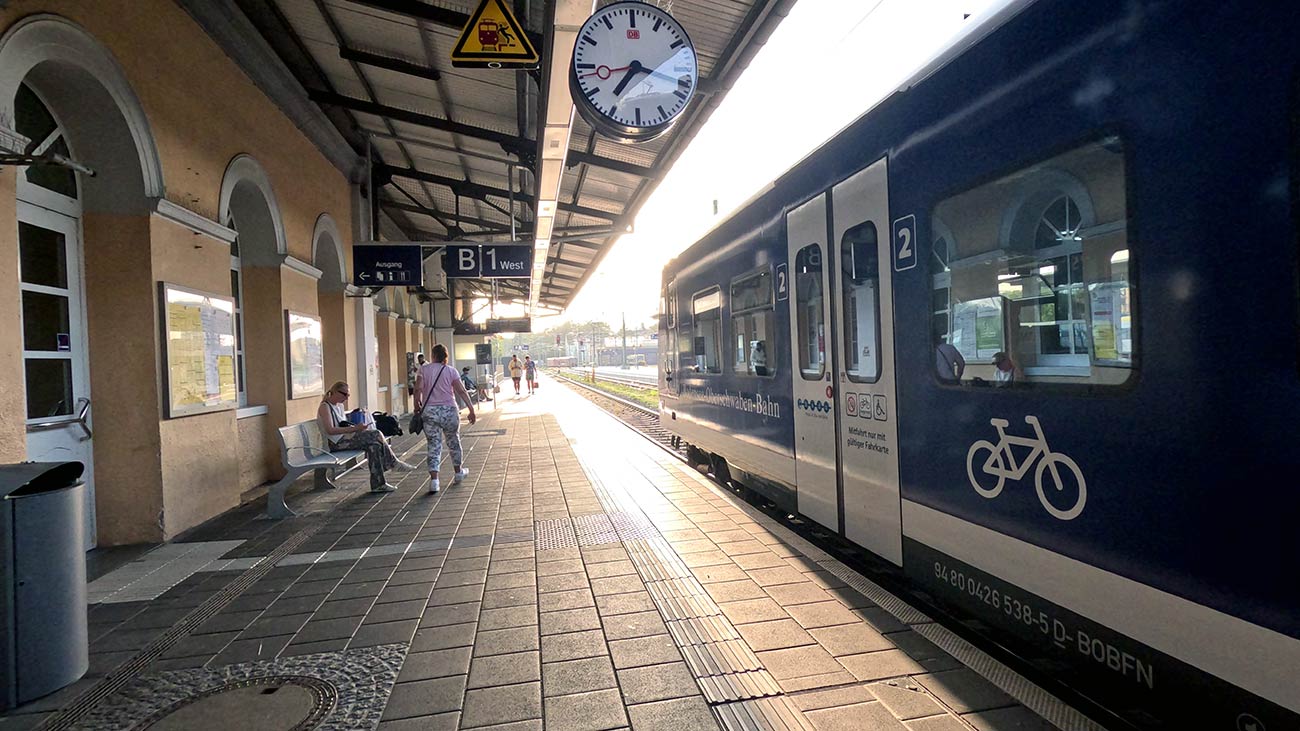
This part of Germany is generally very bike-friendly when it comes to rail transport, especially on regional trains, which form the core of mobility for cycle touring along the Danube and Neckar corridors. Most regional services allow bicycle transport without mandatory reservation, although space is limited and operates on a first-come, first-served basis. A separate bicycle ticket is typically required during weekday morning peak hours, or it can be purchased as an affordable regional day pass, while outside peak periods and on weekends bicycle transport is often free across large parts of Baden-Württemberg. Long-distance trains such as IC and ICE require advance bicycle reservations and have limited capacity, so early planning is important for intercity travel. Overall, the system is well adapted to cycle tourism, offering strong flexibility and occasional dedicated bicycle-friendly or seasonal train services that further improve connectivity for travellers leaving the EuroVelo 6 route.
Bikes on Buses
Long-distance bus services in southern Germany are primarily operated by FlixBus, complemented by a smaller number of regional and private coach operators on selected routes. Bicycle transport is available on certain intercity connections, either via external bike racks or in the luggage compartment, but it is not consistently guaranteed across the network and depends on the specific vehicle type and route configuration. Where available, bicycle transport must be reserved in advance and capacity is limited, making it less flexible compared to rail services. As a result, buses are generally used as a secondary option for cyclists, mainly for longer-distance repositioning between major cities rather than as a core part of cycling itineraries along the Danube region. While useful in specific cases where rail connections are less convenient, they are less predictable and less standardized for bicycle transport, so advance planning is essential.
Arriving at Friedrichshafen Stadt Station
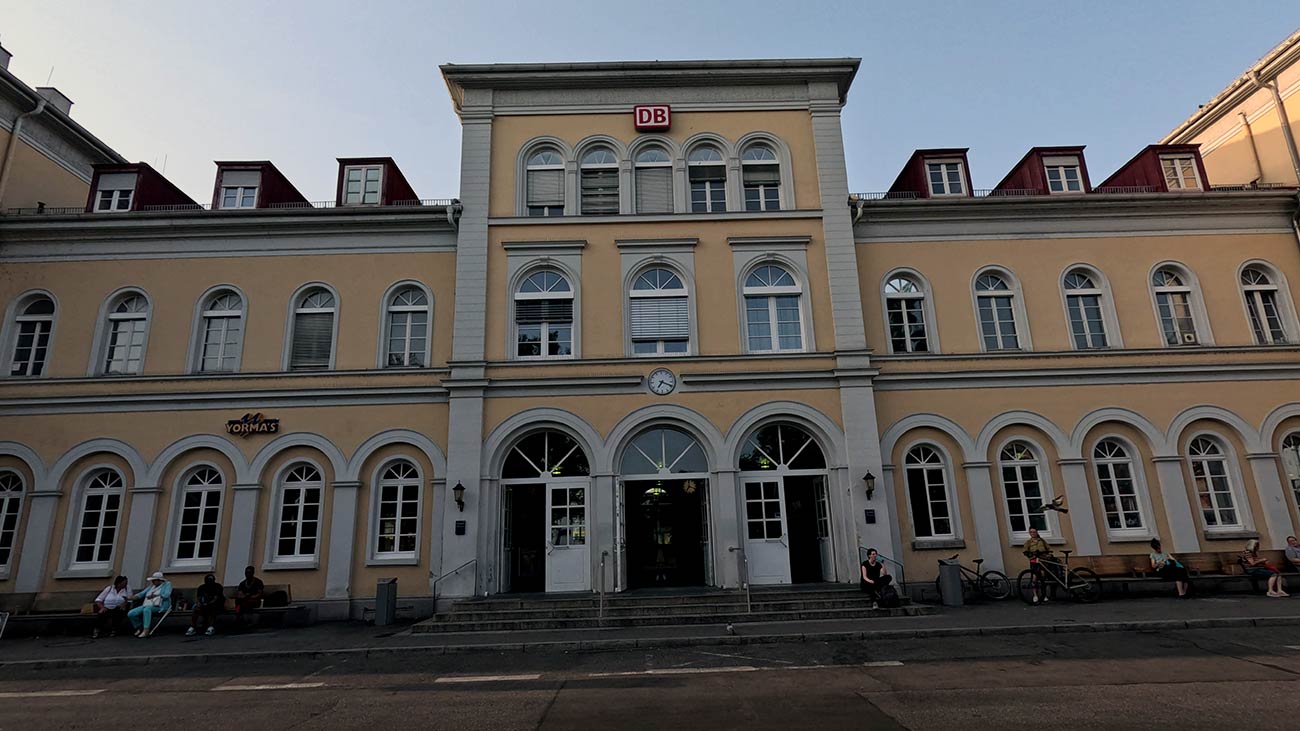
Friedrichshafen’s central station sits at the western edge of the lakefront, only a short walk or ride from the Lakeside Promenade, the Castle Church, and the harbour. The Zeppelin Museum is around a kilometre east along the promenade, reachable on foot in fifteen minutes or by bike in just a few. The Mole Tower is at the end of the harbour mole next to the catamaran terminal, and the entire central area is largely flat and well suited to cycling. The Dornier Museum lies further out next to the airport and is best reached by local bus or by bike along signposted cycle paths from the centre. A second small station, Friedrichshafen Hafen, sits directly at the harbour itself and is convenient for travellers arriving by boat. For onward travel, the same rail and ferry connections link Friedrichshafen back toward Ulm, Ravensburg, the Danube region, and the wider lake corridor, so the city works equally well as a one-day excursion or as a longer base for exploring both sides of Lake Constance. Cycling infrastructure across the city is well developed: besides racks at the station there is a free self-service bike repair station with a pump, tyre levers, and basic tools is available at Antoniusplatz in the centre of the city for quick adjustments and roadside fixes while passing through.