Balaton Lake
Reading time: 10 minutes
LAKE BALATON, VESZPRÉM COUNTY, HUNGARY
Slow Down at the Hungarian Sea
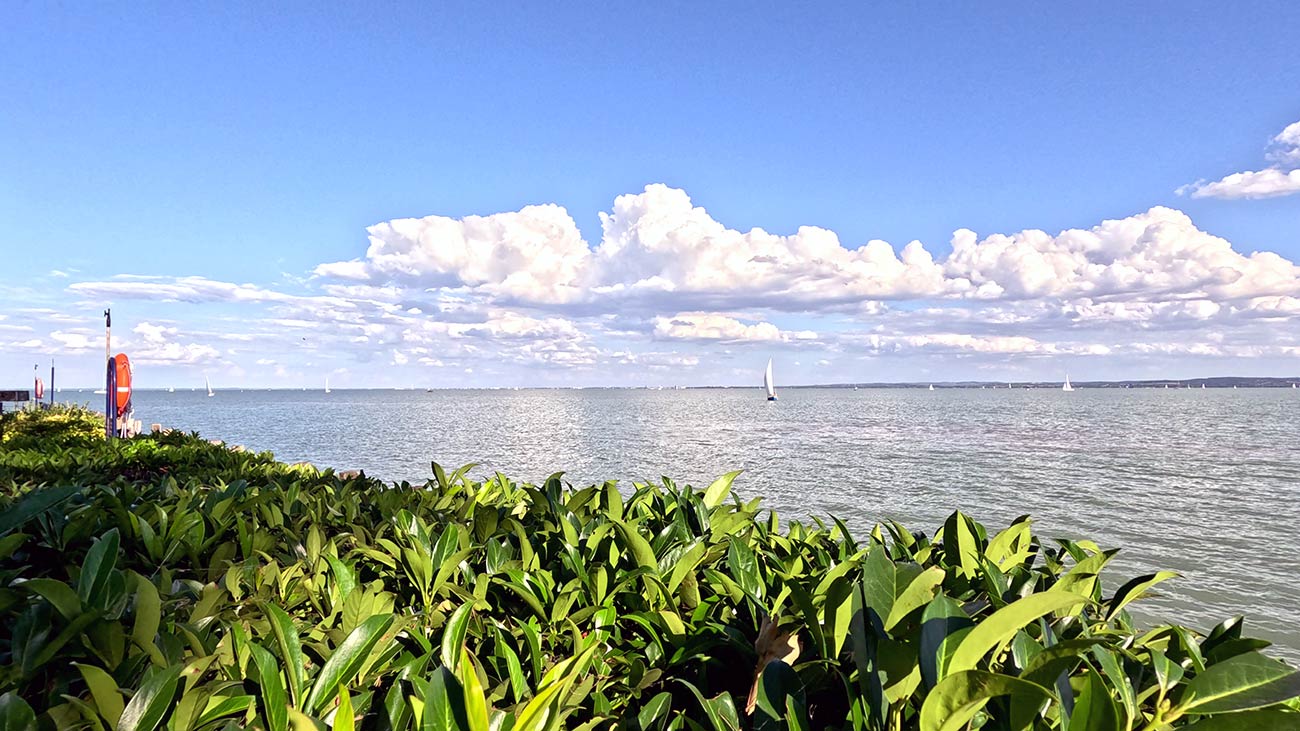
Lake Balaton stretches some 77 kilometres along Hungary’s Transdanubian heart, wide enough that Hungarians have long called it their sea. The northern shore, where this detour unfolds, is the quieter and more layered of the two: volcanic hills rise behind the waterline, vineyards climb the slopes above Olaszrizling country, and basalt uplands fold into the protected landscapes of the Balaton Uplands National Park. The water itself is shallow and warms early, turning a soft jade-green under summer light.
Balatonfüred anchors this shore and serves as the natural base for exploring it. The town built its identity on carbonated mineral springs, declared a spa as far back as the 1770s and reaching its cultural peak during the Reform Era of the early nineteenth century, when politicians, writers and actors gathered here each summer. That heritage still shapes the place: a cardiac hospital draws on the same spring water, the Anna Ball has run as an annual tradition since 1825, and the lakeside walk carries the name of an Indian Nobel laureate who recovered in the town in 1926. Across the water, the Tihany peninsula carries an even older story, with a Benedictine abbey founded in the eleventh century crowning its volcanic ridge.
Reaching the lake from EuroVelo 6 means a train out of Budapest, the route’s Danube gateway, with a direct service delivering you to Balatonfüred in around two hours. A day here tends to follow the shoreline: a morning along the promenade and through the historic streets, a ferry or short bus ride to Tihany for the abbey and the peninsula’s viewpoints, and an unhurried return as the light softens over the lake. Two days lets you fold in the wine villages and the uplands without rushing.
LakeWindViewsParks
Around the Lake from Balatonfüred
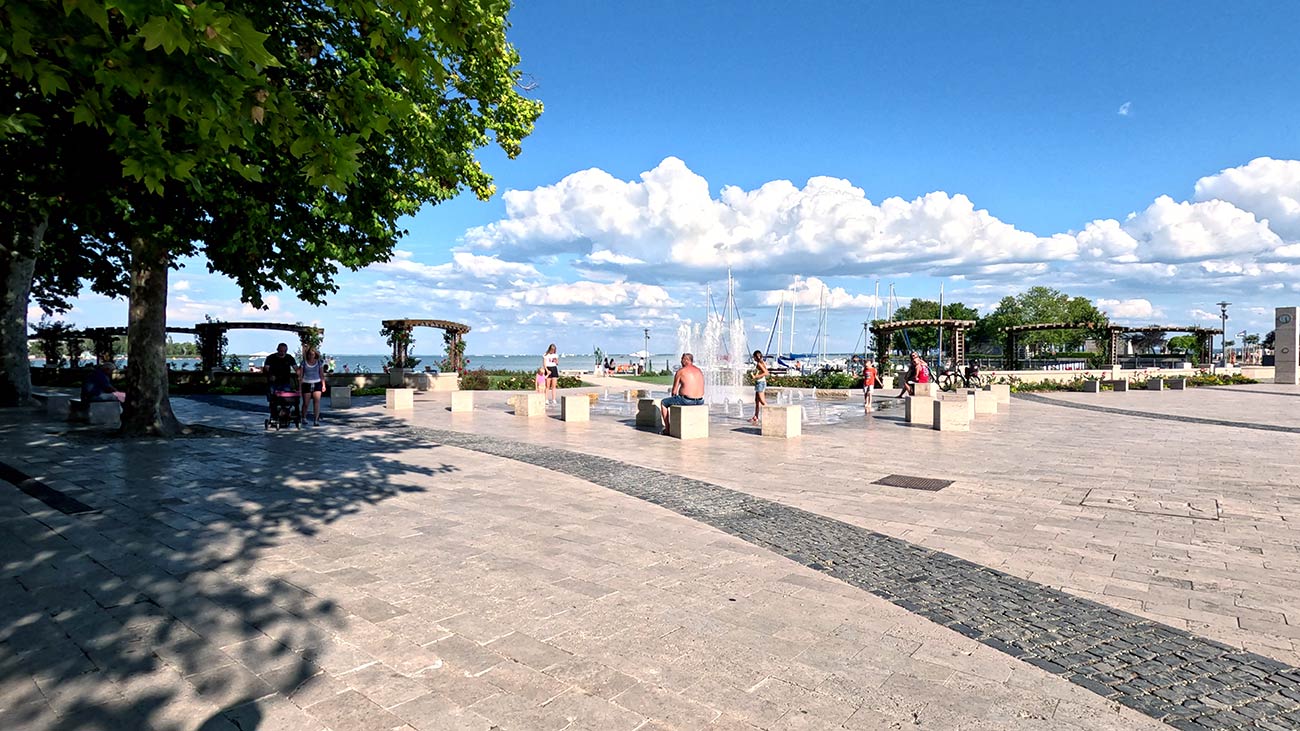
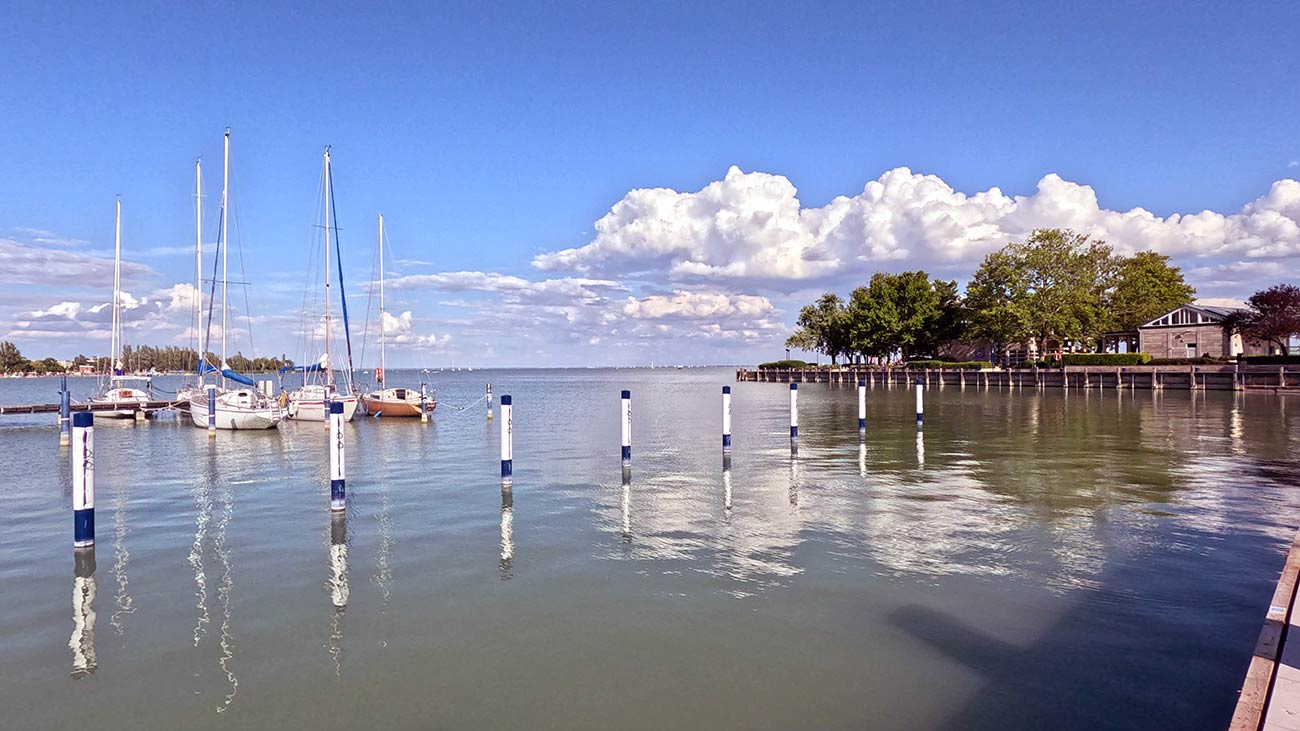
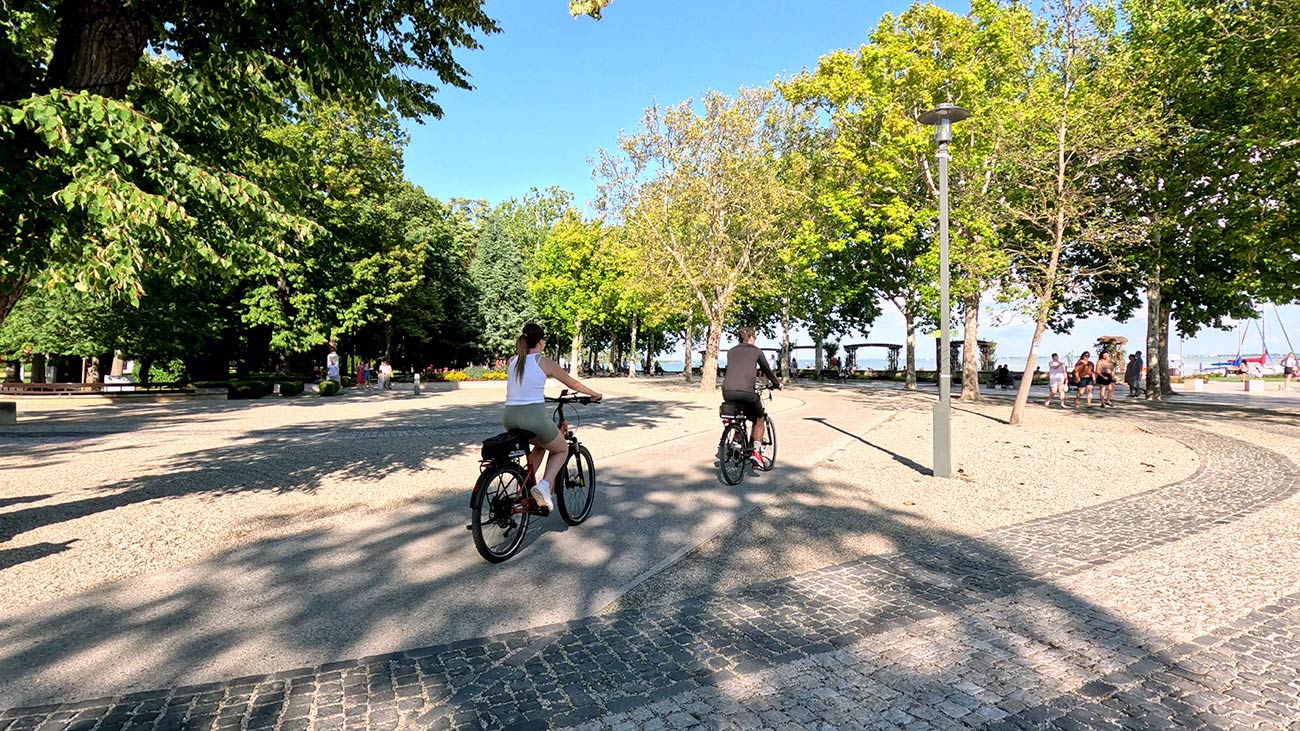
Most visits begin on the Tagore Promenade (Tagore sétány), the tree-lined waterfront walk that runs for roughly a kilometre along Balatonfüred’s shore. The poet Rabindranath Tagore planted the first tree here as thanks for his treatment, and the custom of guests planting their own has continued since, leaving an avenue dotted with statues, busts and memorial plaques. Cafés and marinas line the route, and the promenade doubles as a cycle path, so it folds easily into a day on two wheels. A short walk uphill from the water leads into the Old Town, where Neoclassical villas, the early stone theatre and reform-era townhouses recall the years when Balatonfüred was the gathering point of Hungary’s intellectual life.
From the harbour, Tihany (Tihany-félsziget) sits just across the bay, reachable by ferry in about half an hour or by local bus in roughly the same time. The peninsula is volcanic in origin, ridged with old thermal-spring cones and split by an enclosed Inner Lake (Belső-tó) that lies separate from Balaton itself. At the highest point stands the Tihany Abbey (Tihanyi bencés apátság), a Benedictine monastery founded in 1055 by King Andrew I, whose tomb survives in the Romanesque crypt beneath the church. The building you see today is an eighteenth-century Baroque reconstruction, raised after the original was battered through the Ottoman period. Its founding charter holds particular weight in Hungarian culture: written mostly in Latin, it contains scattered Hungarian words and phrases and counts as the earliest surviving written record of the language. The terrace beside the abbey gives one of the broadest outlooks over the lake.
Viewpoints, in fact, are part of what draws people to the northern shore at all. The land rises sharply behind the water here, and marked trails through the uplands lead to lookouts above Balatonfüred and across the wider Balaton highlands, where the view takes in the open water, the patchwork of vineyards and the long line of the southern shore beyond. Coming back across the bay by ferry offers its own perspective, with the abbey on its ridge and sailing boats scattered over the green water. None of these spots asks for much effort, and the reward is a clear sense of the lake’s full shape, something difficult to grasp from the shoreline alone.
 Useful Links
Mobility for Cyclists
The connection
The gateway is Budapest, where EuroVelo 6 meets the lake’s rail connection. MÁV-START runs direct trains from Budapest’s Southern station (Déli pályaudvar) to Balatonfüred along the northern shore, with the journey taking around two hours and services running frequently through the day, more so in the summer season. The line continues west past Balatonfüred toward Csopak and the far end of the lake, while a short inland branch reaches Veszprém, so the town reads naturally as one stop on a longer northern-shore itinerary. Bikes travel on MÁV regional trains with a separate bike ticket; the one point to plan around is high summer, when bike space on Balaton-bound trains can fill quickly, so boarding early or reserving where possible is worthwhile. Onward, a scheduled ferry crosses to Siófok on the southern shore, and the Balaton bike ring (Balatoni Bringakörút) loops the entire lake for those continuing by bicycle.
Hungarian Trains
The rail network in Hungary is operated mainly by MÁV-START, the passenger arm of the Hungarian State Railways (Magyar Államvasutak), which runs most long-distance services and a large share of regional connections across the country. Alongside MÁV-START, the private operator GySEV / Raaberbahn (Győr-Sopron-Ebenfurti Vasút) runs cross-border lines in the western part of the country toward Austria, while a smaller number of regional operators run local and feeder lines on selected routes. All operators are fully integrated into the national rail system, so transfers between them are straightforward. The Hungarian rail network is organised around Budapest, with high-frequency InterCity and EuroCity services radiating out from the capital toward Lake Balaton, the Croatian border, the Carpathian foothills, and the eastern plains, alongside a dense network of regional and local services. The Danube region in Hungary is particularly well served by rail, with the main north-south corridor running close to the river from the Slovak border through Budapest and onward toward Mohács, and several east-west lines branching out to inland destinations. The MÁV app is the central tool for planning journeys, checking timetables, and purchasing tickets across all services, including both regional and long-distance trains.
Taking your bike
Hungary is generally very bike-friendly when it comes to rail transport, especially on regional services operated by MÁV-START, which form the core of mobility for cycle touring along the Danube and its connecting corridors. On regional and local trains, bicycles can be taken on board for an additional fee, with no advance reservation possible and a first-come, first-served allocation of space. Bicycle tickets are sold as single trips or as affordable daily or weekly passes, valid across the regional network. On long-distance services such as InterCity and EuroCity trains, an advance reservation for the bicycle is mandatory, with the bike spaces located in dedicated zones in second-class carriages. The private operator GySEV / Raaberbahn, which runs cross-border services in the western part of the country, also accepts bicycles on board with broadly similar rules. Folding bikes are carried free of charge as hand luggage on all operators, provided they fit in the luggage racks. Overall, the Hungarian rail system is well adapted to cycle tourism and offers a flexible combination of train and bike that makes it easy to leave the EuroVelo 6 route in either direction for short or extended detours.
Bikes on Buses
Long-distance bus services in Hungary are primarily operated by Volánbusz, the national coach operator now consolidated under the MÁV group, alongside FlixBus and a smaller number of regional and private operators on selected international and domestic routes. The long-distance bus network is unusually well developed by central European standards, with frequent connections from Budapest to all the major regional centres and a dense web of services across the countryside that complement and sometimes overlap with the rail network. Bicycle transport is available on certain FlixBus connections, either via external bike racks or in the luggage compartment, but it is not consistently guaranteed across the network and depends on the specific vehicle type and route configuration. Where available, bicycle transport must be reserved in advance and capacity is limited, making it less flexible compared to rail services. Volánbusz coaches generally do not carry assembled bicycles, although folded or packed bikes may be accepted as luggage on a case-by-case basis. As a result, buses are generally used as a secondary option for cyclists, mainly for longer-distance repositioning between major cities rather than as a core part of cycling itineraries along the Danube region. While useful in specific cases where rail connections are less convenient, they are less predictable and less standardised for bicycle transport, so advance planning is essential.
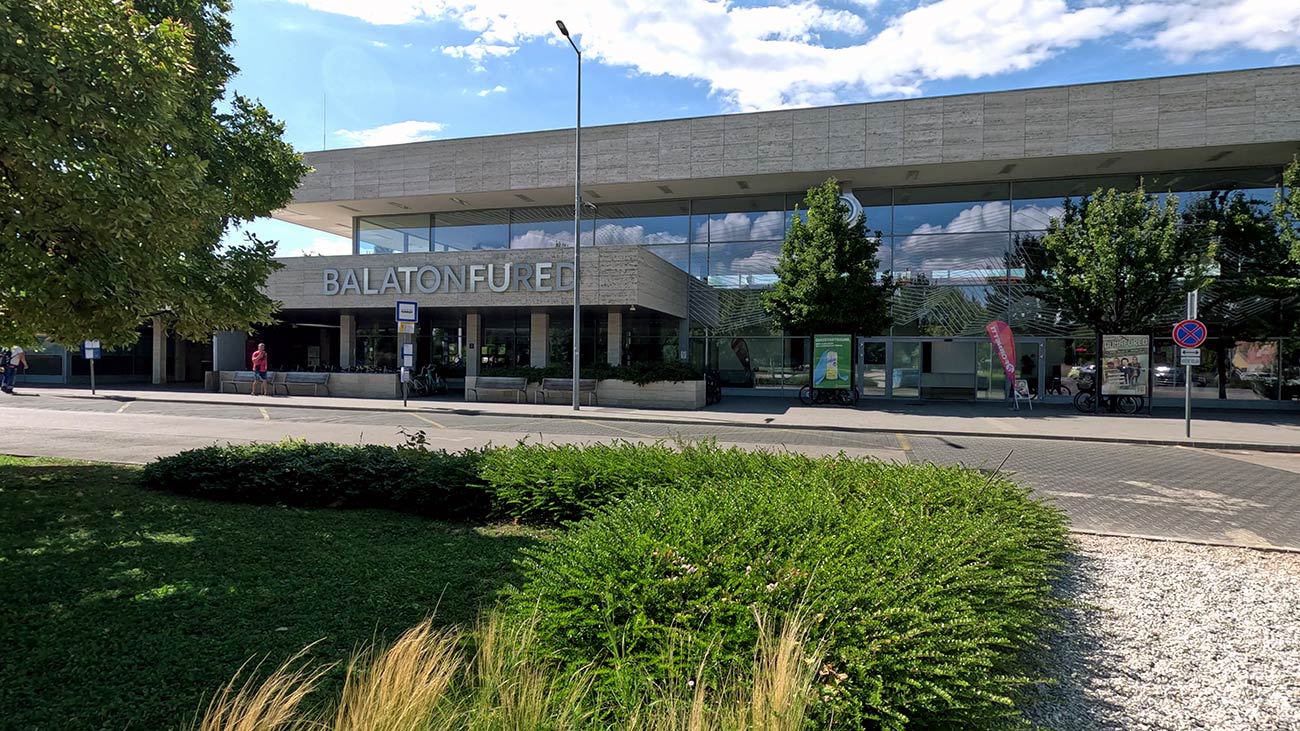
Arriving at Balatonfüred Station
Balatonfüred’s station sits roughly a kilometre back from the waterfront, with the lake and the Tagore Promenade gently downhill to the south and the Old Town a short rise to the north. The walk down to the shore is easy and well signposted, and the centre is compact enough to cover on foot. Cyclists will find the promenade and lakeside paths bike-friendly and tied directly into the Balaton bike ring. Tihany itself has no rail station; the practical approach is to leave heavier luggage in Balatonfüred and cross by ferry or local bus, bearing in mind the climb up to the abbey at the top of the peninsula. Local buses and the seasonal ferry handle onward hops along the shore, so the town works equally well as a single-day visit or the start of a longer loop around the lake.