Pannonhalma Archabbey
Reading time: 13 minutes
PANNONHALMA, GYŐR-MOSON-SOPRON COUNTY, HUNGARY
Hungary’s Oldest Monastery on Saint Martin’s Hill
In the gently rolling country south of the Danube, about twenty kilometres south-east of Győr, a long pale ridge rises out of the Pannonian plain and climbs to a single wooded peak. On the summit, visible from far across the surrounding farmland, stands the Archabbey of Pannonhalma (Pannonhalmi Főapátság), the oldest Benedictine monastery in Hungary and one of the oldest in central Europe. Founded in 996 by Grand Prince Géza, father of King Saint Stephen, the abbey has stood here for more than a thousand years, surviving fires, Tatar invasions, the Ottoman occupation, and the political upheavals of the twentieth century. It remains, today, what it was at the beginning: a living religious community of around fifty Benedictine monks, dedicated to prayer, study, and the quiet preservation of a remarkably continuous European tradition.
The hill on which the abbey stands has been sacred long before the foundation of the monastery. According to local tradition, Saint Martin of Tours, the fourth-century bishop and one of the most beloved saints of medieval Europe, was born at the foot of this hill, in what was then the Roman province of Pannonia. The site has been known ever since as Saint Martin’s Hill (Márton-hegy), and the patron of the abbey has remained Saint Martin himself. Roman wine production once flourished on these slopes, and the monks revived the tradition in later centuries, alongside the cultivation of medicinal herbs, the copying of manuscripts, and the running of one of the earliest schools in Hungary. In 1996, on the millennium of the abbey’s foundation, the entire complex was inscribed as a UNESCO World Heritage Site, formally recognising both its religious heritage and its natural landscape.
For cyclists exploring the Danube along the EuroVelo 6, Pannonhalma is one of the most rewarding spiritual and cultural detours from the Hungarian stretch of the route. The abbey lies a short rail or bus journey south of Győr, the main Hungarian Danube city on the EuroVelo 6 between Bratislava and Budapest, and the trip fits comfortably into a half-day or full-day excursion. A day spent moving between the basilica, the cloister, the library, and the vineyards of the surrounding slopes gives a complete sense of how a Benedictine community has shaped a corner of central Europe for more than a millennium.
A Thousand Years of Monastic Life on Saint Martin’s Hill
The story of Pannonhalma begins in 996, when Grand Prince Géza invited Benedictine monks from Bohemia to settle on the sacred hill above the Pannonian plain. The community grew quickly under his son, King Saint Stephen, the founder of the Christian Hungarian state, who in 1001 placed the monastery directly under the Holy See and endowed it with extensive estates and privileges. The first abbot, Astrik (Anastasius), is best remembered today as the figure who is said to have travelled to Rome to bring back the holy crown that Stephen received at his coronation. From these early years, the monastery became the spiritual centre of the Benedictine order in Hungary and one of the most important cultural institutions in the kingdom, with a working scriptorium, a school, and an archive that grew across the medieval centuries. From 1514, the community was formally elevated to the rank of archabbey, the highest dignity within the Benedictine order, a status it has retained ever since.
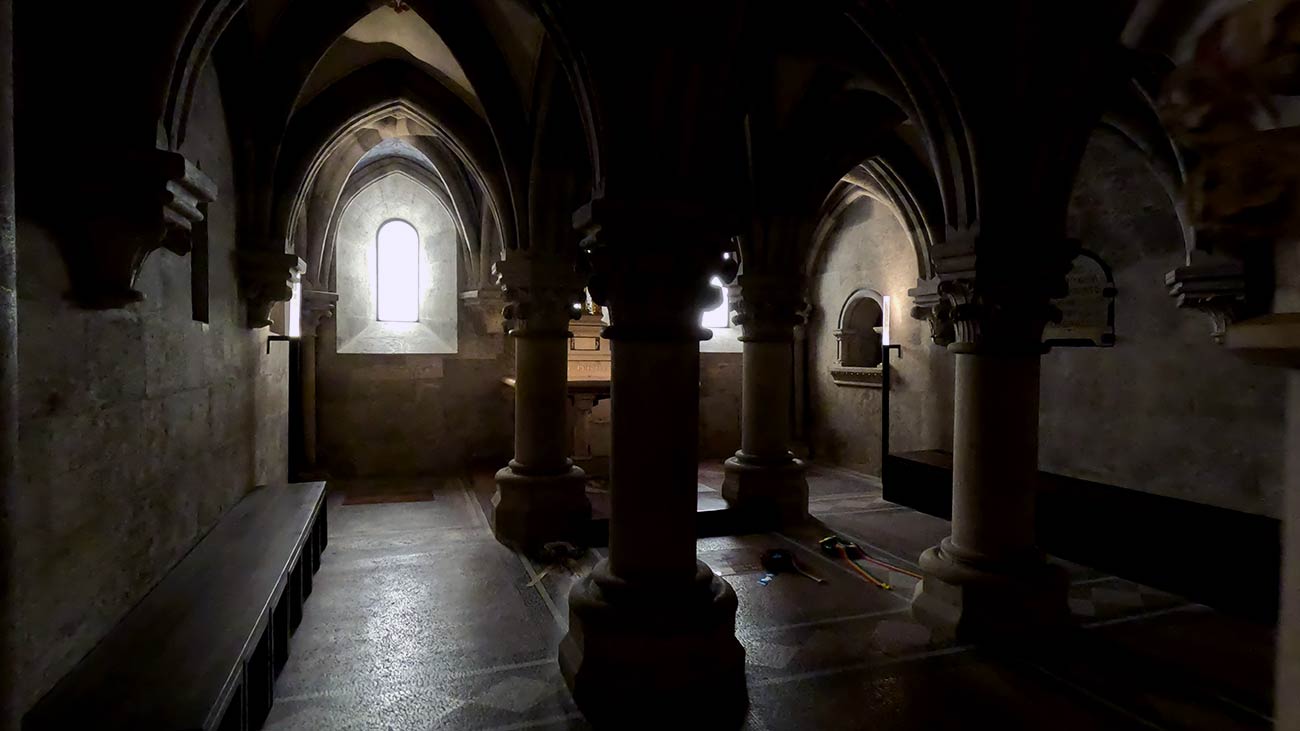
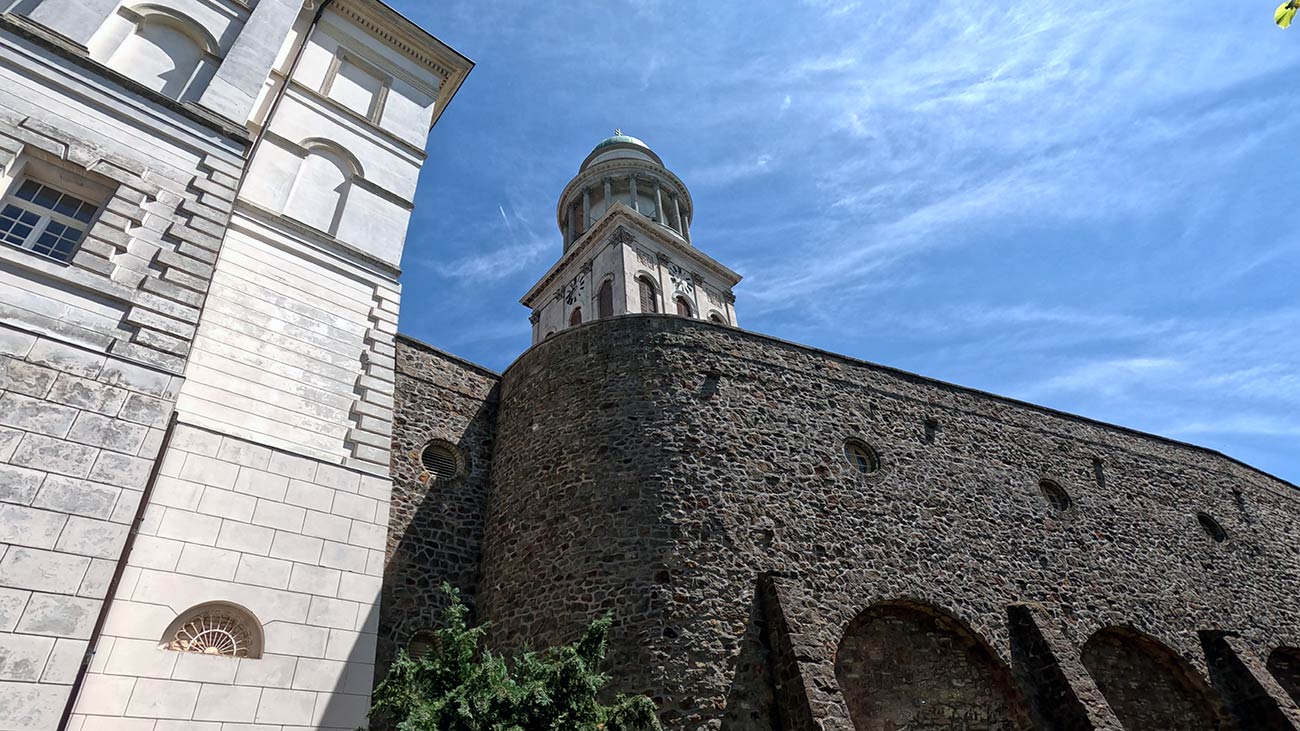
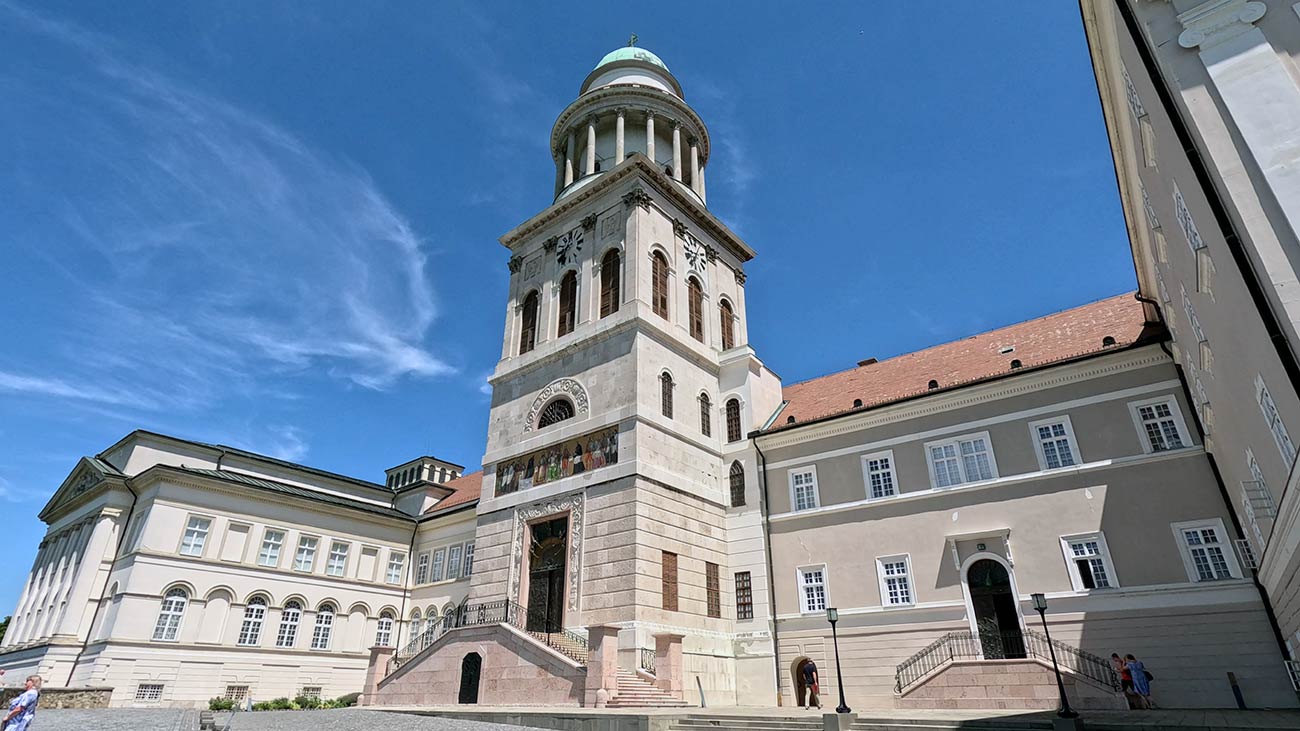
The architectural heart of the complex is the Basilica of Saint Martin (Szent Márton-bazilika), the third church to stand on this site. Construction of the present building began under Abbot Uros in the early thirteenth century, and the basilica was consecrated in 1224 in the presence of the papal legate and the royal court. The early-Gothic structure incorporates remains of its Romanesque predecessors, and the southern aisle wall preserves elements from the eleventh century. Beneath the choir lies the crypt, one of the oldest sections of the complex, with sturdy Romanesque vaulting and an atmosphere of deep quiet. The basilica’s interior was thoughtfully reordered in 2012 to a design by the English architect John Pawson, in a project that combined contemporary minimalism with respect for the medieval fabric, creating one of the most striking sacred interiors in central Europe. Adjoining the basilica, the elegant Cloisters were rebuilt in 1486 under King Matthias Corvinus (Mátyás király), and they retain their late-Gothic vaulting and slender columns. The richly carved Porta Speciosa (the Beautiful Gate), a thirteenth-century portal that once led from the cloister into the basilica, has been called one of the most important pieces of medieval stonework in Hungary.
The undisputed cultural highlight of the abbey is the Library (Főapátsági Könyvtár), one of the oldest and most important historic libraries anywhere in Hungary, with a collection of over 400,000 volumes and manuscripts. The neoclassical library hall was designed by Ferenc Engel in the 1820s and extended by János Packh, who also worked on the Esztergom Basilica, with the spectacular elliptical hall as the centrepiece. The interior was painted by the Vienna master Joseph Klieber, who used a remarkable trompe-l’œil technique: what appears to be polished marble is in fact wood painted to imitate stone. A subtle system of mirrors set into the skylights reflects and redirects natural light through the room, illuminating the books without exposing them to direct sun. The four ceiling allegories represent the medieval university faculties of theology, law, medicine, and the arts. The collection holds some of the most precious documents in Hungarian history, including the Foundation Charter of Tihany Abbey from 1055, the oldest known document to contain words in the Hungarian language. Manuscripts copied here since the time of King Saint Stephen and King Saint Ladislaus have been catalogued in Pannonhalma since the early medieval period, when the abbey effectively functioned as the national archive.
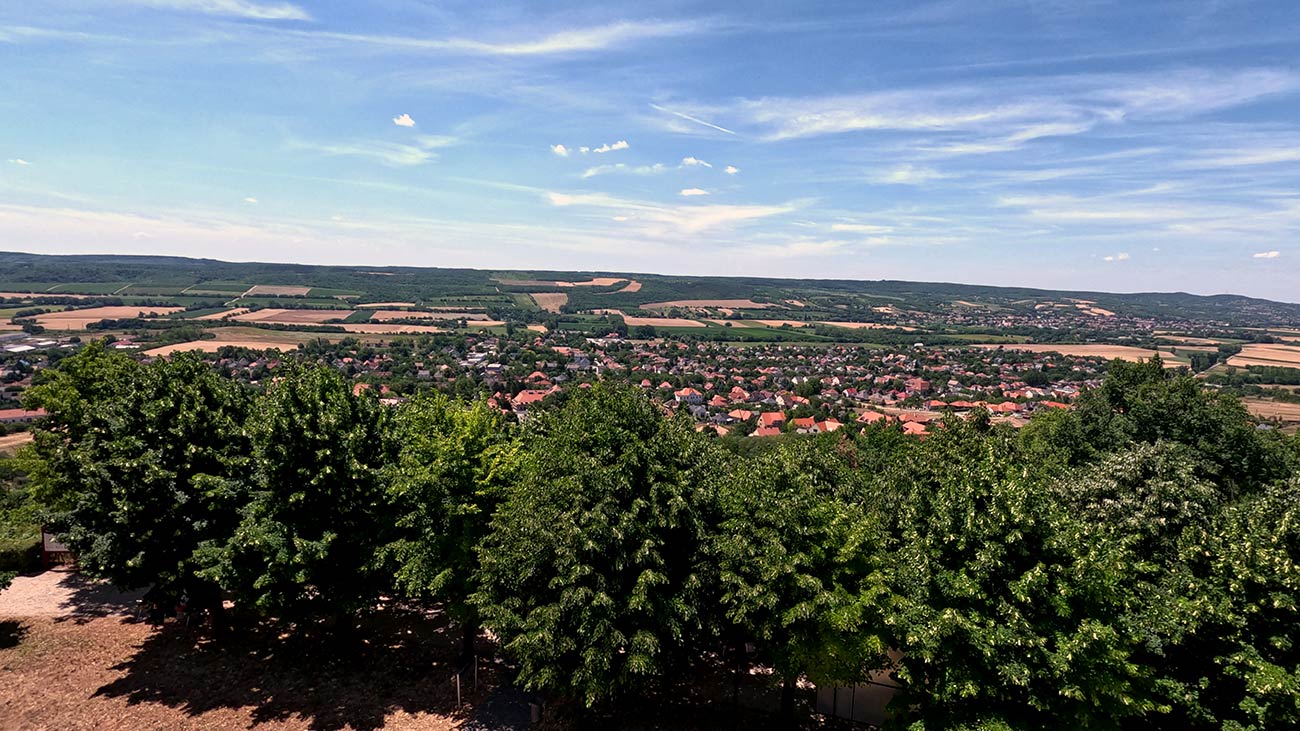
Beyond the basilica and the library, the abbey complex offers a remarkably wide range of further attractions, all woven into the working life of the monastery. The Abbey Museum and Gallery (Apátsági Múzeum és Galéria), opened in 2014 in a restored manor in the town centre, holds the second-largest religious art collection in Hungary, with two permanent exhibitions and rotating temporary displays. The Abbey Winery (Apátsági Pincészet) continues a viticulture tradition that reaches back to Roman times, with the monks today producing a range of award-winning wines from the steep south-facing slopes around the hill; a modern wine cellar offers tastings and tours throughout the year. The Botanical and Herbal Garden (Arborétum és Gyógynövénykert) cultivates more than 400 species of medicinal and aromatic plants, the foundation for the herbal liqueurs, soaps, cosmetics, and infusions that the monastery produces and sells. A modern Treetop Walkway above the hillside forest offers panoramic views across the Pannonian plain, while smaller landmarks across the grounds include the Our Lady Chapel, the Millennium Memorial marking the abbey’s thousand-year jubilee, and the PAUSA Abbey Coffee House in the town centre, where coffees and teas are flavoured with herbs from the monastery’s own garden. Together, these living elements turn what could have been a static monument into a working centre of European culture, exactly as the founding charters intended.
 Useful Links
Mobility for Cyclists
The connection
The most practical connection from t is from Győr, where MÁV-START regional trains run directly to Pannonhalma in around 25 minutes, with departures roughly every two hours. A more frequent alternative is the Volánbusz intercity coach service (line 7030), which runs hourly from Győr’s main bus station to Pannonhalma in around 29 to 34 minutes, with two useful stops in town: Pannonhalma, vár főkapu (the closer one, just below the abbey gates) and Pannonhalma, takarékszövetkezet (in the town centre). Cyclists riding the Hungarian stretch of the EuroVelo 6 will find Győr the natural transfer point, and the trip fits comfortably into a half-day or full-day excursion. The visit also combines well with Zirc Abbey further south in the Bakony mountains or with a longer stay in Győr itself, one of the most underappreciated Baroque towns in Hungary.
Hungarian Trains
The rail network in Hungary is operated mainly by MÁV-START, the passenger arm of the Hungarian State Railways (Magyar Államvasutak), which runs most long-distance services and a large share of regional connections across the country. Alongside MÁV-START, the private operator GySEV / Raaberbahn (Győr-Sopron-Ebenfurti Vasút) runs cross-border lines in the western part of the country toward Austria, while a smaller number of regional operators run local and feeder lines on selected routes. All operators are fully integrated into the national rail system, so transfers between them are straightforward. The Hungarian rail network is organised around Budapest, with high-frequency InterCity and EuroCity services radiating out from the capital toward Lake Balaton, the Croatian border, the Carpathian foothills, and the eastern plains, alongside a dense network of regional and local services. The Danube region in Hungary is particularly well served by rail, with the main north-south corridor running close to the river from the Slovak border through Budapest and onward toward Mohács, and several east-west lines branching out to inland destinations. The MÁV app is the central tool for planning journeys, checking timetables, and purchasing tickets across all services, including both regional and long-distance trains.
Taking your bike
Hungary is generally very bike-friendly when it comes to rail transport, especially on regional services operated by MÁV-START, which form the core of mobility for cycle touring along the Danube and its connecting corridors. On regional and local trains, bicycles can be taken on board for an additional fee, with no advance reservation possible and a first-come, first-served allocation of space. Bicycle tickets are sold as single trips or as affordable daily or weekly passes, valid across the regional network. On long-distance services such as InterCity and EuroCity trains, an advance reservation for the bicycle is mandatory, with the bike spaces located in dedicated zones in second-class carriages. The private operator GySEV / Raaberbahn, which runs cross-border services in the western part of the country, also accepts bicycles on board with broadly similar rules. Folding bikes are carried free of charge as hand luggage on all operators, provided they fit in the luggage racks. Overall, the Hungarian rail system is well adapted to cycle tourism and offers a flexible combination of train and bike that makes it easy to leave the EuroVelo 6 route in either direction for short or extended detours.
Bikes on Buses
Long-distance bus services in Hungary are primarily operated by Volánbusz, the national coach operator now consolidated under the MÁV group, alongside FlixBus and a smaller number of regional and private operators on selected international and domestic routes. The long-distance bus network is unusually well developed by central European standards, with frequent connections from Budapest to all the major regional centres and a dense web of services across the countryside that complement and sometimes overlap with the rail network. Bicycle transport is available on certain FlixBus connections, either via external bike racks or in the luggage compartment, but it is not consistently guaranteed across the network and depends on the specific vehicle type and route configuration. Where available, bicycle transport must be reserved in advance and capacity is limited, making it less flexible compared to rail services. Volánbusz coaches generally do not carry assembled bicycles, although folded or packed bikes may be accepted as luggage on a case-by-case basis. As a result, buses are generally used as a secondary option for cyclists, mainly for longer-distance repositioning between major cities rather than as a core part of cycling itineraries along the Danube region. While useful in specific cases where rail connections are less convenient, they are less predictable and less standardised for bicycle transport, so advance planning is essential.
Arriving at Pannonhalma Station
Pannonhalma’s small railway station sits at the foot of Saint Martin’s Hill, around three kilometres from the abbey gates on top of the ridge. The road up to the abbey climbs steadily and is best ridden by sporty cyclists on lighter bikes, since the gradient becomes noticeable on the final approach. Travellers with a loaded touring bike may prefer to leave the bike at the station and walk up the marked footpath through the woods, which takes around 40 to 50 minutes one way, or to switch to the Volánbusz line 7030 that stops directly at the abbey gates. The historic complex itself is best explored on foot, with the basilica, cloisters, library, gardens, winery, and viewpoints all within walking distance of each other once you arrive. Bike racks are available at the abbey gates. For onward travel, the same rail and bus services connect back toward Győr and the wider Danube region, so Pannonhalma works equally well as a half-day excursion, a full-day visit, or a longer stop combined with neighbouring destinations in north-western Hungary.