Pécs
Reading time: 14 minutes
PÉCS, BARANYA COUNTY, HUNGARY
Where Ottoman Minarets Meet Roman Tombs
In the gentle hills of southern Hungary, where the slopes of the Mecsek mountains drop down toward the open plain that stretches to the Croatian border, lies one of the most layered cities in central Europe. Pécs was founded by the Romans in the early second century AD as Sopianae, became a Christian centre by the fourth century, was conquered by the Ottoman Turks in 1543, and emerged in the modern era as a cultivated university town, a centre of ceramic art, and in 2010 a European Capital of Culture. The result is a small but unusually dense historic centre, where Roman tombs, an Ottoman mosque, a four-spired Gothic cathedral, and a glowing-tiled Art Nouveau cultural quarter all stand within a few minutes' walk of each other.
The city has been continuously inhabited for almost two thousand years, and its older names tell the story of who has held it. To the Romans it was Sopianae, to medieval Hungarians it became Pécs, the Turks during their 143-year occupation called it Peçuy, and the Germans of the surrounding region still know it as Fünfkirchen, the Five Churches. Each layer left its monument, and unusually for the region none of them was entirely removed when the next arrived. The most famous building in the city is in fact a former Ottoman mosque that became a Catholic church, the most important archaeological site is a Roman cemetery preserved beneath today's cathedral square, and even the modern Zsolnay porcelain factory has been transformed into a cultural district while the ceramics themselves continue to be made.
For cyclists exploring the Danube along the EuroVelo 6, Pécs is a straightforward and rewarding detour from the Hungarian and Croatian stretches of the route. The city lies around 30 kilometres west of Mohács on the Hungarian Danube, and roughly 70 kilometres north of Osijek across the Croatian border, both of which sit directly on or near the river corridor. A day or two spent moving between the Roman necropolis, the Ottoman mosque, the cathedral, and the Zsolnay Cultural Quarter offers an unusually concentrated walk through almost two thousand years of European history within a few square kilometres.
UNESCOMosqueMecsekWines
A Roman City, an Ottoman Mosque, and a Quarter of Glowing Tiles
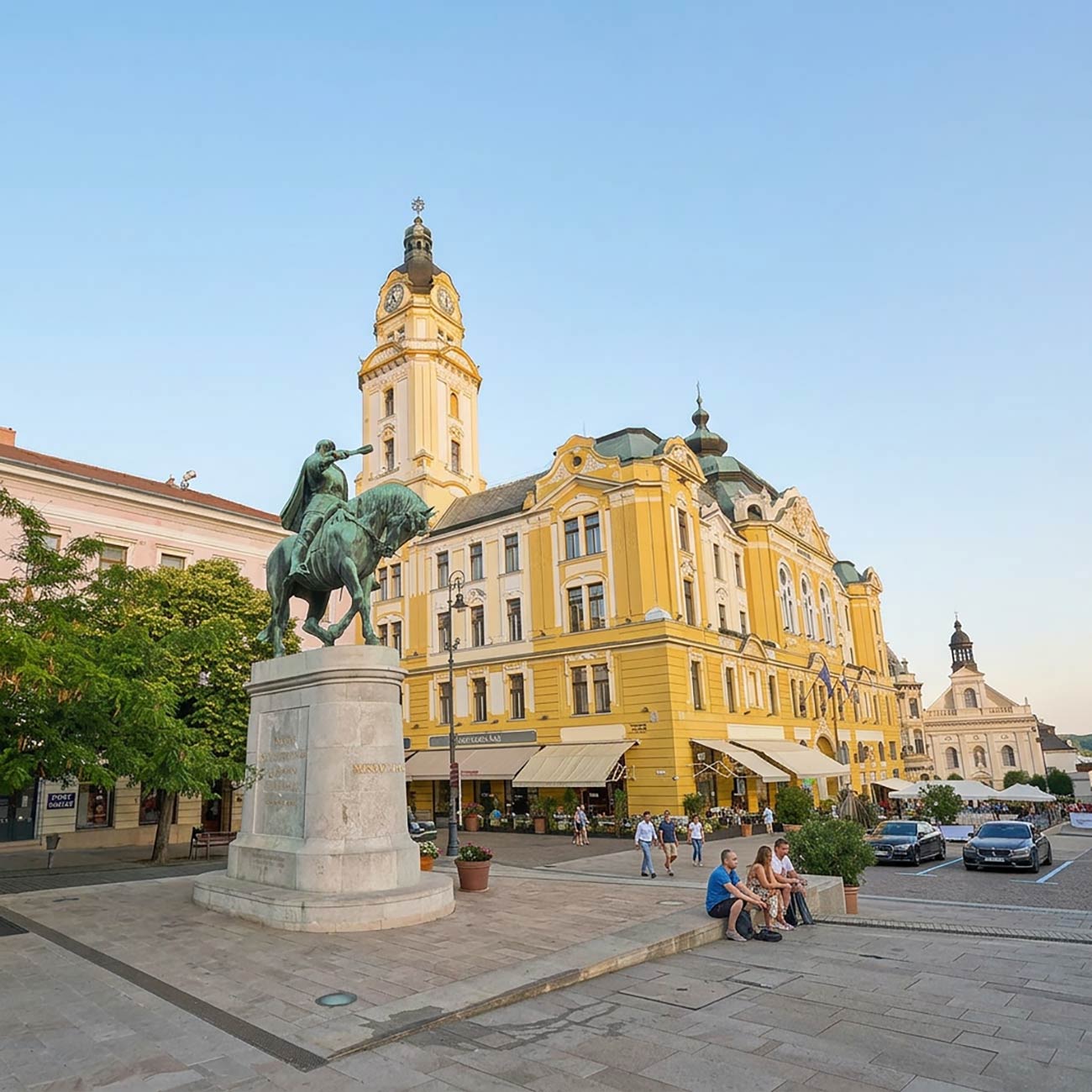
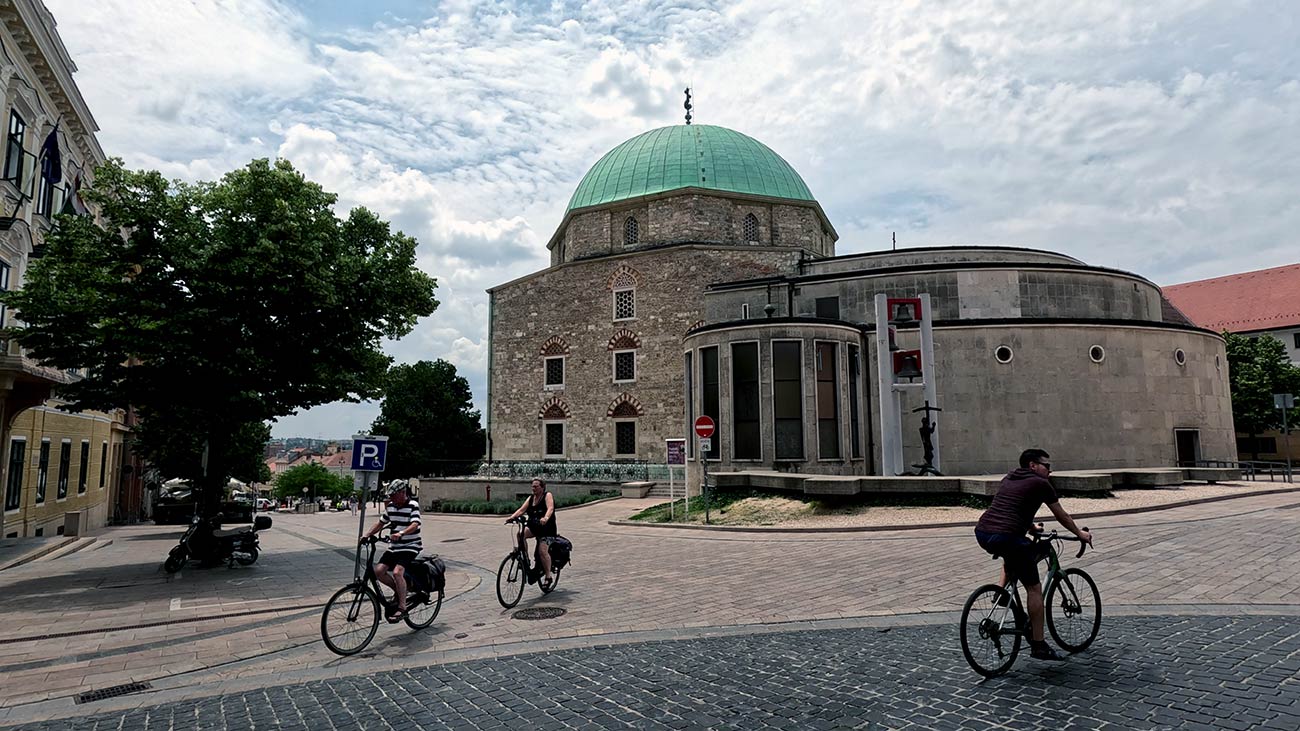
At the head of the central square stands the most distinctive building in Pécs and one of the most unusual sights anywhere in central Europe. The Mosque of Pasha Qasim (Gázi Kászim Pasa dzsámija) was built between 1543 and 1546 under the Ottoman governor Pasha Qasim the Victorious, on the foundations of an earlier medieval church. It is one of the largest surviving pieces of Ottoman religious architecture in Hungary and the most prominent reminder of the long Turkish presence in the city. Its broad pale-stone dome, mihrab niche pointing toward Mecca, and the surviving base of a former minaret are still clearly visible, while the interior preserves Ottoman calligraphic inscriptions alongside the Catholic altars added after the building was returned to Christian worship at the end of the seventeenth century. The mosque-church now functions as the Roman Catholic Inner City Parish Church, and its quiet, simple interior makes a striking contrast with the elaborate Baroque churches typical elsewhere in Hungary.
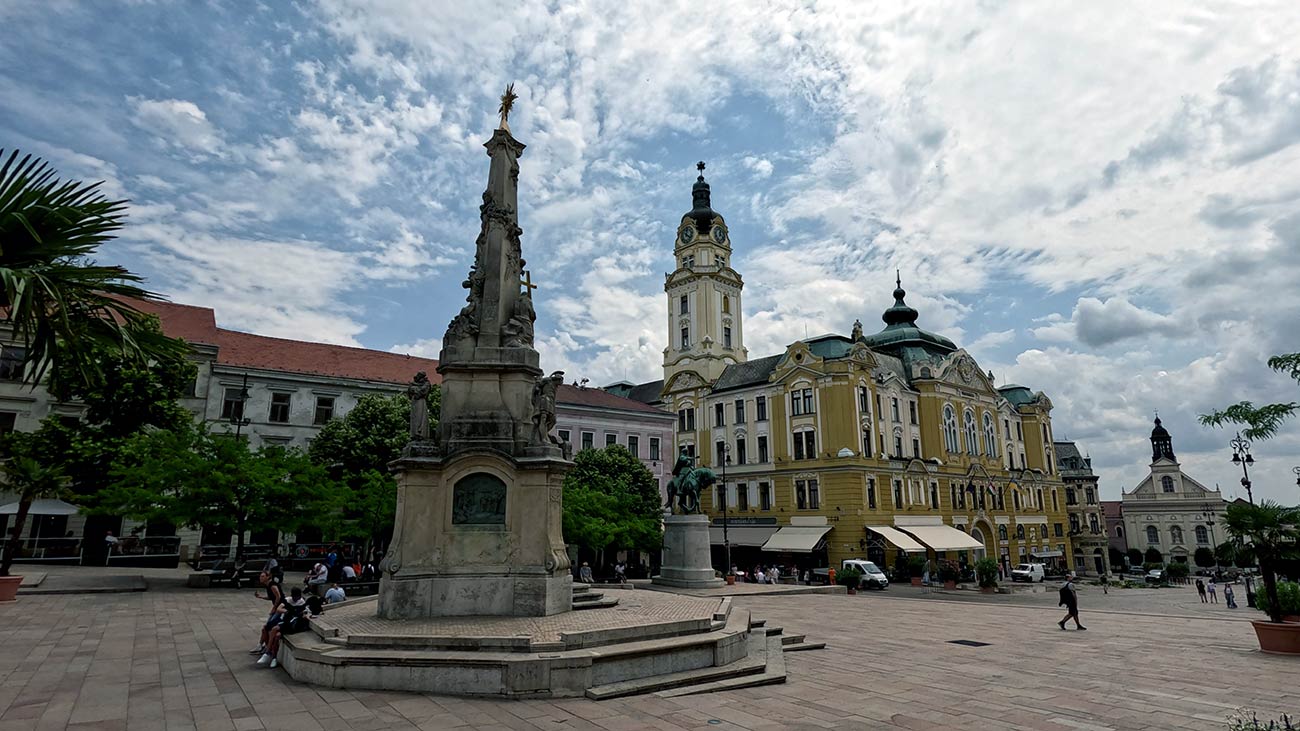
The mosque rises at the upper end of Széchenyi Square (Széchenyi tér), the long sloping main square that has been the civic centre of Pécs for centuries. The space is framed by colourful pastel facades, the elegant Hungarian Art Nouveau City Hall, the County Hall, and the historic Nádor Hotel, and is crossed by long pedestrian routes leading toward all the other main sites in the city. At its centre stands the celebrated Zsolnay Fountain (Zsolnay-kút), an elegant Art Nouveau composition built in 1930 from yellowish-green eosin-glazed pyrogranite, the signature material developed at the local Zsolnay porcelain factory. The fountain's four ornamental ox-head spouts have become one of the symbols of Pécs, and the square as a whole is also home to the Holy Trinity Statue, a Plague Column erected in the early eighteenth century, and a powerful equestrian statue of the medieval Hungarian general János Hunyadi, who famously defended this part of the kingdom against the Ottoman advance. Pavement cafés, ice-cream parlours, and street musicians fill the square through the warmer months, and the lower end of the slope leads naturally into the city's narrow pedestrianised shopping streets.
Just a short walk up the hill from the main square, beneath the open Cathedral Square, lies the most important archaeological site in the city. The Early Christian Necropolis of Pécs, in Hungarian Pécsi ókeresztény sírkamrák, has been a UNESCO World Heritage Site since 2000 and is widely recognised as the largest single Christian burial complex outside Italy. The complex was built in the fourth century AD by the inhabitants of the Roman provincial city of Sopianae, and consists of a network of underground burial chambers, painted memorial chapels, and monumental tombs spread beneath and around the central square. The richly preserved wall paintings, with biblical scenes including Adam and Eve, Daniel in the Lions' Den, and the Magi, are considered among the finest examples of early Christian funerary art anywhere in Europe. Visitors enter through the modern Cella Septichora Visitor Centre, which has been built around the foundations of a remarkable seven-apse memorial chapel and provides access to the most important individual tombs, including the Peter-Paul Tomb, the Jug Tomb, and the Octagonal Tomb.
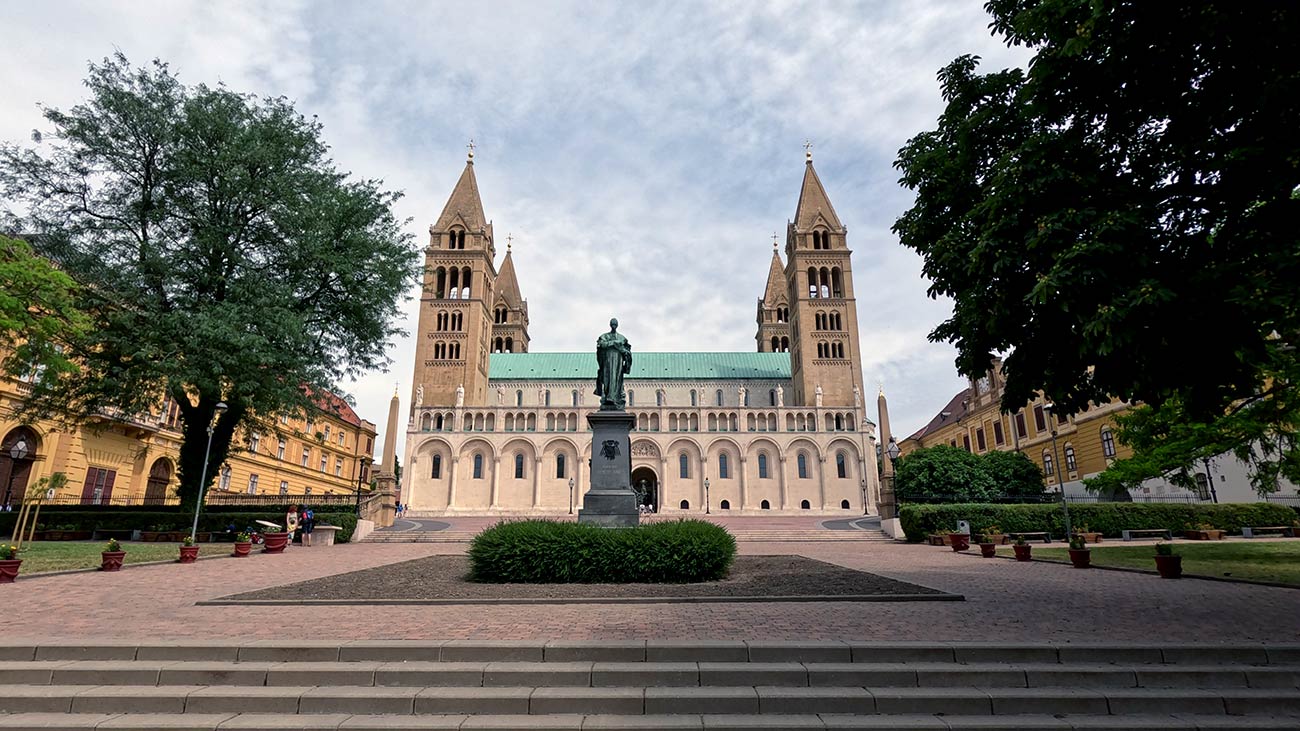
On the western edge of the same square rises Pécs Cathedral (Szent Péter és Szent Pál Székesegyház), the imposing four-spired church dedicated to Saints Peter and Paul. The site has been a place of worship since the early Christian era, and the present building combines a Romanesque core from the eleventh century with extensive nineteenth-century reworkings that gave the cathedral its current striped pale-stone exterior and four corner towers. The interior is dominated by elaborate nineteenth-century mural paintings, a precious medieval crypt, a Romanesque baptismal font, and a treasury of liturgical objects spanning more than a thousand years. Beside the cathedral stands the Bishop's Palace (Püspöki Palota), still used as the residence of the Bishop of Pécs and partially open to visitors, and a short distance away the surviving section of the Barbican (Barbakán) and the city's medieval walls give a clear sense of how the historic centre was fortified during the late Middle Ages.
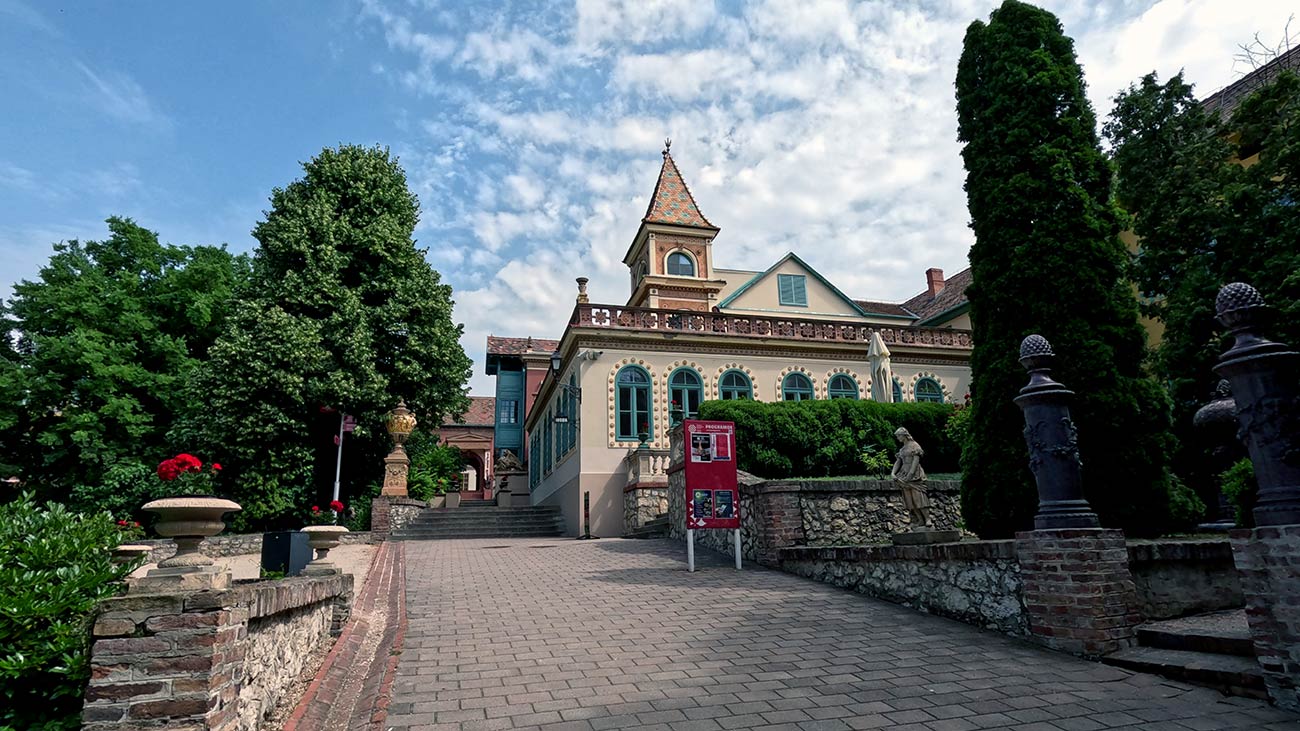
A short walk or short bus ride east of the historic centre lies one of the most ambitious cultural conversions in Hungary. The Zsolnay Cultural Quarter (Zsolnay Kulturális Negyed) occupies the former site of the historic Zsolnay Porcelain Manufactory, founded in the mid-nineteenth century and famous around the world for the iridescent eosin glaze invented there and for the pyrogranite tiles that still decorate buildings as celebrated as the Hungarian Parliament in Budapest. The complex was reopened in 2010 as part of Pécs's preparations for the European Capital of Culture year, and now houses the working ceramics factory, the Zsolnay Museum, a sequence of galleries and exhibition halls, an open-air theatre, restaurants, cafés, and a permanent display of historic Zsolnay pieces in the family villa. Walking the brick-paved streets of the quarter, the tiled facades, ornamental gateways, and chimney towers of the old factory give the place a quiet industrial atmosphere very different from the medieval centre, and it has become one of the most rewarding modern additions to any visit to Pécs.
 Useful Links
Mobility for Cyclists
Reaching the area by train with your bike
Pécs can be reached from the EuroVelo 6 by a single direct rail journey from one of the gateway cities along the Danube and Drava sections of the route. The city lies in southern Hungary, around 30 kilometres west of the Hungarian Danube at Mohács and approximately 70 kilometres north of the Croatian Drava at Osijek, with rail and bus links from both directions.
The connection
The most practical connection from the Hungarian Danube is from Mohács, where Hungarian Railways (MÁV) and Volánbusz buses provide regular onward services. Bus connections are the more frequent option, with around one departure per hour from Mohács bus station, reaching Pécs in about one hour and five minutes. Direct trains also run from the Mohács area to Pécs in around one hour, but with only a small number of departures per day. For cyclists arriving from Croatia, the most practical connection is from Osijek, where Croatian Railways (HŽPP) operate a daily service to the Croatian-Hungarian border town of Beli Manastir, with onward MÁV connections continuing to Pécs in around two hours in total, depending on the transfer. The trip from either direction fits comfortably into a single travel day. Pécs also functions as an important rail hub for southern Hungary, with longer-distance services connecting onward to Budapest, the Lake Balaton region, and the eastern part of the country.
Hungarian Trains
The rail network in Hungary is operated mainly by MÁV-START, the passenger arm of the Hungarian State Railways (Magyar Államvasutak), which runs most long-distance services and a large share of regional connections across the country. Alongside MÁV-START, the private operator GySEV / Raaberbahn (Győr-Sopron-Ebenfurti Vasút) runs cross-border lines in the western part of the country toward Austria, while a smaller number of regional operators run local and feeder lines on selected routes. All operators are fully integrated into the national rail system, so transfers between them are straightforward. The Hungarian rail network is organised around Budapest, with high-frequency InterCity and EuroCity services radiating out from the capital toward Lake Balaton, the Croatian border, the Carpathian foothills, and the eastern plains, alongside a dense network of regional and local services. The Danube region in Hungary is particularly well served by rail, with the main north-south corridor running close to the river from the Slovak border through Budapest and onward toward Mohács, and several east-west lines branching out to inland destinations. The MÁV app is the central tool for planning journeys, checking timetables, and purchasing tickets across all services, including both regional and long-distance trains.
Taking your bike
Hungary is generally very bike-friendly when it comes to rail transport, especially on regional services operated by MÁV-START, which form the core of mobility for cycle touring along the Danube and its connecting corridors. On regional and local trains, bicycles can be taken on board for an additional fee, with no advance reservation possible and a first-come, first-served allocation of space. Bicycle tickets are sold as single trips or as affordable daily or weekly passes, valid across the regional network. On long-distance services such as InterCity and EuroCity trains, an advance reservation for the bicycle is mandatory, with the bike spaces located in dedicated zones in second-class carriages. The private operator GySEV / Raaberbahn, which runs cross-border services in the western part of the country, also accepts bicycles on board with broadly similar rules. Folding bikes are carried free of charge as hand luggage on all operators, provided they fit in the luggage racks. Overall, the Hungarian rail system is well adapted to cycle tourism and offers a flexible combination of train and bike that makes it easy to leave the EuroVelo 6 route in either direction for short or extended detours.
Bikes on Buses
Long-distance bus services in Hungary are primarily operated by Volánbusz, the national coach operator now consolidated under the MÁV group, alongside FlixBus and a smaller number of regional and private operators on selected international and domestic routes. The long-distance bus network is unusually well developed by central European standards, with frequent connections from Budapest to all the major regional centres and a dense web of services across the countryside that complement and sometimes overlap with the rail network. Bicycle transport is available on certain FlixBus connections, either via external bike racks or in the luggage compartment, but it is not consistently guaranteed across the network and depends on the specific vehicle type and route configuration. Where available, bicycle transport must be reserved in advance and capacity is limited, making it less flexible compared to rail services. Volánbusz coaches generally do not carry assembled bicycles, although folded or packed bikes may be accepted as luggage on a case-by-case basis. As a result, buses are generally used as a secondary option for cyclists, mainly for longer-distance repositioning between major cities rather than as a core part of cycling itineraries along the Danube region. While useful in specific cases where rail connections are less convenient, they are less predictable and less standardised for bicycle transport, so advance planning is essential.
Arriving at Pécs Railway Station
The main railway station of Pécs (Pécs vasútállomás) sits at the southern edge of the city centre, around fifteen minutes on foot or under ten minutes by bike from Széchenyi Square. The bus station (Pécs autóbusz-állomás) is located even closer to the centre, only a few minutes' walk from the main square. The historic core is compact, mostly pedestrianised, and easy to navigate on foot, with the cathedral, the mosque, the necropolis, and the Zsolnay Cultural Quarter all reachable on foot or by bike within fifteen minutes of the main square. Bike racks are available at the railway and bus stations. For onward travel, the same connections run back toward Mohács and the wider Hungarian Danube region, as well as south across the Croatian border toward Osijek and the EuroVelo 6 Drava corridor, so Pécs works equally well as a one-day excursion or as a longer overnight detour from the route.