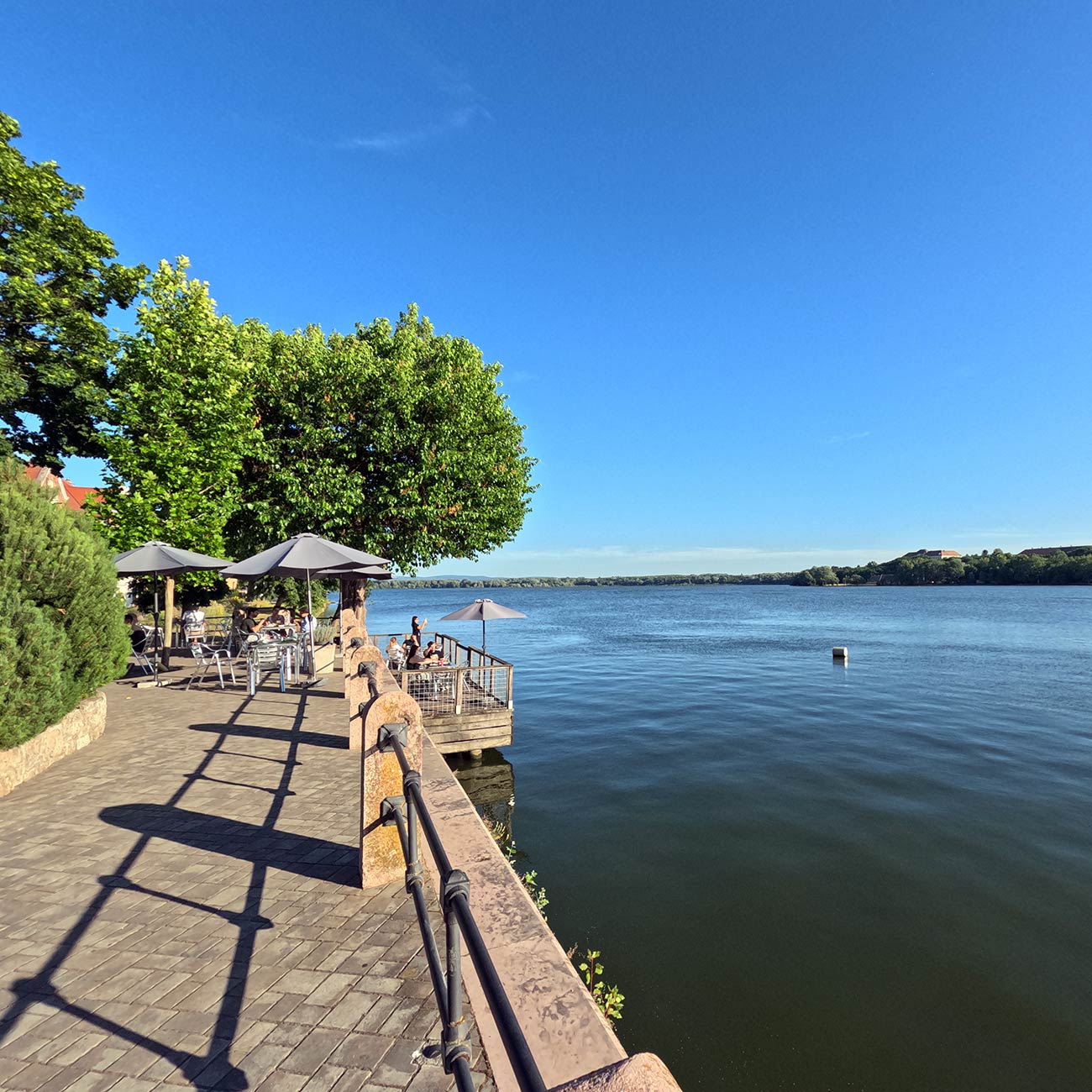
Tata Lake
Reading time: 11 minutes
TATA, KOMÁROM-ESZTERGOM COUNTY, HUNGARY
A Water Castle, a Lake, and a Town Fed by Springs
Tata wraps itself around water. At its centre lies the Old Lake, broad and calm, and the streams, mill ponds and karst springs that gave the town its old nickname, the 'city of waters'. The setting is low and green rather than dramatic: reed beds and plane trees along the shore, a Baroque townscape rising gently behind, and the white spur of Calvary Hill closing the view to the south. Ducks, anglers and walkers share the lakeside on most days, and the pace rarely lifts above a stroll.
The waters drew people here long before the town took shape. Roman Brigetio stood nearby on the Danube, and Benedictine monks settled the marshy valley in the early Middle Ages. Tata's identity, though, was set by its lake and its castle: King Sigismund of Luxembourg kept the place for himself rather than granting it away, and later the Esterházy family made it a seat, leaving Baroque palaces, a riding hall and a landscaped garden across the town. That layering of royal, monastic and aristocratic history still reads clearly on the ground.
From EuroVelo 6 the approach is simple. The route meets the Danube at Komárom, and a short regional train runs south to Tata in well under half an hour. A day here usually starts with the lake circuit on foot or by bike, takes in the castle and the Esterházy buildings around the shore, and ends in the English Garden by the quieter Cseke Lake. Flat ground and short distances make it an easy stop to fit between riverside cycling days.
Around the Old Lake
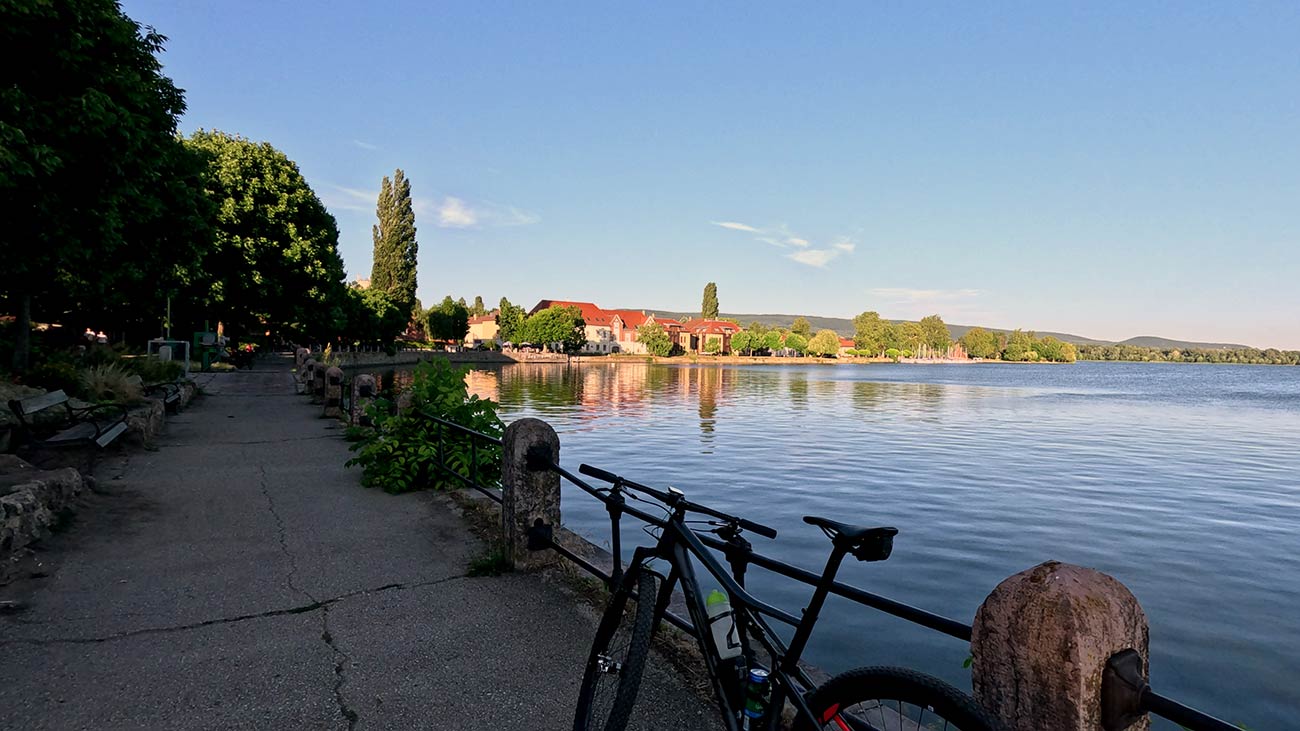
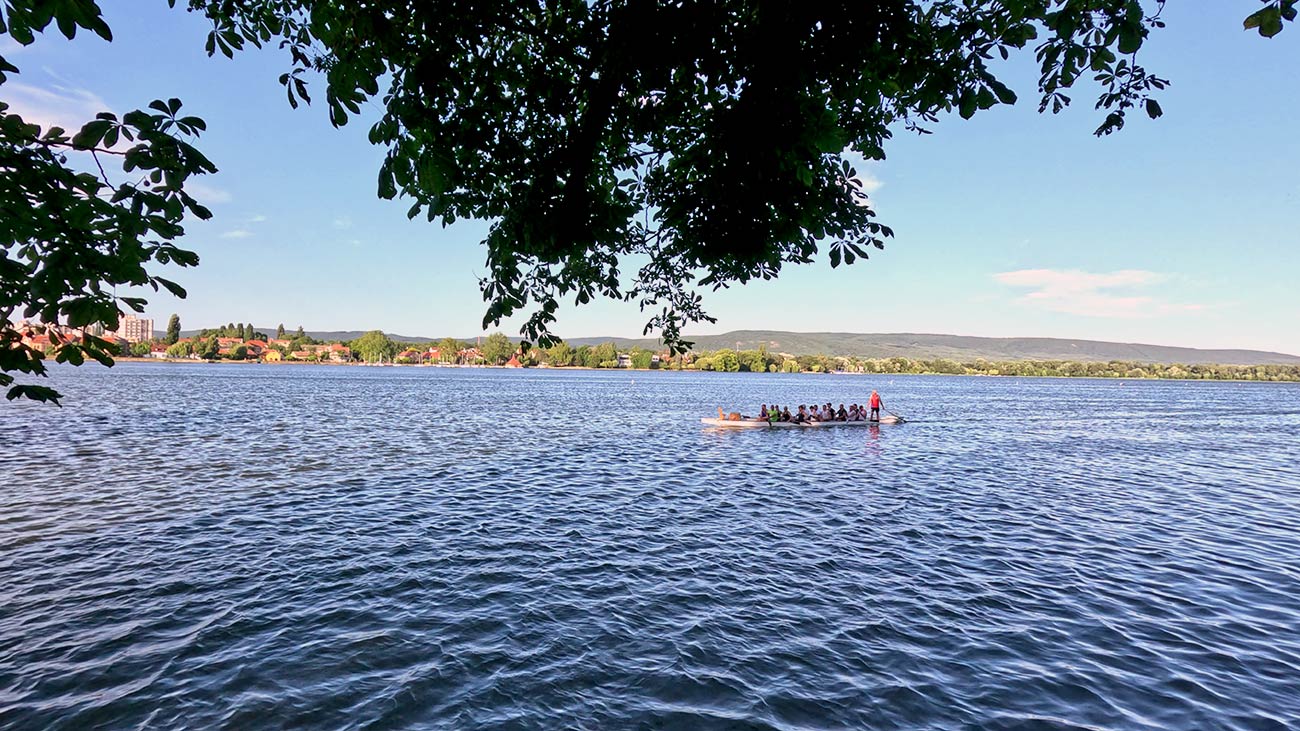
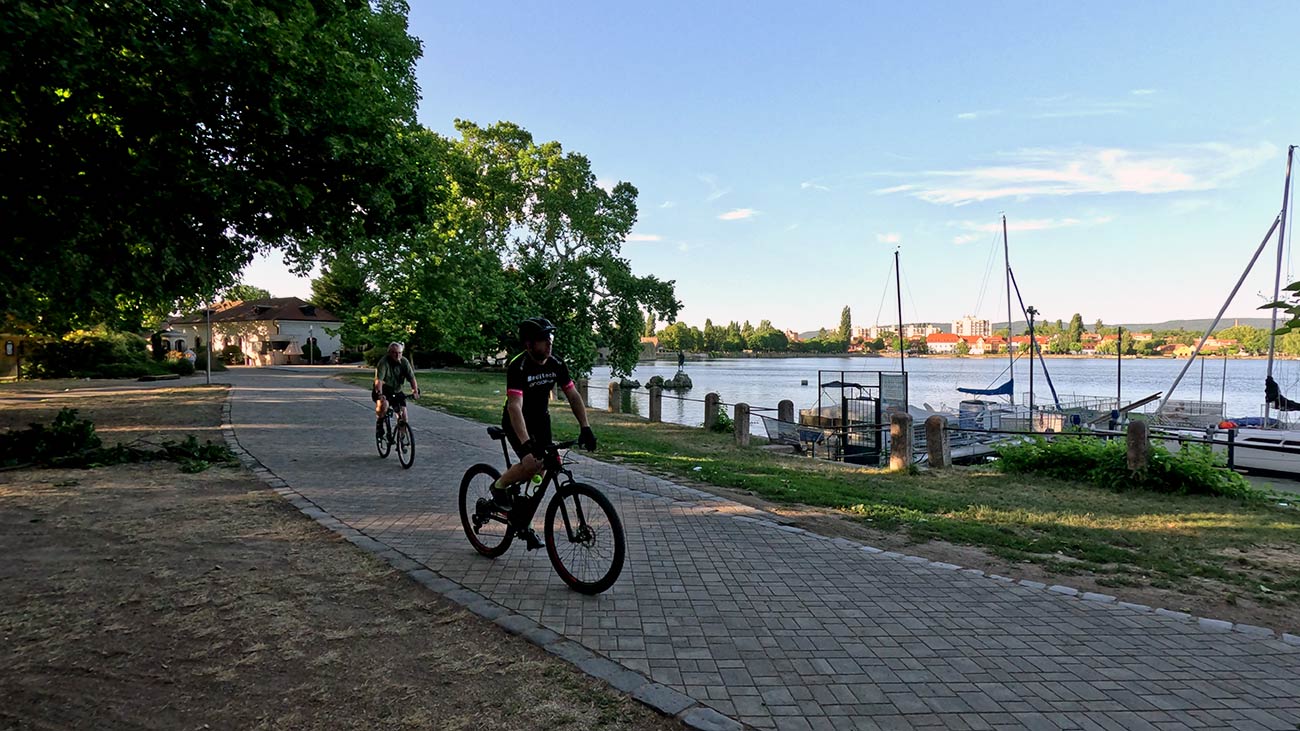
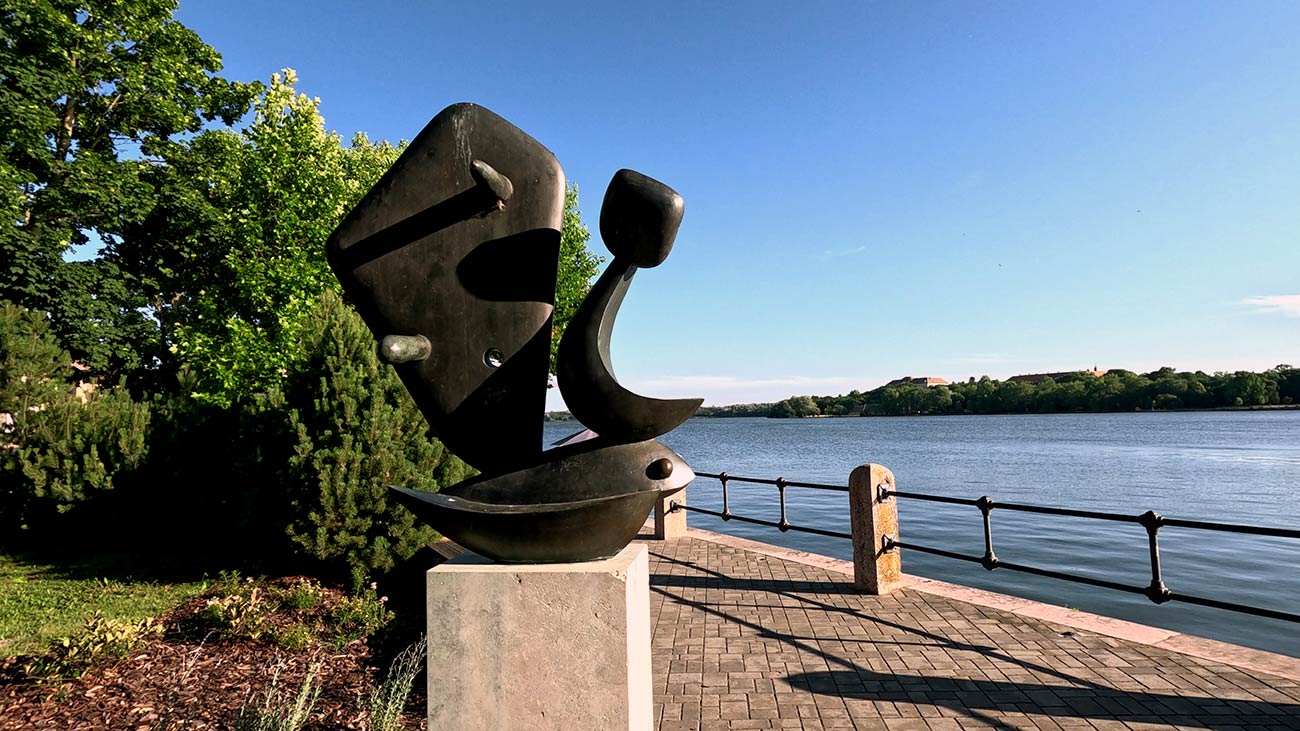
The Old Lake (Öreg-tó) is the heart of any visit, and a level path of roughly seven kilometres rings it, easy to walk or cycle in an afternoon. The lake itself is old in more than name: it formed when the Által stream was dammed and the surrounding marshes drained under Sigismund, and it has long been counted among Hungary's oldest fishponds. Along the promenade you pass weathered watermills fed by the springs, a scatter of historic houses such as the Hamary and Axmann homes, a stretch of railings hung with padlocks, and small jetties where rowing and pedal boats put out in summer. The water is rarely still of life, between waterfowl and the autumn fish harvest that the town still marks each year.
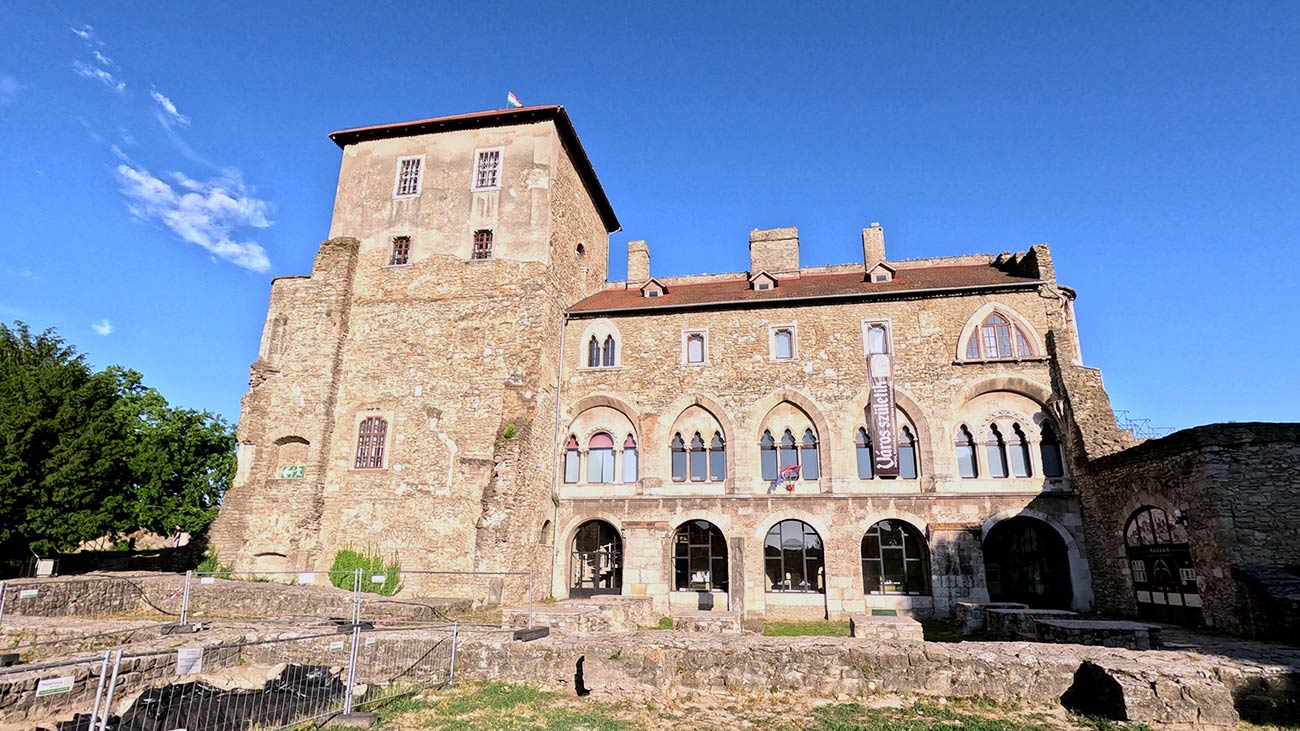
On the northern shore stands Tata Castle (Tatai vár), a water castle reflected in the lake and ringed by a moat crossed on a brick bridge. It was raised around 1400 for King Sigismund, on the footing of an earlier fourteenth-century fortress of the Lackfi family, and it was never really built to fight: kings used it as a summer residence and hunting seat. Matthias Corvinus extended it in Renaissance fashion with arcades and a lakeside terrace, and although the surviving wing is only a fraction of the original complex, its four corner bastions and surrounding water still give a clear sense of the old plan.
Inside, the castle now holds the Kuny Domokos Museum (named for a ceramic artist), with a medieval stone collection, a Knights' Hall, and a striking room reassembled from fragments of Roman wall paintings brought from nearby Brigetio. The romantic character of the outer walls dates from the Esterházy period, while the red-marble main gateway and the bridge over the moat are the work of the architect Jakab Fellner, added in the mid-eighteenth century. The building's lakeside silhouette has also drawn film crews; it has stood in for invented settings, including scenes for the television series The Witcher.
The Esterházy mark extends well beyond the fortress. A short walk away, the Esterházy Palace (Esterházy-kastély) is a Baroque mansion built by Fellner between 1764 and 1769, once host to guests including Francis I and the German Kaiser, and today home to the town library and cultural centre. Together with the riding hall and the old chestnut and plane avenues nearby, it turns the area between the two lakes into a single landscaped quarter rather than a set of separate monuments.
South of the Old Lake, the English Garden (Angolkert) curls around the spring-fed Cseke Lake (Cseke-tó). Commissioned by Count Ferenc Esterházy and laid out from 1783, it is regarded as the first English-style landscape garden in Hungary, an early example of the natural, irregular planting that only later spread across the Continent. The park is dotted with deliberate follies: a mock church ruin designed by the French architect Charles Moreau in 1801, which incorporated genuine carved stones taken from the medieval abbey at Vértesszentkereszt, and a small octagonal 'Turkish mosque' added in 1840, alongside a summer villa and a palm house. A gentle loop of about two kilometres takes in the lot.
What ties these places together is the water itself. The springs that powered the mills and filled the lakes are part of an important karst system, and the town has leaned into that identity: Tata was designated a Ramsar wetland city in the 1990s, and each autumn tens of thousands of wild geese settle on and around the Old Lake on migration. The arrival is enough of an event that the town limits fireworks through the colder months to keep the birds undisturbed, and marks the season with a wild-geese festival in late November.
 Useful Links
Mobility for Cyclists
The connection
EuroVelo 6 touches the Danube at Komárom, the Hungarian half of a town split with Komárno across the river in Slovakia. From Komárom, MÁV-START runs regional and InterRegio trains south to Tata in roughly 15 to 20 minutes, with the quickest closer to a quarter of an hour and departures spread through the day. The track is the Budapest–Hegyeshalom main line, but note that the fast EuroCity and Railjet services skip Tata and stop instead at Tatabánya, so the slower regional train is the one to board. Bikes ride easily on these short regional services without the reservation that longer-distance trains sometimes demand. Tata also slots neatly into a wider plan: Komárom's Monostor Fortress sits right on the river, the corridor continues east toward Esztergom and Budapest, and Győr lies a short hop west on the same line.
Hungarian Trains
The rail network in Hungary is operated mainly by MÁV-START, the passenger arm of the Hungarian State Railways (Magyar Államvasutak), which runs most long-distance services and a large share of regional connections across the country. Alongside MÁV-START, the private operator GySEV / Raaberbahn (Győr-Sopron-Ebenfurti Vasút) runs cross-border lines in the western part of the country toward Austria, while a smaller number of regional operators run local and feeder lines on selected routes. All operators are fully integrated into the national rail system, so transfers between them are straightforward. The Hungarian rail network is organised around Budapest, with high-frequency InterCity and EuroCity services radiating out from the capital toward Lake Balaton, the Croatian border, the Carpathian foothills, and the eastern plains, alongside a dense network of regional and local services. The Danube region in Hungary is particularly well served by rail, with the main north-south corridor running close to the river from the Slovak border through Budapest and onward toward Mohács, and several east-west lines branching out to inland destinations. The MÁV app is the central tool for planning journeys, checking timetables, and purchasing tickets across all services, including both regional and long-distance trains.
Taking your bike
Hungary is generally very bike-friendly when it comes to rail transport, especially on regional services operated by MÁV-START, which form the core of mobility for cycle touring along the Danube and its connecting corridors. On regional and local trains, bicycles can be taken on board for an additional fee, with no advance reservation possible and a first-come, first-served allocation of space. Bicycle tickets are sold as single trips or as affordable daily or weekly passes, valid across the regional network. On long-distance services such as InterCity and EuroCity trains, an advance reservation for the bicycle is mandatory, with the bike spaces located in dedicated zones in second-class carriages. The private operator GySEV / Raaberbahn, which runs cross-border services in the western part of the country, also accepts bicycles on board with broadly similar rules. Folding bikes are carried free of charge as hand luggage on all operators, provided they fit in the luggage racks. Overall, the Hungarian rail system is well adapted to cycle tourism and offers a flexible combination of train and bike that makes it easy to leave the EuroVelo 6 route in either direction for short or extended detours.
Bikes on Buses
Long-distance bus services in Hungary are primarily operated by Volánbusz, the national coach operator now consolidated under the MÁV group, alongside FlixBus and a smaller number of regional and private operators on selected international and domestic routes. The long-distance bus network is unusually well developed by central European standards, with frequent connections from Budapest to all the major regional centres and a dense web of services across the countryside that complement and sometimes overlap with the rail network. Bicycle transport is available on certain FlixBus connections, either via external bike racks or in the luggage compartment, but it is not consistently guaranteed across the network and depends on the specific vehicle type and route configuration. Where available, bicycle transport must be reserved in advance and capacity is limited, making it less flexible compared to rail services. Volánbusz coaches generally do not carry assembled bicycles, although folded or packed bikes may be accepted as luggage on a case-by-case basis. As a result, buses are generally used as a secondary option for cyclists, mainly for longer-distance repositioning between major cities rather than as a core part of cycling itineraries along the Danube region. While useful in specific cases where rail connections are less convenient, they are less predictable and less standardised for bicycle transport, so advance planning is essential.
Arriving at Tata Station
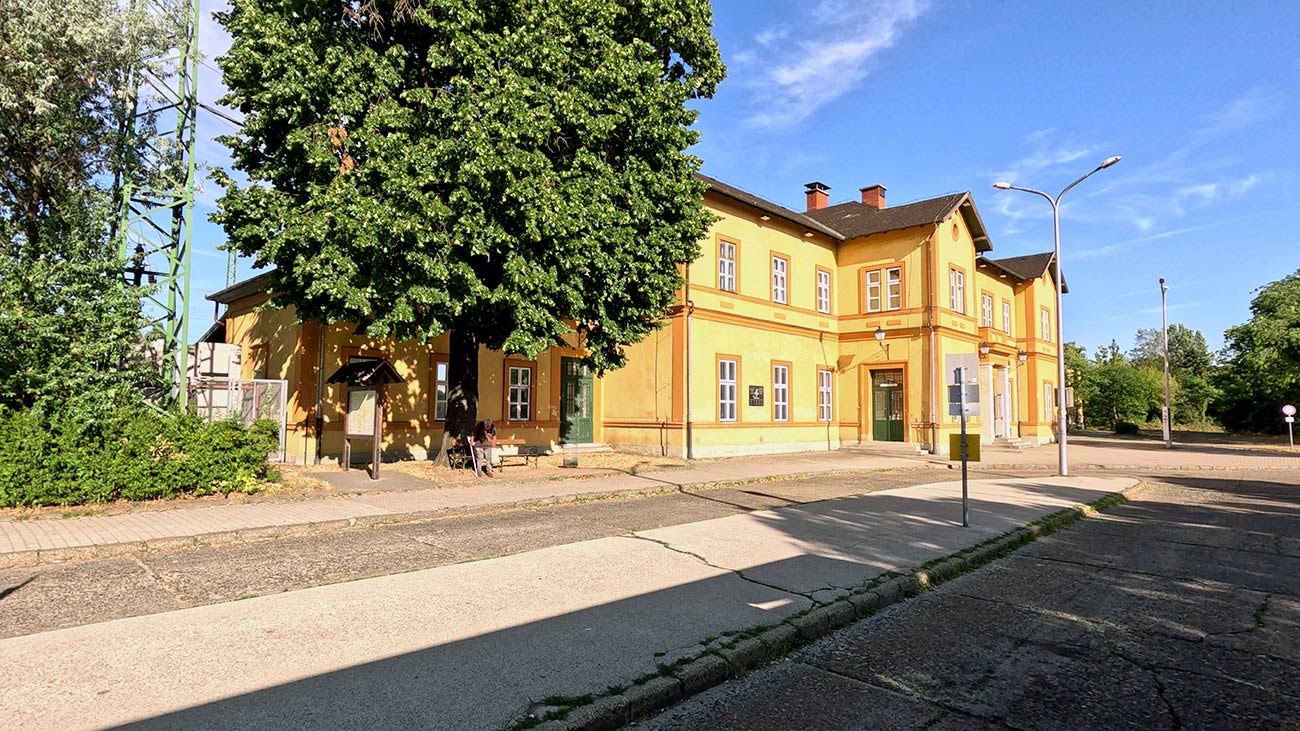
Tata's main station sits roughly two kilometres north-east of the Old Lake, on flat ground, an easy walk of about twenty-five minutes or only a few minutes by bike; a local bus (line 1) links it with the centre and the coach station for anyone who would rather not walk. The streets down to the lake are gentle and signposted, and there is no real climb until you choose to tackle Calvary Hill. A second halt, Tóvároskert, lies nearer the southern side of the lake and can shorten the approach if your train calls there. Leaving a bike by the lakeside promenade is straightforward, and onward trains run west to Győr or back north to Komárom for the riverside route, so Tata reads comfortably as a half-day detour or an overnight stop.