Vršac
Reading time: 14 minutes
VRŠAC, SOUTH BANAT DISTRICT, SERBIA
A Banat Town Beneath a Medieval Tower
In the far south-eastern corner of the Vojvodina plain, where the flat farmland of the Banat finally lifts into a low range of hills before the Romanian border, lies a town whose name first appears in written records in 1427 as Podvrsav. Vršac has worn several different spellings of its name across the centuries, Versecz, Varšoc, Viršica, a quiet reflection of the many peoples, Thracians, Celts, Dacians, Romans, Gepids, Avars, and later Serbs, Germans, Hungarians, and Romanians, who have settled this corner of the Pannonian Plain since prehistoric times. Today the town remains genuinely multiethnic, with Serbs, Romanians, and Hungarians still living side by side, a heritage visible in its churches, its street names, and its long-running theatrical and musical traditions.
Vršac sits at the foot of the Vršac Mountains, the highest hills in the otherwise flat province of Vojvodina, just 14 kilometres from the Romanian border and directly on the historic international railway linking Vienna, Budapest, Belgrade, and Bucharest. The town grew through the eighteenth century into a genuine centre of crafts, trade, and culture, gaining its first pharmacy, post office, and primary school in this period, and its skyline today still carries the marks of that growth: a neo-Gothic town hall, a cluster of Orthodox, Catholic, and Romanian churches, and, on the wooded hill above the town, the broken silhouette of a medieval tower that has watched over the Banat plain since the fifteenth century.
For cyclists exploring the Danube along the EuroVelo 6, Vršac is one of the more rewarding inland detours from the Serbian stretch of the route. The town lies a direct train ride from Belgrade, the country’s capital and main transport hub, or from Pančevo, itself directly on the EuroVelo 6 corridor and a shorter, more convenient connection for cyclists already following the river. A full day spent moving between the pedestrian zone, the churches, the town park, and the hilltop tower offers a genuinely different texture from the river towns further west, with Vršac’s wine country and Banat plain views adding a quiet rural counterpoint to the journey.
A Multiethnic Banat Town Beneath a Fifteenth-Century Tower
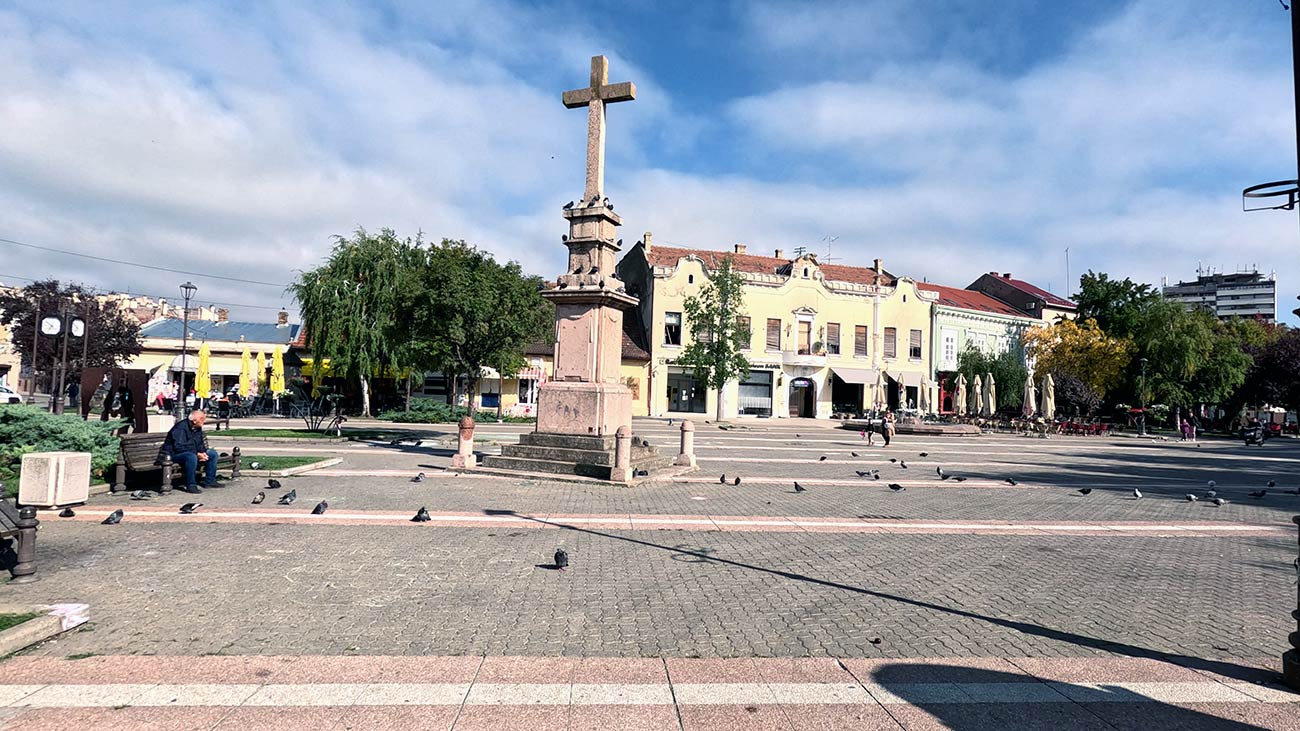
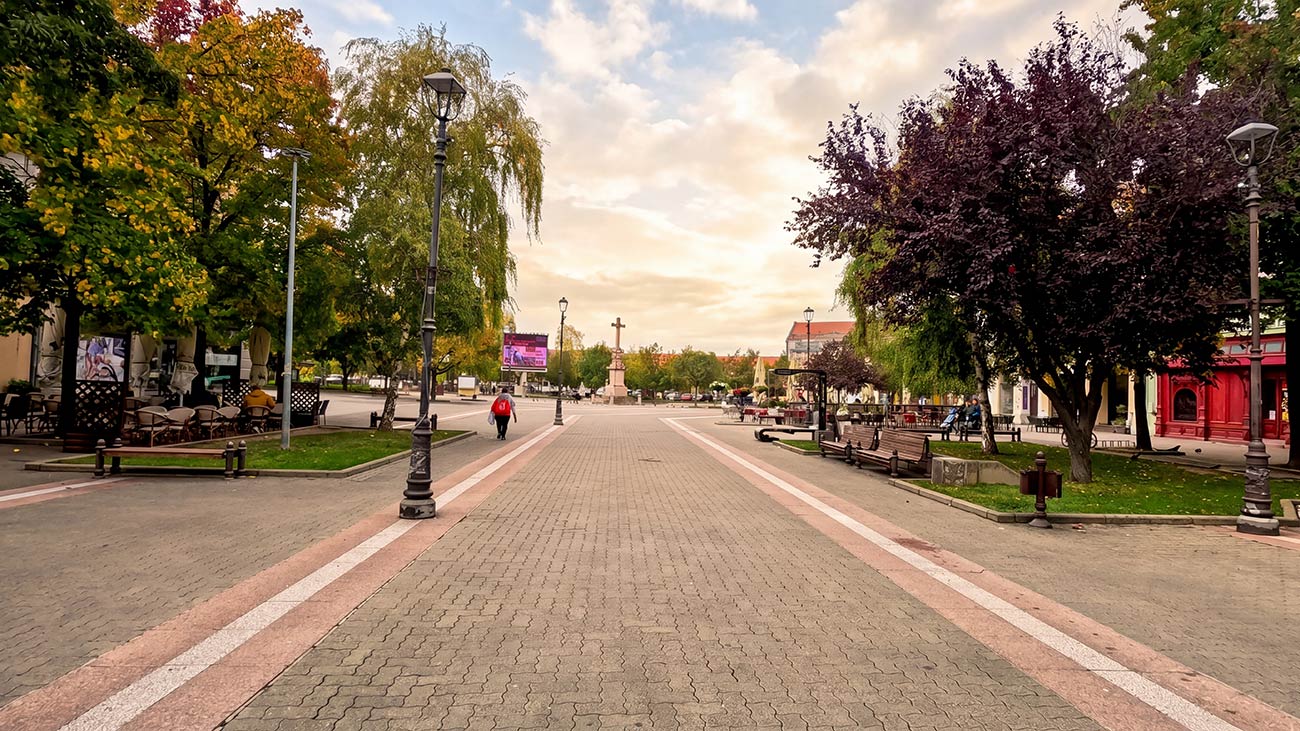
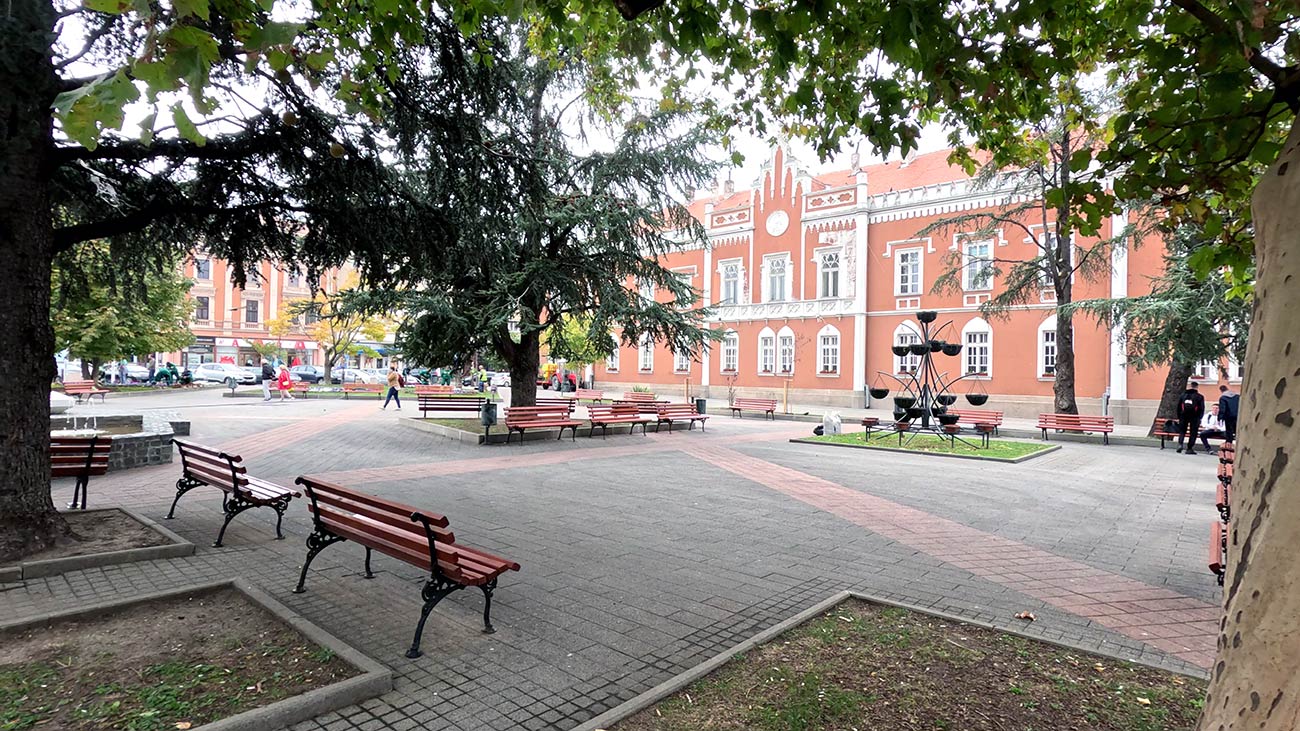
The natural starting point for any visit is the Pedestrian Zone at the heart of Vršac, a centuries-old meeting place that has served over the years as marketplace, public square, and even an execution site, before settling into its present form as a paved, café-lined promenade with three fountains, old oaks, a town clock, and a white cross at its centre. Facing onto this space stands the Town Hall, built in neo-Gothic style from 1859 under the proposal of town head Aleksandar Stojaković, raised after the town’s Serbian and German municipalities, separate administrative units since 1717, formally united in 1795. A memorial inscribed in Latin and Serbian, signed by the town’s leading citizens, was built into its foundations. Nearby, the Banat Eparchial Residence, a Baroque bishop’s palace begun in 1757 and completed in 1763 under Bishop Jovan Georgijević, houses a private chapel with the miracle-working icon known as the Mother of God of Vinca-Bezdin, painted in Russia between the fifteenth and sixteenth centuries.
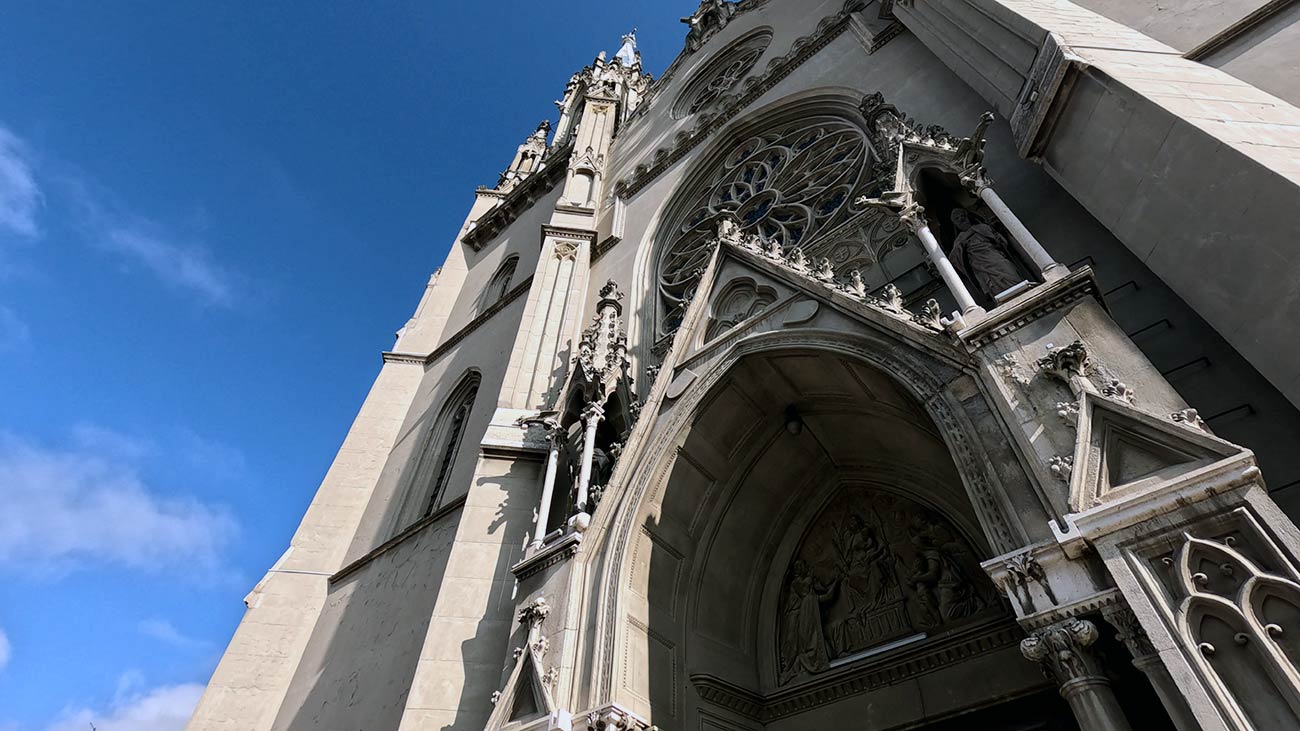
Vršac’s religious diversity is on full display within a short walk of the centre. The Great Synod Church, the oldest Orthodox church in town, was built in 1785 and decorated by some of the most distinguished Serbian painters of the era, including Pavel Đurković, whose iconostasis remains one of the highlights of the interior, alongside two paintings donated by the celebrated artist Paja Jovanović. The smaller Church of the Assumption, affectionately known to locals as Mala crkva (the Small Church), was built in 1768 and consecrated in 1775, funded by a wealthy local merchant. A short distance away, the Roman Catholic Cathedral of St. Gerhard, a neo-Gothic building from 1863, and the Romanian Orthodox Church, completed in 1913 through the efforts of the local Romanian community, complete a remarkable cluster of active places of worship from three different Christian traditions within easy walking distance of one another. The town also honours its own local saint: St. Theodore of Vršac, a bishop who led the Banat Serbs in an uprising against Ottoman rule and was captured and skinned alive by the Pasha of Timișoara, was canonised in 1994, and a church dedicated to him was consecrated on the Hill of Vršac in 2002.
Rising above the town on a 399-metre hill, the Tower of Vršac (Vršački zamak, formerly Vršačka kula) is the unmistakable symbol of the entire region, most likely built around 1439 on the orders of the Serbian despot Đurađ Branković. The surviving defensive tower stands 19.85 metres tall, its sides 13.8 and 11 metres wide, a stark, weathered silhouette against the sky that has watched over the Banat plain for nearly six centuries. The 1701 Treaty of Karlovac ordered the tower’s partial destruction to prevent any future military use, and what remains today is consequently a genuine ruin rather than a restored fortress, climbed for the view rather than for any interior to explore. The walk up through vineyards and orchard terraces, the very same hillside described by the Ottoman traveller Evliya Çelebi as covered in “hills planted with wine grape” bearing grapes “in the colour of a ruby,” gives a clear sense of why Vršac wine has been prized since at least 1494, when the treasurer of the Hungarian king Vladislaus II reportedly paid ten and a half gold coins for a single barrel.
Beyond the churches and the tower, Vršac preserves a notably rich civic and cultural life for a town of its size. The Town Museum, founded in 1898, holds archaeological, art, and natural history collections alongside dedicated memorial exhibits to the painter Paja Jovanović. The National Theatre “Sterija”, tracing its roots to a student performance in September 1792, a date officially recognised as the birth of theatrical life in Serbia, remains active today and hosts the annual Vršac Theatrical Autumn festival of classic drama. The Town Library, founded in 1887 by Felix Mileker and tracing its origins back to a Serbian reading room from 1840, has grown its collection to roughly 200,000 volumes. The Town Park, one of the oldest in Serbia and protected as a Natural Monument since 2000, blends French-style round flowerbeds with a freer English approach to lawns and trees across nearly six hectares. A few kilometres outside town, the Mesić Monastery, likely built in the fifteenth century by a member of the Branković family, and the more recently revived Srediste Monastery preserve a quieter, older religious landscape, while travellers with extra time can also visit the Town Lake, fed by mineral-rich water drawn from 200 metres underground at a constant 25°C, said by analysis to be entirely free of bacteria.
 Useful Links
Mobility for Cyclists
The connection
The most practical connection from the EuroVelo 6 corridor is from Pančevo, itself directly on the route, where Srbija Voz regional trains run to Vršac in around 1 hour 7 to 9 minutes, with departures roughly every four hours throughout the day. Belgrade, the country’s capital and main transport hub, offers an equally practical alternative, with direct trains to Vršac taking around 1 hour 36 to 45 minutes, again roughly every four hours. Cyclists riding the Serbian stretch of the EuroVelo 6 will find Pančevo the more convenient transfer point given its position directly on the route, while Belgrade serves travellers approaching from the wider Danube network or starting their journey from the capital itself.
Serbian Trains
The rail network in Serbia is operated mainly by Srbija Voz, the national passenger rail operator, which runs both regional and InterCity services across the country. For much of the network, the system has historically been considerably less developed than rail networks in neighbouring central European countries, with ageing rolling stock, single-track lines, and journey times that often lag well behind road travel over the same distance. Against this backdrop, the modernised Belgrade-Novi Sad-Subotica corridor stands out as a genuine exception. Upgraded with new high-speed Soko electric trains and a parallel InterRegio service, this stretch has been transformed into one of the fastest and most reliable rail journeys anywhere in the region, with frequent departures running roughly every one-two hours throughout the day and journey times that now comfortably compete with, and often beat, the equivalent bus or car trip. Stops along this corridor include Novi Beograd, Petrovaradin (serving Novi Sad), Vrbas, Bačka Topola, and Subotica on the Soko line, with several additional stops served by the InterRegio service. Away from this modernised corridor, Serbian regional rail tends to be slower and less frequent, and for many shorter regional hops, buses remain the faster and more practical option. The Srbija Voz website and app are the main tools for checking timetables and buying tickets, and the app in particular is useful since not every station along the network, including some stops on the modernised corridor itself, has a staffed ticket counter. Tickets are normally purchased in advance through the website or app, but where no ticket counter is available at the departure station, tickets can simply be bought directly on board the train from the conductor, with no extra fee charged for doing so. This makes the system fairly forgiving for visitors unfamiliar with Serbian rail, since a missing ticket counter at a small rural station is not an obstacle to travel.
Taking your bike
Cycling support on Serbian trains follows clear rules set out by Srbija Voz, though capacity varies considerably by train type. On diesel-engine trains, bicycles are loaded through doors marked with a bicycle symbol and secured on built-in bike racks, of which there are only two per train set, located near the folding seats; bikes cannot be left in front of the wheelchair space or the toilets. On electric multiple-unit trains, bicycles are again loaded through marked doors and placed beside the folding seats near the entrance and toilets, though these carriages have no fixed racks, so the rider should stay close by to steady the bike; up to three bicycles can generally be carried if the multipurpose space is free, at the conductor’s discretion and depending on wheelchair users, prams, or large luggage already on board. The modern Soko electric trains on the upgraded Belgrade-Subotica corridor offer the most generous capacity, with dedicated bicycle space in every carriage near the luggage racks (the lower shelf folds down to free the space), allowing up to eight bicycles per train under normal conditions, again at the conductor’s discretion. On all train types, bicycles may be refused if the train is already at full capacity on a given stretch. On any other Serbian train not covered by these specific rules, and on all international services, a bicycle can still be carried as ordinary luggage if it is folded and packed so that it fits within the same compartment as its owner. Srbija Voz accepts no liability for damage or loss of bicycles carried on board. Given this patchwork of rules, the modernised Soko service remains the most reliable option for cyclists travelling with an assembled touring bike, while a folded or disassembled bike packed as luggage travels reliably on any service.
Bikes on Buses
Long-distance bus services in Serbia are extensive and, on most routes away from the main modernised rail corridor, faster and more frequent than the equivalent train journey. The network is operated by a large number of carriers, with Lasta among the largest national operators, alongside numerous regional companies such as Niš-Ekspres and Banat Trans, and the international operator FlixBus on selected routes. Bicycle transport on Serbian buses is not standardised across operators: bikes are typically carried in the luggage compartment beneath the bus when space allows, but capacity is not guaranteed, and advance reservation or direct confirmation with the specific operator is recommended, especially for an assembled touring bike. As a result, buses are best used by cyclists as a secondary, flexible option for repositioning between towns, particularly where rail connections are slow, infrequent, or simply don’t exist on a given route, while a packed or folded bike travels far more reliably as ordinary luggage than an assembled one.
Arriving at Vršac Station
Vršac’s railway station sits a short walk or ride from the historic centre, with the pedestrian zone, the Town Hall, and the cluster of churches all reachable on foot in around ten to fifteen minutes along flat, well-signposted streets. The climb up to the Tower of Vršac on the hill above town is the one genuinely uphill stretch of the visit, best tackled on foot or by bike along the marked path through the vineyards. The town centre itself is compact and easy to navigate, with most of the main sights clustered within a few minutes’ walk of one another. Bike racks are available near the pedestrian zone and at the railway station. For onward travel, the same line connects back toward Pančevo and Belgrade and the wider Danube region, so Vršac works equally well as a full-day excursion or as a longer overnight stop combined with the surrounding Banat wine country.