Zrenjanin
Reading time: 12 minutes
ZRENJANIN, CENTRAL BANAT DISTRICT, SERBIA
A City on a Quiet Bend of the Begej
On the wide, almost endlessly flat plain of the Serbian Banat, where the Pannonian Basin stretches out toward the horizon and small rivers wind slowly through farmland, lies the largest city of central Vojvodina. Zrenjanin grew up around a bend of the river Begej, in a region that has belonged in turn to the Ottoman Empire, the Habsburg Crown, and finally to Yugoslavia and Serbia. Each of those eras left its mark, but the most visible layer today is the late Habsburg one: a generous nineteenth-century town centre of pastel facades, ornamental gables, and broad pedestrian streets that radiate out from a single grand square.
The city has worn several names across its history. Until the early twentieth century it was known as Veliki Bečkerek (in Hungarian Nagybecskerek), then briefly as Petrovgrad, and from 1946 onwards as Zrenjanin, in honour of the Yugoslav partisan and national hero Žarko Zrenjanin. Multilingualism is part of the city’s living character to this day, with Serbian, Hungarian, Romanian, and Slovak still spoken across the surrounding villages of the Banat. The cathedrals of two different Christian traditions share the same central square, the theatre is the oldest in Serbia, and the riverbanks carry a chain of architectural set-pieces designed in styles that range from neo-Romanesque to Art Nouveau.
For cyclists exploring the Danube along the EuroVelo 6, Zrenjanin is one of the more rewarding inland detours from the Serbian stretch of the route. The city lies a direct train ride from Pančevo, itself on the EuroVelo 6 corridor. The journey crosses the flat plains of the southern Banat in around an hour and a half and arrives in a city whose pace, scale, and architectural confidence still belong to a different age.
A Multicultural City Around Freedom Square and the Begej
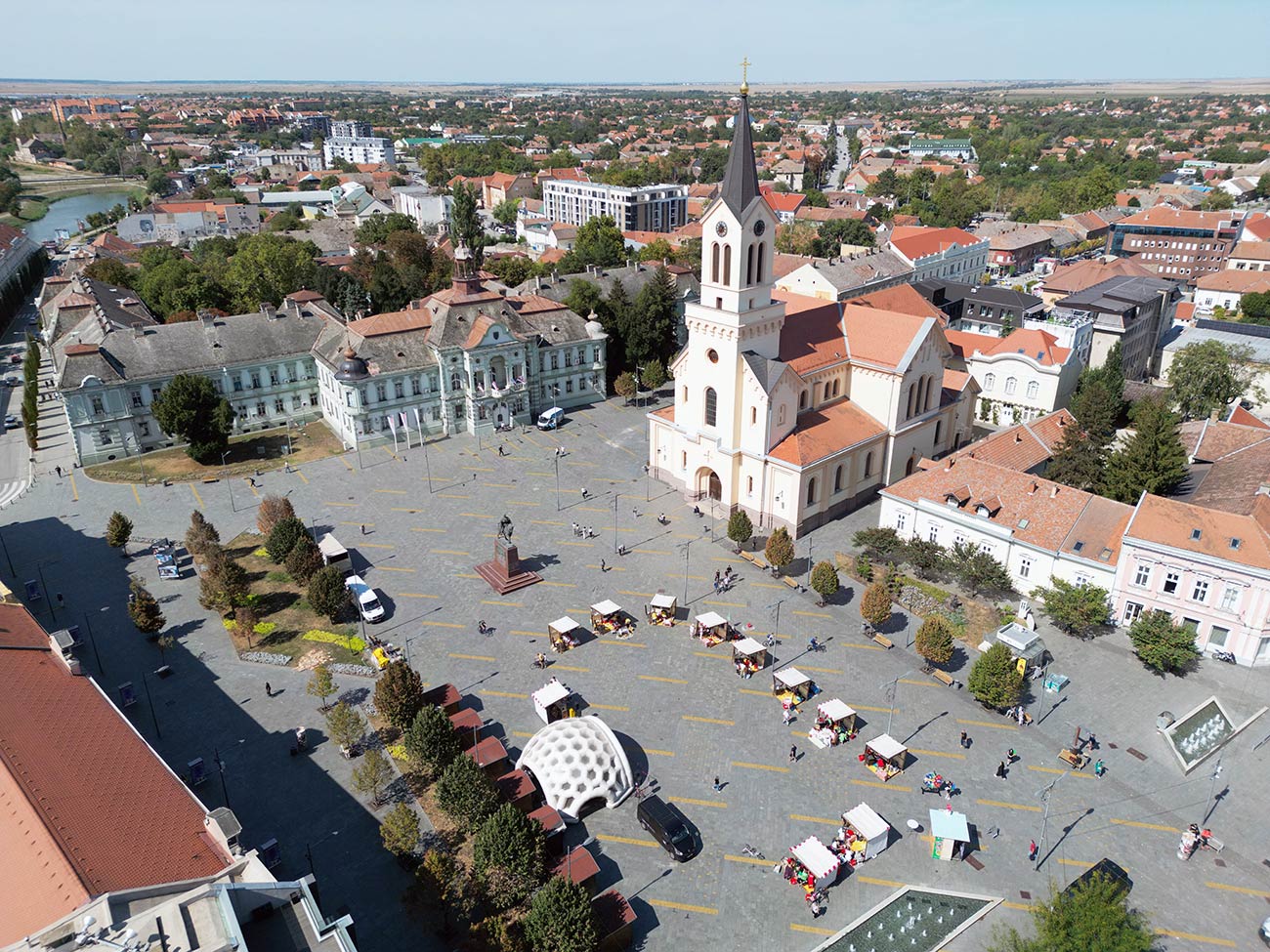
The heart of Zrenjanin is Freedom Square (Trg Slobode), a generously proportioned central square laid out in the late Habsburg manner, with broad pedestrian zones, symmetrical paths, and a cluster of monumental buildings around its edges. The square has been the civic and architectural focus of the city for more than two centuries, and its arrangement still carries a strong sense of the Austro-Hungarian planning that gave Bečkerek its modern shape after a great fire in 1807 destroyed almost every building in the town centre. Pavement cafés, bakeries, and benches line the square in warm weather, while the surrounding pedestrianised streets, including the long café-lined King Alexander Street, were laid out as a single car-free zone in the 1980s. The most photographed building on the square is the City Hall (Gradska kuća), a striking neo-Baroque and Art Nouveau composition with a central clock tower. The building originally went up in 1820, after the old Torontál County seat was destroyed in the great fire of 1807, and it was thoroughly remodelled in its present form at the end of the nineteenth century. Inside, the grand staircase is decorated with three large stained-glass panels representing Justice, Wisdom, and Power, damaged in a storm in 2003 and carefully restored afterwards. The City Hall has been the symbol of Zrenjanin for more than a century, depicted on countless postcards since the late 1800s, and today houses both the local municipal authority and the Historical Archive of Zrenjanin. A small inner courtyard garden, laid out in 1887, opens behind the building in summer.
Facing the City Hall across the square stands the Roman Catholic Cathedral of St. John of Nepomuk (Katedrala svetog Ivana Nepomuka), a neo-Baroque church from the mid-nineteenth century that gives the square its religious counterpoint. A short walk away the Serbian Orthodox Cathedral of the Assumption of the Virgin stands among other downtown landmarks, and the proximity of the two cathedrals captures something essential about Zrenjanin’s mixed inheritance. Between them, on the corner of the square, is the National Museum of Zrenjanin (Narodni muzej Zrenjanin), housed in a former finance palace, with a collection of over 33,000 objects covering the natural history, archaeology, and cultural heritage of the central Banat. A short walk along King Alexander Street leads to the Toša Jovanović Theatre (Narodno pozorište “Toša Jovanović”), named after the celebrated nineteenth-century Serbian stage actor. The Baroque building dates from 1836 and is widely recognised as the oldest theatre building in Serbia, standing on the site of the former Bečkerek fortress.
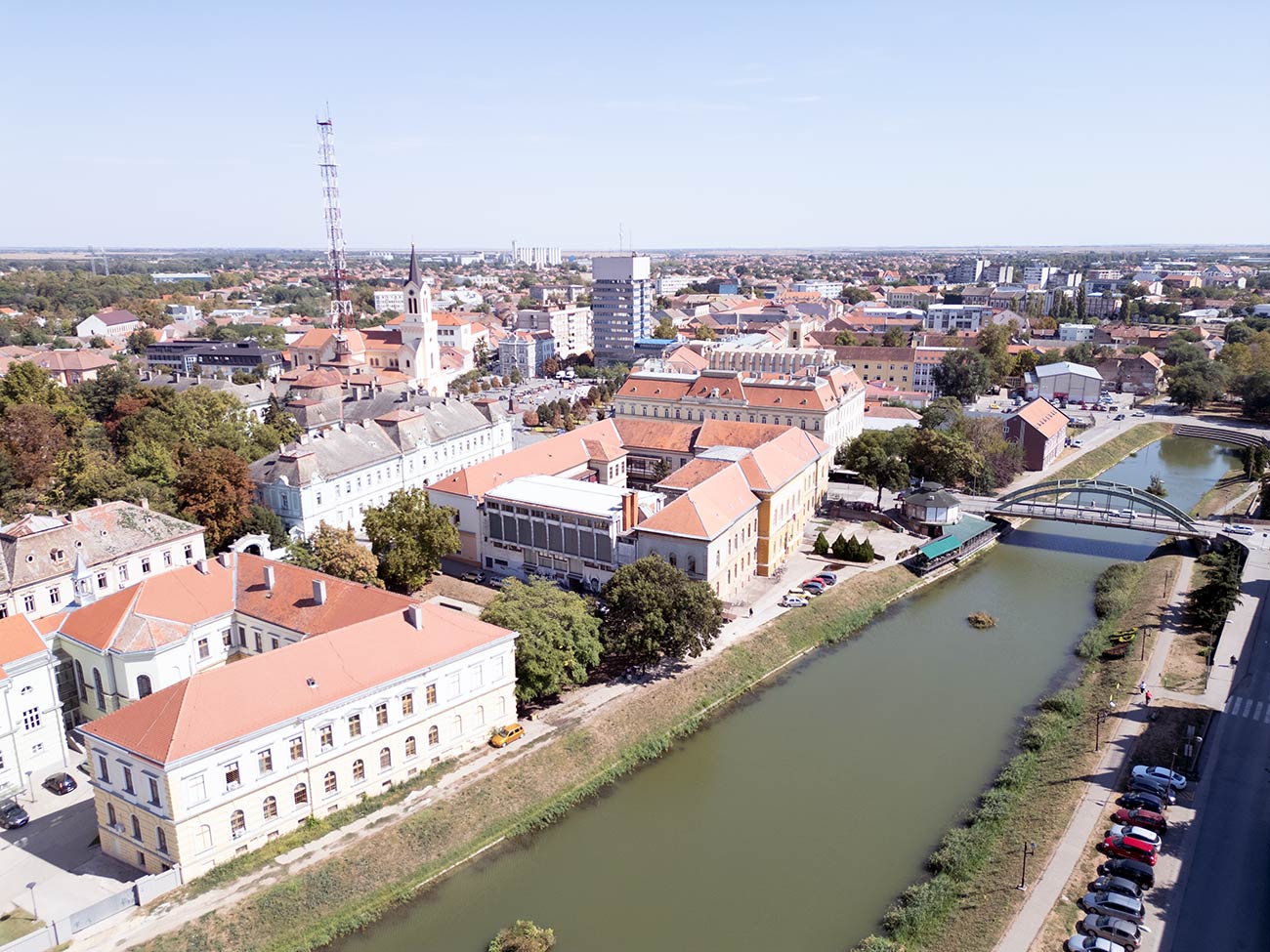
A little further along, the river opens up into a wide curving lake that follows the line of the old Begej. Until the 1980s the Begej itself flowed through the city centre on this bend, but its course was rerouted, and the original channel was left as a still ornamental water feature crossed by a series of small footbridges. The most striking of the older riverside structures is the Courthouse (Sudska palata) on Kej 2 Oktobra, a vast neo-Romanesque building completed in 1908 and best seen from the quayside on the opposite bank, with a heavily ornamented central avant-corps featuring a balustrade, pyramidal spires, and a triple-arched portal; it today houses the administrative offices of the Central Banat District. The riverbanks are crossed by ten bridges, of which two are of particular historical interest: the small Iron Bridge (Mali most) from 1904, the oldest of the surviving bridges, and the so-called Eiffel Bridge, built in 1903 by the engineering company founded by Gustave Eiffel. Together with the riverside promenade, the historic theatre, and the broad city park behind the City Hall, they form one of the most atmospheric urban riverfront ensembles in northern Serbia.
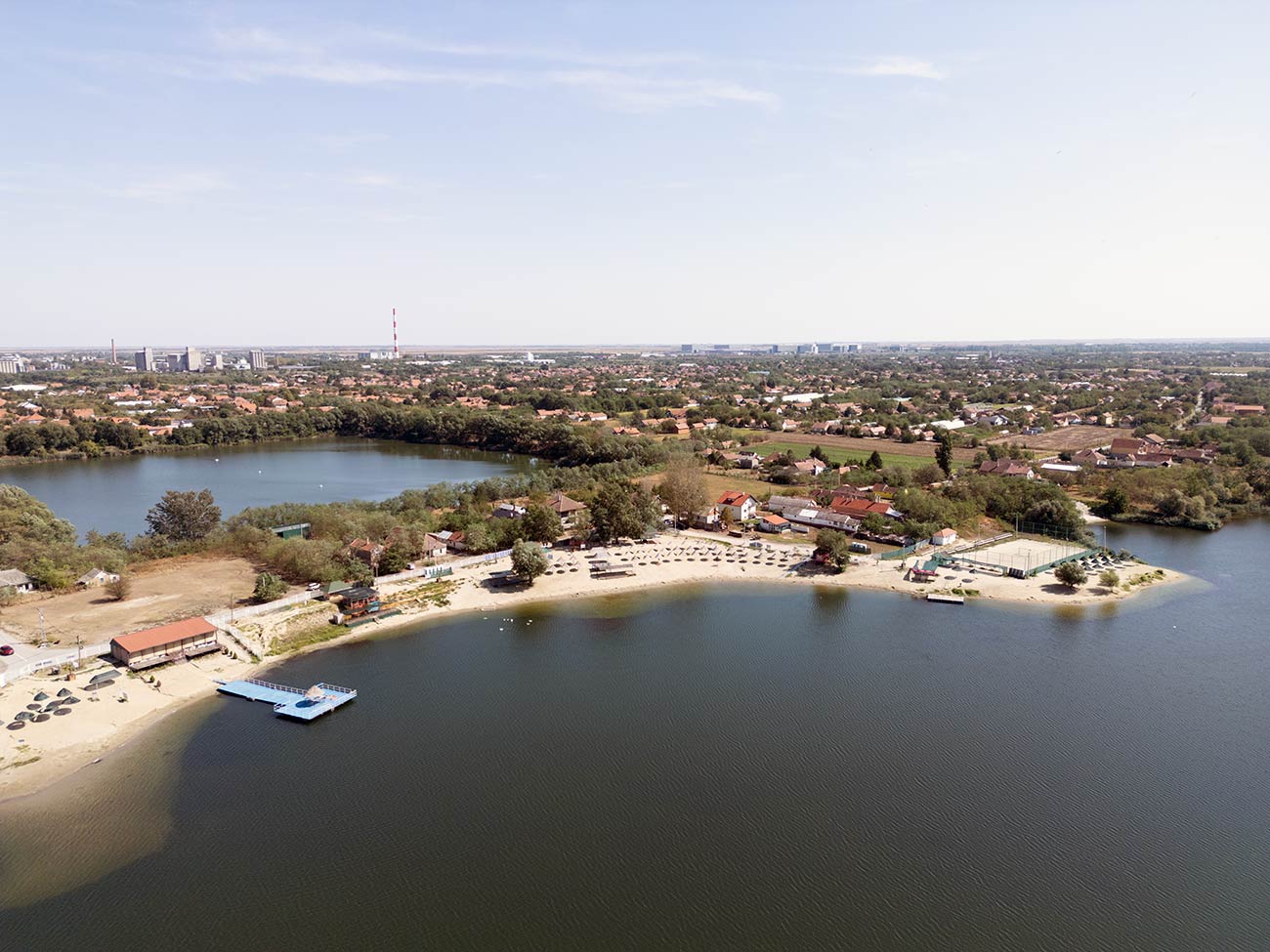
Beyond the city, the Begej and the surrounding plains hold a few quiet rewards for travellers with extra time. The Stari Begej-Carska Bara Special Nature Reserve, a short distance south-west of the city, is one of the most important wetlands in Vojvodina, with rich populations of waterbirds, marsh vegetation, and quiet canoe routes that pass beneath low willows. The small village of Ečka, just outside the city, is the home of the early-nineteenth-century Kaštel mansion, built in 1820 by a noble family in the English style and now operating as a hotel. The Rusanda spa, located 17 kilometres north of Zrenjanin, has more than a century and a half of tradition in mineral mud cures and sits within a quiet pine and linden forest crossed by walking paths.
 Useful Links
Mobility for Cyclists
The connection
The most practical connection from the EuroVelo 6 corridor is from Pančevo, where Srbija Voz runs a direct regional train to Zrenjanin twice daily, with a journey time of around 1 hour 34 to 36 minutes. Cyclists riding the Serbian stretch of the EuroVelo 6 will find Pančevo the natural transfer point, since it sits directly on the route. Given the limited frequency of the service, it’s worth checking departure times in advance and planning the day’s itinerary around them.
Serbian Trains
The rail network in Serbia is operated mainly by Srbija Voz, the national passenger rail operator, which runs both regional and InterCity services across the country. For much of the network, the system has historically been considerably less developed than rail networks in neighbouring central European countries, with ageing rolling stock, single-track lines, and journey times that often lag well behind road travel over the same distance. Against this backdrop, the modernised Belgrade-Novi Sad-Subotica corridor stands out as a genuine exception. Upgraded with new high-speed Soko electric trains and a parallel InterRegio service, this stretch has been transformed into one of the fastest and most reliable rail journeys anywhere in the region, with frequent departures running roughly every one-two hours throughout the day and journey times that now comfortably compete with, and often beat, the equivalent bus or car trip. Stops along this corridor include Novi Beograd, Petrovaradin (serving Novi Sad), Vrbas, Bačka Topola, and Subotica on the Soko line, with several additional stops served by the InterRegio service. Away from this modernised corridor, Serbian regional rail tends to be slower and less frequent, and for many shorter regional hops, buses remain the faster and more practical option. The Srbija Voz website and app are the main tools for checking timetables and buying tickets, and the app in particular is useful since not every station along the network, including some stops on the modernised corridor itself, has a staffed ticket counter. Tickets are normally purchased in advance through the website or app, but where no ticket counter is available at the departure station, tickets can simply be bought directly on board the train from the conductor, with no extra fee charged for doing so. This makes the system fairly forgiving for visitors unfamiliar with Serbian rail, since a missing ticket counter at a small rural station is not an obstacle to travel.
Taking your bike
Cycling support on Serbian trains follows clear rules set out by Srbija Voz, though capacity varies considerably by train type. On diesel-engine trains, bicycles are loaded through doors marked with a bicycle symbol and secured on built-in bike racks, of which there are only two per train set, located near the folding seats; bikes cannot be left in front of the wheelchair space or the toilets. On electric multiple-unit trains, bicycles are again loaded through marked doors and placed beside the folding seats near the entrance and toilets, though these carriages have no fixed racks, so the rider should stay close by to steady the bike; up to three bicycles can generally be carried if the multipurpose space is free, at the conductor’s discretion and depending on wheelchair users, prams, or large luggage already on board. The modern Soko electric trains on the upgraded Belgrade-Subotica corridor offer the most generous capacity, with dedicated bicycle space in every carriage near the luggage racks (the lower shelf folds down to free the space), allowing up to eight bicycles per train under normal conditions, again at the conductor’s discretion. On all train types, bicycles may be refused if the train is already at full capacity on a given stretch. On any other Serbian train not covered by these specific rules, and on all international services, a bicycle can still be carried as ordinary luggage if it is folded and packed so that it fits within the same compartment as its owner. Srbija Voz accepts no liability for damage or loss of bicycles carried on board. Given this patchwork of rules, the modernised Soko service remains the most reliable option for cyclists travelling with an assembled touring bike, while a folded or disassembled bike packed as luggage travels reliably on any service.
Bikes on Buses
Long-distance bus services in Serbia are extensive and, on most routes away from the main modernised rail corridor, faster and more frequent than the equivalent train journey. The network is operated by a large number of carriers, with Lasta among the largest national operators, alongside numerous regional companies such as Niš-Ekspres and Banat Trans, and the international operator FlixBus on selected routes. Bicycle transport on Serbian buses is not standardised across operators: bikes are typically carried in the luggage compartment beneath the bus when space allows, but capacity is not guaranteed, and advance reservation or direct confirmation with the specific operator is recommended, especially for an assembled touring bike. As a result, buses are best used by cyclists as a secondary, flexible option for repositioning between towns, particularly where rail connections are slow, infrequent, or simply don’t exist on a given route, while a packed or folded bike travels far more reliably as ordinary luggage than an assembled one.
Arriving at Zrenjanin Station
Zrenjanin’s railway station sits within reach of the historic centre, with Freedom Square, the City Hall, the cathedrals, and the riverfront all reachable on foot in around fifteen to twenty minutes along flat, well-signposted streets, or considerably faster by bike. The old town itself is compact and walkable once you arrive, with most of the main sights clustered close together. Bike racks are available near the station and around the central square. For onward travel, the same line connects back toward Pančevo and the wider Danube region, so Zrenjanin works equally well as a full-day excursion or as a longer overnight stop in the Banat.