Beckov Castle
Reading time: 14 minutes
BECKOV CASTLE, TRENČÍN REGION, SLOVAKIA
A Castle of Legends on a Limestone Cliff
Above a quiet village in the middle Váh valley, where the river winds between the Carpathian foothills and the Považský Inovec range, a vast ruin rises from a single 60-metre limestone cliff. Beckov Castle has watched over this stretch of the river for more than 800 years, and the silhouette of its broken walls, towers, and Gothic windows is one of the most recognisable in western Slovakia. Visible from far across the Považie region, the castle still acts as a kind of natural marker on the long valley road north from Bratislava toward Trenčín and the Tatras, the geography of which it once controlled.
The history of the place reaches deep into the Middle Ages. The first written mentions appear during the reign of King Béla III of Hungary in the twelfth century, under the older name Blundus, and recent archaeological research in 2023 has confirmed surviving masonry from the second half of the twelfth century in the upper walls. The castle guarded the north-south trade route along the Váh, withstood the Tatar invasion of 1241 thanks to its limestone cliffs, and later resisted Turkish raids in the centuries that followed. Its most distinguished chapter, however, came at the end of the fourteenth century, when King Sigismund granted Beckov to Stibor of Stiboricz, a Polish-born nobleman and one of the most powerful advisers in the Kingdom of Hungary. Stibor chose Beckov as his main residence from among more than thirty castles he owned, and rebuilt it as a richly Gothic family seat with a decorated chapel and a famous sculpture of the Black Madonna.
For cyclists exploring the Danube along the EuroVelo 6, Beckov is one of the more rewarding cultural detours from the Slovak stretch of the route. The castle lies around 100 kilometres north-east of Bratislava in the Trenčín Region, on the main railway line and the Váh Cycle Path (Vážska cyklomagistrála), and can be reached by a single direct train from the Slovak capital. The final approach by bike along the Váh valley is gentle and well signposted, and the visit can be combined naturally with a longer stay in nearby Trenčín for travellers wanting to spend more than a day in the area.
CastleHillViewsExhibition
A Gothic Stronghold of the Stibor Family
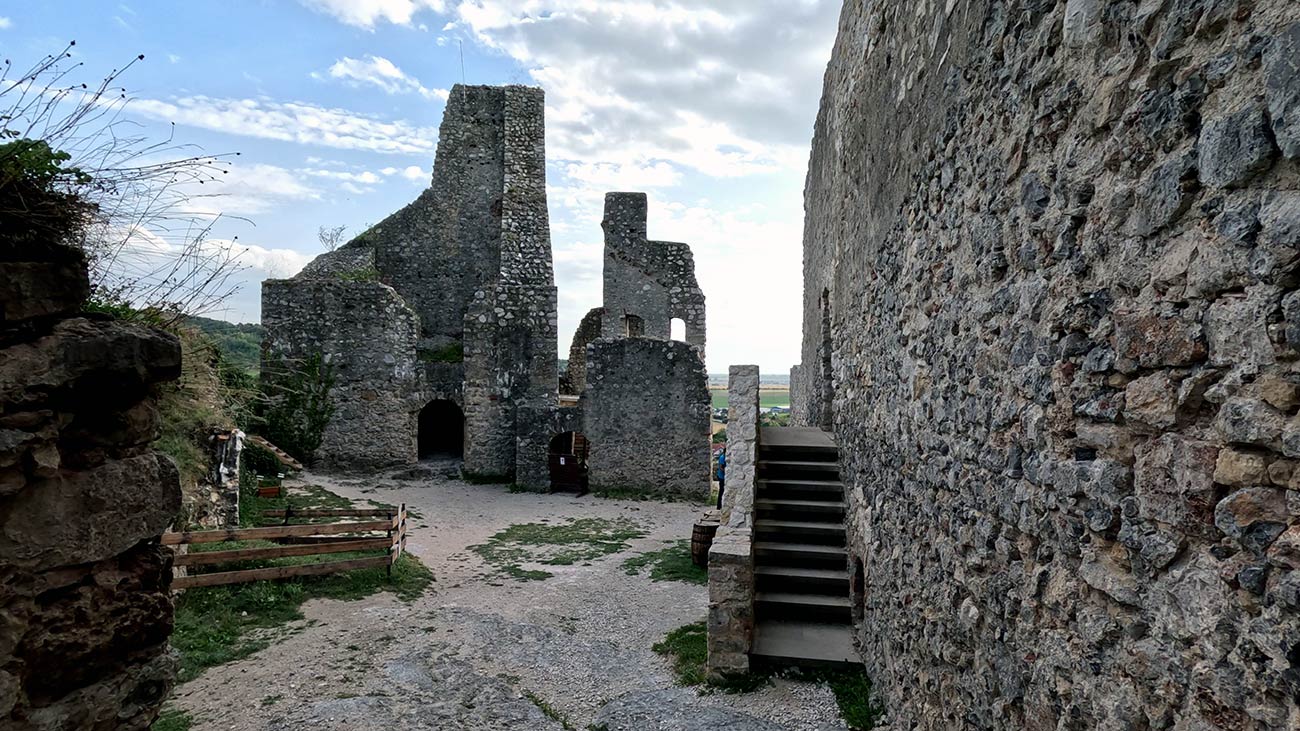
The natural shape of Beckov Castle is given by the limestone cliff that rises 60 metres above the surrounding plain, with the village of Beckov gathered at its foot. The site has been fortified since at least the twelfth century, and the earliest surviving sections of the upper walls date from this period. The combination of high stone walls, irregular oval defensive lines, and the natural steepness of the rock made the castle one of the few in this part of central Europe to withstand the Tatar invasion of 1241, when most of the Hungarian kingdom further east was overrun. The outer walls were strengthened repeatedly in the centuries that followed, with later Gothic and Renaissance additions wrapping themselves around the older defences. Today the silhouette of the broken towers and the surviving gates is one of the most photographed images in the entire Trenčín Region.
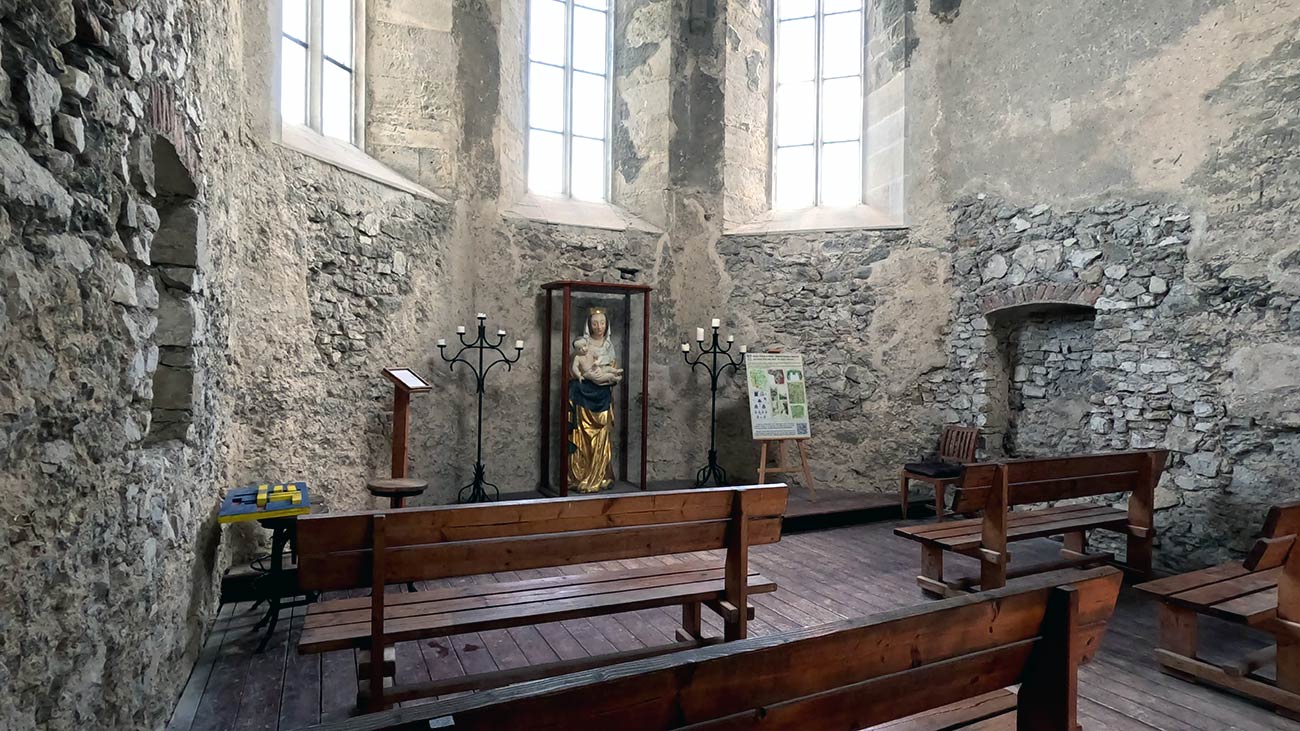
The castle entered its most significant chapter in 1388, when King Sigismund of Luxembourg granted Beckov to Stibor of Stiboricz, a Polish-born noble, Voivode of Transylvania, and one of the king’s closest advisers. Stibor chose Beckov as his main residence from a personal portfolio of more than thirty castles and estates, and he rebuilt the fortress in elegant Gothic style, with new representative apartments, a decorated chapel, and a stone family coat of arms above the chapel door. Inside the chapel once stood a sculpture of the Black Madonna that was considered, in its day, one of the most beautiful in Europe. Stibor also linked the town walls of Beckov directly to the castle fortifications and granted the settlement below significant urban privileges. His son, also named Stibor, continued his work after his father’s death in 1414, and the castle remained in the family until the male line died out.
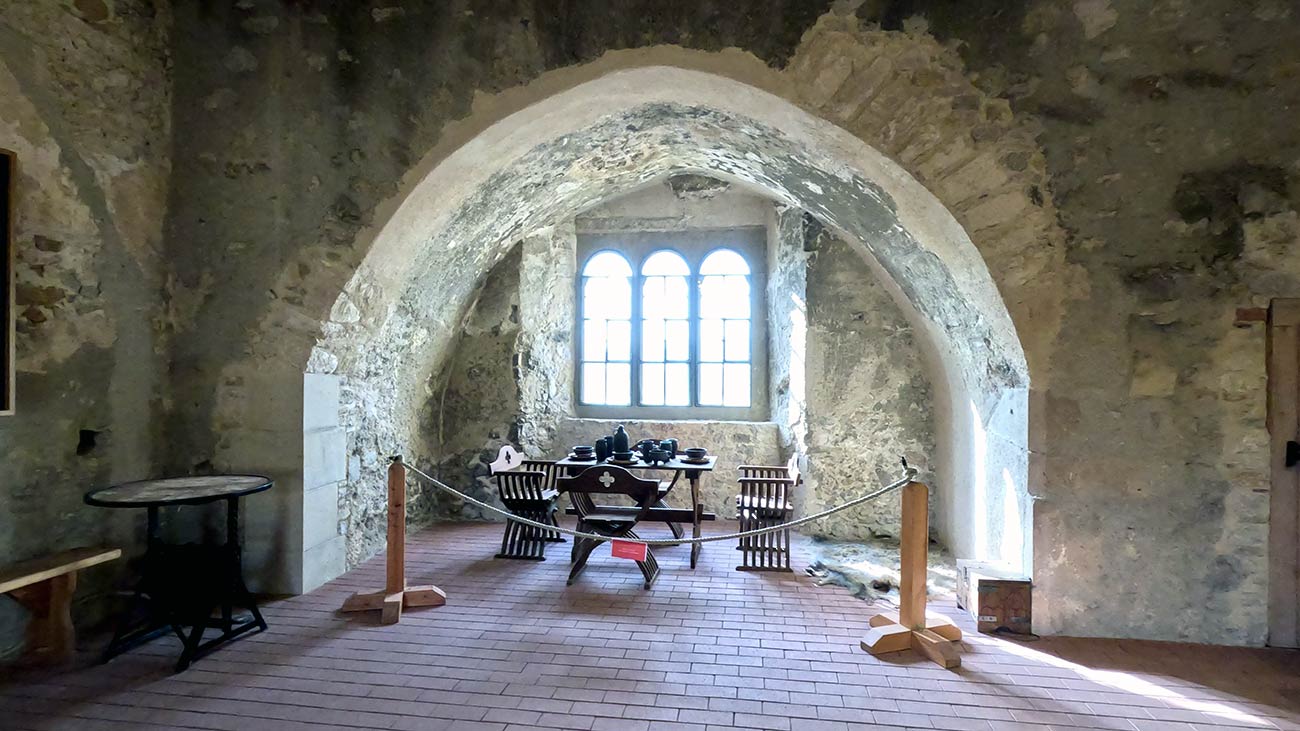
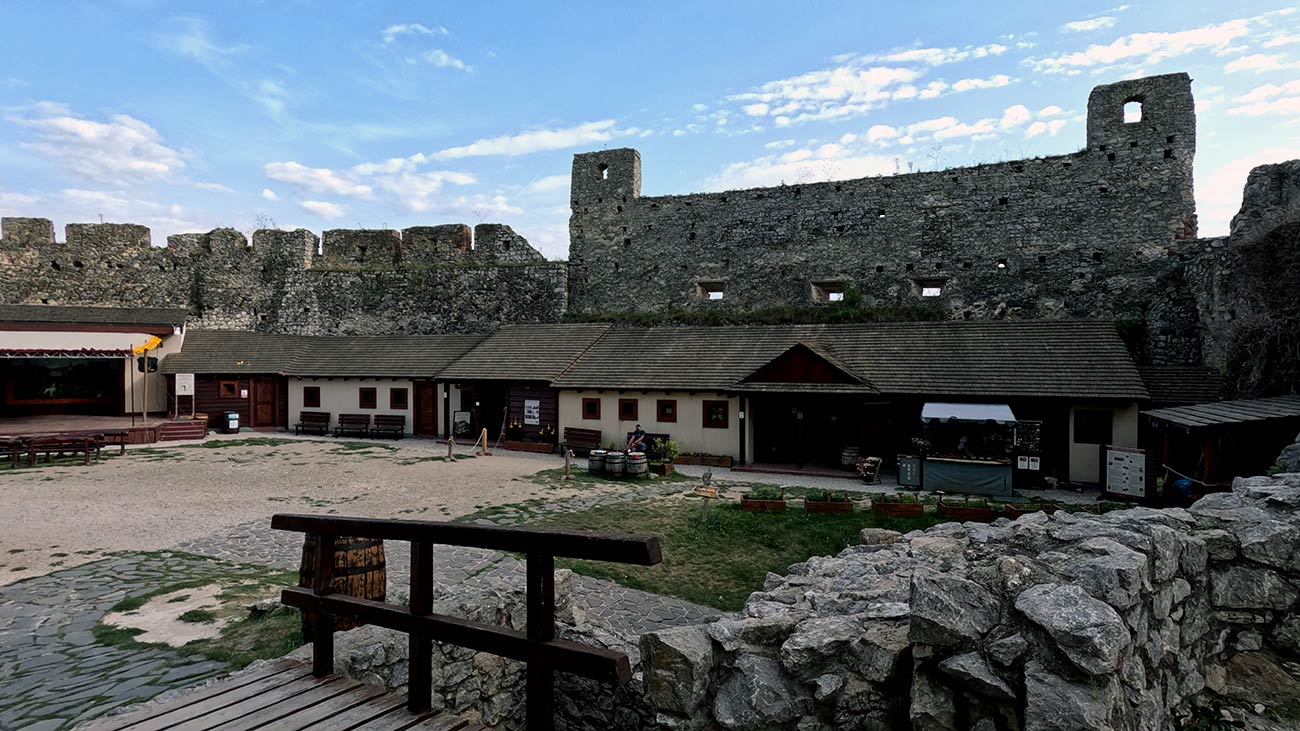
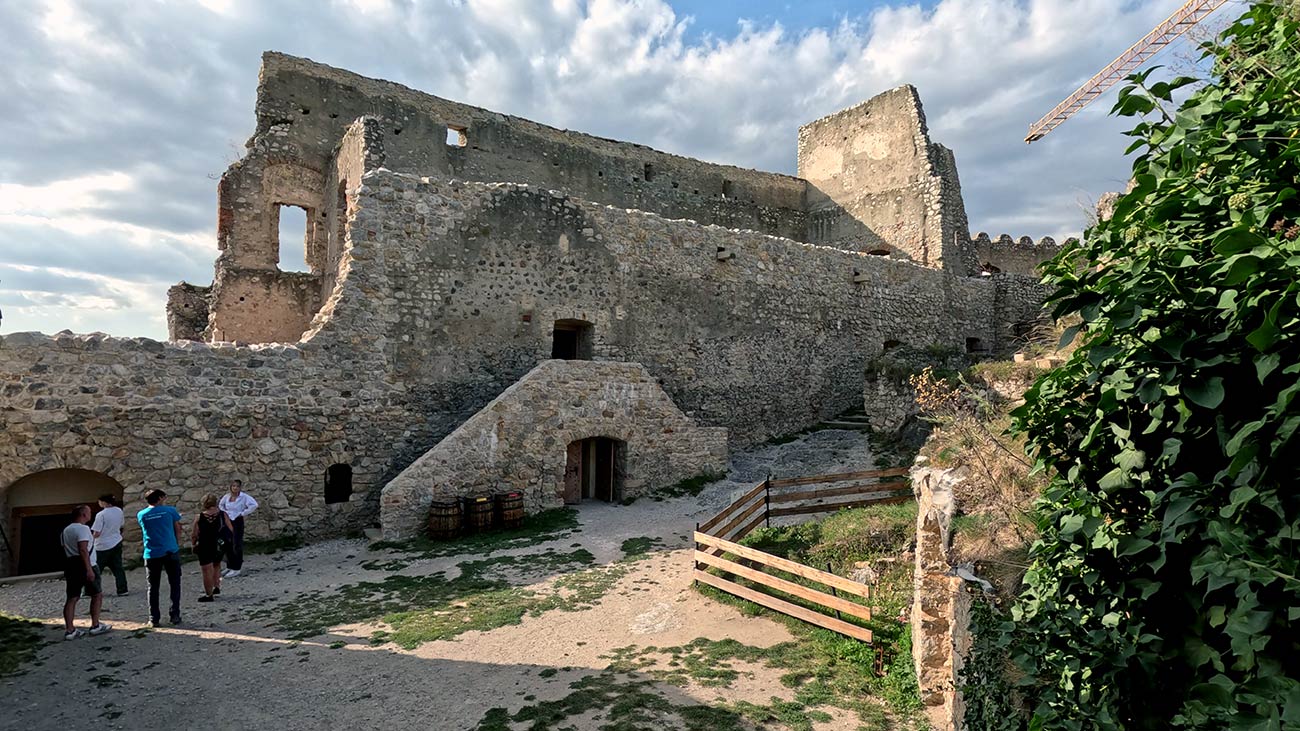
Inside the surviving walls, the modern visitor route passes through a sequence of well-restored spaces that climb gradually upward through the rock. From the entrance, a Gothic gate with a pointed arch leads into the lower courtyard, dominated by the medieval guard tower and the line of the curtain wall. A second gate continues into the upper ward, where the chapel, the residential apartments, and the now open-air amphitheatre stand around the small central yard. Stone water tanks, a well shaft, and a Gothic staircase in the chapel remain in place, alongside fragments of the Renaissance decoration that was added to the residential rooms in later centuries. The site is presented as a working museum, with interactive exhibitions, an amphitheatre used for summer cultural events, and a small castle buffet for refreshments along the route.
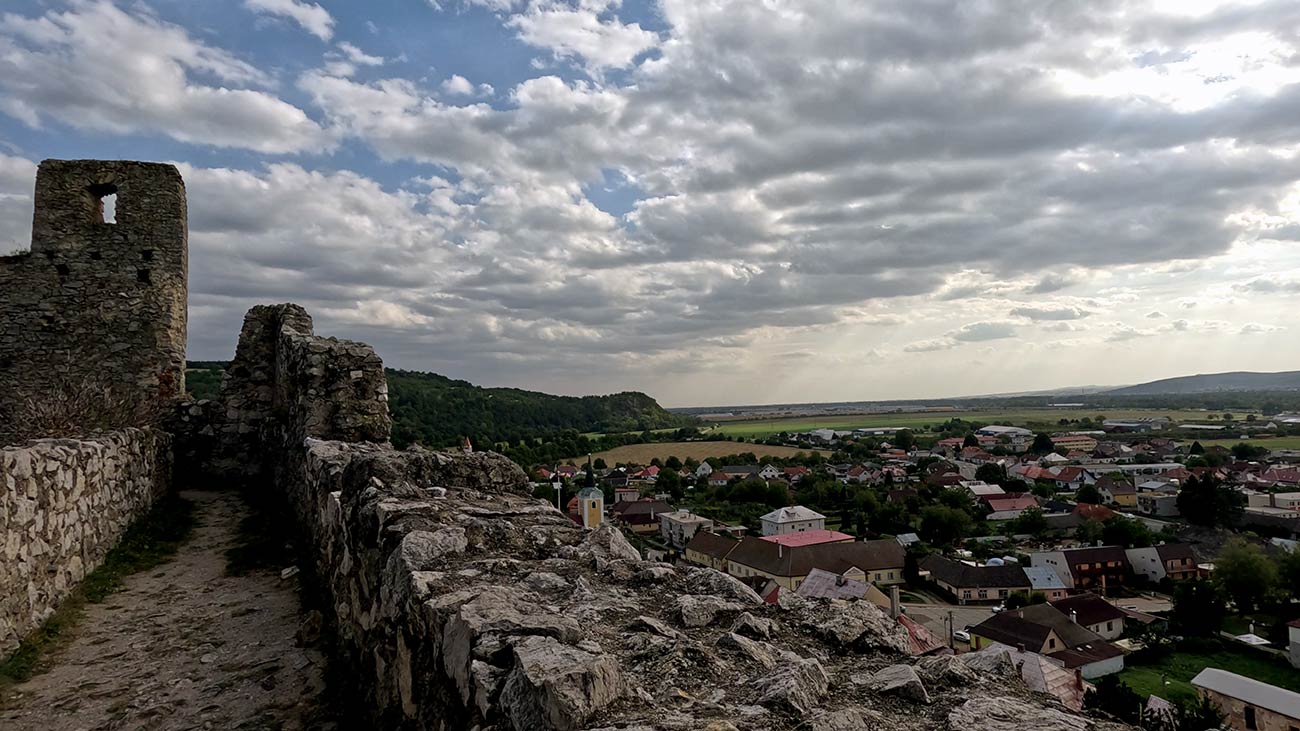
From the upper ramparts the view stretches across the Váh valley toward the Považský Inovec hills, the Little Carpathians on the western horizon, and the Biele Karpaty (White Carpathians) further to the north. On clear days you can see the silhouette of Trenčín Castle further upstream, a clear reminder that Beckov was once part of a coordinated chain of Hungarian frontier fortresses guarding the Váh valley between the Little Carpathians and the Tatras. Around the castle, the village of Beckov preserves a small Baroque church, a Franciscan monastery from the seventeenth century, and the Stiborov dvor restaurant in a historic burgher house near the base of the cliff, offering regional cuisine for travellers continuing their journey. The road back down to the Váh is short, and most visitors complete the visit in a focused half-day, returning to either Nové Mesto nad Váhom or Trenčín by late afternoon.
 Useful Links
Mobility for Cyclists
Reaching the area by train with your bike
Beckov Castle can be reached from the EuroVelo 6 by a single direct rail journey from one of the main cities on the Danube cycle path, followed by a short ride along the Váh valley. The castle lies in the Trenčín Region of western Slovakia, around 100 kilometres north-east of Bratislava, on the main north-south railway corridor and the regional cycle network along the river.
The connection
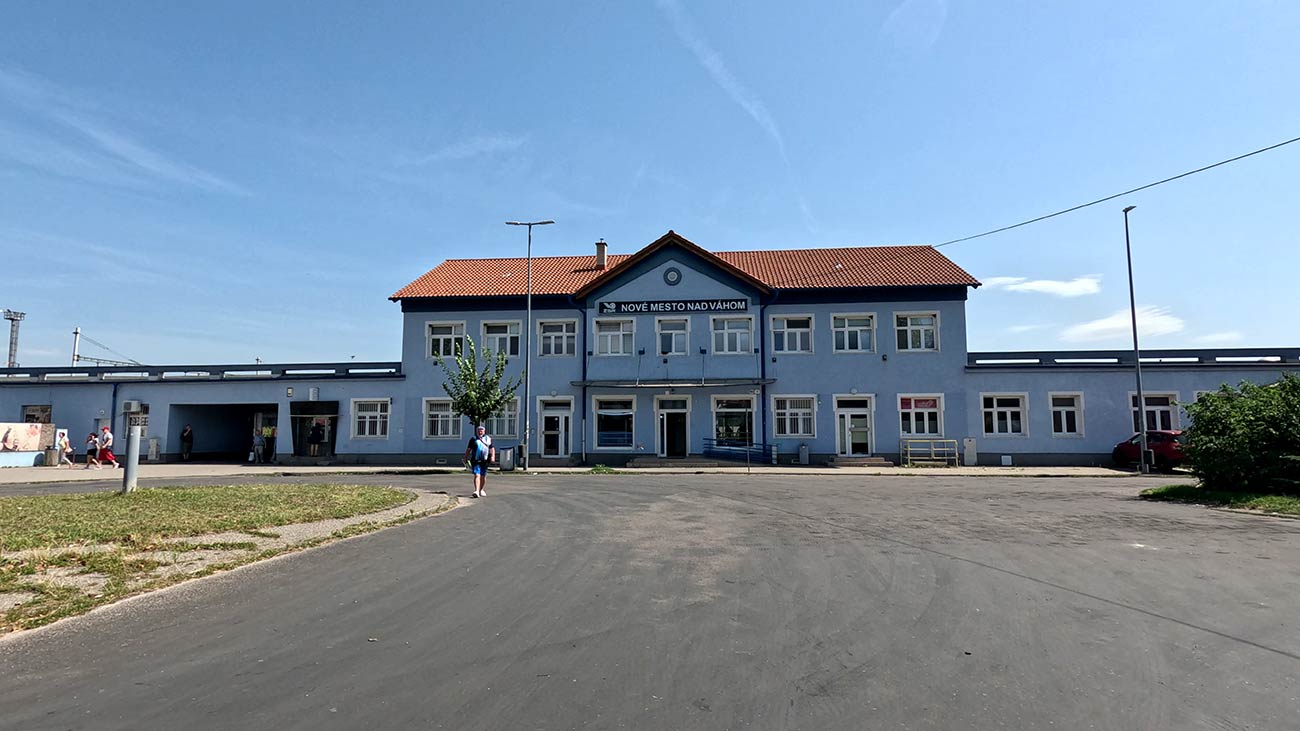
The most practical connection from the EuroVelo 6 corridor is from Bratislava, where ZSSK regional and InterCity trains run directly to Nové Mesto nad Váhom in around one hour to one hour and ten minutes, with hourly departures throughout the day. Nové Mesto nad Váhom is the nearest railway station to the castle and the natural arrival point for travellers using public transport. The line follows the broad Váh valley northward through the heart of western Slovakia, with views of the rolling Carpathian foothills along the way. Cyclists riding the Slovak stretch of the EuroVelo 6 will find Bratislava the natural transfer point. Beckov can also be approached from the north for travellers already in the area, since the same line continues onward to Trenčín and beyond toward Žilina and the Tatras.
Slovak Trains
The rail network in Slovakia is operated mainly by Železničná spoločnosť Slovensko (Slovak Railway Company, commonly known as ZSSK), the national passenger railway operator and by far the largest carrier in the country. ZSSK runs most long-distance services as well as a large share of regional connections, including the InterCity and EuroCity trains on the main east–west corridor and the dense network of regional and suburban Os and REX services that branch out into the Slovak countryside. Tickets, timetables, and bicycle reservations can be planned and booked through the ZSSK website and the IDS ZSSK app, which together serve as the central tools for travel across the system. Alongside ZSSK, the private operator RegioJet runs a smaller number of long-distance trains on selected routes, although its bicycle transport capacity is limited and depends on the specific train and route. A further private operator, Leo Express, does not serve the routes covered by this guide. For travellers leaving the EuroVelo 6 along the Slovak stretch of the Danube, the natural rail gateway is Bratislava, the country’s capital, where two regional railway branches run north into the surrounding region: one west and north toward Trenčín along the Váh valley, and one east toward Nitra. Both corridors are served by frequent ZSSK regional trains throughout the day, making short detours from the Danube cycle path quick and easy to organise.
Taking your bike
Slovakia is generally very bike-friendly when it comes to rail transport, especially on regional services operated by ZSSK, which form the core of mobility for cycle touring along the Danube and its connecting corridors. On regional and local trains (the Os and REX categories), bicycles can be taken on board for an additional fee, with no advance reservation possible and a first-come, first-served allocation of space. Bicycle tickets are sold as single trips or as affordable daily, weekly, or monthly passes, valid across the regional network. On long-distance services such as R (fast), Ex (express), EC, IC, and RJX trains, an advance reservation for the bicycle is mandatory, with the bike spaces located in dedicated zones in second-class carriages or in mobile luggage compartments. The private operator RegioJet runs a smaller number of long-distance trains on selected Slovak routes and also accepts bicycles on some of these, but the capacity is more limited than on ZSSK trains and an advance reservation is required. Leo Express, a further private operator, is fully bike-friendly on its train services and allows up to four bicycles per train with advance reservation, although its routes do not cover the detours in this guide and are mainly relevant for cyclists travelling between the Czech Republic and other parts of Slovakia. Folding bikes are carried free of charge as hand luggage on all three operators, provided they fit in the luggage racks. Overall, the Slovak rail system is well adapted to cycle tourism and offers a flexible combination of train and bike that makes it easy to leave the EuroVelo 6 route in either direction for short or extended detours.
Bikes on Buses
Long-distance bus services in Slovakia are primarily operated by FlixBus, complemented by RegioJet and Slovak Lines on selected routes, alongside a smaller number of regional and private coach operators. As in many central European countries, the long-distance bus market in Slovakia is less developed than the wider rail network, and many domestic connections that would otherwise be served by intercity coaches are instead handled by ZSSK trains. FlixBus is generally the most practical option for cyclists, with bicycle transport available on certain connections, either via external bike racks or in the luggage compartment, although it is not consistently guaranteed across the network and depends on the specific vehicle type and route configuration. Where available, bicycle transport must be reserved in advance and capacity is limited, making it less flexible compared to rail services. RegioJet also runs long-distance coaches alongside its trains, and Slovak Lines operates a network of domestic and international routes from Bratislava, but the bicycle-carrying options on both operators are limited and not guaranteed on the routes relevant to the detours in this guide. As a result, buses are generally used as a secondary option for cyclists, mainly for longer-distance repositioning between major cities rather than as a core part of cycling itineraries along the Danube region. While useful in specific cases where rail connections are less convenient, they are less predictable and less standardised for bicycle transport, so advance planning is essential.
Arriving at Nové Mesto nad Váhom or Combining with Trenčín
From Nové Mesto nad Váhom station, the final stretch to Beckov is a short ride of around 10 kilometres on a regional road that follows the Váh valley south. The route is mostly flat, signposted, and shared with light local traffic, with the silhouette of the castle visible from several kilometres away. Allow about 30 to 40 minutes of easy cycling. A small parking area at the foot of the castle offers space to lock bikes before climbing the paved access road up to the gates. Travellers planning to spend the night in Trenčín instead can combine the visit with a stop there, leaving the bikes at the accommodation and reaching Beckov by regional bus along the Váh, with services running several times a day from the Trenčín bus station and stopping in the village of Beckov below the castle. For onward travel, the same ZSSK line connects back toward Bratislava and the wider Danube region, as well as further north toward Trenčín, Žilina, and the Tatras, so Beckov works equally well as a half-day excursion from Bratislava or as one stop on a longer Slovak itinerary.