Senec
Reading time: 12 minutes
SENEC, BRATISLAVA REGION, SLOVAKIA
Sunny Lakes and a Renaissance Old Town in Bratislava's Backyard
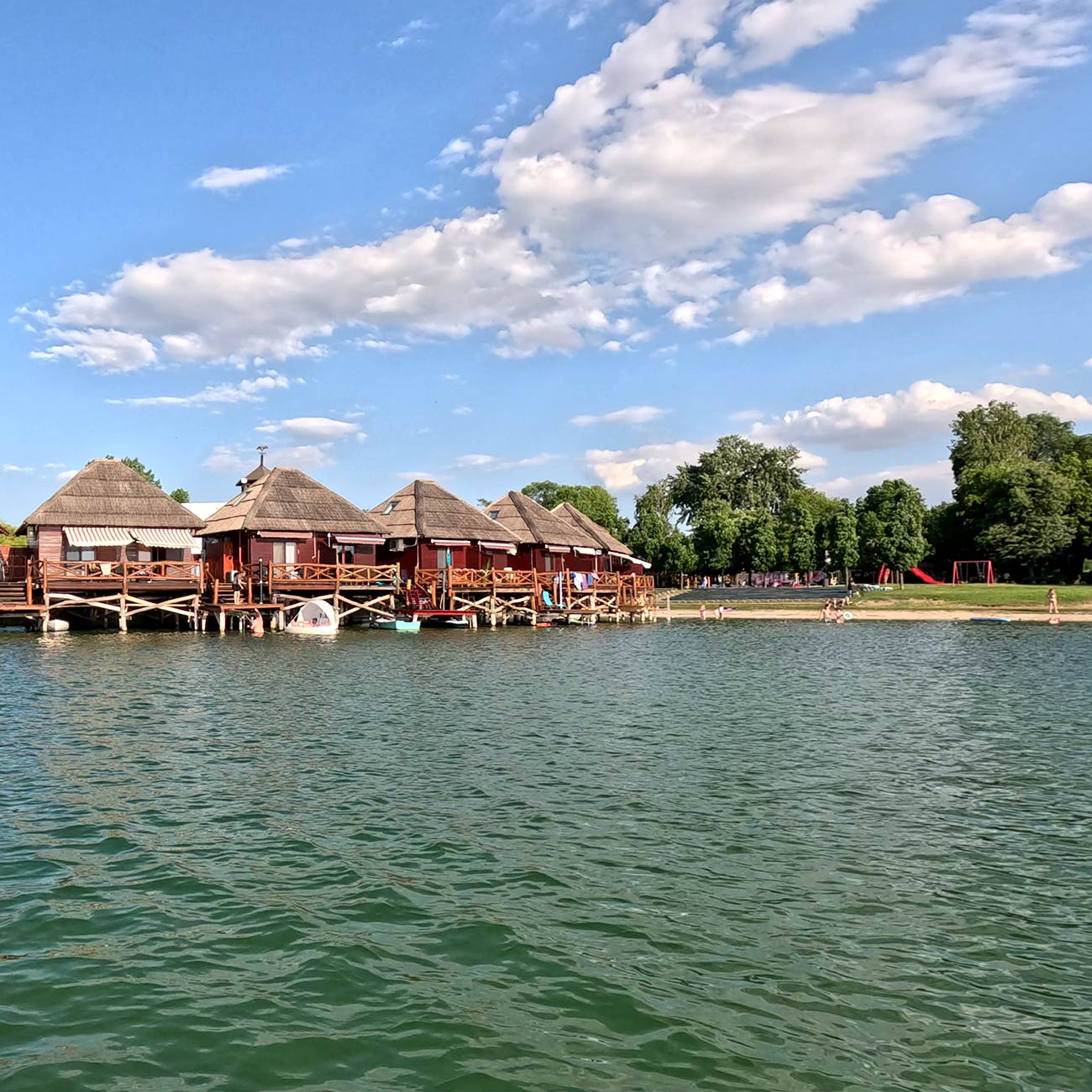
Just 25 kilometres north-east of Bratislava, where the rolling hills of the Little Carpathians give way to the broad lowland plains of the Danubian basin, lies one of the most popular weekend destinations of the Slovak capital. Senec is a small town of around 15,600 inhabitants that, for several months of the year, transforms into one of the country's best-loved summer resorts. The reason is a chain of warm, shallow lakes on the southern edge of the town known as Slnečné jazerá (Sunny Lakes), whose water reaches an average summer temperature of 25 degrees Celsius and whose surroundings enjoy more than 2,200 hours of sunshine each year, more than almost anywhere else in central Europe.
The town has a quieter side that often catches visitors by surprise. The historical record traces Senec back to 1252, when it first appeared in a deed between a Bratislava palatine and Count Roland, and it received its formal city privileges from King Matthias Corvinus in the 1480s. The result of these long centuries of urban life is a small but distinctive old centre clustered around the main square, with a Renaissance manor house, a richly decorated Gothic-Baroque church, a Plague Pillar from 1747, and a nineteenth-century synagogue that recalls the once-significant Jewish community of the town. Senec is not a place that overwhelms with monuments, but the layers of history along its main streets reward an unhurried hour or two between bathing and sunbathing at the lakes.
For cyclists exploring the Danube along the EuroVelo 6, Senec is one of the easiest detours imaginable from the Slovak stretch of the route. A direct ZSSK regional train covers the 25 kilometres from Bratislava in just 25 minutes, with hourly departures throughout the day, and the lakeside and the old town are both within a short walk of the train station. The result is a small but unusually well-balanced excursion: a half-day or full day combining open water, low-key Slovak resort life, and a quiet Renaissance market town.
LakeBeachViewsSun
A Resort Town with a Long Renaissance History
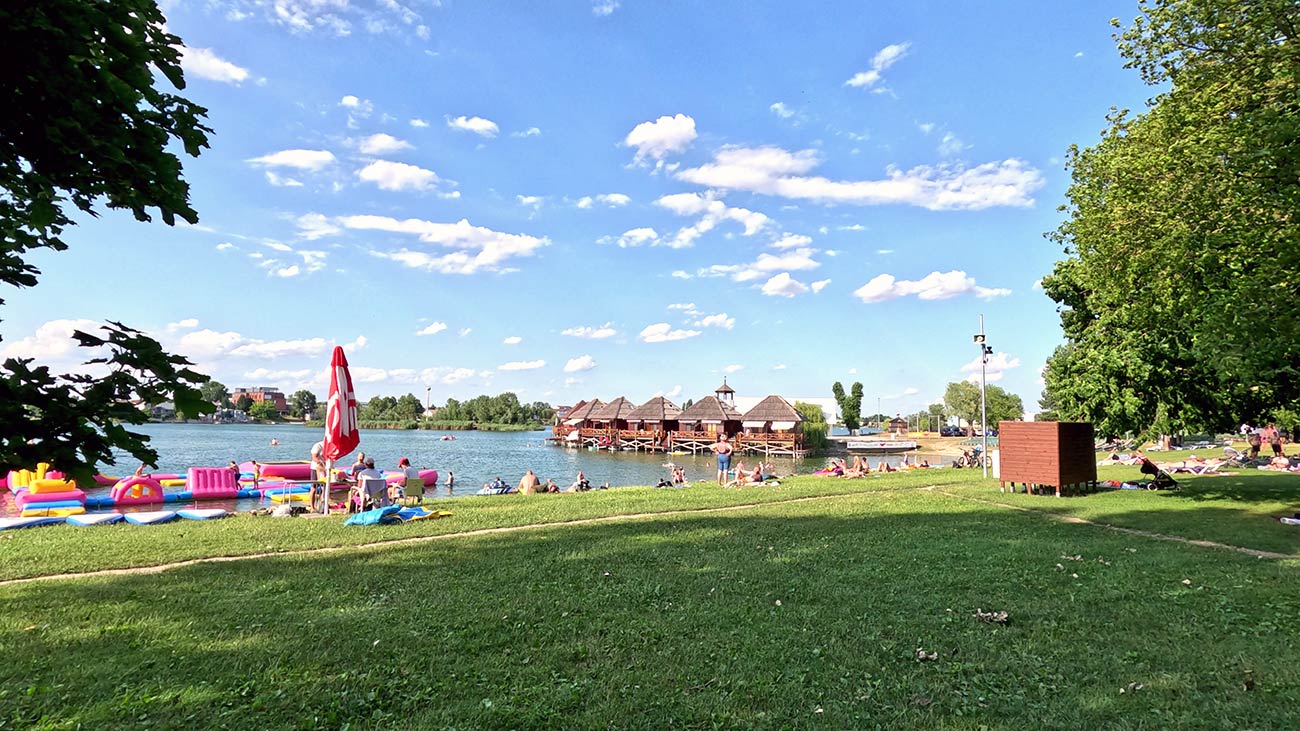
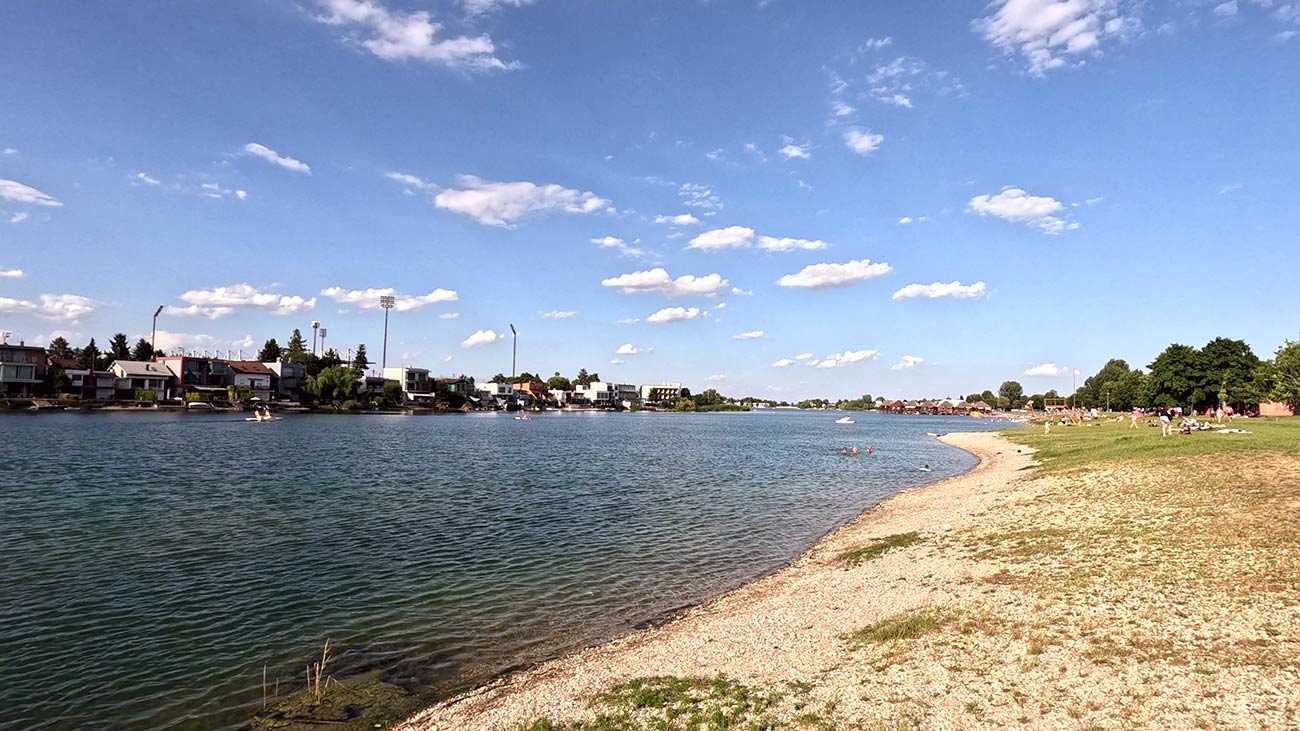
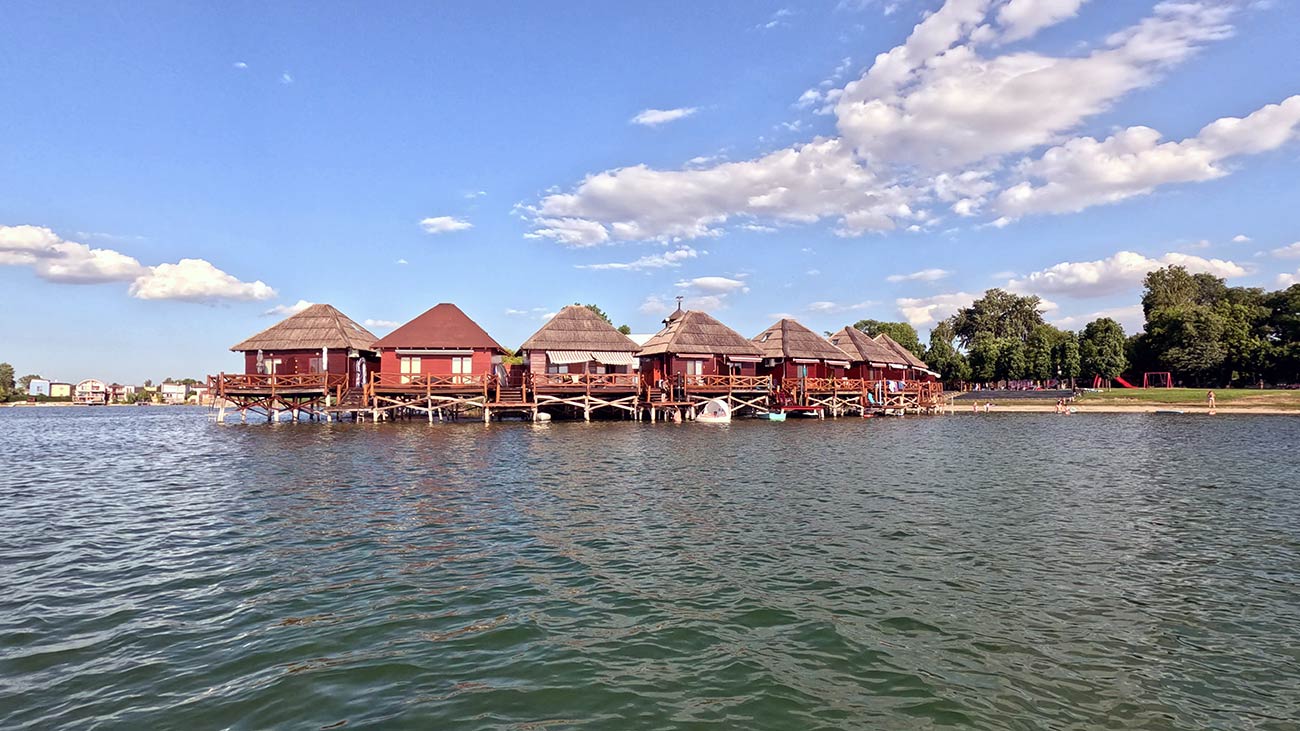
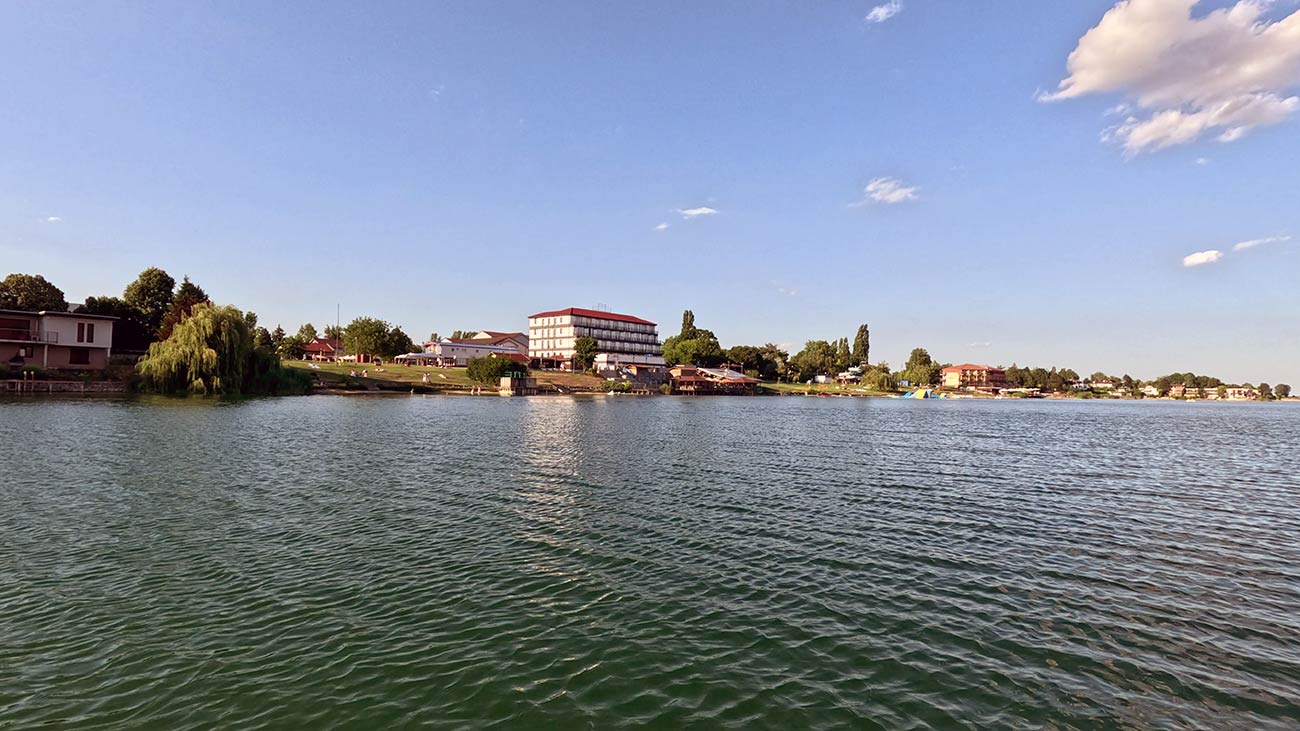
The natural anchor of any visit to Senec is the Sunny Lakes (Slnečné jazerá), a complex of four interconnected lakes immediately south of the town centre. The water comes from groundwater rather than a river feed, and the gently warming basin gives an unusually high average summer temperature of around 25 degrees Celsius, making the lakes a popular bathing destination throughout the season. The shoreline is dotted with hotels, bungalow colonies, family campsites, a summer open-air cinema, restaurants, kiosks, and a long sequence of grassy beach areas with sandpits, slides, and swings for children. The resort offers a generous mix of outdoor activities, including tennis, squash, bowling, billiards, minigolf, table tennis, beach volleyball, fishing, and small-boat hire on the lakes themselves. A separate Aquapark Senec, built around a thermal water drill completed in 2004, opens out the season with heated indoor and outdoor pools, slides, and a sauna world that operates year-round, alongside spa treatments, massages, fitness centres, and a small wellness complex within the surrounding hotels. The lakes themselves are an extension of Bratislava's weekend culture as much as a destination in their own right, and on a hot summer day the place takes on the relaxed informality of a Slovak seaside town transplanted inland.
The historic core of Senec, only a short walk north of the lakes, preserves a small but unusually concentrated set of monuments from the late medieval and Renaissance periods. The most distinctive of these is the Turkish House (Turecký dom), a Renaissance manor house from the second half of the sixteenth century that stands on the main square and is widely considered the most treasured monument in the town. The unusual name reflects the architectural fashions of the period, when the Ottoman frontier was not far away, and the building once played both a defensive role and served as a meeting place for the Bratislava district board across several centuries. A short walk away, the Large Stift (Veľký Stift) is a substantial Renaissance complex that has had one of the more colourful afterlives in Slovak architecture, serving in turn as a noble manor, a women's house of correction, an orphanage, and a military training institution before settling into its current civic role. Together with the surrounding burgher houses, these two Renaissance survivors give a clear sense of how Senec functioned as a small but prosperous regional centre during the centuries of Habsburg rule.
The religious life of the town is gathered around two principal buildings of very different character. The Church of Bishop St Nicholas (Kostol biskupa sv. Mikuláša) is the architectural anchor of the old town, with Gothic foundations from the original medieval church preserved beneath an eighteenth-century Baroque rebuilding that gave the structure its current outline, its painted ceilings, and its delicate altars. It is the oldest building in Senec and the dominant landmark of the historic centre. On the other side of the cultural spectrum stands the Senec Synagogue, built in 1825 to serve what was then a large and active Jewish community in the town and the surrounding region. The building survives as the only synagogue in the wider area and now functions as a cultural and community space, with regular exhibitions and concerts that recall the social and religious diversity of pre-war Slovakia. Both buildings sit within easy walking distance of the main square and form a quiet but rewarding sequence for travellers interested in the deeper layers of Senec's history before heading back to the lakes.
 Useful Links
Mobility for Cyclists
Reaching the area by train with your bike
Senec can be reached from the EuroVelo 6 by a single short rail journey from one of the main cities on the Danube cycle path. The town lies just 25 kilometres north-east of Bratislava in the Bratislava Region, on the main north-south rail corridor running from the Slovak capital through the southern lowlands, and is one of the most easily accessible day-trip destinations on the entire Slovak section of the route.
The connection
The most practical connection from the EuroVelo 6 corridor is from Bratislava, where ZSSK regional and S-Bahn services run directly to Senec in around 25 minutes, with hourly departures throughout the day. The line runs east from Bratislava Hlavná Stanica through the flat Danubian lowlands and is heavily used as a commuter corridor, which means trains are frequent, fast, and reliable. Cyclists riding the Slovak stretch of the EuroVelo 6 will find Bratislava the natural transfer point, and the journey fits comfortably into a half-day excursion.
Slovak Trains
The rail network in Slovakia is operated mainly by Železničná spoločnosť Slovensko (Slovak Railway Company, commonly known as ZSSK), the national passenger railway operator and by far the largest carrier in the country. ZSSK runs most long-distance services as well as a large share of regional connections, including the InterCity and EuroCity trains on the main east–west corridor and the dense network of regional and suburban Os and REX services that branch out into the Slovak countryside. Tickets, timetables, and bicycle reservations can be planned and booked through the ZSSK website and the IDS ZSSK app, which together serve as the central tools for travel across the system. Alongside ZSSK, the private operator RegioJet runs a smaller number of long-distance trains on selected routes, although its bicycle transport capacity is limited and depends on the specific train and route. A further private operator, Leo Express, does not serve the routes covered by this guide. For travellers leaving the EuroVelo 6 along the Slovak stretch of the Danube, the natural rail gateway is Bratislava, the country's capital, where two regional railway branches run north into the surrounding region: one west and north toward Trenčín along the Váh valley, and one east toward Nitra. Both corridors are served by frequent ZSSK regional trains throughout the day, making short detours from the Danube cycle path quick and easy to organise.
Taking your bike
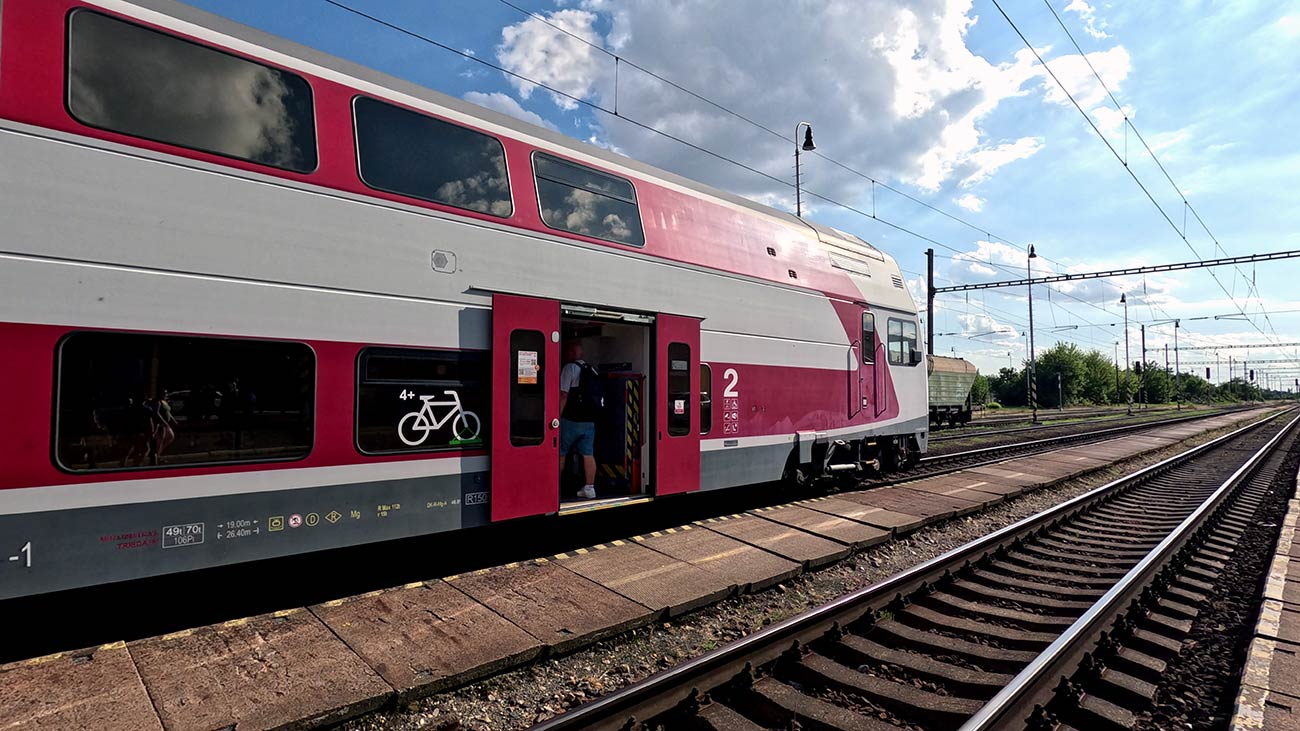
Slovakia is generally very bike-friendly when it comes to rail transport, especially on regional services operated by ZSSK, which form the core of mobility for cycle touring along the Danube and its connecting corridors. On regional and local trains (the Os and REX categories), bicycles can be taken on board for an additional fee, with no advance reservation possible and a first-come, first-served allocation of space. Bicycle tickets are sold as single trips or as affordable daily, weekly, or monthly passes, valid across the regional network. On long-distance services such as R (fast), Ex (express), EC, IC, and RJX trains, an advance reservation for the bicycle is mandatory, with the bike spaces located in dedicated zones in second-class carriages or in mobile luggage compartments. The private operator RegioJet runs a smaller number of long-distance trains on selected Slovak routes and also accepts bicycles on some of these, but the capacity is more limited than on ZSSK trains and an advance reservation is required. Leo Express, a further private operator, is fully bike-friendly on its train services and allows up to four bicycles per train with advance reservation, although its routes do not cover the detours in this guide and are mainly relevant for cyclists travelling between the Czech Republic and other parts of Slovakia. Folding bikes are carried free of charge as hand luggage on all three operators, provided they fit in the luggage racks. Overall, the Slovak rail system is well adapted to cycle tourism and offers a flexible combination of train and bike that makes it easy to leave the EuroVelo 6 route in either direction for short or extended detours.
Bikes on Buses
Long-distance bus services in Slovakia are primarily operated by FlixBus, complemented by RegioJet and Slovak Lines on selected routes, alongside a smaller number of regional and private coach operators. As in many central European countries, the long-distance bus market in Slovakia is less developed than the wider rail network, and many domestic connections that would otherwise be served by intercity coaches are instead handled by ZSSK trains. FlixBus is generally the most practical option for cyclists, with bicycle transport available on certain connections, either via external bike racks or in the luggage compartment, although it is not consistently guaranteed across the network and depends on the specific vehicle type and route configuration. Where available, bicycle transport must be reserved in advance and capacity is limited, making it less flexible compared to rail services. RegioJet also runs long-distance coaches alongside its trains, and Slovak Lines operates a network of domestic and international routes from Bratislava, but the bicycle-carrying options on both operators are limited and not guaranteed on the routes relevant to the detours in this guide. As a result, buses are generally used as a secondary option for cyclists, mainly for longer-distance repositioning between major cities rather than as a core part of cycling itineraries along the Danube region. While useful in specific cases where rail connections are less convenient, they are less predictable and less standardised for bicycle transport, so advance planning is essential.
Arriving at Senec Station
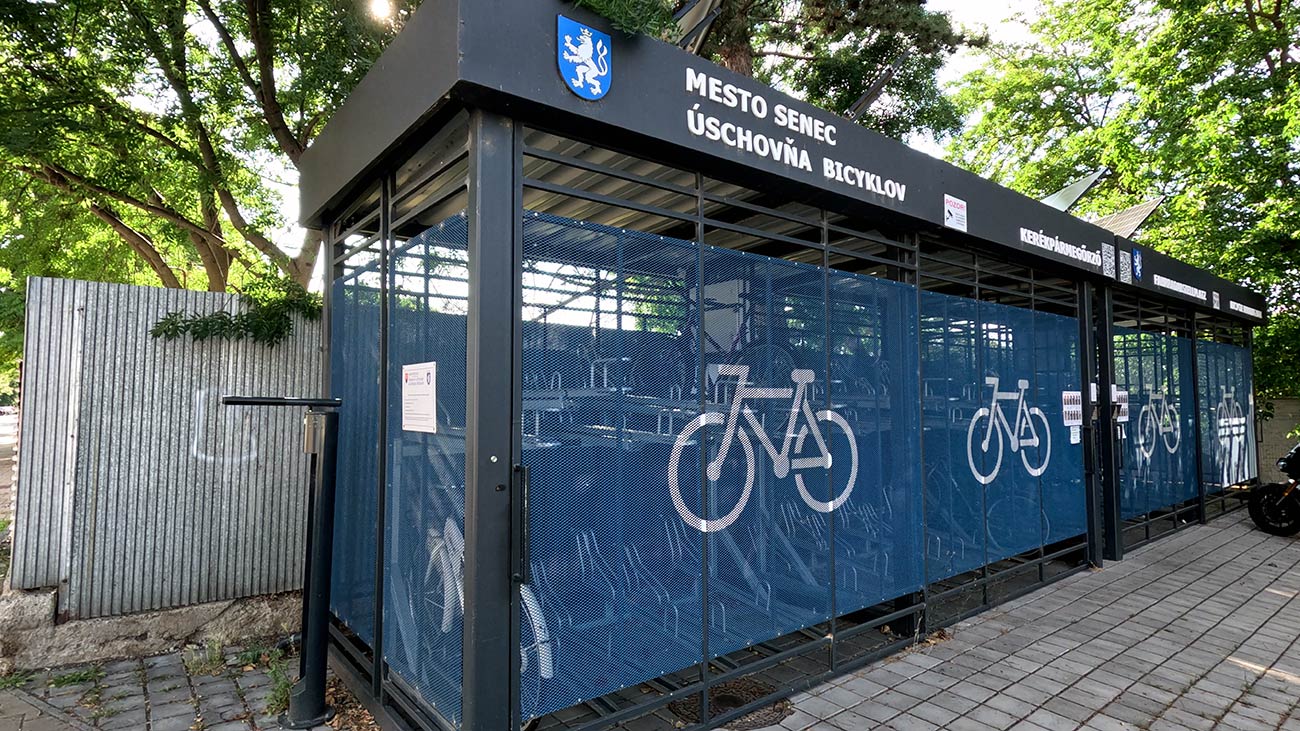
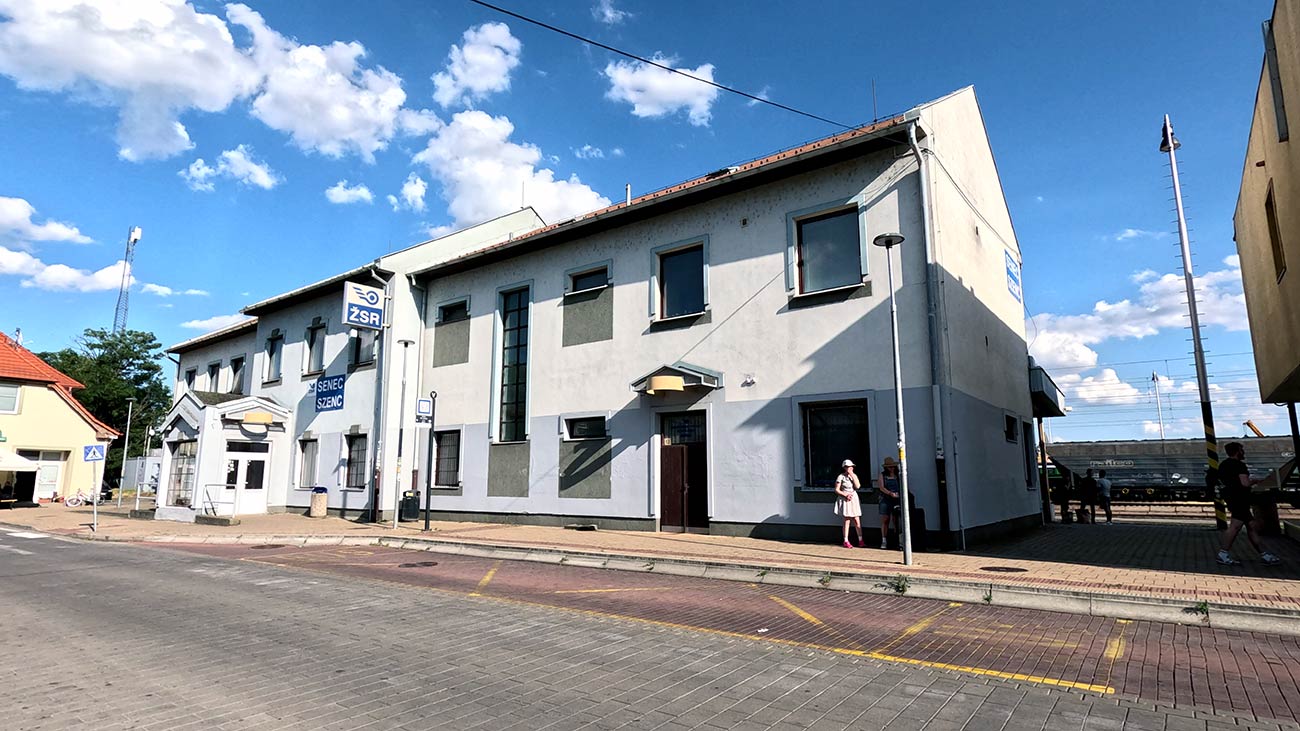
Senec railway station sits at the eastern edge of the town, around ten minutes on foot or under five minutes by bike from the main square, the historic centre, and the Renaissance Turkish House. The Sunny Lakes recreational area lies just south of the centre and is reached in a further ten to fifteen minutes by foot or bike along largely flat, signposted streets, with a network of pedestrian and cycle paths threading between the four lakes and connecting the various beaches, hotels, and the Aquapark. The entire visit, from station to lakes and back through the historic centre, can be comfortably completed on foot in a half day. Bike racks are available at the station and at several points around the lakes and the main square. For onward travel, the same line connects back toward Bratislava and the wider Danube region, as well as further east toward Galanta and the southern lowlands, so Senec works equally well as a quick afternoon excursion or as a longer day combining the lakes and the old town.