Smolenice Castle
Reading time: 14 minutes
SMOLENICE CASTLE, TRNAVA REGION, SLOVAKIA
A Romantic Castle on the Eastern Slope of the Little Carpathians
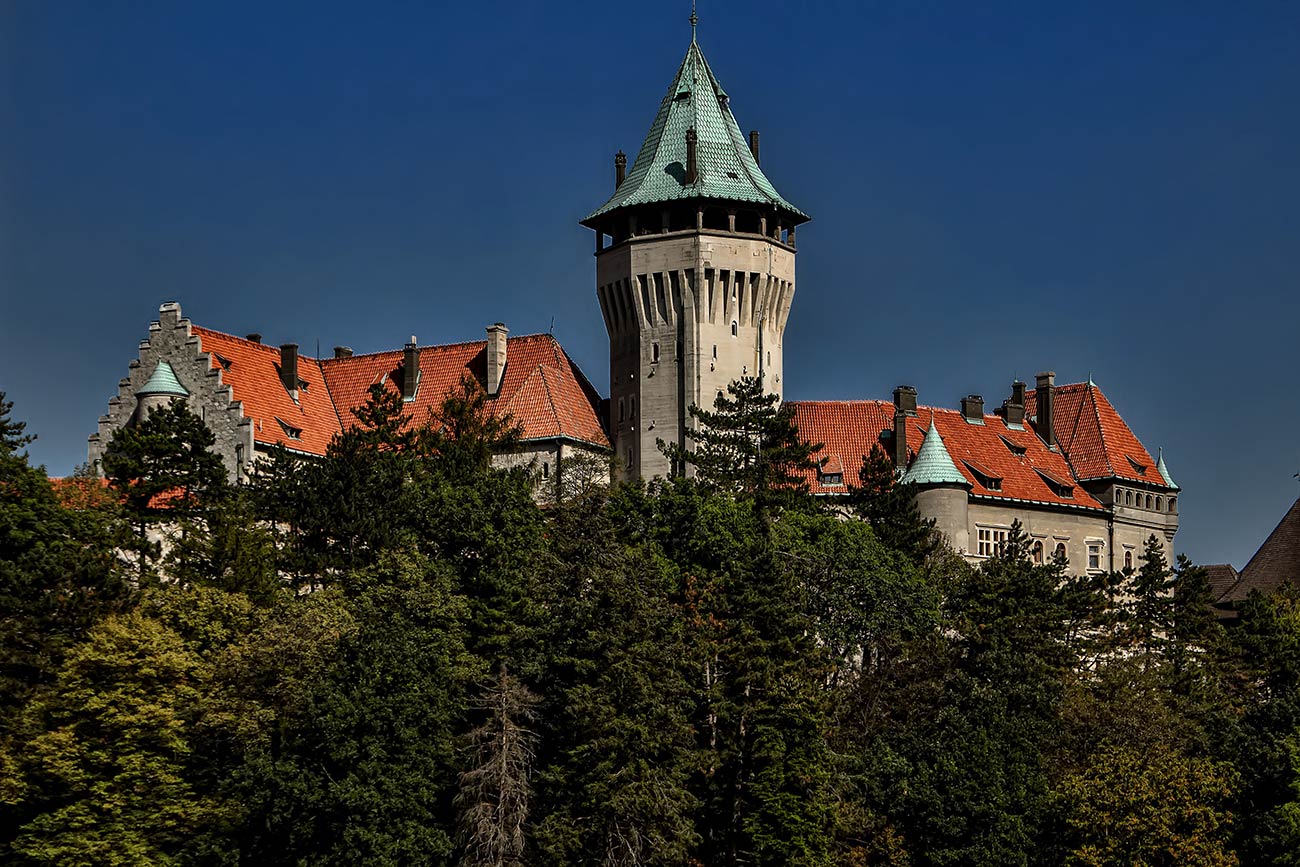
Where the long ridge of the Little Carpathians (Malé Karpaty) drops gently toward the open plain west of Trnava, a slender white castle rises above the village of Smolenice like an illustration from a romantic novel. Pale walls, conical roofs, a tall central tower, and a sequence of bastions and ornamental balconies climb the wooded slope just above the village rooftops, all of it framed by oak forest and vineyards. Smolenice Castle has the air of a place that has stood here for centuries, and in a sense it has. The first written record of the settlement of Smolenice reaches back to 1256, and the medieval seat of the estate, built on the same hill in the fifteenth century, was already a working fortress of the Hungarian frontier. The building seen today, however, is something rather different: a careful early twentieth-century reconstruction in the romantic style, raised on the foundations of the medieval castle by a wealthy noble family who had inherited a ruin and decided to build a vision in its place.
The combination of authentic medieval site and twentieth-century romantic architecture gives Smolenice a distinctive character among Slovak castles. After several centuries of ownership by some of the most powerful noble families of the Hungarian kingdom, including the Stibor family, the Orszáaghs, the Erdődys, and finally the Pálffys, the castle had fallen into deep decay by the end of the eighteenth century. The Napoleonic Wars finished the work, and the main building and tower burned down. Reconstruction began only in 1887, when Count Jozef Pálffy Jr. commissioned the architect Jozef Hubert to design a new castle on the foundations of the old, in a romantic mix of Gothic Revival, French Renaissance, and Slovak vernacular details. The work was paused by the First World War and resumed only after the Second, and the castle was completed and handed over to the Slovak Academy of Sciences in 1953 as a congress and conference centre, a role it still serves today.
For cyclists exploring the Danube along the EuroVelo 6, Smolenice Castle is one of the more romantic detours from the Slovak stretch of the route. The castle lies around 60 kilometres north-east of Bratislava in the Trnava Region, easily reached by a regional train with a change in Trnava. A day spent moving between the castle interior, the wooded slopes of the surrounding nature park, and the small village below offers a clear contrast to the open river road, and an unusual mix of authentic medieval setting and Belle Époque fairy-tale architecture that few castles in central Europe can quite match.
CastleRomanticHistoryWoods
A Medieval Foundation and a Romantic Rebuilding
The settlement of Smolenice appears in the historical record for the first time in 1256, although the place itself was already known earlier as a small frontier community on the eastern slope of the Little Carpathians. The decisive chapter in the castle’s history begins in 1388, when the Hungarian king Sigismund of Luxembourg issued a deed of donation granting the entire Smolenice estate to the powerful Polish-Hungarian nobleman Stibor of Stiboricz, the same lord who held Beckov and many other castles across the kingdom. From 1438, the estate passed to Count George of Pezinok and Saint George, and through him into a long sequence of aristocratic owners. A proper stone castle was built on the hill in the fifteenth century, becoming the centre of the Smolenice estate, and its strategic position on the trade route between the Váh and Morava valleys gave it considerable importance throughout the late Middle Ages.
In the early sixteenth century the castle came into the hands of the Orszáaghs family, and in 1777 it was acquired as a pawn by Ján Pálffy of the great Pálffy dynasty. By this point the building was already in poor condition. The Pálffys never lived at the castle, which decayed further during the last years of the Erdődy family, particularly under Krištof III, whose finances did not stretch to maintenance. The final blow came during the Napoleonic Wars of the early nineteenth century, when the main castle building and the central tower burned down. For most of the nineteenth century, the hill above Smolenice was crowned by little more than overgrown walls.
The castle as visitors see it today is the work of Count Jozef Pálffy Jr., the last Pálffy landlord of Smolenice and Dobrá Voda, who decided at the end of the nineteenth century to rebuild the medieval ruin as a romantic family residence. Work began on the fortification walls in 1887, with the original bastions of the medieval castle preserved and given a height extension and new roofs. The Count commissioned the Slovak architect Jozef Hubert to design the new structure, and Hubert produced one of the most spectacular romantic castles in central Europe, combining elements of Gothic Revival, French Renaissance château architecture, and Slovak vernacular design into a single picturesque composition. Construction was interrupted by the First World War, when several rooms were used to store the Pálffy family archives, and resumed only after the Second World War. In 1945, the castle passed into state ownership and was taken over by the Slovak National Council as a summer residence. On 26 June 1953 it was formally handed over to the Slovak Academy of Sciences (Slovenská akadémia vied, SAV), which has used it ever since as a working congress centre for international scientific meetings.
The visitor experience at Smolenice today combines authentic castle architecture with a quietly active institutional life. Guided castle tours lead visitors through the main public rooms, including the elaborately decorated Yellow Salon, the Knights’ Hall, the central tower, several smaller salons, and the broad lower courtyard with its sweeping views across the plain to the east. The Gallery at the Castle (Galéria na zámku) operates a small art gallery, café, and bistro within the castle walls, and the castle also offers 42 guest rooms and suites for travellers wanting to spend a night in the building itself. Around the castle, marked walking paths lead into the wooded Little Carpathians Protected Landscape Area, with quieter trails climbing up toward the ridge and longer routes connecting to neighbouring castles such as Ostrý Kameň and the well-preserved Červený Kameň to the south.
 Useful Links
Mobility for Cyclists
Reaching the area by train with your bike
Smolenice Castle can be reached from the EuroVelo 6 by a regional rail journey from one of the main cities on the Danube cycle path, with a single change in Trnava. The castle lies in the Trnava Region of western Slovakia, around 60 kilometres north-east of Bratislava, on the branch railway line from Trnava up into the foothills of the Little Carpathians.
The connection
The most practical connection from the EuroVelo 6 corridor is from Bratislava, where ZSSK regional trains run frequently to Trnava in around 45 minutes, with departures every 20 to 30 minutes throughout the day. At Trnava, travellers change for a local regional train on the branch line to Smolenice, which takes around 20 to 25 minutes with hourly departures. The full journey from Bratislava to Smolenice takes around one hour and a half including the change. Cyclists riding the Slovak stretch of the EuroVelo 6 will find Bratislava the natural transfer point. The visit also combines naturally with a stop at Trnava, an important medieval city often called Little Rome for its many churches, on either the outbound or return leg.
Slovak Trains
The rail network in Slovakia is operated mainly by Železničná spoločnosť Slovensko (Slovak Railway Company, commonly known as ZSSK), the national passenger railway operator and by far the largest carrier in the country. ZSSK runs most long-distance services as well as a large share of regional connections, including the InterCity and EuroCity trains on the main east–west corridor and the dense network of regional and suburban Os and REX services that branch out into the Slovak countryside. Tickets, timetables, and bicycle reservations can be planned and booked through the ZSSK website and the IDS ZSSK app, which together serve as the central tools for travel across the system. Alongside ZSSK, the private operator RegioJet runs a smaller number of long-distance trains on selected routes, although its bicycle transport capacity is limited and depends on the specific train and route. A further private operator, Leo Express, does not serve the routes covered by this guide. For travellers leaving the EuroVelo 6 along the Slovak stretch of the Danube, the natural rail gateway is Bratislava, the country’s capital, where two regional railway branches run north into the surrounding region: one west and north toward Trenčín along the Váh valley, and one east toward Nitra. Both corridors are served by frequent ZSSK regional trains throughout the day, making short detours from the Danube cycle path quick and easy to organise.
Taking your bike
Slovakia is generally very bike-friendly when it comes to rail transport, especially on regional services operated by ZSSK, which form the core of mobility for cycle touring along the Danube and its connecting corridors. On regional and local trains (the Os and REX categories), bicycles can be taken on board for an additional fee, with no advance reservation possible and a first-come, first-served allocation of space. Bicycle tickets are sold as single trips or as affordable daily, weekly, or monthly passes, valid across the regional network. On long-distance services such as R (fast), Ex (express), EC, IC, and RJX trains, an advance reservation for the bicycle is mandatory, with the bike spaces located in dedicated zones in second-class carriages or in mobile luggage compartments. The private operator RegioJet runs a smaller number of long-distance trains on selected Slovak routes and also accepts bicycles on some of these, but the capacity is more limited than on ZSSK trains and an advance reservation is required. Leo Express, a further private operator, is fully bike-friendly on its train services and allows up to four bicycles per train with advance reservation, although its routes do not cover the detours in this guide and are mainly relevant for cyclists travelling between the Czech Republic and other parts of Slovakia. Folding bikes are carried free of charge as hand luggage on all three operators, provided they fit in the luggage racks. Overall, the Slovak rail system is well adapted to cycle tourism and offers a flexible combination of train and bike that makes it easy to leave the EuroVelo 6 route in either direction for short or extended detours.
Bikes on Buses
Long-distance bus services in Slovakia are primarily operated by FlixBus, complemented by RegioJet and Slovak Lines on selected routes, alongside a smaller number of regional and private coach operators. As in many central European countries, the long-distance bus market in Slovakia is less developed than the wider rail network, and many domestic connections that would otherwise be served by intercity coaches are instead handled by ZSSK trains. FlixBus is generally the most practical option for cyclists, with bicycle transport available on certain connections, either via external bike racks or in the luggage compartment, although it is not consistently guaranteed across the network and depends on the specific vehicle type and route configuration. Where available, bicycle transport must be reserved in advance and capacity is limited, making it less flexible compared to rail services. RegioJet also runs long-distance coaches alongside its trains, and Slovak Lines operates a network of domestic and international routes from Bratislava, but the bicycle-carrying options on both operators are limited and not guaranteed on the routes relevant to the detours in this guide. As a result, buses are generally used as a secondary option for cyclists, mainly for longer-distance repositioning between major cities rather than as a core part of cycling itineraries along the Danube region. While useful in specific cases where rail connections are less convenient, they are less predictable and less standardised for bicycle transport, so advance planning is essential.
Arriving at Smolenice Station
Smolenice railway station sits at the edge of the village, about 15 to 20 minutes on foot from the castle entrance along a marked, gently uphill road. The walk leads through the village centre and into the lower part of the castle park, with the white walls of the castle visible from a long way off. Bike racks are available at the station for travellers who prefer to leave the bicycle behind, since the final climb to the castle gates is best done on foot. The wider Little Carpathians offer extensive marked cycle and hiking routes for those wanting to extend the visit, and the castle park itself is well suited to short, slow walks among old trees. For onward travel, the same line connects back toward Trnava and Bratislava, as well as further north toward the small spa villages and forest paths of the western Little Carpathians, so Smolenice works equally well as a half-day excursion or as a quiet overnight stay in the castle itself.