Trenčín
Reading time: 15 minutes
TRENČÍN, TRENČÍN REGION, SLOVAKIA
A Roman Frontier and a Medieval Crown on the Váh
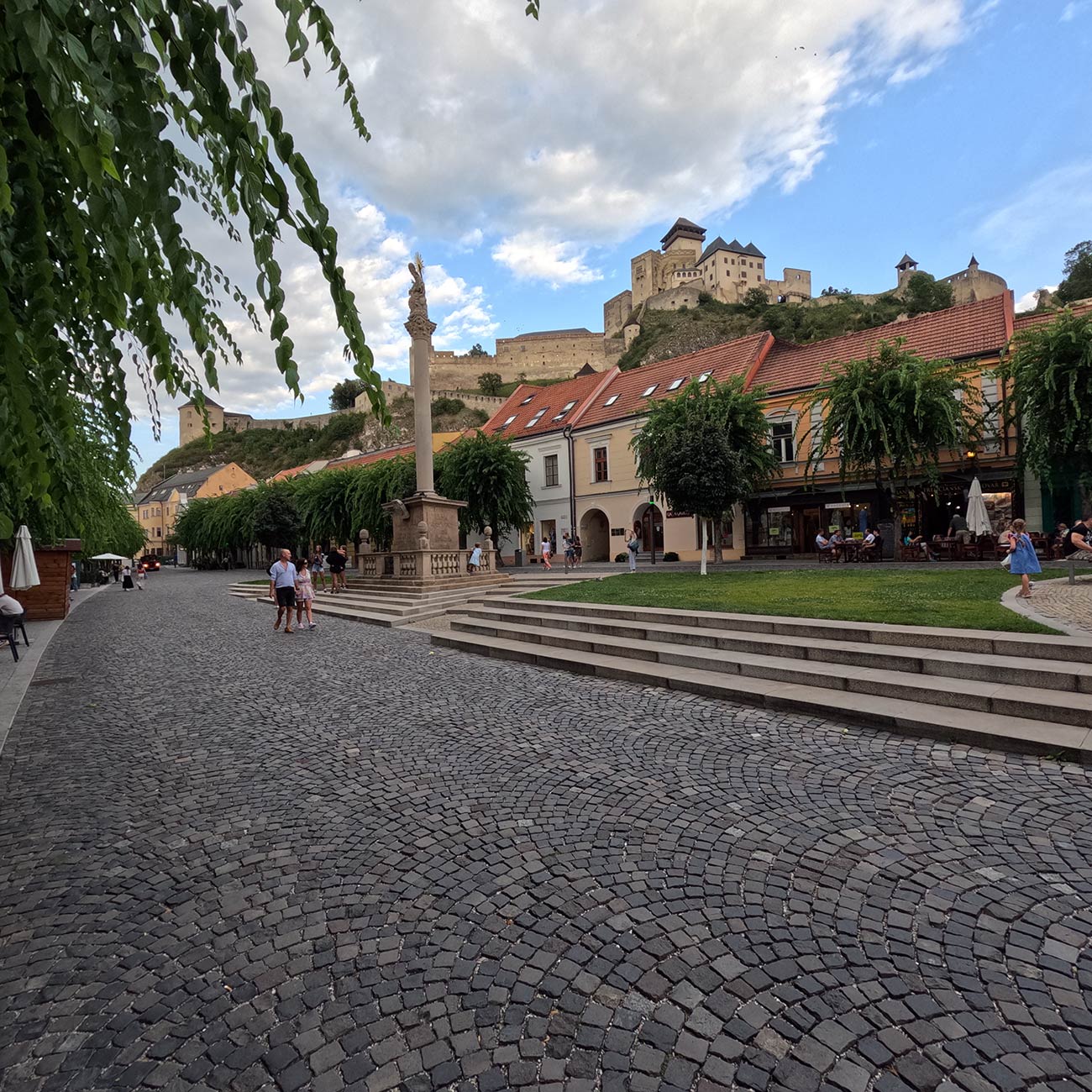
In the middle of the Váh valley in western Slovakia, where the river widens between the Strážov and Považský Inovec mountain ranges, a single vast castle dominates the entire horizon. Trenčín has grown up around this cliff-top fortress for almost two thousand years, and the silhouette of Trenčín Castle, with its towers, palaces, and curtain walls climbing up the steep limestone bluff above the city, remains the defining image of the town today. The view from the castle ramparts stretches across one of the most historic stretches of land in central Europe: a strategic river crossing, a long-distance trade corridor, and the northern frontier of the Roman Empire all gathered into a single panorama.
The story of the city goes back further than almost anywhere else in Slovakia. In 179 AD, a Roman legion travelling north under the campaigns of Emperor Marcus Aurelius carved an inscription into the cliff below today's castle, commemorating their victory over the Germanic Quadi at a place they called Laugaricio. The inscription survives, making Trenčín the northernmost confirmed Roman military presence in central Europe. From the eleventh century onwards, the strategic rock was crowned by a stone castle that grew across the medieval centuries into one of the largest in the kingdom, and the town below it developed into an important regional centre on the main road between Bratislava and the Tatras. In 2026, Trenčín was named European Capital of Culture, adding a contemporary chapter to its long story.
For cyclists exploring the Danube along the EuroVelo 6, Trenčín is one of the more rewarding city detours from the Slovak stretch of the route. The city lies around 130 kilometres north-east of Bratislava in the heart of the Považie region, easily reached by frequent ZSSK trains running between Bratislava, Žilina, and the Tatras. A day spent moving between the long tree-lined main square, the steep climb up to the castle, the Roman inscription on the rock, and the surrounding old town offers a particularly concentrated view of how Slovak history has worked across the centuries, from a legionary outpost to a medieval royal seat to a thoroughly modern European cultural city.
CastleHillViewsCulture
A Castle Above the City, an Old Town, and a Roman Inscription on the Rock
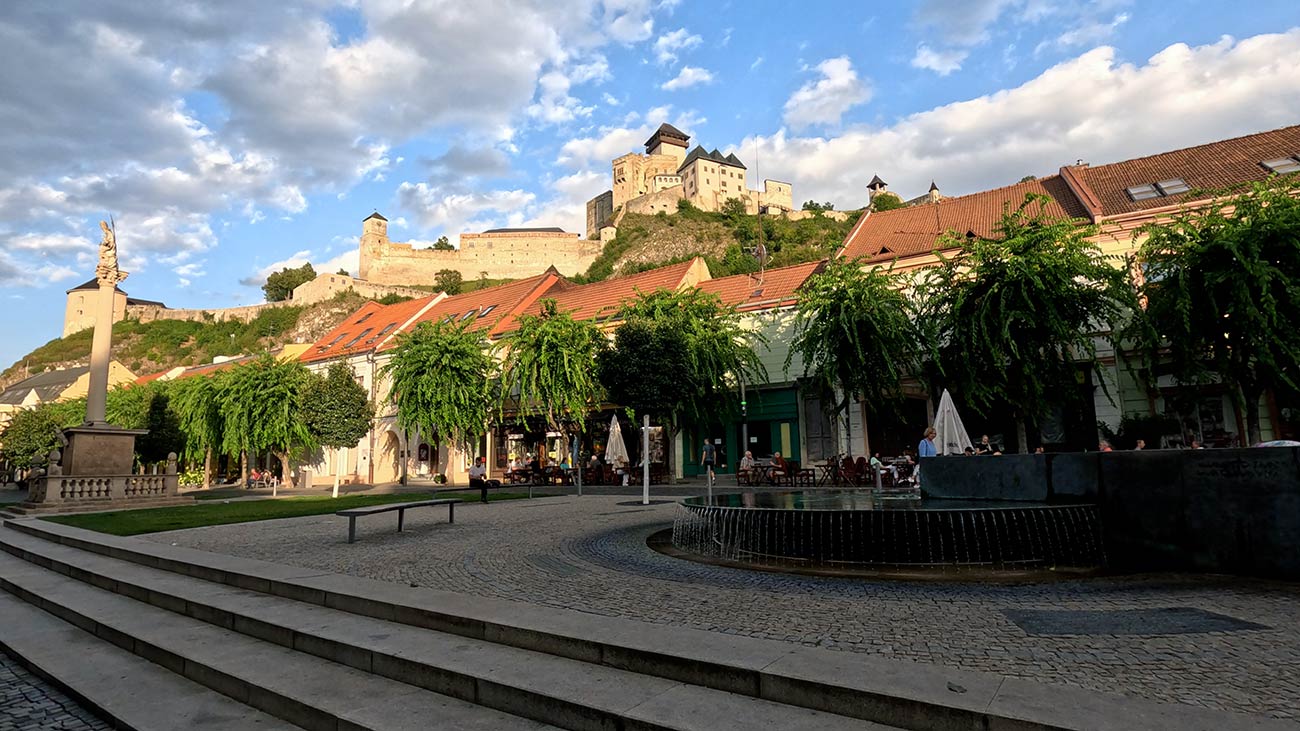
Towering 70 metres above the city on a sheer limestone cliff, Trenčín Castle (Trenčiansky hrad) is one of the largest and most spectacular medieval castles in Slovakia and the defining landmark of the town. The earliest stone structures on the rock date from the eleventh century, including a small Romanesque rotunda whose remains have been excavated within the upper walls, and the castle reached its greatest extent in the early fourteenth century under Matthew Csák of Trenčín (in Slovak Matúš Čák Trenčiansky), one of the most powerful magnates in the Kingdom of Hungary, who effectively ruled a swathe of present-day Slovakia from this base and gave the famous Gothic keep its name: Matthew's Tower (Matúšova veža). The visitor route passes through the lower bailey, the medieval kitchens, the chapel, the Knights' Hall, Barbara's Palace named after Barbara of Cilli, and the Well of Love, before climbing 270 steps inside Matthew's Tower to a panoramic viewing platform with sweeping views of the Váh valley and the silhouette of Beckov Castle further downstream. The same castle ticket also includes access to two further atmospheric sites on the way up from the centre: the Hangman's House (Katov dom), a small medieval building that once housed the city executioner and now displays a collection of historical instruments of judicial punishment, and the Charnel House (Kostnica) beside the parish church.
One of the most remarkable archaeological monuments in central Europe sits carved directly into the limestone of the same castle rock, hidden in a small enclosed courtyard at the rear of the Hotel Elizabeth in the centre of town. The Roman Inscription (Rímsky nápis) was cut into the cliff in 179 AD by soldiers of the Second Auxiliary Roman Legion and commemorates their victory over the Germanic Quadi tribe during the campaigns of Emperor Marcus Aurelius and his son Commodus. The Latin text names the legion's commander, Maximianus, and the strength of the unit garrisoned here at the place the Romans called Laugaricio, making this the northernmost confirmed Roman military inscription in central Europe. The inscription itself is best seen from the summer terrace of the Hotel Elizabeth restaurant, where a glass wall protects the rock face, and standing in front of these eighteen-hundred-year-old carved Latin words remains one of the most quietly moving small experiences anywhere in Slovakia.
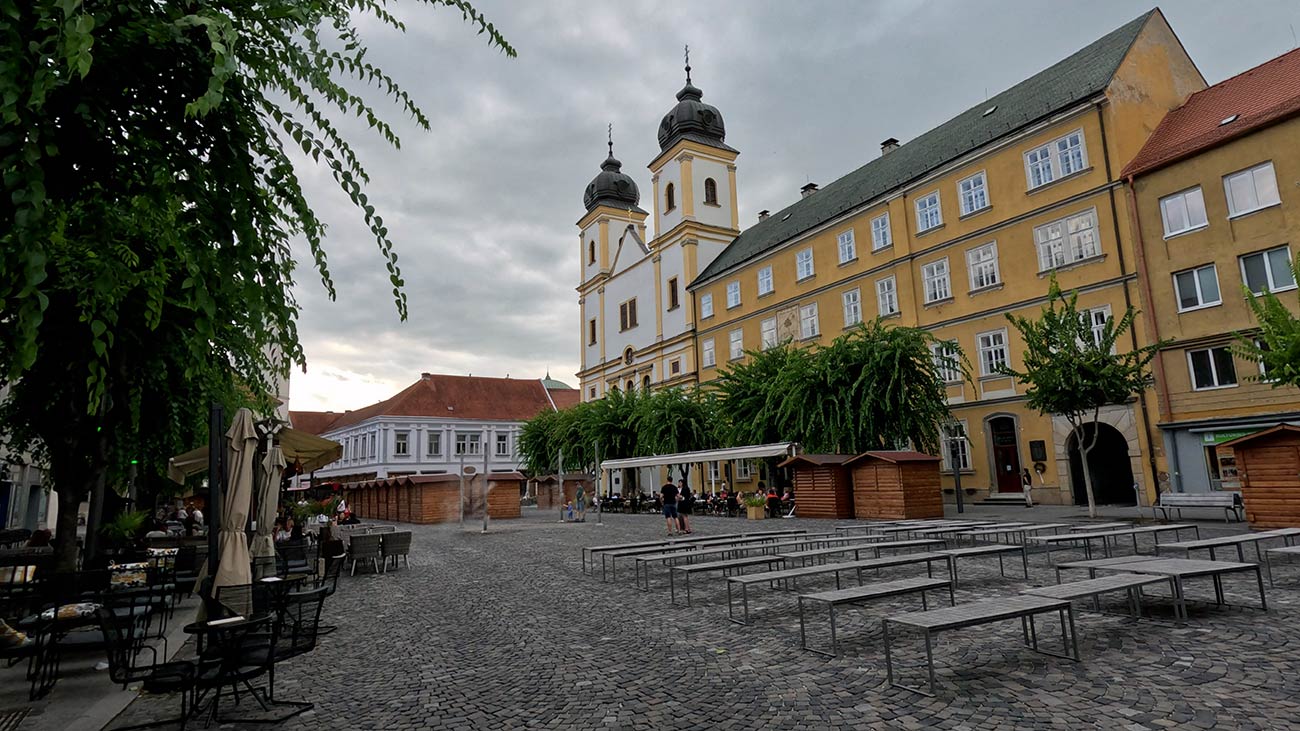
At the heart of the old town stretches the long, lenticular Mier Square (Mierové námestie), a tree-lined civic space that has been the centre of life in Trenčín for centuries. The square is unusually green for central Europe, with a double row of plane trees flanking historic burgher houses on either side, and a comprehensive 2018 restoration has given it modern lighting and added a bronze city model by local artist Igor Mosný along with a fountain dedicated to Marcus Aurelius that recalls the Roman past. At its centre rises the elegant Plague Column (Morový stĺp), erected in 1712 to commemorate the victims of the 1710 plague epidemic, alongside an eighteenth-century statue of St John of Nepomuk. The southern end of the square is closed by the Piarist Church of St Francis Xavier (Piaristický kostol sv. Františka Xaverského), built by the Jesuits between 1653 and 1657 and considered one of the most important Baroque sacred buildings in Slovakia. The square is lined with cafés, restaurants, and small shops, and during the European Capital of Culture programme in 2026 it hosts a year-long sequence of open-air concerts, street art events, and contemporary cultural festivals.
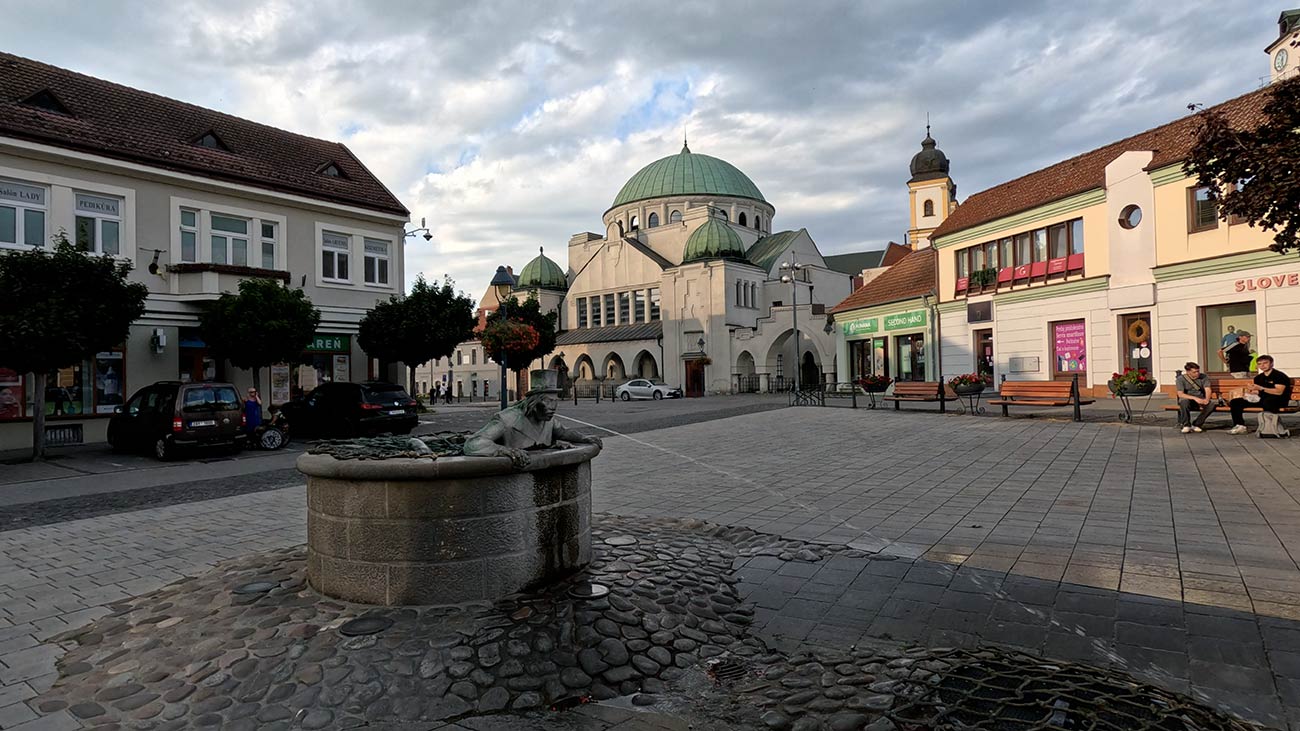
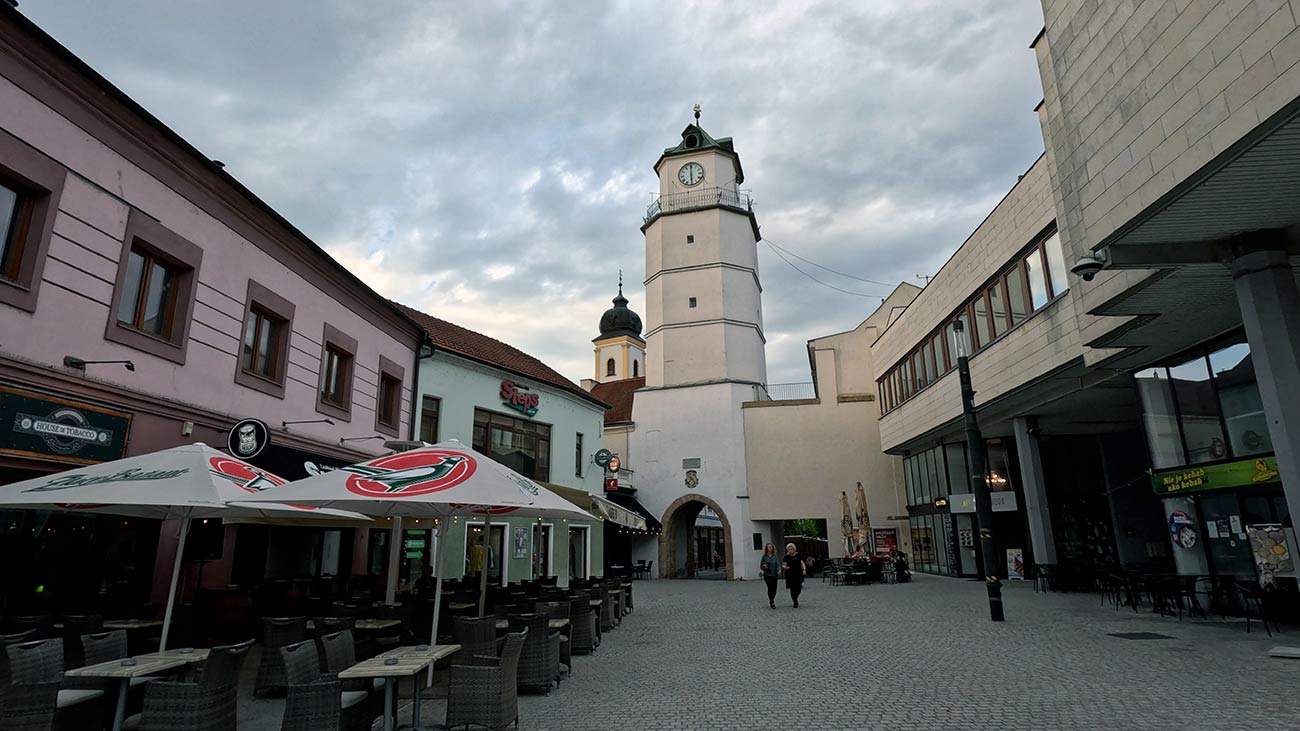
Just behind the southern end of the square stands the City Tower (Mestská veža), a Gothic gate tower originally built in the early fifteenth century as the Lower Gate of the medieval fortifications. The tower can be climbed during the warmer months from May to September, with an elevator carrying visitors to the first balcony and a narrower stair continuing up to the circular observation deck for a view across the entire main square, the climb to the castle, and the rooftops of the old town. Around the corner on Štúrovo Square (Štúrovo námestie), the Trenčín Synagogue (Synagóga) rises in a striking mix of Moorish and Art Nouveau styles, designed in the early twentieth century by the architect Richard Scheibner and now restored as a cultural centre and exhibition space dedicated to Jewish history and contemporary art. The same small square holds the playful Valentin the Vodník Fountain, a sculpture of a Slavic water spirit that watches passers-by from its central plinth. The narrow streets that climb from Mier Square toward the castle, including Matúšova and Hviezdoslavova, preserve a quieter, more residential side of the old town with small workshops, family-run cafés, and the Parish Church of the Nativity of the Virgin Mary, the oldest church in the town, founded in the fourteenth century on the slope directly below the castle walls.
 Useful Links
Mobility for Cyclists
Reaching the area by train with your bike
Trenčín can be reached from the EuroVelo 6 by a single direct rail journey from one of the main cities on the Danube cycle path. The city lies in western Slovakia, around 130 kilometres north-east of Bratislava, on the main north-south rail corridor that connects the Slovak capital with Žilina, the Tatras, and onward to Košice.
The connection
The most practical connection from the EuroVelo 6 corridor is from Bratislava, where ZSSK regional, fast, and InterCity trains run directly to Trenčín in around one hour to one hour and thirty minutes, depending on the service. Departures are very frequent, with several trains per hour throughout the day, and the line follows the broad Váh valley northward through the heart of western Slovakia. Cyclists riding the Slovak stretch of the EuroVelo 6 will find Bratislava the natural transfer point. Trenčín can also be combined naturally with a visit to Beckov Castle, the dramatic ruin on a limestone cliff downstream, with regular regional buses connecting Trenčín bus station to the village of Beckov along the Váh in around 30 to 40 minutes. The private operator RegioJet also runs a smaller number of long-distance trains on the same corridor, with bike capacity available by advance reservation.
Slovak Trains
The rail network in Slovakia is operated mainly by Železničná spoločnosť Slovensko (Slovak Railway Company, commonly known as ZSSK), the national passenger railway operator and by far the largest carrier in the country. ZSSK runs most long-distance services as well as a large share of regional connections, including the InterCity and EuroCity trains on the main east–west corridor and the dense network of regional and suburban Os and REX services that branch out into the Slovak countryside. Tickets, timetables, and bicycle reservations can be planned and booked through the ZSSK website and the IDS ZSSK app, which together serve as the central tools for travel across the system. Alongside ZSSK, the private operator RegioJet runs a smaller number of long-distance trains on selected routes, although its bicycle transport capacity is limited and depends on the specific train and route. A further private operator, Leo Express, does not serve the routes covered by this guide. For travellers leaving the EuroVelo 6 along the Slovak stretch of the Danube, the natural rail gateway is Bratislava, the country's capital, where two regional railway branches run north into the surrounding region: one west and north toward Trenčín along the Váh valley, and one east toward Nitra. Both corridors are served by frequent ZSSK regional trains throughout the day, making short detours from the Danube cycle path quick and easy to organise.
Taking your bike
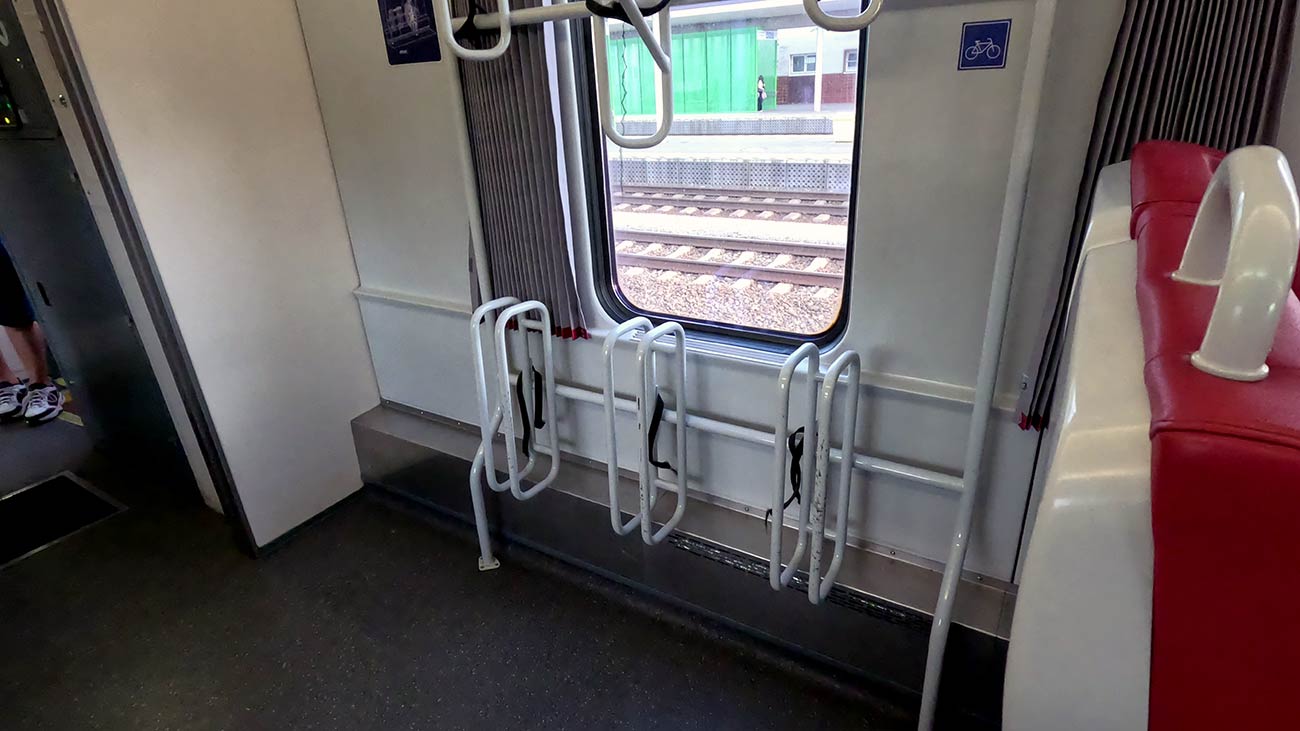
Slovakia is generally very bike-friendly when it comes to rail transport, especially on regional services operated by ZSSK, which form the core of mobility for cycle touring along the Danube and its connecting corridors. On regional and local trains (the Os and REX categories), bicycles can be taken on board for an additional fee, with no advance reservation possible and a first-come, first-served allocation of space. Bicycle tickets are sold as single trips or as affordable daily, weekly, or monthly passes, valid across the regional network. On long-distance services such as R (fast), Ex (express), EC, IC, and RJX trains, an advance reservation for the bicycle is mandatory, with the bike spaces located in dedicated zones in second-class carriages or in mobile luggage compartments. The private operator RegioJet runs a smaller number of long-distance trains on selected Slovak routes and also accepts bicycles on some of these, but the capacity is more limited than on ZSSK trains and an advance reservation is required. Leo Express, a further private operator, is fully bike-friendly on its train services and allows up to four bicycles per train with advance reservation, although its routes do not cover the detours in this guide and are mainly relevant for cyclists travelling between the Czech Republic and other parts of Slovakia. Folding bikes are carried free of charge as hand luggage on all three operators, provided they fit in the luggage racks. Overall, the Slovak rail system is well adapted to cycle tourism and offers a flexible combination of train and bike that makes it easy to leave the EuroVelo 6 route in either direction for short or extended detours.
Bikes on Buses
Long-distance bus services in Slovakia are primarily operated by FlixBus, complemented by RegioJet and Slovak Lines on selected routes, alongside a smaller number of regional and private coach operators. As in many central European countries, the long-distance bus market in Slovakia is less developed than the wider rail network, and many domestic connections that would otherwise be served by intercity coaches are instead handled by ZSSK trains. FlixBus is generally the most practical option for cyclists, with bicycle transport available on certain connections, either via external bike racks or in the luggage compartment, although it is not consistently guaranteed across the network and depends on the specific vehicle type and route configuration. Where available, bicycle transport must be reserved in advance and capacity is limited, making it less flexible compared to rail services. RegioJet also runs long-distance coaches alongside its trains, and Slovak Lines operates a network of domestic and international routes from Bratislava, but the bicycle-carrying options on both operators are limited and not guaranteed on the routes relevant to the detours in this guide. As a result, buses are generally used as a secondary option for cyclists, mainly for longer-distance repositioning between major cities rather than as a core part of cycling itineraries along the Danube region. While useful in specific cases where rail connections are less convenient, they are less predictable and less standardised for bicycle transport, so advance planning is essential.
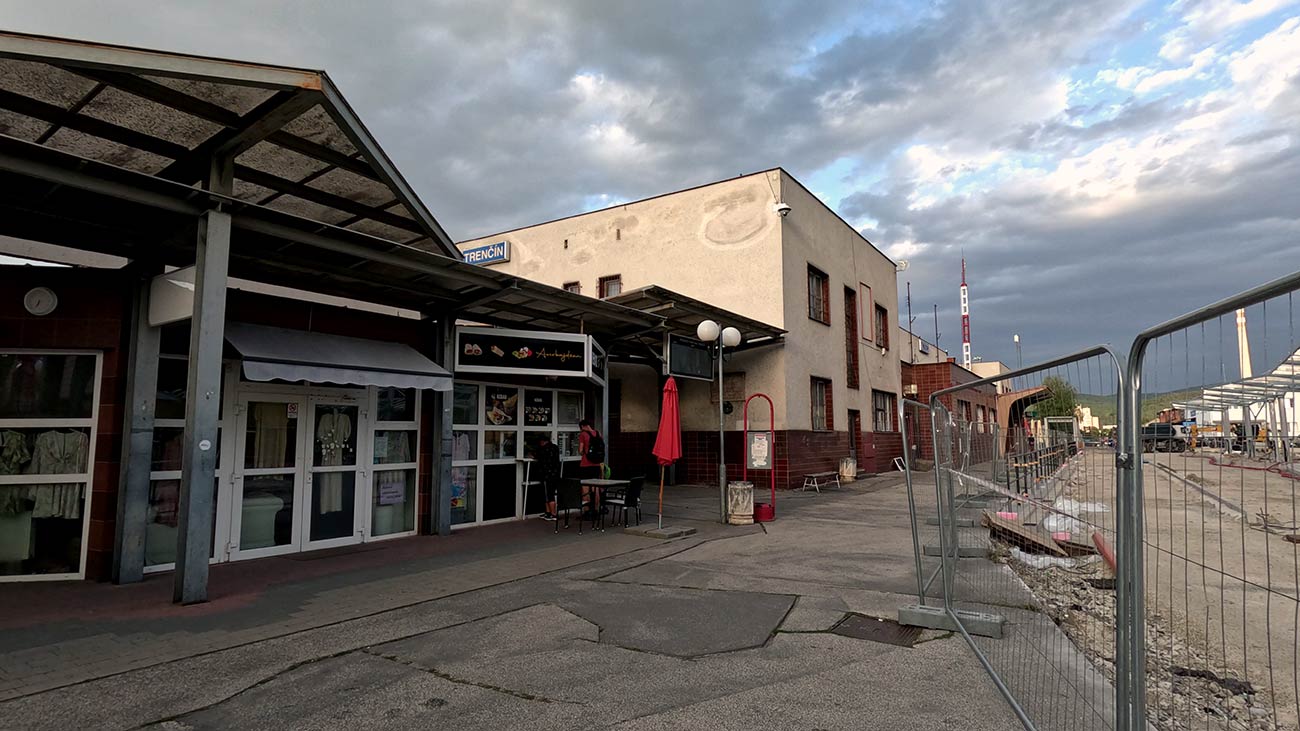
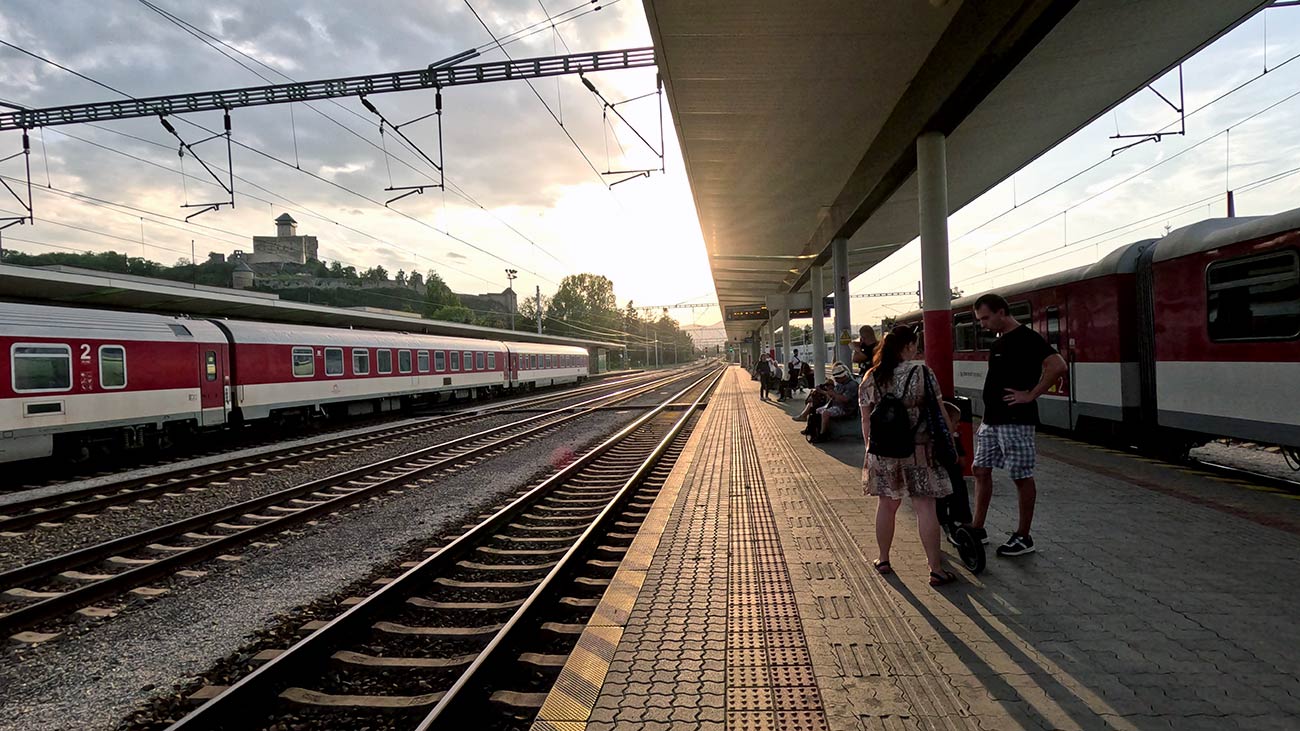
Arriving at Trenčín Hlavná Stanica
Trenčín's main railway station sits on the eastern side of the Váh, only a short walk or ride across the river bridge from the historic centre. Mier Square, the City Tower, the Synagogue, and the foot of the castle stairway are all reachable on foot in around fifteen minutes from the station along largely flat, well-signposted streets. The old town is compact and entirely walkable, with the climb up to the castle best done on foot from Mier Square along Matúšova Street. Cycling infrastructure across the city is reasonable, with the Váh Cycle Path (Vážska cyklomagistrála) passing directly through Trenčín and offering an easy way to extend the visit by bike along the river. Bike racks are available at the station and at several points around Mier Square. For onward travel, the same ZSSK line connects back toward Bratislava and the wider Danube region, as well as further north toward Žilina, the Tatras, and Košice, so Trenčín works equally well as a half-day excursion, a one-night detour, or a longer base for exploring the surrounding region.